跳至主要内容
CAS 2 条记录

CAS 100-51-6

CAS 100-51-6 与法规 1223/2009 附件 II–VI 中的 2 条欧盟附件记录相匹配。

CAS 100-51-6 的记录

2 共
附件
III
条目
45

BENZYL ALCOHOL

Benzyl Alcohol

For purposes other than inhibiting the development of microorganisms in the product. This purpose has to be apparent from the presentation of the product. The presence of the substance shall be indicated in the list o...
化学身份与性质

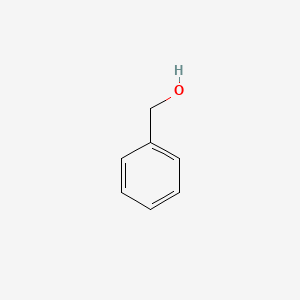
CAS 100-51-6 的 PubChem 二维化学结构
CAS 100-51-6PubChem CID 244

Benzyl Alcohol

Benzyl alcohol is an aromatic alcohol that consists of benzene bearing a single hydroxymethyl substituent. It has a role as an antioxidant, a metabolite, a solvent and a fragrance. — ChEBI

IUPAC 名称
phenylmethanol
分子式
C7H8O
分子量
108.14 g/mol
精确质量
108.057514874 Da
XLogP3
1.1
拓扑极性表面积
20.2 Ų
氢键供体
1
氢键受体
1
共价单元
1
已定义的立体中心
0

又称

benzenemethanolphenylcarbinolBenzenecarbinolHydroxytolueneBenzoyl alcoholalpha-ToluenolPhenylmethyl alcohol(Hydroxymethyl)benzene
另有 16 个已报告名称
Phenolcarbinolalpha-hydroxytolueneAlcool benzyliqueBenzal alcoholMethanol, phenyl-benzylic alcoholBenzylicumhydroxymethylbenzenePhenylcarbinolumUlesfiaAlcohol, BenzylAlcohol bencilicoalcoholum benzylicumFEMA No. 2137NCI-C06111Alcool benzilico
外部数据库标识符

来自其他科学数据库的证据

EMBL-EBI ChEBI
标识符精确匹配CHEBI:17987

benzyl alcohol

An aromatic alcohol that consists of benzene bearing a single hydroxymethyl substituent.

配方
C7H8O
平均质量
108.140 g/mol
单同位素质量
108.05751 Da
形式电荷
0
  • benzyl alcohols — is a (CHEBI:22743)
  • solvent — has role (CHEBI:46787)
  • metabolite — has role (CHEBI:25212)
  • antioxidant — has role (CHEBI:22586)
  • fragrance — has role (CHEBI:48318)
  • antiparasitic agent — has role (CHEBI:35442)
  • solvent — has role (CHEBI:46787)
  • metabolite — has role (CHEBI:25212)
  • antioxidant — has role (CHEBI:22586)
  • fragrance — has role (CHEBI:48318)
  • antiparasitic agent — has role (CHEBI:35442)
  • benzyl alcohols — is a (CHEBI:22743)
其他整理的名称
phenylmethanolAlcohol, benzylAlcohol,benzylAlcohol benzylicusalcoholum benzylicumalcool benzyliquealpha-HydroxytolueneAromatic alcoholbenzenecarbinolBenzenemethanolBenzyl alcoholBenzylalkoholbenzylic alcoholE-1519E1519FEMA NO. 2137(hydroxymethyl)benzeneHydroxymethylbenzeneINS-1519INS NO.1519NSC-8044PhenylcarbinolPhenylmethanolphenylmethyl alcoholalpha-toluenol
来自此来源的交叉引用
  • CAS: 100-51-6 — ChemIDplus
  • CAS: 100-51-6 — KEGG COMPOUND
  • CAS: 100-51-6 — NIST Chemistry WebBook
  • REGISTRY_NUMBER: 26514 — Gmelin
  • REGISTRY_NUMBER: 878307 — Reaxys
  • MANUAL_X_REF: 334 — DrugCentral
  • MANUAL_X_REF: Benzyl_Alcohol — Wikipedia
  • MANUAL_X_REF: BENZYL-ALCOHOL — MetaCyc
  • MANUAL_X_REF: C00029811 — KNApSAcK
  • MANUAL_X_REF: C00556 — KEGG COMPOUND
  • MANUAL_X_REF: c0278 — UM-BBD
  • MANUAL_X_REF: C03485 — KEGG COMPOUND
  • MANUAL_X_REF: D00077 — KEGG DRUG
  • MANUAL_X_REF: HMDB0003119 — HMDB

映射方: Exact CAS cross-reference in the ChEBI compound record. 来源更新: 2021-09-27. 检索时间: 2026-08-31. 打开来源记录

NIH PubChem PUG-View
标识符精确匹配244

Attributed physical-property, hazard, environmental and use annotations.

  • Substance: Benzyl Alcohol 来源: NTP Technical Reports
  • NTP Technical Report: TR-343: Toxicology and Carcinogenesis Studies of Benzyl Alcohol (CASRN 100-51-6) in F344/N Rats and B6C3F1 Mice (Gavage Studies) (1989 ) 来源: NTP Technical Reports
  • Peer Review Date: 11/06/87 来源: NTP Technical Reports
  • Conclusion for Male Rat: No Evidence 来源: NTP Technical Reports
  • Conclusion for Female Rat: No Evidence 来源: NTP Technical Reports
  • Conclusion for Male Mice: No Evidence 来源: NTP Technical Reports
  • Conclusion for Female Mice: No Evidence 来源: NTP Technical Reports
  • Summary: Under the conditions of these 2-year gavage studies, there was no evidence of carcinogenic activity of benzyl alcohol for male or female F344/N rats dosed with 200 or 400 mg/kg. Survival in both dose groups of female rats was 50% that of vehicle controls, primarily due to an increased number of gavage-related deaths. There was no evidence of carcinogenic activity of benzyl alcohol for male or female B6C3F1 mice dosed with 100 or 200 mg/kg for 2 years. 来源: NTP Technical Reports
  • First Aid: EYES: First check the victim for contact lenses and remove if present. Flush victim's eyes with water or normal saline solution for 20 to 30 minutes while simultaneously calling a hospital or poison control center. Do not put any ointments, oils, or medication in the victim's eyes without specific instructions from a physician. IMMEDIATELY transport the victim after flushing eyes to a hospital even if no symptoms (such as redness or irritation) develop.; SKIN: IMMEDIATELY flood affected skin with water while removing and isolating all contaminated clothing. Gently wash all affected skin areas thoroughly with soap and water. IMMEDIATELY call a hospital or poison control center even if no symptoms (such as redness or irritation) develop. IMMEDIATELY transport the victim to a hospital for treatment after washing the affected areas.; INHALATION: IMMEDIATELY leave the contaminated area; take deep breaths of fresh air. If symptoms (such as wheezing, coughing, shortness of breath, or burning in the mouth, throat, or chest) develop, call a physician and be prepared to transport the victim to a hospital. Provide proper respiratory protection to rescuers entering an unknown atmosphere. Whene 来源: CAMEO Chemicals
  • Signal: Warning 来源: Regulation (EC) No 1272/2008 of the European Parliament and of the Council
  • GHS Hazard Statements: H302: Harmful if swallowed [Warning Acute toxicity, oral]; H317: May cause an allergic skin reaction [Warning Sensitization, Skin]; H319: Causes serious eye irritation [Warning Serious eye damage/eye irritation] 来源: Regulation (EC) No 1272/2008 of the European Parliament and of the Council
  • Precautionary Statement Codes: P261, P264, P264+P265, P270, P272, P280, P301+P317, P302+P352, P305+P351+P338, P321, P330, P333+P317, P337+P317, P362+P364, and P501 (click each P-code to see the statement) 来源: Regulation (EC) No 1272/2008 of the European Parliament and of the Council
  • Note: This chemical does not meet GHS hazard criteria for < 0.1% (1 of 4746) of reports. 来源: European Chemicals Agency (ECHA)
  • Signal: Warning 来源: European Chemicals Agency (ECHA)
  • GHS Hazard Statements: H302 (> 99.9%): Harmful if swallowed [Warning Acute toxicity, oral]; H319 (18.8%): Causes serious eye irritation [Warning Serious eye damage/eye irritation]; H332 (95.3%): Harmful if inhaled [Warning Acute toxicity, inhalation] 来源: European Chemicals Agency (ECHA)
  • Precautionary Statement Codes: P261, P264, P264+P265, P270, P271, P280, P301+P317, P304+P340, P305+P351+P338, P317, P330, P337+P317, and P501 (click each P-code to see the statement) 来源: European Chemicals Agency (ECHA)
  • ECHA C&L Notifications Summary: Aggregated GHS information provided per 4746 reports by companies from 43 notifications to the ECHA C&L Inventory. Each notification may be associated with multiple companies.; Reported as not meeting GHS hazard criteria per 1 of 4746 reports by companies.; There are 42 notifications provided by 4745 of 4746 reports by companies with hazard statement code(s).; Information may vary between notifications depending on impurities, additives, and other factors. The percentage value in parenthesis indicates the notified classification ratio from companies that provide hazard codes. Only hazard codes with percentage values above 10% are shown. For more detailed information, please visit ECHA C&L website. 来源: European Chemicals Agency (ECHA)
  • GHS Hazard Statements: H302 (100%): Harmful if swallowed [Warning Acute toxicity, oral]; H312 (100%): Harmful in contact with skin [Warning Acute toxicity, dermal]; H315 (100%): Causes skin irritation [Warning Skin corrosion/irritation]; H319 (100%): Causes serious eye irritation [Warning Serious eye damage/eye irritation]; H332 (100%): Harmful if inhaled [Warning Acute toxicity, inhalation]; H335 (100%): May cause respiratory irritation [Warning Specific target organ toxicity, single exposure; Respiratory tract irritation] 来源: European Chemicals Agency (ECHA)
  • Precautionary Statement Codes: P261, P264, P264+P265, P270, P271, P280, P301+P317, P302+P352, P304+P340, P305+P351+P338, P317, P319, P321, P330, P332+P317, P337+P317, P362+P364, P403+P233, P405, and P501 (click each P-code to see the statement) 来源: European Chemicals Agency (ECHA)
  • ECHA C&L Notifications Summary: The GHS information provided by 1 company from 1 notification to the ECHA C&L Inventory. 来源: European Chemicals Agency (ECHA)
  • Signal: Warning 来源: NITE-CMC
  • Cosmetic Ingredient Review Finding(s): Safe in the present practices of use and concentration. Ingredient, concentration, and use information are available in documents discoverable at https://cir-reports.cir-safety.org 来源: Cosmetic Ingredient Review (CIR)
  • Toxicity Summary: IDENTIFICATION: Benzyl alcohol is an aromatic organic alcohol, water-white in color with a faint aromatic odor and a sharp burning taste; it is a preservative, a solvent, and a local anesthetic. It is used in a wide variety of products including photographic developer for color movie films; dyeing nylon filament, textiles, and sheet plastics; solvent for dyestuffs, cellulose esters, casein, waxes; heat-sealing polyethylene films; intermediate for benzyl esters and ethers; bacteriostatic; cosmetics, ointments, emulsions; ball point pen inks; stencil inks. HUMAN EXPOSURE AND TOXICITY: Benzyl alcohol has been found to be irritating to the skin at levels 3% or greater. Patch test with 0.65% benzyl alcohol did not produce irritation of the skin. Benzyl alcohol poisoning can cause the gasping syndrome in neonates. The infants had a typical course of gradual neurologic deterioration, severe metabolic acidosis, the striking onset of gasping respirations, thrombocytopenia, hepatic and renal failure, hypotension, cardiovascular collapse and death. In every infant, unmetabolized benzyl alcohol was identified in the urine. Hypersensitivity reactions may occur after parenteral or dermal exposur 来源: Hazardous Substances Data Bank (HSDB)
  • Environmental Bioconcentration: An estimated BCF of 1.4 was calculated in fish for benzyl alcohol(SRC), using a log Kow of 1.10(1) and a regression-derived equation(2). According to a classification scheme(3), this BCF suggests the potential for bioconcentration in aquatic organisms is low(SRC). 来源: Hazardous Substances Data Bank (HSDB)
  • Environmental Fate: TERRESTRIAL FATE: Based on a classification scheme(1), Koc values of <5(2) and 29(3) indicate that benzyl alcohol is expected to have very high mobility in soil(SRC). Volatilization of benzyl alcohol from moist soil surfaces is not expected to be an important fate process(SRC) given an estimated Henry's Law constant of 3.37X10⁻⁷ atm-cu m/mole(4). Benzyl alcohol is not expected to volatilize from dry soil surfaces(SRC) based upon a vapor pressure of 9.4X10⁻² mm Hg at 25 °C(5). Utilizing the Japanese MITI test, 94% of the Theoretical BOD was reached in 2 weeks(6) indicating that biodegradation is an important environmental fate process in soil(SRC). 来源: Hazardous Substances Data Bank (HSDB)
  • Environmental Fate: AQUATIC FATE: Based on a classification scheme(1), Koc values of <5(2) and 27(3) indicate that benzyl alcohol is not expected to adsorb to suspended solids and sediment(SRC). Volatilization from water surfaces is not expected to be an important fate process(4) based upon a Henry's Law constant of 3.37X10⁻⁷ atm-cu m/mole(5). According to a classification scheme(6), an estimated BCF of 1.4(SRC), from its log Kow of 1.10(7) and a regression-derived equation(8), suggests the potential for bioconcentration in aquatic organisms is low(SRC). Utilizing the Japanese MITI test, 94% of the Theoretical BOD was reached in 2 weeks(9) indicating that biodegradation is an important environmental fate process in water(SRC). 来源: Hazardous Substances Data Bank (HSDB)
  • Environmental Fate: ATMOSPHERIC FATE: According to a model of gas/particle partitioning of semivolatile organic compounds in the atmosphere(1), benzyl alcohol, which has a vapor pressure of 9.4X10⁻² mm Hg at 25 °C(2), is expected to exist solely as a vapor in the ambient atmosphere. Vapor phase benzyl alcohol is degraded in the atmosphere by reaction with photochemically produced hydroxyl radicals(SRC); the half-life for this reaction in air is estimated to be 2 days(SRC), calculated from its rate constant of 2.3X10⁻¹¹ cu cm/molecule sec at 25 °C(3). Benzyl alcohol does not contain chromophores that absorb at wavelengths >290 nm(4) and therefore is not expected to be susceptible to direct photolysis by sunlight(SRC). 来源: Hazardous Substances Data Bank (HSDB)
  • Consumer Uses: Other; Solvent; Solvents (which become part of product formulation or mixture); Insulators; Preservative; Not Known or Reasonably Ascertainable; Fragrance; Cleaning agent 来源: EPA Chemical Data Reporting (CDR)
  • Industry Uses: Processing aids not otherwise specified; Flavoring and nutrient; Solvents (which become part of product formulation or mixture); Dispersing agent; Solvent; Foamant; Other; Intermediate; Solvents (for cleaning or degreasing); Hardener; Cleaning agent; Fragrance; Not Known or Reasonably Ascertainable; Filler; Preservative 来源: EPA Chemical Data Reporting (CDR)
  • Cosmetic Ingredient Review Link: CIR ingredient: Benzyl Alcohol 来源: Cosmetic Ingredient Review (CIR)
  • Sources/Uses: Used as a preservative, epoxy resin catalyst, and in the photographic developer C-22; [Kanerva, p. 1757] Used as a preservative, solvent, and local anesthetic; [Marks, p. 136] Used as a preservative in drugs for injection; [Kanerva, p. 462-3] Used in flavors and perfumes and as a solvent for inks and dyes; [AIHA] 来源: Haz-Map, Information on Hazardous Chemicals and Occupational Diseases
  • Industrial Processes with risk of exposure: Using Disinfectants or Biocides [Category: Clean]; Plastic Composites Manufacturing [Category: Industry]; Photographic Processing [Category: Other] 来源: Haz-Map, Information on Hazardous Chemicals and Occupational Diseases
  • Uses: For benzyl alcohol (USEPA/OPP Pesticide Code: 9502) there are 0 labels match. /SRP: Not registered for current use in the U.S., but approved pesticide uses may change periodically and so federal, state and local authorities must be consulted for currently approved uses./ 来源: Hazardous Substances Data Bank (HSDB)
  • Uses: The active ingredient is no longer contained in any registered /pesticide/ products ... "cancelled." 来源: Hazardous Substances Data Bank (HSDB)
  • Uses: ... Photographic developer for color movie films; dyeing nylon filament, textiles, and sheet plastics; solvent for dyestuffs, cellulose esters, casein, waxes, etc.; heat-sealing polyethylene films; intermediate for benzyl esters and ethers; bacteriostat; cosmetics, ointments, emulsions; ball point pen inks; stencil inks. 来源: Hazardous Substances Data Bank (HSDB)
  • Uses: Benzyl alcohol is used in cosmetics as a fragrance component, preservative, solvent, and viscosity-decreasing agent. In January 1998, benzyl alcohol was reported to be used in 322 cosmetic formulations. 来源: Hazardous Substances Data Bank (HSDB)
  • Uses: For more Uses (Complete) data for BENZYL ALCOHOL (13 total), please visit the HSDB record page. 来源: Hazardous Substances Data Bank (HSDB)

映射方: Existing checksum-valid CAS to unique PubChem CID match. 检索时间: 2026-08-31. 打开来源记录

科学分类和危害注释仅提供背景信息,不能取代上方所示针对具体市场的监管决定。

其他来源的覆盖范围和匹配状态
来源结果已检查
EMBL-EBI ChEBI精确匹配2026-08-31
NIH PubChem PUG-View精确匹配2026-08-31

已记录的无匹配结果是该来源已被检查的有效证据;这并不表示该物质在别处不存在。

于 2026-08-31 通过校验和有效的 CAS 匹配从美国国立卫生研究院 (NIH) PubChem 检索。化学性质不能取代本页的监管决定。

本站如何使用 CAS 100-51-6

CAS 100-51-6 是化学文摘社 (Chemical Abstracts Service) 的标识符,用于将本页对应到特定物质。在当前数据集中,有 2 条欧盟附件记录共用该标识符,可帮助您交叉核对同一物质是出现在一种还是多种监管情境中。

当供应商规格书、SDS 或原料档案给出 CAS 100-51-6,而您需要在一处查看所有关联的附件 II–VI 记录时,请使用本页。上方的条目卡片是查看浓度限值、警示语、附件归属和产品类型条件的最快途径。

常见问题

以 CAS 100-51-6 标识的物质,如果在不同情境下适用不同条件,可能出现在欧盟化妆品法规的多个附件中。例如,某物质可能在附件 III 中按特定条件受到限制,同一 CAS 也可能在附件 IV 中作为准用着色剂按另行规定的条件出现。每个条目都必须单独审查。

将 CAS 编号与您的原料规格书和 CoA 文件进行交叉核对。当该 CAS 出现在附件 II 时,应核实其不存在。当其出现在附件 III 时,应核实您的配方满足浓度限值和产品类型条件。共用此 CAS 编号的所有附件条目均列于上方。

CAS 编号由美国化学文摘社 (Chemical Abstracts Service) 分配,全球通用。EC 编号是来自 EINECS、ELINCS 或 NLP 清单等名录的欧盟委员会标识符。两种标识符都可能出现在欧盟化妆品附件条目中。有些物质两者都有,有些只有其一,一些较旧的条目可能两者都没有。

INCI 检查器接受成分名称、CAS 编号和 EC 编号。可直接检查此 CAS 编号,然后对照供应商规格书和所有关联的附件条件核实结果。

工具与后续步骤

检查您的配方

扫描完整的 INCI 成分表,然后使用 CAS 100-51-6 交叉核对匹配物质背后的任何供应商文件。

INCI 检查器

浏览附件

按类别浏览所有欧盟化妆品法规附件。

全部附件

按名称搜索

搜索您的文件中与 CAS 100-51-6 并列出现的 INCI 名称、别名或相关标识符。

搜索