
Carbendazim
Carbendazim 在附件 II 中被列为在欧盟市场上市的化妆品的禁用物质。
记录详情
化学名称
Carbendazim
化学名称 / IUPAC 名称
methyl benzimidazol-2-ylcarbamate
监管信息
SCCS 意见
- Opinion concerning Chemical Ingredients in Cosmetic Products classified as Carcinogenic, Mutagenic or Toxic to Reproduction according to the Chemicals Directive 67/548/EECC
- Opinion concerning Chemical Ingredients in Cosmetic Products classified as Carcinogenic, Mutagenic or Toxic to Reproduction according to the Chemicals Directive 67/548/EEC
CMR
| 类别 | Carcinogenic | Mutagenic | Reprotoxic |
|---|---|---|---|
| Cat. 1B | — | ✓ | ✓ |
关键数据
化学身份与性质
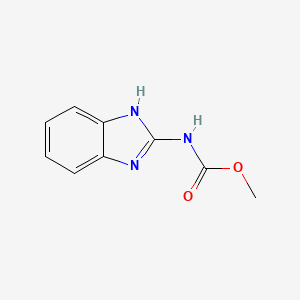
Carbendazim
Carbendazim is a member of the class of benzimidazoles that is 2-aminobenzimidazole in which the primary amino group is substituted by a methoxycarbonyl group. A fungicide, carbendazim controls Ascomycetes, Fungi Imperfecti, and Basidiomycetes on a wide variety of crops, including bananas, cereals, cotton, fruits, grapes, mushrooms, ornamentals, peanuts, sugarbeet, soybeans, tobacco, and vegetables. It has a role as a metabolite, an antinematodal drug, a microtubule-destabilising agent and an antifungal agrochemical. It is a member of benzimidazoles, a carbamate ester, a benzimidazole fungicide and a benzimidazolylcarbamate fungicide. It is functionally related to a 2-aminobenzimidazole. — ChEBI
- IUPAC 名称
- methyl N-(1H-benzimidazol-2-yl)carbamate
- 分子式
- C9H9N3O2
- 分子量
- 191.19 g/mol
- 精确质量
- 191.069476538 Da
- XLogP3
- 1.5
- 拓扑极性表面积
- 67.0 Ų
- 氢键供体
- 2
- 氢键受体
- 3
- 共价单元
- 1
- 已定义的立体中心
- 0
又称
另有 16 个已报告名称
外部数据库标识符
- ChEBI:CHEBI:3392
- ChEMBL:CHEMBL70971
- EPA DTXSID:DTXSID4024729
- PubMed:22994080
- PubMed:22982763
- PubMed:22980892
- PubMed:22974217
- PubMed:22960505
- PubMed:22952946
- PubMed:22868159
- PubMed:22854093
- PubMed:22845779
- PubMed:22806849
- PubMed:22803343
- PubMed:22747978
来自其他科学数据库的证据
EMBL-EBI ChEBI
carbendazim
A member of the class of benzimidazoles that is 2-aminobenzimidazole in which the primary amino group is substituted by a methoxycarbonyl group. A fungicide, carbendazim controls Ascomycetes, Fungi Imperfecti, and Basidiomycetes on a wide variety of crops, including bananas, cereals, cotton, fruits, grapes, mushrooms, ornamentals, peanuts, sugarbeet, soybeans, tobacco, and vegetables.
- 配方
- C9H9N3O2
- 平均质量
- 191.190 g/mol
- 单同位素质量
- 191.06948 Da
- 形式电荷
- 0
- benzimidazoles — is a (CHEBI:22715)
- benzimidazolylcarbamate fungicide — is a (CHEBI:87064)
- benzimidazole fungicide — is a (CHEBI:87036)
- carbamate ester — is a (CHEBI:23003)
- antineoplastic agent — has role (CHEBI:35610)
- antinematodal drug — has role (CHEBI:35444)
- microtubule-destabilising agent — has role (CHEBI:61951)
- metabolite — has role (CHEBI:25212)
- antifungal agrochemical — has role (CHEBI:86328)
- 2-aminobenzimidazole — has functional parent (CHEBI:27822)
- antineoplastic agent — has role (CHEBI:35610)
- antinematodal drug — has role (CHEBI:35444)
- microtubule-destabilising agent — has role (CHEBI:61951)
- metabolite — has role (CHEBI:25212)
- antifungal agrochemical — has role (CHEBI:86328)
- benzimidazoles — is a (CHEBI:22715)
- benzimidazolylcarbamate fungicide — is a (CHEBI:87064)
- benzimidazole fungicide — is a (CHEBI:87036)
- carbamate ester — is a (CHEBI:23003)
- 10978195 来源: PubMed
- 11087478 来源: PubMed
- 11782195 来源: PubMed
- 12127542 来源: PubMed
- 12517096 来源: PubMed
- 15161186 来源: PubMed
- 15769154 来源: PubMed
- 15769157 来源: PubMed
- 16420038 来源: PubMed
- 17331623 来源: PubMed
- 17375953 来源: PubMed
- 17618711 来源: PubMed
- 18052123 来源: PubMed
- 18342506 来源: PubMed
- 18616265 来源: PubMed
- 18778877 来源: PubMed
- 18954075 来源: PubMed
- 19319825 来源: PubMed
- 19560843 来源: PubMed
- 20038099 来源: PubMed
- 20408555 来源: PubMed
- 20483609 来源: PubMed
- 20553011 来源: PubMed
- 20621724 来源: PubMed
其他整理的名称
来自此来源的交叉引用
- CAS: 10605-21-7 — ChemIDplus
- CAS: 10605-21-7 — KEGG COMPOUND
- MANUAL_X_REF: 116 — PPDB
- MANUAL_X_REF: C10897 — KEGG COMPOUND
- MANUAL_X_REF: carbendazim — Alan Wood's Pesticides
- MANUAL_X_REF: Carbendazim — Wikipedia
- MANUAL_X_REF: HMDB0031769 — HMDB
- MANUAL_X_REF: US3010968 — Patent
- REGISTRY_NUMBER: 649044 — Reaxys
映射方: Exact CAS cross-reference in the ChEBI compound record. 来源更新: 2023-11-22. 检索时间: 2026-08-31. 打开来源记录
NIH PubChem PUG-View
Attributed physical-property, hazard, environmental and use annotations.
- Color/Form: White powder 来源: Hazardous Substances Data Bank (HSDB)
- Color/Form: Crystalline powder 来源: Hazardous Substances Data Bank (HSDB)
- Color/Form: Nearly white solid /Technical/ 来源: Hazardous Substances Data Bank (HSDB)
- Color/Form: Light-gray powder 来源: Hazardous Substances Data Bank (HSDB)
- Color/Form: Off-white, crystalline powder 来源: Hazardous Substances Data Bank (HSDB)
- Density: 1.45 at 68 °F (NTP, 1992) - Denser than water; will sink 来源: CAMEO Chemicals
- Density: 1.45 g/cu cm at 25 °C 来源: Hazardous Substances Data Bank (HSDB)
- Density: 0.27 g/cm³ 来源: ILO-WHO International Chemical Safety Cards (ICSCs)
- Dissociation Constants: pKa = 4.29 来源: Hazardous Substances Data Bank (HSDB)
- Dissociation Constants: pKa = 4.2, weak base 来源: Hazardous Substances Data Bank (HSDB)
- LogP: log Kow = 1.52 来源: Hazardous Substances Data Bank (HSDB)
- LogP: 1.52 来源: Human Metabolome Database (HMDB)
- LogP: 1.49 来源: ILO-WHO International Chemical Safety Cards (ICSCs)
- Melting Point: 576 to 585 °F (decomposes) (NTP, 1992) 来源: CAMEO Chemicals
- Melting Point: Decomposes at 300 °C 来源: Hazardous Substances Data Bank (HSDB)
- Melting Point: MP: 302-307 °C (decomposes) 来源: Hazardous Substances Data Bank (HSDB)
- Melting Point: 302 - 307 °C 来源: Human Metabolome Database (HMDB)
- Odor: Odorless /Technical/ 来源: Hazardous Substances Data Bank (HSDB)
- Physical Description: Carbendazim appears as light gray or beige powder. (NTP, 1992) 来源: CAMEO Chemicals
- Physical Description: White to light-gray, odorless solid; [HSDB] Powder; [MSDSonline] 来源: Haz-Map, Information on Hazardous Chemicals and Occupational Diseases
- Physical Description: Solid 来源: Human Metabolome Database (HMDB)
- Physical Description: COLOURLESS CRYSTALS OR GREY-TO-WHITE POWDER. 来源: ILO-WHO International Chemical Safety Cards (ICSCs)
- Solubility: less than 1 mg/mL at 70 °F (NTP, 1992) 来源: CAMEO Chemicals
- Solubility: Solubility in water at 24 °C: 29 mg/L at pH 4; 8 mg/L at pH 7; 1.49 mg/L at pH 8 来源: Hazardous Substances Data Bank (HSDB)
- Solubility: Soluble in (g/L at 24 °C): dimethylformamide 5, acetone 0.3, ethanol 0.3, chloroform 0.1, ehtyl acetate 0.135, dichlormethane 0.068, benzene 0.036, cyclohexane <0.01, diethyl ether <0.01, hexane 0.0005 来源: Hazardous Substances Data Bank (HSDB)
- Solubility: Xylene: <1 g/100 g at 20 °C; Cylcohexanone: < 1 g/100 g /Technical grade/ 来源: Hazardous Substances Data Bank (HSDB)
- Solubility: Solubility at 20 °C (mg/L): hexane 0.5; benzene 36; dichloromethane 68; ethanol 300; dimethylformamide 5000, chloroform 100, acetone 300 来源: Hazardous Substances Data Bank (HSDB)
- Solubility: Slightly soluble in most solvents 来源: Hazardous Substances Data Bank (HSDB)
- Solubility: 29 mg/L @ 24C (exp) 来源: Human Metabolome Database (HMDB)
- Solubility: Solubility in water, g/100ml at 24 °C: 0.0008 来源: ILO-WHO International Chemical Safety Cards (ICSCs)
- Vapor Pressure: less than 0.000000075 mmHg at 68 °F ; <0.001 mmHg at 257 °F (NTP, 1992) 来源: CAMEO Chemicals
- Vapor Pressure: 7.5X10⁻¹⁰ mm Hg at 20 °C 来源: Hazardous Substances Data Bank (HSDB)
- Vapor Pressure: Vapor pressure at 20 °C: negligible 来源: ILO-WHO International Chemical Safety Cards (ICSCs)
- Carcinogen Classification: No indication of carcinogenicity to humans (not listed by IARC). 来源: Toxin and Toxin Target Database (T3DB)
- Exposure Routes: The substance can be absorbed into the body by inhalation of its aerosol. 来源: ILO-WHO International Chemical Safety Cards (ICSCs)
- Exposure Routes: Inhalation (L793) ; oral (L793); dermal (L793) 来源: Toxin and Toxin Target Database (T3DB)
- First Aid: EYES: First check the victim for contact lenses and remove if present. Flush victim's eyes with water or normal saline solution for 20 to 30 minutes while simultaneously calling a hospital or poison control center. Do not put any ointments, oils, or medication in the victim's eyes without specific instructions from a physician. If symptoms (such as redness or irritation) develop, immediately transport the victim to a hospital.; SKIN: IMMEDIATELY flood affected skin with water while removing and isolating all contaminated clothing. Gently wash all affected skin areas thoroughly with soap and water. If symptoms such as redness or irritation develop, IMMEDIATELY call a physician and be prepared to transport the victim to a hospital for treatment.; INHALATION: IMMEDIATELY leave the contaminated area; take deep breaths of fresh air. If symptoms (such as wheezing, coughing, shortness of breath, or burning in the mouth, throat, or chest) develop, call a physician and be prepared to transport the victim to a hospital. Provide proper respiratory protection to rescuers entering an unknown atmosphere. Whenever possible, Self-Contained Breathing Apparatus (SCBA) should be used; if not availabl 来源: CAMEO Chemicals
- Signal: Danger 来源: Regulation (EC) No 1272/2008 of the European Parliament and of the Council
- GHS Hazard Statements: H317: May cause an allergic skin reaction [Warning Sensitization, Skin]; H340: May cause genetic defects [Danger Germ cell mutagenicity]; H360FD: May damage fertility; May damage the unborn child [Danger Reproductive toxicity]; H400: Very toxic to aquatic life [Warning Hazardous to the aquatic environment, acute hazard]; H410: Very toxic to aquatic life with long lasting effects [Warning Hazardous to the aquatic environment, long-term hazard] 来源: Regulation (EC) No 1272/2008 of the European Parliament and of the Council
- Precautionary Statement Codes: P203, P261, P272, P273, P280, P302+P352, P318, P321, P333+P317, P362+P364, P391, P405, and P501 (click each P-code to see the statement) 来源: Regulation (EC) No 1272/2008 of the European Parliament and of the Council
- Note: This chemical does not meet GHS hazard criteria for 0.3% (2 of 692) of reports. 来源: European Chemicals Agency (ECHA)
- Signal: Danger 来源: European Chemicals Agency (ECHA)
- GHS Hazard Statements: H317 (27.9%): May cause an allergic skin reaction [Warning Sensitization, Skin]; H340 (99.6%): May cause genetic defects [Danger Germ cell mutagenicity]; H360 (74%): May damage fertility or the unborn child [Danger Reproductive toxicity]; H360FD (25.6%): May damage fertility; May damage the unborn child [Danger Reproductive toxicity]; H400 (98.1%): Very toxic to aquatic life [Warning Hazardous to the aquatic environment, acute hazard]; H410 (99.7%): Very toxic to aquatic life with long lasting effects [Warning Hazardous to the aquatic environment, long-term hazard] 来源: European Chemicals Agency (ECHA)
- Precautionary Statement Codes: P203, P261, P272, P273, P280, P302+P352, P318, P321, P333+P317, P362+P364, P391, P405, and P501 (click each P-code to see the statement) 来源: European Chemicals Agency (ECHA)
- ECHA C&L Notifications Summary: Aggregated GHS information provided per 692 reports by companies from 27 notifications to the ECHA C&L Inventory. Each notification may be associated with multiple companies.; Reported as not meeting GHS hazard criteria per 2 of 692 reports by companies.; There are 26 notifications provided by 690 of 692 reports by companies with hazard statement code(s).; Information may vary between notifications depending on impurities, additives, and other factors. The percentage value in parenthesis indicates the notified classification ratio from companies that provide hazard codes. Only hazard codes with percentage values above 10% are shown. For more detailed information, please visit ECHA C&L website. 来源: European Chemicals Agency (ECHA)
- Signal: Danger 来源: NITE-CMC
- GHS Hazard Statements: H317: May cause an allergic skin reaction [Warning Sensitization, Skin]; H340: May cause genetic defects [Danger Germ cell mutagenicity]; H360: May damage fertility or the unborn child [Danger Reproductive toxicity]; H371: May cause damage to organs [Warning Specific target organ toxicity, single exposure]; H373: May causes damage to organs through prolonged or repeated exposure [Warning Specific target organ toxicity, repeated exposure] 来源: NITE-CMC
- Precautionary Statement Codes: P203, P260, P261, P264, P270, P272, P280, P302+P352, P308+P316, P318, P319, P321, P333+P317, P362+P364, P405, and P501 (click each P-code to see the statement) 来源: NITE-CMC
- Signal: Warning 来源: NITE-CMC
- Health Effects: Carbendazim is a suspected endocrine disruptor. It is also a developmental toxin. Animals exposed to carbendazim in the womb to have serious deformities such as lack of eyes and hydrocephalus (water on the brain). Carbendazim can disrupt the development of sperm and damage testicular development in adult rats. 来源: Toxin and Toxin Target Database (T3DB)
- Toxicity Summary: IDENTIFICATION AND USE: Carbendazim is a white powder. it is a systemic leaf and soil fungicide, absorbed through the roots and green tissues. HUMAN EXPOSURE AND TOXICITY: Six human chromosomes were investigated in pairs (1 and 8, 11 and 18, and X and 17). Abnormalities were classified as chromosome loss (including centromeric positive micronuclei), chromosome gain, non-disjunction, or polyploidy. ANIMAL STUDIES: Previous studies indicate that carbendazim may interfere with mitosis and thus may disrupt or inhibit microtubule function resulting in apoptosis. Carbendazim even at low dose exhibited toxicity, affected the liver and also caused specific changes in hematological and biochemical parameters in the rat. Male rats (6 per dose level) were gavaged with 200, 3400 and 5000 mg/kg 5 days/wk for 2 wk. Two out of the 6 rats died at the dose level of 3400 mg/kg per day. At all dose levels, gross and microscopic evidence of adverse effects on the testes and reduction or absence of sperm in the epididymides was seen. The testes were small and discolored, with tubular degeneration and evidence of aspermatogenesis. At the dose level of 3400 mg/kg per day, there were also morphological ch 来源: Hazardous Substances Data Bank (HSDB)
- Toxicity Summary: Carbendazim targets beta tubulin in actively dividing cells. It binds to microtubules, interfering with cell functions, such as meiosis and intracellular transportation (A15332). 来源: Toxin and Toxin Target Database (T3DB)
- Environmental Bioconcentration: BCFs of <1.5-3.5 and 0.6-1.1 were measured using carp (Cyprinus carpio) exposed to 2 and 20 ug/L, respectively, carbendazim over a 6-week period(1). Carbendazim was not bioconcentrated in perch (Perca fluviatilis) and carp exposed to food pellets containing a mixture of 13 pesticides(2). According to a classification scheme(3), these BCF values suggest bioconcentration in aquatic organisms is low(SRC). 来源: Hazardous Substances Data Bank (HSDB)
- Environmental Fate: TERRESTRIAL FATE: Based on a classification scheme(1), Koc values of 122.3-2805(2-3), indicate that carbendazim is expected to have high mobility in some soils with decreasing mobility as the amount of clay and organic carbon content increases, pH will have a lesser effect on mobility. Volatilization of carbendazim from moist soil surfaces is not expected to be an important fate process(SRC) given an estimated Henry's Law constant of 1.5X10⁻¹² atm-cu m/mole(SRC), using a fragment constant estimation method(4). Carbendazim is not expected to volatilize from dry soil surfaces(SRC) based upon a vapor pressure of 7.5X10⁻¹⁰ mm Hg at 25 °C(5). Measured soil biodegradation rates of 45% in 21 days and 45% in 14 days suggest that carbendazim is expected to biodegrade slowly under normal environmental conditions(6). However, biodegradation rates of 100% in 5 days and 97% in 9 days suggest that biodegradation of carbendazim will be enhanced in pretreated soils(6). 来源: Hazardous Substances Data Bank (HSDB)
- Environmental Fate: TERRESTRIAL FATE: Carbendazim is absorbed through the roots and green tissues of plants, with translocation acropetally. 来源: Hazardous Substances Data Bank (HSDB)
- Environmental Fate: AQUATIC FATE: Based on a classification scheme(1), Koc values of 122.3-2805(2-3), indicate that carbendazim is expected to adsorb to suspended solids and sediment(SRC). Volatilization from water surfaces is not expected(4) based upon an estimated Henry's Law constant of 1.5X10⁻¹² atm-cu m/mole(SRC), developed using a fragment constant estimation method(5). Measured hydrolysis half-lives for carbendazim at 22 °C were >350 days at pH 5-7 and 124 days at pH 9(6). According to a classification scheme(7), BCFs of <1.5-3.5 measured in carp(8), suggest bioconcentration in aquatic organisms is low(SRC). A 0% of Theoretical BOD using activated sludge in the Japanese MITI test(8) suggests that biodegradation is not an important environmental fate process in water(SRC). 来源: Hazardous Substances Data Bank (HSDB)
- Environmental Fate: ATMOSPHERIC FATE: According to a model of gas/particle partitioning of semivolatile organic compounds in the atmosphere(1), carbendazim, which has a vapor pressure of 7.5X10⁻¹⁰ mm Hg at 25 °C(2), is expected to exist solely in the particulate phase in the ambient atmosphere. Particulate-phase carbendazim may be removed from the air by wet and dry deposition(SRC). 来源: Hazardous Substances Data Bank (HSDB)
- Sources/Uses: Used as a fungicide in cereals, fruits, vines, hops, vegetables, ornamentals, coffee, cotton, rice, flax, beet, sugar cane, peanuts, oilseed rape, cucurbits, rubber, tobacco, turf, mushrooms, and other crops; [HSDB] 来源: Haz-Map, Information on Hazardous Chemicals and Occupational Diseases
- Industrial Processes with risk of exposure: Farming (Pesticides) [Category: Industry] 来源: Haz-Map, Information on Hazardous Chemicals and Occupational Diseases
- Uses: For carbendazim (USEPA/OPP Pesticide Code: 128872) ACTIVE products with label matches. /SRP: Registered for use in the U.S. but approved pesticide uses may change periodically and so federal, state and local authorities must be consulted for currently approved uses./ 来源: Hazardous Substances Data Bank (HSDB)
- Uses: Fungicide 来源: Hazardous Substances Data Bank (HSDB)
- Uses: Systemic leaf and soil fungicide, absorbed through the roots and green tissues. 来源: Hazardous Substances Data Bank (HSDB)
- Uses: /Carbendazim is/ used as a preservative in paint, papermaking and leather industry, and as a preservative of fruits. 来源: Hazardous Substances Data Bank (HSDB)
- Uses: Antimicrobial in caulks, concrete, grouts, inks, paints, sealants, stains and textiles 来源: Hazardous Substances Data Bank (HSDB)
- Uses: It is a systemic fungicide that is selectively toxic to microorganisms and invertebrates. It is also employed as a casting worm control agent in amenity turf situations such as golf greens and tennis courts. It is also used to control plant diseases in cereals and fruits, including citrus, bananas, strawberries, pineapples, and pomes. 来源: Toxin and Toxin Target Database (T3DB)
映射方: Existing checksum-valid CAS to unique PubChem CID match. 检索时间: 2026-08-31. 打开来源记录
科学分类和危害注释仅提供背景信息,不能取代上方所示针对具体市场的监管决定。
其他来源的覆盖范围和匹配状态
| 来源 | 结果 | 已检查 |
|---|---|---|
| EMBL-EBI ChEBI | 精确匹配 | 2026-08-31 |
| NIH PubChem PUG-View | 精确匹配 | 2026-08-31 |
已记录的无匹配结果是该来源已被检查的有效证据;这并不表示该物质在别处不存在。
于 2026-08-31 通过校验和有效的 CAS 匹配从美国国立卫生研究院 (NIH) PubChem 检索。化学性质不能取代本页的监管决定。
Carbendazim 的相关记录
该记录的直接匹配结果有限,因此同时显示附件 II 中的相邻条目。
2-Methoxyethoxy)ethanol (Diethylene glycol monomethyl ether; DEGME)
Disodium[5-[[4'-[[2,6-dihydroxy-3-[(2-hydroxy-5-sulphophenyl)azo]phenyl]azo][1,1'-biphenyl]-4-yl]...
(+/-)-2-(2,4-Dichlorophenyl)-3-(1H-1,2,4-triazol-1-yl)propyl-1,1,2,2-tetrafluoroethylether (Tetra...
4-[4-(1,3-Dihydroxyprop-2-yl)phenylamino]-1,8-dihydroxy-5-nitroanthraquinone
附件 II 对 Carbendazim 意味着什么
Carbendazim 被列为欧盟化妆品法规 1223/2009 附件 II 中的禁用物质,不得有意添加。第 17 条另行规定了在良好生产规范下技术上不可避免、且符合第 3 条安全要求的非有意微量存在的情形。
配方师必须筛查其成分和原料,确保均不含该物质。供应商应在被要求时提供证明不含该物质的文件。
本页还显示 12 条相关附件记录,其标识符、附件逻辑或命名模式存在重叠。
合规核查清单
- 核实该物质不存在于所有原料和成品配方中。
- 向原料供应商索取不含该物质的确认函或 CoA。
- 将筛查结果记录在产品信息档案 (PIF) 中。
- 该物质具有 CMR 分类。使用前请查看上方的 CMR 表,并核实现行附件 II/III 状态。