
3,4-Dihydrocoumarin, when used as a fragrance ingredient
3,4-Dihydrocoumarin, when used as a fragrance ingredient 在附件 II 中被列为在欧盟市场上市的化妆品的禁用物质。
记录详情
化学名称
3,4-Dihydrocoumarin, when used as a fragrance ingredient
化学名称 / IUPAC 名称
3,4-Dihydrocoumarin; Melilotin
监管信息
关键数据
化学身份与性质
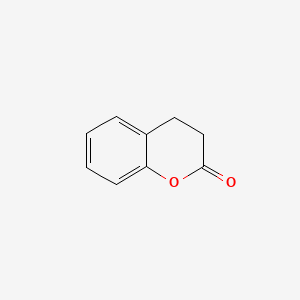
Dihydrocoumarin
3,4-dihydrocoumarin is a chromanone that is the 3,4-dihydro derivative of coumarin. It has a role as a plant metabolite. It is functionally related to a coumarin. — ChEBI
- IUPAC 名称
- 3,4-dihydrochromen-2-one
- 分子式
- C9H8O2
- 分子量
- 148.16 g/mol
- 精确质量
- 148.052429494 Da
- XLogP3
- 1.6
- 拓扑极性表面积
- 26.3 Ų
- 氢键供体
- 0
- 氢键受体
- 2
- 共价单元
- 1
- 已定义的立体中心
- 0
又称
另有 16 个已报告名称
外部数据库标识符
- ChEBI:CHEBI:16151
- ChEMBL:CHEMBL89306
- EPA DTXSID:DTXSID2020474
- PubMed:40784488
- PubMed:29968805
- PubMed:26795242
- PubMed:25027835
- PubMed:22978790
- PubMed:22789709
- PubMed:22719717
- PubMed:22679830
- PubMed:22654578
- PubMed:22590613
- PubMed:22589881
- PubMed:22577559
来自其他科学数据库的证据
NIH PubChem PUG-View
Attributed physical-property, hazard, environmental and use annotations.
- Boiling Point: 522 °F at 760 mmHg (NTP, 1992) 来源: CAMEO Chemicals
- Boiling Point: 272 °C 来源: Hazardous Substances Data Bank (HSDB)
- Boiling Point: 271.00 to 272.00 °C. @ 760.00 mm Hg 来源: Human Metabolome Database (HMDB)
- Boiling Point: 272 °C 来源: Joint FAO/WHO Expert Committee on Food Additives (JECFA)
- Color/Form: Leaflets 来源: Hazardous Substances Data Bank (HSDB)
- Color/Form: White to light yellow, oily liquid 来源: Hazardous Substances Data Bank (HSDB)
- Color/Form: Colorless crystals 来源: Hazardous Substances Data Bank (HSDB)
- Density: 1.169 at 64 °F (NTP, 1992) - Denser than water; will sink 来源: CAMEO Chemicals
- Density: 1.169 @ 18 °C 来源: Hazardous Substances Data Bank (HSDB)
- Density: 1.186-1.192 来源: Joint FAO/WHO Expert Committee on Food Additives (JECFA)
- Flash Point: 266 °F (NTP, 1992) 来源: CAMEO Chemicals
- Flash Point: 130 °C 来源: Haz-Map, Information on Hazardous Chemicals and Occupational Diseases
- Flash Point: 130 °C 来源: Hazardous Substances Data Bank (HSDB)
- Melting Point: 77 °F (NTP, 1992) 来源: CAMEO Chemicals
- Melting Point: 25 °C 来源: Hazardous Substances Data Bank (HSDB)
- Melting Point: 25 °C 来源: Human Metabolome Database (HMDB)
- Odor: Herbal 来源: Hazardous Substances Data Bank (HSDB)
- Odor: Odor similar to coumarin at room temp or reminiscent of nitrobenzene at higher temp. 来源: Hazardous Substances Data Bank (HSDB)
- Odor: Coconut odor 来源: Hazardous Substances Data Bank (HSDB)
- Odor: Hay-like 来源: Hazardous Substances Data Bank (HSDB)
- Physical Description: 3,4-dihydrocoumarin is a white to pale yellow clear oily liquid with a sweet odor. Solidifies around room temperature. (NTP, 1992) 来源: CAMEO Chemicals
- Physical Description: White to light yellow liquid; Colorless solid; [HSDB] Low melting solid; mp = 24-26 deg C; [MSDSonline] 来源: Haz-Map, Information on Hazardous Chemicals and Occupational Diseases
- Physical Description: Solid 来源: Human Metabolome Database (HMDB)
- Physical Description: colourless to pale yellow liquid; coconut-like aroma 来源: Joint FAO/WHO Expert Committee on Food Additives (JECFA)
- Refractive Index: Index of refraction: 1.5563 @ 20 °C/D 来源: Hazardous Substances Data Bank (HSDB)
- Refractive Index: 1.555-1.559 来源: Joint FAO/WHO Expert Committee on Food Additives (JECFA)
- Solubility: less than 1 mg/mL at 68 °F (NTP, 1992) 来源: CAMEO Chemicals
- Solubility: Slightly soluble in ether and carbon tetrachloride 来源: Hazardous Substances Data Bank (HSDB)
- Solubility: 1:2.5-3.5 IN 70% ALCOHOL 来源: Hazardous Substances Data Bank (HSDB)
- Solubility: Soluble in chloroform. 来源: Hazardous Substances Data Bank (HSDB)
- Solubility: Soluble in chlorinated solvents 来源: Hazardous Substances Data Bank (HSDB)
- Solubility: In water, 3,000 mg/l at 37 °C 来源: Hazardous Substances Data Bank (HSDB)
- Solubility: 3 mg/mL at 37 °C 来源: Human Metabolome Database (HMDB)
- Solubility: Slightly soluble in water; soluble in oil 来源: Joint FAO/WHO Expert Committee on Food Additives (JECFA)
- Solubility: soluble (in ethanol) 来源: Joint FAO/WHO Expert Committee on Food Additives (JECFA)
- Vapor Pressure: 13.4 mmHg at 77 °F ; 19.5 mmHg at 108 °F; 27.4 mmHg at 145 °F (NTP, 1992) 来源: CAMEO Chemicals
- Vapor Pressure: 13.4 [mmHg] 来源: Haz-Map, Information on Hazardous Chemicals and Occupational Diseases
- Substance: 3,4-Dihydrocoumarin 来源: NTP Technical Reports
- NTP Technical Report: TR-423: Toxicology and Carcinogenesis Studies of 3,4-Dihydrocoumarin (CASRN 119-84-6) in F344/N Rats and B6C3F1 Mice (Gavage Studies) (1993 ) 来源: NTP Technical Reports
- Peer Review Date: 06/23/92 来源: NTP Technical Reports
- Conclusion for Male Rat: Some Evidence 来源: NTP Technical Reports
- Conclusion for Female Rat: No Evidence 来源: NTP Technical Reports
- Conclusion for Male Mice: No Evidence 来源: NTP Technical Reports
- Conclusion for Female Mice: Some Evidence 来源: NTP Technical Reports
- Summary: Under the conditions of these 2-year gavage studies, there was some evidence of carcinogenic activity of 3,4-dihydrocoumarin in male F344/N rats based on increased incidences of renal tubule adenomas and focal hyperplasia. The transitional cell carcinomas in two 600 mg/kg males may also have been chemical related. There was no evidence of carcinogenic activity of 3,4-dihydrocoumarin in female F344/N rats receiving 150, 300, or 600 mg/kg. There was no evidence of carcinogenic activity of 3,4-dihydrocoumarin in male B6C3F1 mice receiving 200, 400, or 800 mg/kg. There was some evidence of carcinogenic activity in female B6C3F1 mice based on increased incidences of hepatocellular adenoma and hepatocellular adenoma or carcinoma (combined).; 3,4-Dihydrocoumarin caused ulcers, hyperplasia, and inflammation of the forestomach, parathyroid gland hyperplasia, and increased severity of nephropathy in male rats. 来源: NTP Technical Reports
- First Aid: EYES: First check the victim for contact lenses and remove if present. Flush victim's eyes with water or normal saline solution for 20 to 30 minutes while simultaneously calling a hospital or poison control center. Do not put any ointments, oils, or medication in the victim's eyes without specific instructions from a physician. IMMEDIATELY transport the victim after flushing eyes to a hospital even if no symptoms (such as redness or irritation) develop.; SKIN: IMMEDIATELY flood affected skin with water while removing and isolating all contaminated clothing. Gently wash all affected skin areas thoroughly with soap and water. If symptoms such as redness or irritation develop, IMMEDIATELY call a physician and be prepared to transport the victim to a hospital for treatment.; INHALATION: IMMEDIATELY leave the contaminated area; take deep breaths of fresh air. If symptoms (such as wheezing, coughing, shortness of breath, or burning in the mouth, throat, or chest) develop, call a physician and be prepared to transport the victim to a hospital. Provide proper respiratory protection to rescuers entering an unknown atmosphere. Whenever possible, Self-Contained Breathing Apparatus (SCBA) shou 来源: CAMEO Chemicals
- Signal: Warning 来源: European Chemicals Agency (ECHA)
- GHS Hazard Statements: H302 (> 99.9%): Harmful if swallowed [Warning Acute toxicity, oral]; H317 (97.4%): May cause an allergic skin reaction [Warning Sensitization, Skin] 来源: European Chemicals Agency (ECHA)
- Precautionary Statement Codes: P261, P264, P270, P272, P280, P301+P317, P302+P352, P321, P330, P333+P317, P362+P364, and P501 (click each P-code to see the statement) 来源: European Chemicals Agency (ECHA)
- ECHA C&L Notifications Summary: Aggregated GHS information provided per 1702 reports by companies from 11 notifications to the ECHA C&L Inventory. Each notification may be associated with multiple companies.; Information may vary between notifications depending on impurities, additives, and other factors. The percentage value in parenthesis indicates the notified classification ratio from companies that provide hazard codes. Only hazard codes with percentage values above 10% are shown. For more detailed information, please visit ECHA C&L website. 来源: European Chemicals Agency (ECHA)
- Signal: Warning 来源: Hazardous Chemical Information System (HCIS), Safe Work Australia
- GHS Hazard Statements: H302: Harmful if swallowed [Warning Acute toxicity, oral]; H317: May cause an allergic skin reaction [Warning Sensitization, Skin] 来源: Hazardous Chemical Information System (HCIS), Safe Work Australia
- Precautionary Statement Codes: P261, P264, P270, P272, P280, P301+P317, P302+P352, P321, P330, P333+P317, P362+P364, and P501 (click each P-code to see the statement) 来源: Hazardous Chemical Information System (HCIS), Safe Work Australia
- Sources/Uses: Used in perfumes and flavors--has GRAS status in US; [HSDB] 来源: Haz-Map, Information on Hazardous Chemicals and Occupational Diseases
- Uses: ...Used in perfumery industry for its haylike odor. 来源: Hazardous Substances Data Bank (HSDB)
- Uses: It has GRAS status and can be used as a food flavor ingredient with a sweet caramel-like taste. 来源: Hazardous Substances Data Bank (HSDB)
- Uses: ... In woodruff-type flavor compositions. 来源: Hazardous Substances Data Bank (HSDB)
映射方: Existing checksum-valid CAS to unique PubChem CID match. 检索时间: 2026-08-31. 打开来源记录
科学分类和危害注释仅提供背景信息,不能取代上方所示针对具体市场的监管决定。
其他来源的覆盖范围和匹配状态
| 来源 | 结果 | 已检查 |
|---|---|---|
| NIH PubChem PUG-View | 精确匹配 | 2026-08-31 |
已记录的无匹配结果是该来源已被检查的有效证据;这并不表示该物质在别处不存在。
于 2026-08-31 通过校验和有效的 CAS 匹配从美国国立卫生研究院 (NIH) PubChem 检索。化学性质不能取代本页的监管决定。
3,4-Dihydrocoumarin, when used as a fragrance ingredient 的清单链接
3,4-Dihydrocoumarin, when used as a fragrance ingredient 的相关记录
该记录的直接匹配结果有限,因此同时显示附件 II 中的相邻条目。
Diethyl maleate, when used as a fragrance ingredient
2,4-Dihydroxy-3-methylbenzaldehyde, when used as a fragrance ingredient
Cyclamen alcohol, when used as a fragrance ingredient
3,7-Dimethyl-2-octen-1-ol (6,7-Dihydrogeraniol), when used as a fragrance ingredient
4,6-Dimethyl-8-tert-butylcoumarin, when used as a fragrance ingredient
Alanroot oil (Inula helenium L.) (CAS No 97676-35-2), when used as a fragrance ingredient
5-tert.-Butyl-1,2,3-trimethyl-4,6-dinitrobenzene (Musk Tibetene)
7,11-Dimethyl-4,6,10-dodecatrien-3-one (Pseudomethylionone), when used as a fragrance ingredient
6,10-Dimethyl-3,5,9-undecatrien-2-one (Pseudoionone), when used as a fragrance ingredient
附件 II 对 3,4-Dihydrocoumarin, when used as a fragrance ingredient 意味着什么
3,4-Dihydrocoumarin, when used as a fragrance ingredient 被列为欧盟化妆品法规 1223/2009 附件 II 中的禁用物质,不得有意添加。第 17 条另行规定了在良好生产规范下技术上不可避免、且符合第 3 条安全要求的非有意微量存在的情形。
配方师必须筛查其成分和原料,确保均不含该物质。供应商应在被要求时提供证明不含该物质的文件。
本记录与 1 个 CosIng 清单成分相关联,便于名称和标识符的交叉引用。 本页还显示 12 条相关附件记录,其标识符、附件逻辑或命名模式存在重叠。
合规核查清单
- 核实该物质不存在于所有原料和成品配方中。
- 向原料供应商索取不含该物质的确认函或 CoA。
- 将筛查结果记录在产品信息档案 (PIF) 中。