
[Oxalylbis(iminoethylene)]bis[(o-chlorobenzyl)diethylammonium] salts, e.g. ambenonium chloride (INN)
[Oxalylbis(iminoethylene)]bis[(o-chlorobenzyl)diethylammonium] salts, e.g. ambenonium chloride (INN) 在附件 II 中被列为在欧盟市场上市的化妆品的禁用物质。
记录详情
化学名称
[Oxalylbis(iminoethylene)]bis[(o-chlorobenzyl)diethylammonium] salts, e.g. ambenonium chloride (INN)
监管信息
关键数据
化学身份与性质
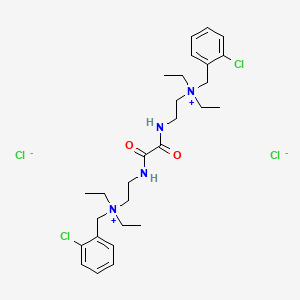
Ambenonium Chloride
Ambenonium chloride is a symmetrical oxalamide-based bis-quaternary ammonium salt having ethyl and 2-chlorobenzyl groups attached to the nitrogens. It has a role as a neurotransmitter agent and an EC 3.1.1.8 (cholinesterase) inhibitor. It is a quaternary ammonium salt and an organic chloride salt. — ChEBI
- IUPAC 名称
- (2-chlorophenyl)methyl-[2-[[2-[2-[(2-chlorophenyl)methyl-diethylazaniumyl]ethylamino]-2-oxoacetyl]amino]ethyl]-diethylazanium dichloride
- 分子式
- C28H42Cl4N4O2
- 分子量
- 608.5 g/mol
- 精确质量
- 608.203237 Da
- 拓扑极性表面积
- 58.2 Ų
- 氢键供体
- 2
- 氢键受体
- 4
- 共价单元
- 3
- 已定义的立体中心
- 0
又称
另有 16 个已报告名称
外部数据库标识符
- ChEBI:CHEBI:2628
- ChEMBL:CHEMBL1200541
- EPA DTXSID:DTXSID3022582
- PubMed:33844597
- PubMed:11132996
- PubMed:11099780
- PubMed:8010419
- PubMed:3912090
来自其他科学数据库的证据
NIH PubChem PUG-View
Attributed physical-property, hazard, environmental and use annotations.
- Carcinogen Classification: No indication of carcinogenicity to humans (not listed by IARC). 来源: Toxin and Toxin Target Database (T3DB)
- Exposure Routes: Oral - poorly absorbed from the gastrointestinal tract. 来源: Toxin and Toxin Target Database (T3DB)
- Signal: Danger 来源: European Chemicals Agency (ECHA)
- GHS Hazard Statements: H300 (100%): Fatal if swallowed [Danger Acute toxicity, oral] 来源: European Chemicals Agency (ECHA)
- Precautionary Statement Codes: P264, P270, P301+P316, P321, P330, P405, and P501 (click each P-code to see the statement) 来源: European Chemicals Agency (ECHA)
- ECHA C&L Notifications Summary: Aggregated GHS information provided per 38 reports by companies from 1 notifications to the ECHA C&L Inventory.; Information may vary between notifications depending on impurities, additives, and other factors. The percentage value in parenthesis indicates the notified classification ratio from companies that provide hazard codes. Only hazard codes with percentage values above 10% are shown. For more detailed information, please visit ECHA C&L website. 来源: European Chemicals Agency (ECHA)
- Health Effects: Acute exposure to cholinesterase inhibitors can cause a cholinergic crisis characterized by severe nausea/vomiting, salivation, sweating, bradycardia, hypotension, collapse, and convulsions. Increasing muscle weakness is a possibility and may result in death if respiratory muscles are involved. Accumulation of ACh at motor nerves causes overstimulation of nicotinic expression at the neuromuscular junction. When this occurs symptoms such as muscle weakness, fatigue, muscle cramps, fasciculation, and paralysis can be seen. When there is an accumulation of ACh at autonomic ganglia this causes overstimulation of nicotinic expression in the sympathetic system. Symptoms associated with this are hypertension, and hypoglycemia. Overstimulation of nicotinic acetylcholine receptors in the central nervous system, due to accumulation of ACh, results in anxiety, headache, convulsions, ataxia, depression of respiration and circulation, tremor, general weakness, and potentially coma. When there is expression of muscarinic overstimulation due to excess acetylcholine at muscarinic acetylcholine receptors symptoms of visual disturbances, tightness in chest, wheezing due to bronchoconstriction, incre 来源: Toxin and Toxin Target Database (T3DB)
- Toxicity Summary: Ambenonium is a cholinesterase or acetylcholinesterase (AChE) inhibitor. A cholinesterase inhibitor (or 'anticholinesterase') suppresses the action of acetylcholinesterase. Because of its essential function, chemicals that interfere with the action of acetylcholinesterase are potent neurotoxins, causing excessive salivation and eye-watering in low doses, followed by muscle spasms and ultimately death. Nerve gases and many substances used in insecticides have been shown to act by binding a serine in the active site of acetylcholine esterase, inhibiting the enzyme completely. Acetylcholine esterase breaks down the neurotransmitter acetylcholine, which is released at nerve and muscle junctions, in order to allow the muscle or organ to relax. The result of acetylcholine esterase inhibition is that acetylcholine builds up and continues to act so that any nerve impulses are continually transmitted and muscle contractions do not stop. Among the most common acetylcholinesterase inhibitors are phosphorus-based compounds, which are designed to bind to the active site of the enzyme. The structural requirements are a phosphorus atom bearing two lipophilic groups, a leaving group (such as a hal 来源: Toxin and Toxin Target Database (T3DB)
- Uses: Ambenonium is used to treat muscle weakness due to muscle disease (myasthenia gravis). 来源: Toxin and Toxin Target Database (T3DB)
映射方: Existing checksum-valid CAS to unique PubChem CID match. 检索时间: 2026-08-31. 打开来源记录
科学分类和危害注释仅提供背景信息,不能取代上方所示针对具体市场的监管决定。
其他来源的覆盖范围和匹配状态
| 来源 | 结果 | 已检查 |
|---|---|---|
| NIH PubChem PUG-View | 精确匹配 | 2026-08-31 |
已记录的无匹配结果是该来源已被检查的有效证据;这并不表示该物质在别处不存在。
于 2026-09-02 通过校验和有效的 CAS 匹配从美国国立卫生研究院 (NIH) PubChem 检索。化学性质不能取代本页的监管决定。
[Oxalylbis(iminoethylene)]bis[(o-chlorobenzyl)diethylammonium] salts, e.g. ambenonium chloride (INN) 的相关记录
该记录的直接匹配结果有限,因此同时显示附件 II 中的相邻条目。
O,O'-Diethyl-O-4-nitrophenyl phosphorothioate (Parathion - ISO)
Digitaline and all heterosides of Digitalis purpurea L.
7-[2-Hydroxy-3-(N-(2-hydroxyethyl)-N-methylamino)propyl]theophylline; (Xanthinol)
2-Diethylaminoethyl 3-hydroxy-4-phenylbenzoate and its salts
Dichloroethylenes (acetylene chlorides) e.g. Vinylidene chloride (1,1-Dichloroethylene)
附件 II 对 [Oxalylbis(iminoethylene)]bis[(o-chlorobenzyl)diethylammonium] salts, e.g. ambenonium chloride (INN) 意味着什么
[Oxalylbis(iminoethylene)]bis[(o-chlorobenzyl)diethylammonium] salts, e.g. ambenonium chloride (INN) 被列为欧盟化妆品法规 1223/2009 附件 II 中的禁用物质,不得有意添加。第 17 条另行规定了在良好生产规范下技术上不可避免、且符合第 3 条安全要求的非有意微量存在的情形。
配方师必须筛查其成分和原料,确保均不含该物质。供应商应在被要求时提供证明不含该物质的文件。
本页还显示 12 条相关附件记录,其标识符、附件逻辑或命名模式存在重叠。
合规核查清单
- 核实该物质不存在于所有原料和成品配方中。
- 向原料供应商索取不含该物质的确认函或 CoA。
- 将筛查结果记录在产品信息档案 (PIF) 中。
常见问题
附件 II 记录 [Oxalylbis(iminoethylene)]bis[(o-chlorobenzyl)diethylammonium] salts, e.g. ambenonium chloride (INN) 的来源说明
本页概述欧盟委员会公开化妆品资料中 [Oxalylbis(iminoethylene)]bis[(o-chlorobenzyl)diethylammonium] salts, e.g. ambenonium chloride (INN) 的一条附件 II 记录,并在可用时补充关联的清单或标识符匹配。
请使用本记录页面查看 [Oxalylbis(iminoethylene)]bis[(o-chlorobenzyl)diethylammonium] salts, e.g. ambenonium chloride (INN) 的附件 II 条件,但任何最终监管决定都应对照现行官方附件措辞和来源文件确认。