
BUTOXYETHANOL
Ethylene glycol monobutyl ether (EGBE)
BUTOXYETHANOL은(는) 부속서 III에 등재되어 있으며 이 기록에 표시된 조건에서만 사용할 수 있습니다. 이 기록의 최대 농도: a) 4.0% b) 2.0%.
기록 세부 정보
최대 농도
a) 4.0% b) 2.0%
기타 제한 사항
(a) (b) No use in aerosol dispensers (sprays)
INCI 용어집 명칭
BUTOXYETHANOL
화학명
Ethylene glycol monobutyl ether (EGBE)
규제 정보
식별된 원료
주요 데이터
화학적 정체 및 특성
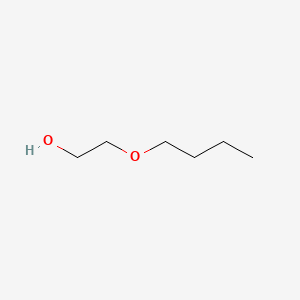
2-Butoxyethanol
2-butoxyethanol is a primary alcohol that is ethanol in which one of the methyl hydrogens is replaced by a butoxy group. A high-boiling (171C) colourless liquid, it is used as a solvent for paints and inks, as well as in some dry cleaning solutions. It has a role as a protic solvent. It is a primary alcohol and a glycol ether. — ChEBI
- IUPAC 명칭
- 2-butoxyethanol
- 분자식
- C6H14O2
- 분자량
- 118.17 g/mol
- 정확한 질량
- 118.099379685 Da
- XLogP3
- 0.8
- 위상 극성 표면적
- 29.5 Ų
- 수소 결합 공여체
- 1
- 수소 결합 수용체
- 2
- 공유결합 단위
- 1
- 정의된 입체중심
- 0
다른 이름
보고된 명칭 16개 더 보기
외부 데이터베이스 식별자
- ChEBI:CHEBI:63921
- ChEMBL:CHEMBL284588
- EPA DTXSID:DTXSID1024097
- PubMed:32979392
- PubMed:29556671
- PubMed:22959174
- PubMed:22898986
- PubMed:22804997
- PubMed:22649449
- PubMed:22580533
- PubMed:22563443
- PubMed:22479475
- PubMed:22448341
- PubMed:22330932
- PubMed:22315560
추가 과학 데이터베이스의 근거
NIH PubChem PUG-View
Attributed physical-property, hazard, environmental and use annotations.
- Autoignition Temperature: 472 °F (USCG, 1999) 출처: CAMEO Chemicals
- Autoignition Temperature: 238 °C (460 °F) 출처: Hazardous Substances Data Bank (HSDB)
- Autoignition Temperature: 238 °C 출처: ILO-WHO International Chemical Safety Cards (ICSCs)
- Boiling Point: 340 °F at 743 mmHg (NTP, 1992) 출처: CAMEO Chemicals
- Boiling Point: 168.4 °C 출처: Hazardous Substances Data Bank (HSDB)
- Boiling Point: 168.40 °C. @ 760.00 mm Hg 출처: Human Metabolome Database (HMDB)
- Boiling Point: 171 °C 출처: ILO-WHO International Chemical Safety Cards (ICSCs)
- Boiling Point: 339 °F 출처: Occupational Safety and Health Administration (OSHA)
- Boiling Point: 168.4 °C @760 [mm Hg] 출처: PAC Chemical Database, U.S. Department of Energy
- Boiling Point: 339 °F 출처: The National Institute for Occupational Safety and Health (NIOSH)
- Color/Form: Colorless liquid 출처: Hazardous Substances Data Bank (HSDB)
- Density: 0.902 at 68 °F (USCG, 1999) - Less dense than water; will float 출처: CAMEO Chemicals
- Density: 0.9015 at 20 °C 출처: Hazardous Substances Data Bank (HSDB)
- Density: Relative density (water = 1): 0.90 출처: ILO-WHO International Chemical Safety Cards (ICSCs)
- Density: 0.9 출처: Occupational Safety and Health Administration (OSHA)
- Density: 0.9012 @ 20°C 출처: PAC Chemical Database, U.S. Department of Energy
- Density: 0.90 출처: The National Institute for Occupational Safety and Health (NIOSH)
- Flash Point: 141 °F (NTP, 1992) 출처: CAMEO Chemicals
- Flash Point: 62 °C 출처: Haz-Map, Information on Hazardous Chemicals and Occupational Diseases
- Flash Point: 143 °F (62 °C) (Closed Cup) 출처: Hazardous Substances Data Bank (HSDB)
- Flash Point: 60 °C c.c. 출처: ILO-WHO International Chemical Safety Cards (ICSCs)
- Flash Point: 143 °F 출처: Occupational Safety and Health Administration (OSHA)
- Flash Point: 143 °F 출처: The National Institute for Occupational Safety and Health (NIOSH)
- LogP: log Kow = 0.83 출처: Hazardous Substances Data Bank (HSDB)
- LogP: 0.83 출처: Human Metabolome Database (HMDB)
- LogP: 0.830 출처: ILO-WHO International Chemical Safety Cards (ICSCs)
- Melting Point: -94 °F (NTP, 1992) 출처: CAMEO Chemicals
- Melting Point: -74.8 °C 출처: Hazardous Substances Data Bank (HSDB)
- Melting Point: -74.8 °C 출처: Human Metabolome Database (HMDB)
- Melting Point: -75 °C 출처: ILO-WHO International Chemical Safety Cards (ICSCs)
- Melting Point: -107 °F 출처: Occupational Safety and Health Administration (OSHA)
- Melting Point: -74.8 °C 출처: PAC Chemical Database, U.S. Department of Energy
- Melting Point: -107 °F 출처: The National Institute for Occupational Safety and Health (NIOSH)
- Odor: Mild, ether-like odor 출처: Hazardous Substances Data Bank (HSDB)
- Odor: Slight, rancid odor 출처: Hazardous Substances Data Bank (HSDB)
- Odor: Weak, pleasant odor 출처: Hazardous Substances Data Bank (HSDB)
- Odor: Characteristic; quality: sweet, ester; hedonic tone: pleasant 출처: Hazardous Substances Data Bank (HSDB)
- Physical Description: Ethylene glycol monobutyl ether appears as a colorless liquid with a mild, pleasant odor. Less dense than water. Flash point 160 °F. Irritates skin and eyes and may be toxic by ingestion. Used as a solvent and to make paints and varnish. 출처: CAMEO Chemicals
- Physical Description: Large Crystals; CBI; Gas Vapor; Liquid; Liquid; Liquid; Other Solid 출처: EPA Chemical Data Reporting (CDR)
- Physical Description: Colorless liquid with a mild, ether-like odor; [NIOSH] 출처: Haz-Map, Information on Hazardous Chemicals and Occupational Diseases
- Physical Description: Liquid 출처: Human Metabolome Database (HMDB)
- Physical Description: COLOURLESS LIQUID WITH CHARACTERISTIC ODOUR. 출처: ILO-WHO International Chemical Safety Cards (ICSCs)
- Physical Description: Colorless liquid with a mild, ether-like odor. 출처: Occupational Safety and Health Administration (OSHA)
- Physical Description: Colorless liquid with a mild, ether-like odor. 출처: The National Institute for Occupational Safety and Health (NIOSH)
- Refractive Index: Index of refraction: 1.4198 at 20 °C/D 출처: Hazardous Substances Data Bank (HSDB)
- Solubility: greater than or equal to 100 mg/mL at 72 °F (NTP, 1992) 출처: CAMEO Chemicals
- Solubility: Miscible with water 출처: Hazardous Substances Data Bank (HSDB)
- Solubility: Soluble in ethyl alcohol, ethyl ether; slightly soluble in carbon tetrachloride 출처: Hazardous Substances Data Bank (HSDB)
- Solubility: Soluble in mineral oil, most organic solvents. 출처: Hazardous Substances Data Bank (HSDB)
- Solubility: Mixes in all proportions with acetone, benzene, carbon tetrachloride, ethyl ether, n-heptane and water; miscible in all proportions with many ketones, ethers, alcohols, aromatic paraffin and halogenated hydrocarbons. 출처: Hazardous Substances Data Bank (HSDB)
- Solubility: 1000 mg/mL at 20 °C 출처: Human Metabolome Database (HMDB)
- Solubility: Solubility in water: miscible 출처: ILO-WHO International Chemical Safety Cards (ICSCs)
- Solubility: Miscible 출처: The National Institute for Occupational Safety and Health (NIOSH)
- Vapor Pressure: 0.76 mmHg at 68 °F ; 0.88 mmHg at 77 °F; 300 mmHg at 284 °F (NTP, 1992) 출처: CAMEO Chemicals
- Vapor Pressure: 0.88 [mmHg] 출처: Haz-Map, Information on Hazardous Chemicals and Occupational Diseases
- Vapor Pressure: Vapor pressure = 0.6 mm Hg at 20 °C (0.89 hPa); 3.7 hPa at 40 °C; Conversions: 1 mg/cu m = 0.204 ppm; 1 ppm = 4.90 mg/cu m 출처: Hazardous Substances Data Bank (HSDB)
- Vapor Pressure: Vapor pressure: -31 °C at 1 Pa; -8 °C at 10 Pa; 20 °C at 100 Pa; 55 °C at 1 kPa; 103.2 °C at 10kPa; 170.2 °C at kPa 출처: Hazardous Substances Data Bank (HSDB)
- Vapor Pressure: 0.88 mm Hg at 25 °C 출처: Hazardous Substances Data Bank (HSDB)
- Vapor Pressure: Vapor pressure, kPa at 20 °C: 0.10 출처: ILO-WHO International Chemical Safety Cards (ICSCs)
- Vapor Pressure: 0.8 mmHg 출처: Occupational Safety and Health Administration (OSHA)
- Vapor Pressure: 0.8 [mm Hg] @25 °C 출처: PAC Chemical Database, U.S. Department of Energy
- Vapor Pressure: 0.8 mmHg 출처: The National Institute for Occupational Safety and Health (NIOSH)
- Viscosity: 3.15 centistokes at 25 °C 출처: Hazardous Substances Data Bank (HSDB)
- IARC Carcinogenic Agent: 2-Butoxyethanol 출처: International Agency for Research on Cancer (IARC)
- IARC Carcinogenic Classes: Group 3: Not classifiable as to its carcinogenicity to humans 출처: International Agency for Research on Cancer (IARC)
- IARC Monographs: Volume 88: (2006) Formaldehyde, 2-Butoxyethanol and 1-tert-Butoxypropan-2-ol 출처: International Agency for Research on Cancer (IARC)
- Publication Year: 2006 출처: International Agency for Research on Cancer (IARC)
- Evaluation Year: 2004 출처: International Agency for Research on Cancer (IARC)
- Substance: 2-Butoxyethanol (Ethylene Glycol Monobutyl Ether) 출처: NTP Technical Reports
- NTP Technical Report: TR-484: Toxicology and Carcinogenesis Studies of 2-Butoxyethanol (CASRN 111-76-2) in F344/N Rats and B6C3F1 Mice (Inhalation Studies) (2000 ) 출처: NTP Technical Reports
- Peer Review Date: 10/30/98 출처: NTP Technical Reports
- Conclusion for Male Rat: No Evidence 출처: NTP Technical Reports
- Conclusion for Female Rat: Equivocal Evidence 출처: NTP Technical Reports
- Conclusion for Male Mice: Some Evidence 출처: NTP Technical Reports
- Conclusion for Female Mice: Some Evidence 출처: NTP Technical Reports
- Exposure Routes: The substance can be absorbed into the body by inhalation, through the skin and by ingestion. 출처: ILO-WHO International Chemical Safety Cards (ICSCs)
- Exposure Routes: inhalation, skin absorption, ingestion, skin and/or eye contact 출처: The National Institute for Occupational Safety and Health (NIOSH)
- First Aid: EYES: First check the victim for contact lenses and remove if present. Flush victim's eyes with water or normal saline solution for 20 to 30 minutes while simultaneously calling a hospital or poison control center. Do not put any ointments, oils, or medication in the victim's eyes without specific instructions from a physician. IMMEDIATELY transport the victim after flushing eyes to a hospital even if no symptoms (such as redness or irritation) develop.; SKIN: IMMEDIATELY flood affected skin with water while removing and isolating all contaminated clothing. Gently wash all affected skin areas thoroughly with soap and water. If symptoms such as redness or irritation develop, IMMEDIATELY call a physician and be prepared to transport the victim to a hospital for treatment.; INHALATION: IMMEDIATELY leave the contaminated area; take deep breaths of fresh air. If symptoms (such as wheezing, coughing, shortness of breath, or burning in the mouth, throat, or chest) develop, call a physician and be prepared to transport the victim to a hospital. Provide proper respiratory protection to rescuers entering an unknown atmosphere. Whenever possible, Self-Contained Breathing Apparatus (SCBA) shou 출처: CAMEO Chemicals
- First Aid: (General first aid procedures); Eye: Irrigate immediately - If this chemical contacts the eyes, immediately wash (irrigate) the eyes with large amounts of water, occasionally lifting the lower and upper lids. Get medical attention immediately.; Skin: Soap wash promptly - If this chemical contacts the skin, promptly wash the contaminated skin with soap and water. If this chemical penetrates the clothing, promptly remove the clothing and wash the skin with soap and water. Get medical attention promptly.; Breathing: Respiratory support; Swallow: Medical attention immediately - If this chemical has been swallowed, get medical attention immediately. 출처: The National Institute for Occupational Safety and Health (NIOSH)
- Signal: Danger 출처: Regulation (EC) No 1272/2008 of the European Parliament and of the Council
- GHS Hazard Statements: H302: Harmful if swallowed [Warning Acute toxicity, oral]; H315: Causes skin irritation [Warning Skin corrosion/irritation]; H319: Causes serious eye irritation [Warning Serious eye damage/eye irritation]; H331: Toxic if inhaled [Danger Acute toxicity, inhalation] 출처: Regulation (EC) No 1272/2008 of the European Parliament and of the Council
- Precautionary Statement Codes: P261, P264, P264+P265, P270, P271, P280, P301+P317, P302+P352, P304+P340, P305+P351+P338, P316, P321, P330, P332+P317, P337+P317, P362+P364, P403+P233, P405, and P501 (click each P-code to see the statement) 출처: Regulation (EC) No 1272/2008 of the European Parliament and of the Council
- Note: This chemical does not meet GHS hazard criteria for 0.4% (13 of 3076) of reports. 출처: European Chemicals Agency (ECHA)
- Signal: Danger 출처: European Chemicals Agency (ECHA)
- GHS Hazard Statements: H302 (99.5%): Harmful if swallowed [Warning Acute toxicity, oral]; H312 (79.9%): Harmful in contact with skin [Warning Acute toxicity, dermal]; H315 (99.6%): Causes skin irritation [Warning Skin corrosion/irritation]; H319 (99.5%): Causes serious eye irritation [Warning Serious eye damage/eye irritation]; H331 (11.7%): Toxic if inhaled [Danger Acute toxicity, inhalation]; H332 (83.6%): Harmful if inhaled [Warning Acute toxicity, inhalation] 출처: European Chemicals Agency (ECHA)
- Precautionary Statement Codes: P261, P264, P264+P265, P270, P271, P280, P301+P317, P302+P352, P304+P340, P305+P351+P338, P316, P317, P321, P330, P332+P317, P337+P317, P362+P364, P403+P233, P405, and P501 (click each P-code to see the statement) 출처: European Chemicals Agency (ECHA)
- ECHA C&L Notifications Summary: Aggregated GHS information provided per 3076 reports by companies from 31 notifications to the ECHA C&L Inventory. Each notification may be associated with multiple companies.; Reported as not meeting GHS hazard criteria per 13 of 3076 reports by companies.; There are 30 notifications provided by 3063 of 3076 reports by companies with hazard statement code(s).; Information may vary between notifications depending on impurities, additives, and other factors. The percentage value in parenthesis indicates the notified classification ratio from companies that provide hazard codes. Only hazard codes with percentage values above 10% are shown. For more detailed information, please visit ECHA C&L website. 출처: European Chemicals Agency (ECHA)
- Note: This chemical does not meet GHS hazard criteria for 12.7% (87 of 686) of reports. 출처: European Chemicals Agency (ECHA)
- GHS Hazard Statements: H302 (12.4%): Harmful if swallowed [Warning Acute toxicity, oral]; H312 (11.1%): Harmful in contact with skin [Warning Acute toxicity, dermal]; H318 (38.9%): Causes serious eye damage [Danger Serious eye damage/eye irritation]; H319 (37.3%): Causes serious eye irritation [Warning Serious eye damage/eye irritation] 출처: European Chemicals Agency (ECHA)
- Precautionary Statement Codes: P264, P264+P265, P270, P280, P301+P317, P302+P352, P305+P351+P338, P305+P354+P338, P317, P321, P330, P337+P317, P362+P364, and P501 (click each P-code to see the statement) 출처: European Chemicals Agency (ECHA)
- ECHA C&L Notifications Summary: Aggregated GHS information provided per 686 reports by companies from 9 notifications to the ECHA C&L Inventory. Each notification may be associated with multiple companies.; Reported as not meeting GHS hazard criteria per 87 of 686 reports by companies.; There are 8 notifications provided by 599 of 686 reports by companies with hazard statement code(s).; Information may vary between notifications depending on impurities, additives, and other factors. The percentage value in parenthesis indicates the notified classification ratio from companies that provide hazard codes. Only hazard codes with percentage values above 10% are shown. For more detailed information, please visit ECHA C&L website. 출처: European Chemicals Agency (ECHA)
- NFPA Health Rating: 3 - Materials that, under emergency conditions, can cause serious or permanent injury. 출처: Hazardous Substances Data Bank (HSDB)
- NFPA Fire Rating: 2 - Materials that must be moderately heated or exposed to relatively high ambient temperatures before ignition can occur. Materials would not under normal conditions form hazardous atmospheres with air, but under high ambient temperatures or under moderate heating could release vapor in sufficient quantities to produce hazardous atmospheres with air. 출처: Hazardous Substances Data Bank (HSDB)
- NFPA Instability Rating: 0 - Materials that in themselves are normally stable, even under fire conditions. 출처: Hazardous Substances Data Bank (HSDB)
- Target Organs: Hematologic 출처: EPA Integrated Risk Information System (IRIS)
- Target Organs: Eyes, skin, respiratory system, central nervous system, hematopoietic system, blood, kidneys, liver, lymphoid system 출처: The National Institute for Occupational Safety and Health (NIOSH)
- Cosmetic Ingredient Review Conclusion: On the basis of the animal and clinical data included in this report, the Expert Panel concludes that Butoxyethanol is safe in hair and nail products at concentrations up to 10.0%. Note: In 2002, the CIR Expert Panel considered available new data on this ingredient and reaffirmed the above conclusion. 출처: Cosmetic Ingredient Review (CIR)
- Cosmetic Ingredient Review Finding(s): Safe for use in cosmetics, with qualifications 출처: Cosmetic Ingredient Review (CIR)
- Toxicity Summary: 2-Butoxyethanol is a high production volume glycol ether. It is a colorless liquid that is miscible in water and soluble in most organic solvents. 2-Butoxyethanol is used widely as a solvent in surface coatings, such as spray lacquers, quick dry lacquers, enamels, varnishes, varnish removers and latex paint. Based on limited data, ambient exposures in air are generally in the ug/cu m range. Industrial exposure of the general population to this chemical is most likely from inhalation and dermal absorption during the use of products containing 2-butoxyethanol. Levels of airborne 2-butoxyethanol in occupational settings are typically in the mg/cu m range. The results of in vitro studies indicate that human red blood cells are not as sensitive to the hemolytic effects of 2-butoxyethanol and 2-butoxyacetic acid and also that red blood cells are more sensitive to hemolysis by 2-butoxyacetic acid than to hemolysis by 2-butoxyethanol. 2-Butoxyethanol is readily absorbed following inhalation, oral or dermal exposure. The chemical is metabolized via alcohol and aldehyde dehydrogenases, with the formation of 2-butoxyacetaldehyde and 2-butoxyacetic acid, the principal metabolite, although othe 출처: Hazardous Substances Data Bank (HSDB)
- Environmental Bioconcentration: An estimated BCF of 3 was calculated for ethylene glycol mono-n-butyl ether(SRC), using an estimated log Kow of 0.83(1) and a regression-derived equation(2). According to a classification scheme(3), this BCF suggests the potential for bioconcentration in aquatic organisms is low (SRC). 출처: Hazardous Substances Data Bank (HSDB)
- Environmental Fate: TERRESTRIAL FATE: Based on a classification scheme(1), an estimated Koc value of 8(SRC), determined from a log Kow of 0.83(2), indicates that ethylene glycol mono-n-butyl ether is expected to have very high mobility in soil(SRC). Volatilization of ethylene glycol mono-n-butyl ether from moist soil surfaces is expected to be an important fate process(SRC) given an Henry's Law constant of 1.60X10⁻⁶ atm-cu m/mole(3). Ethylene glycol mono-n-butyl ether is expected to volatilize slowly from dry soil surfaces(SRC) based upon a vapor pressure of 0.88 mm Hg(4). Ethylene glycol mono-n-butyl ether reached 96% of its theoretical BOD in 14 days using an activated sludge inoculum(5). Therefore this compound is expected to biodegrade rapidly in the soil environment. 출처: Hazardous Substances Data Bank (HSDB)
- Environmental Fate: AQUATIC FATE: Based on a classification scheme(1), an estimated Koc value of 8(SRC), determined from a log Kow of 0.83(2), indicates that ethylene glycol mono-n-butyl ether is not expected to adsorb to suspended solids and sediment(SRC). Volatilization from water surfaces is expected(3) based upon a Henry's Law constant of 1.6X10⁻⁶ atm-cu m/mole(4). Using this Henry's Law constant and an estimation method(3), volatilization half-lives for a model river and model lake are 17 and 185 days, respectively(SRC). According to a classification scheme(5), an estimated BCF of 3, from its log Kow of 0.83(2) and a regression-derived equation(6), suggests the potential for bioconcentration in aquatic organisms is low(SRC). Alcohols and ethers are generally resistant to hydrolysis(7). Ethylene glycol mono-n-butyl ether reached 96% of its Theoretical BOD in 14 days using an activated sludge inoculum(8). Therefore this compound is expected to biodegrade rapidly in the aquatic environment. 출처: Hazardous Substances Data Bank (HSDB)
- Environmental Fate: ATMOSPHERIC FATE: According to a model of gas/particle partitioning of semivolatile organic compounds in the atmosphere(1), ethylene glycol mono-n-butyl ether, which has a vapor pressure of 0.88 mm Hg at 25 °C(2) is expected to exist solely as a vapor in the ambient atmosphere. Vapor-phase ethylene glycol mono-n-butyl ether is degraded in the atmosphere by reaction with photochemically-produced hydroxyl radicals(SRC); the half-life for this reaction in air is estimated to be 15 hours(SRC), calculated from its rate constant of 1.86X10⁻¹¹ cu cm/molecule-sec at 25 °C(3). Ethylene glycol mono-n-butyl ether does not contain chromophores that absorb at wavelengths >290 nm(4), and therefore is not expected to be susceptible to direct photolysis by sunlight(SRC). 출처: Hazardous Substances Data Bank (HSDB)
- Consumer Uses: Insulators; Dispersing agent; Solvent; Other; Surfactant (surface active agent); Monomers; Processing aids not otherwise specified; Cleaning agent; Viscosity modifiers; Not Known or Reasonably Ascertainable; Corrosion inhibitor; Catalyst; Film former; Intermediate; Etching agent; Propellants, non-motive (blowing agents) 출처: EPA Chemical Data Reporting (CDR)
- Industry Uses: Intermediate; Etching agent; Adhesion/cohesion promoter; Chelating agent; Demulsifier; Surface modifier; Cleaning agent; Hydraulic fluids; Viscosity modifiers; Catalyst; Waterproofing agent; Not Known or Reasonably Ascertainable; Diluent; Surfactant (surface active agent); Monomers; Processing aids not otherwise specified; Fuel agents; Plating agent; Anti-freeze agent; Solvent; Dispersing agent; Lubricating agent; Other 출처: EPA Chemical Data Reporting (CDR)
- Cosmetic Ingredient Review Link: CIR ingredient: Butoxyethanol 출처: Cosmetic Ingredient Review (CIR)
- Sources/Uses: Used as solvent in surface coatings; [ACGIH] Also used in hydraulic fluids, glass cleaners, and leather cleaners; [Sullivan, p. 1203] Used as a solvent in paints, coatings, inks, metal cleaners, and household cleaners; Occupational exposures are high in silk screen printing; [Reference #2] 출처: Haz-Map, Information on Hazardous Chemicals and Occupational Diseases
- Industrial Processes with risk of exposure: Semiconductor Manufacturing [Category: Industry]; Painting (Solvents) [Category: Paint]; Dry Cleaning [Category: Clean]; Textiles (Printing, Dyeing, or Finishing) [Category: Industry]; Silk-Screen Printing [Category: Other] 출처: Haz-Map, Information on Hazardous Chemicals and Occupational Diseases
- Activities with risk of exposure: Intalagio printing [Category: Hobbies] 출처: Haz-Map, Information on Hazardous Chemicals and Occupational Diseases
- Uses: Both oil base and water base fracturing fluids are being used in the fracturing industry. Water base, which includes alcohol-water mixtures and low strength acids, make up the majority of treating fluids. The common chemicals added to these fluids are polymers for viscosity development, crosslinkers for viscosity enhancement, pH control chemicals, gel breakers for polymer degradation following the treatment, surfactants, clay stabilizers, alcohol, bactericides, fluid loss additives and friction reducer. /Hydraulic fracturing/ 출처: Hazardous Substances Data Bank (HSDB)
- Uses: Hydraulic fracturing uses a specially blended liquid which is pumped into a well under extreme pressure causing cracks in rock formations underground. These cracks in the rock then allow oil and natural gas to flow, increasing resource production. ... Chemical Name: 2-Butoxyethanol; Chemical Purpose: Product stabilizer; Product Function: surfactant. 출처: Hazardous Substances Data Bank (HSDB)
- Uses: For ethylene glycol monobutyl ether (USEPA/OPP Pesticide Code: 011501) there are 0 labels match. /SRP: Not registered for current use in the U.S., but approved pesticide uses may change periodically and so federal, state and local authorities must be consulted for currently approved uses./ 출처: Hazardous Substances Data Bank (HSDB)
- Uses: In hydraulic fluids 출처: Hazardous Substances Data Bank (HSDB)
- Uses: For more Uses (Complete) data for ETHYLENE GLYCOL MONO-N-BUTYL ETHER (11 total), please visit the HSDB record page. 출처: Hazardous Substances Data Bank (HSDB)
매핑 기준: Existing checksum-valid CAS to unique PubChem CID match. 가져온 시각: 2026-08-31. 출처 기록 열기
과학적 분류와 유해성 주석은 맥락을 제공할 뿐이며, 위에 표시된 시장별 규제 판단을 대체하지 않습니다.
추가 출처 적용 범위 및 일치 상태
| 출처 | 결과 | 확인됨 |
|---|---|---|
| NIH PubChem PUG-View | 정확히 일치 | 2026-08-31 |
기록된 불일치는 출처를 확인했다는 유용한 근거이며, 해당 물질이 다른 곳에 존재하지 않는다는 주장이 아닙니다.
체크섬이 유효한 CAS 일치를 통해 2026-09-02에 NIH PubChem에서 가져왔습니다. 화학적 특성은 이 페이지의 규제 판단을 대체하지 않습니다.
BUTOXYETHANOL의 목록 링크
BUTOXYETHANOL의 관련 기록
이 기록에 직접 일치하는 항목이 제한적이어서, 부속서 III의 인접 항목도 함께 표시합니다.
CI 19140 / ACID YELLOW 23
ACID BLUE 9
1-(5,6,7,8-Tetrahydro-3,5,5,6,8,8,-hexamethyl-2-naphthyl)ethan-1-one (AHTN)
BUTOXYETHANOL에 대한 부속서 III의 의미
BUTOXYETHANOL은(는) EU 화장품 규정 1223/2009 부속서 III에 따른 사용제한 물질입니다. 화장품에서의 사용은 위 항목에 명시된 농도 한도, 제품 유형 제한 및 필수 경고 문구를 포함한 특정 조건에서만 허용됩니다.
이 물질을 처방에 포함할 때는 최대 농도, 제품 범위 및 경고 표시 등 모든 조건을 동시에 충족해야 합니다. 한 조건을 준수한다고 해서 다른 조건이 면제되지 않습니다.
이 기록은 명칭 및 식별자 교차 참조를 위해 CosIng 목록 원료 1건과 연결되어 있습니다. 또한 이 페이지에는 식별자, 부속서 논리 또는 명칭 패턴이 겹치는 관련 부속서 기록 12건이 표시됩니다.
규제 준수 체크리스트
- 처방 농도가 다음을 초과하지 않는지 확인하세요: a) 4.0% b) 2.0%
- 제품 유형 적합성을 확인하세요: a) Solvent in oxidative hair dye products b) Solvent in non-oxidative hair dye products
- 사용 조건을 제품정보파일(PIF)에 기록하세요.