
Sodium borate
Canada Hotlist: Sodium borate
Health Canada lists this ingredient as restricted; the listed conditions and warnings apply.
Décision réglementaire et conditions complètes
- Statut
- Restricted
- Rôle juridique
- Official guidance
- Résumé réglementaire
- Health Canada lists this ingredient as restricted; the listed conditions and warnings apply.
- Conditions et restrictions
Synonyms or related compounds: Borax; Sodium tetraborate | See " Boric acid and its salts ".
Identité de la substance
- Nom dans la source officielle
- Sodium borate
- CAS
- 1303-96-4
- EC
- 215-540-4
- Correspondance d’identité
- cas_number
- Ingrédient associé
- SODIUM BORATE
Données d’identité CosIng associées
Noms et alias
Description CosIng : Disodium tetraborate, anhydrous (boric acid, disodium salt); Disodium tetraborate decahydrate (borax decahydrate)
Note de restriction de l’inventaire de l’UE : II/1396
Fonction cosmétique enregistrée : BUFFERING
Pages de fonctions :BUFFERING
Voir le profil complet de l’ingrédientAperçu multi-marchés pour cette identité
Fiches exactes associées actuellement présentes sur ce site. L’absence d’un marché signifie qu’aucune correspondance exacte n’a été importée, et non une autorisation d’utiliser la substance.
European Union
1 fiche associée
Ouvrir la fiche justificativeCanada
Fiche actuelle2 fiches associées · 2 avec conditions spécifiques
Ouvrir la fiche justificativeNew Zealand
2 fiches associées
Ouvrir la fiche justificativeChina
1 fiche associée · 1 avec conditions spécifiques
Ouvrir la fiche justificativeSouth Korea
1 fiche associée · 1 avec conditions spécifiques
Ouvrir la fiche justificativeBrazil
1 fiche associée · 1 avec conditions spécifiques
Ouvrir la fiche justificativeIndia
1 fiche associée · 1 avec conditions spécifiques
Ouvrir la fiche justificativeSaudi Arabia
1 fiche associée
Ouvrir la fiche justificative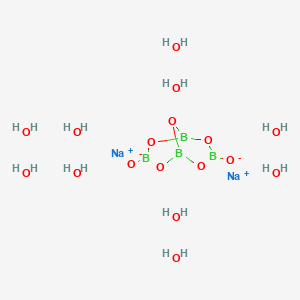
Chimie vérifiée pour le CAS 1303-96-4
Borax (B4Na2O7.10H2O)
Borax is a mineral with formula of Na2B4O5(OH)4·8H2O. The IMA symbol is Brx. — RRUFF Project
- Nom IUPAC
- disodium;3,7-dioxido-2,4,6,8,9-pentaoxa-1,3,5,7-tetraborabicyclo[3.3.1]nonane;decahydrate
- Formule moléculaire
- B4H20Na2O17
- Masse moléculaire
- 381.4 g/mol
- Masse exacte
- 382.0868084 Da
- Masse monoisotopique
- 382.0868084 Da
- Surface polaire topologique
- 102,0 Ų
- Complexité moléculaire
- 121,0
- Charge formelle
- 0
- Donneurs de liaisons hydrogène
- 10
- Accepteurs de liaisons hydrogène
- 17
- Liaisons rotatives
- 0
- Atomes lourds
- 23
- Unités covalentes
- 13
Noms et synonymes signalés à PubChem
16 autres noms signalés
Identifiants de bases de données externes
- ChEMBL:CHEMBL3833375
- EPA DTXSID:DTXSID701014356
- PubMed:10010
Statistiques de structure avancées
- Stéréocentres atomiques définis
- 0
- Stéréocentres atomiques non définis
- 0
- Stéréocentres de liaison définis
- 0
- Stéréocentres de liaison non définis
- 0
- Conformères 3D
- 0
Identifiants de structure lisibles par machine
- SMILES
B1(OB2OB(OB(O1)O2)[O-])[O-].O.O.O.O.O.O.O.O.O.O.[Na+].[Na+]- InChI
InChI=1S/B4O7.2Na.10H2O/c5-1-7-3-9-2(6)10-4(8-1)11-3;;;;;;;;;;;;/h;;;10*1H2/q-2;2*+1;;;;;;;;;;- InChIKey
CDMADVZSLOHIFP-UHFFFAOYSA-N
Preuves issues de bases de données scientifiques complémentaires
NIH PubChem PUG-View
Attributed physical-property, hazard, environmental and use annotations.
- Boiling Point: 608 °F Source: Occupational Safety and Health Administration (OSHA)
- Boiling Point: 608 °F Source: The National Institute for Occupational Safety and Health (NIOSH)
- Color/Form: White, monoclinic crystals Source: Hazardous Substances Data Bank (HSDB)
- Color/Form: Hard crystals, granules or crystalline powder; efflorescent in dry air, the crystals often being coated with white powder Source: Hazardous Substances Data Bank (HSDB)
- Color/Form: Crystalline granules or crystalline powder Source: Hazardous Substances Data Bank (HSDB)
- Color/Form: White, crystalline solid [Note: Becomes anhydrous at 608 degrees F] Source: Hazardous Substances Data Bank (HSDB)
- Density: 1.73 g/cu cm Source: Hazardous Substances Data Bank (HSDB)
- Density: Relative density (water = 1): 1.7 Source: ILO-WHO International Chemical Safety Cards (ICSCs)
- Density: 1.73 Source: Occupational Safety and Health Administration (OSHA)
- Density: 1.73 @25 °C Source: PAC Chemical Database, U.S. Department of Energy
- Density: 1.73 Source: The National Institute for Occupational Safety and Health (NIOSH)
- Melting Point: 75 °C (decomposes) Source: Hazardous Substances Data Bank (HSDB)
- Melting Point: 167 °F Source: Occupational Safety and Health Administration (OSHA)
- Melting Point: 167 °F Source: The National Institute for Occupational Safety and Health (NIOSH)
- Odor: Odorless Source: Hazardous Substances Data Bank (HSDB)
- Physical Description: Liquid; Other Solid; Large Crystals; Wet Solid; Dry Powder Source: EPA Chemical Data Reporting (CDR)
- Physical Description: White, odorless, crystalline solid; Becomes anhydrous at 608 degrees F; [NIOSH] Source: Haz-Map, Information on Hazardous Chemicals and Occupational Diseases
- Physical Description: WHITE CRYSTALS OR CRYSTALLINE POWDER. Source: ILO-WHO International Chemical Safety Cards (ICSCs)
- Physical Description: White, odorless, crystalline solid. Source: Occupational Safety and Health Administration (OSHA)
- Physical Description: White, odorless, crystalline solid. [herbicide] [Note: Becomes anhydrous at 608 °F.] Source: The National Institute for Occupational Safety and Health (NIOSH)
- Refractive Index: Index of refraction: 1.447 (alpha); 1.469 (beta); 1.472 (gamma) Source: Hazardous Substances Data Bank (HSDB)
- Solubility: Aqueous solution is alkaline to litmus and phenolphthalein; pH about pH = 9.5 Source: Hazardous Substances Data Bank (HSDB)
- Solubility: At 100 °C loses 5H2O; at 150 °C loses 9H2O; becomes anhydrous at 320 °C; borax dissolves many metallic oxides when fused with them Source: Hazardous Substances Data Bank (HSDB)
- Solubility: In water, 5.93X10+4 mg/L at 25 °C Source: Hazardous Substances Data Bank (HSDB)
- Solubility: 3.17 g/100 g water at 25 °C Source: Hazardous Substances Data Bank (HSDB)
- Solubility: 1 g/16 mL in water; 1 g/0.6 mL boiling water; 1 g/1 mL glycerol; insoluble in alcohol Source: Hazardous Substances Data Bank (HSDB)
- Solubility: Insoluble in ethanol Source: Hazardous Substances Data Bank (HSDB)
- Solubility: 0.60 g/100 g acetone Source: Hazardous Substances Data Bank (HSDB)
- Solubility: Solubility in water, g/100ml at 20 °C: 5.1 Source: ILO-WHO International Chemical Safety Cards (ICSCs)
- Solubility: 6% Source: The National Institute for Occupational Safety and Health (NIOSH)
- Vapor Pressure: Approximately 0 mm Hg Source: Hazardous Substances Data Bank (HSDB)
- Vapor Pressure: 0 mmHg (approx) Source: Occupational Safety and Health Administration (OSHA)
- Vapor Pressure: 0 mmHg (approx) Source: The National Institute for Occupational Safety and Health (NIOSH)
- pH: pH at 20 °C: 9.3 (0.1% solution); 9.2 (1.0% solution) Source: Hazardous Substances Data Bank (HSDB)
- Exposure Routes: The substance can be absorbed into the body by inhalation and by ingestion. Source: ILO-WHO International Chemical Safety Cards (ICSCs)
- Exposure Routes: inhalation, ingestion, skin and/or eye contact Source: The National Institute for Occupational Safety and Health (NIOSH)
- First Aid: (General first aid procedures); Eye: Irrigate immediately - If this chemical contacts the eyes, immediately wash (irrigate) the eyes with large amounts of water, occasionally lifting the lower and upper lids. Get medical attention immediately.; Skin: Soap wash - If this chemical contacts the skin, wash the contaminated skin with soap and water.; Breathing: Respiratory support; Swallow: Medical attention immediately - If this chemical has been swallowed, get medical attention immediately. Source: The National Institute for Occupational Safety and Health (NIOSH)
- Signal: Danger Source: Regulation (EC) No 1272/2008 of the European Parliament and of the Council
- GHS Hazard Statements: H360FD: May damage fertility; May damage the unborn child [Danger Reproductive toxicity] Source: Regulation (EC) No 1272/2008 of the European Parliament and of the Council
- Precautionary Statement Codes: P203, P280, P318, P405, and P501 (click each P-code to see the statement) Source: Regulation (EC) No 1272/2008 of the European Parliament and of the Council
- Note: This chemical does not meet GHS hazard criteria for < 0.1% (1 of 2865) of reports. Source: European Chemicals Agency (ECHA)
- Signal: Danger Source: European Chemicals Agency (ECHA)
- GHS Hazard Statements: H319 (12.6%): Causes serious eye irritation [Warning Serious eye damage/eye irritation]; H360 (93.2%): May damage fertility or the unborn child [Danger Reproductive toxicity] Source: European Chemicals Agency (ECHA)
- Precautionary Statement Codes: P203, P264+P265, P280, P305+P351+P338, P318, P337+P317, P405, and P501 (click each P-code to see the statement) Source: European Chemicals Agency (ECHA)
- ECHA C&L Notifications Summary: Aggregated GHS information provided per 2865 reports by companies from 31 notifications to the ECHA C&L Inventory. Each notification may be associated with multiple companies.; Reported as not meeting GHS hazard criteria per 1 of 2865 reports by companies.; There are 30 notifications provided by 2864 of 2865 reports by companies with hazard statement code(s).; Information may vary between notifications depending on impurities, additives, and other factors. The percentage value in parenthesis indicates the notified classification ratio from companies that provide hazard codes. Only hazard codes with percentage values above 10% are shown. For more detailed information, please visit ECHA C&L website. Source: European Chemicals Agency (ECHA)
- Signal: Danger Source: NITE-CMC
- GHS Hazard Statements: H315: Causes skin irritation [Warning Skin corrosion/irritation]; H319: Causes serious eye irritation [Warning Serious eye damage/eye irritation]; H335: May cause respiratory irritation [Warning Specific target organ toxicity, single exposure; Respiratory tract irritation]; H360: May damage fertility or the unborn child [Danger Reproductive toxicity]; H370: Causes damage to organs [Danger Specific target organ toxicity, single exposure]; H372: Causes damage to organs through prolonged or repeated exposure [Danger Specific target organ toxicity, repeated exposure]; H413: May cause long lasting harmful effects to aquatic life [Hazardous to the aquatic environment, long-term hazard] Source: NITE-CMC
- Precautionary Statement Codes: P203, P260, P261, P264, P264+P265, P270, P271, P273, P280, P302+P352, P304+P340, P305+P351+P338, P308+P316, P318, P319, P321, P332+P317, P337+P317, P362+P364, P403+P233, P405, and P501 (click each P-code to see the statement) Source: NITE-CMC
- GHS Hazard Statements: H303: May be harmful if swallowed [Warning Acute toxicity, oral]; H315: Causes skin irritation [Warning Skin corrosion/irritation]; H319: Causes serious eye irritation [Warning Serious eye damage/eye irritation]; H361: Suspected of damaging fertility or the unborn child [Warning Reproductive toxicity]; H370: Causes damage to organs [Danger Specific target organ toxicity, single exposure]; H372: Causes damage to organs through prolonged or repeated exposure [Danger Specific target organ toxicity, repeated exposure]; H373: May causes damage to organs through prolonged or repeated exposure [Warning Specific target organ toxicity, repeated exposure] Source: NITE-CMC
- Target Organs: Eyes, skin, respiratory system Source: The National Institute for Occupational Safety and Health (NIOSH)
- Cosmetic Ingredient Review Conclusion: The Expert Panel concludes that Sodium Borate and Boric Acid, in concentrations less than or equal to 5 percent, are safe as cosmetic ingredients when used as currently recommended; however, cosmetic formulations containing free Sodium Borate or Boric Acid at this concentration should not be used on infant skin or injured skin. Note: In 2003, the CIR Expert Panel considered available new data on these ingredients and reaffirmed the above conclusion. Source: Cosmetic Ingredient Review (CIR)
- Cosmetic Ingredient Review Finding(s): Safe for use in cosmetics, with qualifications Source: Cosmetic Ingredient Review (CIR)
- Environmental Bioconcentration: In a greenhouse experiment with sandy loam soil treated with 0-8.0 ppm boron as borax, boron toxicity symptoms appeared earliest in lentil plants and barley seedlings exposed to 8.0 ppm boron. In barley the severity of boron toxicity decreased with the decrease in boron levels, whereas in lentil the severity of the symptoms eventually reached the same level in 2 and 4 ppm boron treatments as with the highest concentration. Dry matter yield decreased 38.6% in lentil and 23.4% in barley exposed to 8.0 ppm boron in comparison with controls. Boron contents of lentil and barley plants on soil treated with 8 ppm boron were approximately 7- and approximately 8-fold those of control plants, respectively. Source: Hazardous Substances Data Bank (HSDB)
- Environmental Fate: TERRESTRIAL FATE: Boron is naturally occurring and ubiquitous in the environment. No microbial degradation. Disappearance from soil is by washing out. Persistence in soil is about 2 years, depending on rainfall and soil structure. Source: Hazardous Substances Data Bank (HSDB)
- Consumer Uses: Other; Adhesion/cohesion promoter; Soil amendments (fertilizers); Not Known or Reasonably Ascertainable; Flame retardant Source: EPA Chemical Data Reporting (CDR)
- Industry Uses: Abrasives; Plating agent; Etching agent; Chelating agent; Flame retardant; Soil amendments (fertilizers) Source: EPA Chemical Data Reporting (CDR)
- Cosmetic Ingredient Review Link: CIR ingredient: Sodium Borate Source: Cosmetic Ingredient Review (CIR)
- Sources/Uses: Used as a preservative, antiseptic and fungicide; also used to manufacture glazes, enamels, soldering fluxes and cleaning compounds and to fireproof textiles and wood; [ACGIH] Boric acid and borates as tablets or powder are used to kill larvae in barns and other insects in houses. Rarely, they are sprayed as herbicides. [EPA: Recognition of Pesticide Poisonings] Used in photo developing bath; [www.ci.tucson.az.us/arthazards/medium.html] Borax (borax decahydrate) is found naturally in some salt lakes and alkaline soils. Boric acid is formed by crystallizing a solution of hydrochloric acid or sulfuric acid and borax. [Hawley] Source: Haz-Map, Information on Hazardous Chemicals and Occupational Diseases
- Industrial Processes with risk of exposure: Soldering [Category: Heat or Machine]; Using Disinfectants or Biocides [Category: Clean]; Farming (Pesticides) [Category: Industry]; Photographic Processing [Category: Other]; Textiles (Printing, Dyeing, or Finishing) [Category: Industry] Source: Haz-Map, Information on Hazardous Chemicals and Occupational Diseases
- Uses: For borax (USEPA/OPP Pesticide Code: 011102) ACTIVE products with label matches. /SRP: Registered for use in the U.S. but approved pesticide uses may change periodically and so federal, state and local authorities must be consulted for currently approved uses./ Source: Hazardous Substances Data Bank (HSDB)
- Uses: Long been used as a mild antiseptic fungicide and as a herbicide ... Total control of vegetation on non-crop land, such as paths, giving long-term control. Also used in insect baits for food stores to control Formicidae. Source: Hazardous Substances Data Bank (HSDB)
- Uses: Soldering metals; manufacture of glazes and enamels; tanning; in cleaning compounds; artificially aging wood; as preservative, either alone or with other antiseptics against wood fungus; fireproofing fabrics and wood; curing and preserving skins; in cockroach control. In buffers; as a complexing or masking agent in analytical chemistry. Pharmaceutic aid (alkalizer). Source: Hazardous Substances Data Bank (HSDB)
- Uses: Used in ant poisons, for fly control around refuse and manure piles, as a larvicide, in manufacture of glazes, enamels, cleaning compounds, and in soldering metals Source: Hazardous Substances Data Bank (HSDB)
- Uses: For more Uses (Complete) data for BORAX (17 total), please visit the HSDB record page. Source: Hazardous Substances Data Bank (HSDB)
Mis en correspondance par: Existing checksum-valid CAS to unique PubChem CID match. Récupéré le: 2026-08-31. Ouvrir la fiche source
Les classifications scientifiques et les annotations de danger apportent du contexte et ne remplacent pas la décision réglementaire propre au marché indiquée ci-dessus.
Couverture des sources complémentaires et état des correspondances
| Source | Résultat | Vérifié |
|---|---|---|
| NIH PubChem PUG-View | Correspondance exacte | 2026-08-31 |
Une absence de correspondance enregistrée est une preuve utile que la source a été vérifiée ; ce n’est pas l’affirmation que la substance n’existe pas ailleurs.
Récupéré depuis NIH PubChem le 2026-09-02 par correspondance CAS à somme de contrôle valide. Les propriétés chimiques ne remplacent pas la décision réglementaire de cette page.
Source officielle et provenance
- Source enregistrée
- Health Canada Cosmetic Ingredient Hotlist
- Référence de la source
- Hotlist restricted entry 75
- Identifiant de la fiche source
restricted:75- Version de la source
- Health Canada Hotlist 2025-08-13
- Langue de la source
- English
- État de la traduction
- Original is English
- Source mise à jour le
- 2025-08-13
- Instantané vérifié le
- 2026-08-30 04:07 UTC
- Méthode de validation
- strict HTML tables t1=490 and t2=90
- SHA-256
8b52ff573d08373ee90121f6a701b3607e4a3d6fc748a7d56171eb53510af91a
Notes du jeu de données enregistré
- Couverture du jeu de données
- Administrative prohibitions, restrictions, conditions and warning requirements
- Note sur l’autorité
- Official Health Canada compliance indicator; not a complete safety clearance
Place de cette fiche dans le jeu de données du marché
Répartition des statuts
Un texte de conditions est présent pour 172 des 580 fiches actuelles. Un champ de conditions vide est interprété selon le type de fiche ci-dessus ; il n’est jamais converti en une affirmation d’utilisation sans restriction.
Canada contexte du marché
Complete Hotlist snapshot
Version de la couverture : Health Canada Cosmetic Ingredient Hotlist, 13 August 2025
All prohibited and restricted Hotlist entries, including conditions and warning requirements published in the official list.
Liste de contrôle de vérification
- Search English/French names and CAS identifiers.
- Apply every restriction, concentration and label warning.
- Check Food and Drugs Act/Cosmetic Regulations requirements.
- Recheck the current Hotlist before notification or sale.
Sources officielles du marché
- Health Canada Cosmetic Ingredient HotlistOfficial Health Canada compliance indicator; not a complete safety clearance
Procédure de vérification et exhaustivité de la fiche
Avant d’utiliser ce résultat dans une décision de conformité
- Confirmez que « Sodium borate » et chaque identifiant CAS/CE correspondent à la matière de votre spécification fournisseur.
- Search English/French names and CAS identifiers.
- Apply every restriction, concentration and label warning.
- Check Food and Drugs Act/Cosmetic Regulations requirements.
- Recheck the current Hotlist before notification or sale.
- Consignez la version de la source et revérifiez auprès de l’autorité de réglementation avant la fabrication, la notification ou la mise sur le marché.
Champs disponibles dans cette fiche
- Nom officiel de la substanceDisponible
- CASDisponible
- ECDisponible
- Texte de condition distinctDisponible
- Date d’effetNon fourni
- Empreinte de l’instantané et méthodeDisponible
Questions auxquelles cette page répond
Citation stable
Sodium borate. Hotlist restricted entry 75. Canada. Source version Health Canada Hotlist 2025-08-13. CosIng Checker regulatory record: https://cosingchecker.com/fr/regulations/ca/records/565/
Citez l’autorité de réglementation comme autorité juridique. Cette page est un index structuré de preuves et une aide à la vérification, et non un substitut au texte officiel ni à une évaluation juridique professionnelle.
Interprétation et limites pour Canada
This substance is not unrestricted: cosmetic use is subject to the conditions in the cited official record.
Check product type, body area, concentration, purity and warning requirements before deciding whether a formulation is compliant.
Comment interpréter le rôle juridique
The authority uses this source as compliance guidance; the underlying legislation remains controlling.
Preuves sur cette page
- Résultat enregistré : Restricted
- Rôle juridique : Official guidance
- Version de la source : Health Canada Hotlist 2025-08-13
Ce que cela ne prouve pas
The Hotlist is an administrative compliance tool, not an exhaustive safety approval list.
Recherche complémentaire sur la substance auprès de sources faisant autorité
Aucune de ces sources ne prévaut sur la décision de marché ci-dessus.
Cosmetic Ingredient Review safety assessments
Expert Panel conclusions, assessed ingredient groups, use conditions, dates and report documents
Independent expert review considered by FDA; not a government approval or binding market rule
Rechercher cette identité à la sourceFDA Global Substance Registration System
UNII identifiers, preferred names, substance types, codes and public substance relationships
Identity registry only; UNII availability does not imply FDA review or approval
Rechercher cette identité à la sourceILO/WHO International Chemical Safety Cards
Hazards, symptoms, first aid, storage, incompatibilities and physical properties for covered chemicals
International occupational chemical-safety reference; not cosmetic-use approval
Rechercher cette identité à la sourceJapan NITE-CHRIP
Chemical identity, Japanese and foreign legal lists, GHS hazards and exposure-related information
Chemical-management evidence; cosmetic status remains governed by the applicable MHLW standard and market rules
Rechercher cette identité à la sourceNIOSH Pocket Guide to Chemical Hazards
REL, PEL, IDLH, properties, exposure routes, symptoms, target organs, first aid and measurement methods for covered workplace chemicals
US occupational-health guidance and limits; not a cosmetic ingredient decision
Rechercher cette identité à la sourceOECD eChemPortal
Gateway to authority-owned physical-property, fate, ecotoxicity, toxicity, exposure and GHS records
Discovery gateway; each linked authority remains responsible for its data
Rechercher cette identité à la sourceUS EPA CompTox CTX APIs
Clé d’API requise pour l’importDTXSID identity, experimental and predicted properties, toxicity, bioactivity, exposure and environmental data
Scientific and computational evidence; predictions must remain labelled and do not determine cosmetic legality
Rechercher cette identité à la source