
PHENYL MERCURIC CHLORIDE
Chlorophenylmercury
PHENYL MERCURIC CHLORIDE est lié à 1 fiche d’annexe de l’UE sur cette page. Note d’inventaire : V/17.
En un coup d’œil
- Fonction
- Preservative
- CAS
- 100-56-1
- EC
- 202-865-1
- Annexes de l’UE
- Annexe V/17
- Annexe V/17:
max. 0.007% · Eye products · avertissement d'étiquetage :
Contains Phenylmercuric compounds
Preuves réglementaires par marché
Cette matrice distingue les règles d’ingrédients vérifiées des sources cartographiées mais pas encore importées. L’absence de règle importée ne signifie pas que l’ingrédient est autorisé.
Balayez ou faites défiler horizontalement pour voir toutes les colonnes.
| Marché | Statut des preuves | Fiches | Langue de la source |
|---|---|---|---|
| European Union | Preuves associées Positive-list entry with conditions Ouvrir cette preuve | 1 | English and EU languages |
| Great Britain | Source cartographiée Official source mapped; ingredient rule not imported | 0 | English |
| Canada | Source cartographiée Official source mapped; ingredient rule not imported | 0 | English and French |
| New Zealand | Source cartographiée Official source mapped; ingredient rule not imported | 0 | English |
| ASEAN | Source cartographiée Official source mapped; ingredient rule not imported | 0 | English and national languages |
| China | Source cartographiée Official source mapped; ingredient rule not imported | 0 | Chinese with selected English material |
| Japan | Source cartographiée Official source mapped; ingredient rule not imported | 0 | Japanese; official English translation available |
| South Korea | Source cartographiée Official source mapped; ingredient rule not imported | 0 | Korean with some English names |
| United States | Source cartographiée Official source mapped; ingredient rule not imported | 0 | English |
| Australia | Source cartographiée Official source mapped; ingredient rule not imported | 0 | English |
| Brazil | Source cartographiée Official source mapped; ingredient rule not imported | 0 | Portuguese with INCI crosswalks |
| India | Source cartographiée Official source mapped; ingredient rule not imported | 0 | English and Hindi |
| Saudi Arabia | Source cartographiée Official source mapped; ingredient rule not imported | 0 | Arabic and English |
Détails d’inventaire pour PHENYL MERCURIC CHLORIDE
Nom INCI
PHENYL MERCURIC CHLORIDE
Description
Chlorophenylmercury
Provenance de la fiche
- Référence d’inventaire
- 59213
- Identité importée
- PHENYL MERCURIC CHLORIDE
- Mise à jour de la source
- 16/10/2010
Fiches d’annexe pour PHENYL MERCURIC CHLORIDE
PHENYL MERCURIC ACETATE / PHENYL MERCURIC BENZOATE
Données clés
- PRESERVATIVE
Exclusively or mainly intended to inhibit the development of micro-organisms in the cosmetic product. All authorised preservatives are substances in the positive list of Annex V to the Cosmetics Regulation 1223/2009.
Identité et propriétés chimiques
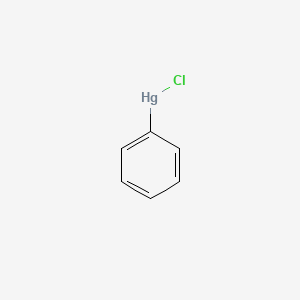
Phenylmercuric Chloride
Phenylmercuric chloride is an organomercuric compound. Mercury is a heavy, silvery d-block metal and one of six elements that are liquid at or near room temperature and pressure. It is a naturally occuring substance, and combines with other elements such as chlorine, sulfur, or oxygen to form inorganic mercury compounds (salts). Mercury also combines with carbon to make organic mercury compounds. (L1) — Toxin and Toxin Target Database (T3DB)
- Nom IUPAC
- chloro(phenyl)mercury
- Formule moléculaire
- C6H5ClHg
- Masse moléculaire
- 313.15 g/mol
- Masse exacte
- 313.978621 Da
- Surface polaire topologique
- 0,0 Ų
- Donneurs de liaisons hydrogène
- 0
- Accepteurs de liaisons hydrogène
- 0
- Unités covalentes
- 1
- Stéréocentres définis
- 0
Également connu sous le nom de
16 autres noms signalés
Identifiants de bases de données externes
- EPA DTXSID:DTXSID4042129
- PubMed:17489621
- PubMed:13717574
- PubMed:9144456
Preuves issues de bases de données scientifiques complémentaires
NIH PubChem PUG-View
Attributed physical-property, hazard, environmental and use annotations.
- Color/Form: White satiny leaflets Source: Hazardous Substances Data Bank (HSDB)
- LogP: log Kow= 1.78 Source: Hazardous Substances Data Bank (HSDB)
- Melting Point: 250-252 °C Source: Hazardous Substances Data Bank (HSDB)
- Physical Description: White solid; [Merck Index] White powder; [MSDSonline] Source: Haz-Map, Information on Hazardous Chemicals and Occupational Diseases
- Solubility: Sol in about 20,000 parts cold water; slightly sol in hot alcohol; sol in benzene, ether, pyridine Source: Hazardous Substances Data Bank (HSDB)
- Vapor Pressure: 0.02 [mmHg] Source: Haz-Map, Information on Hazardous Chemicals and Occupational Diseases
- Carcinogen Classification: No indication of carcinogenicity (not listed by IARC). (L135) Source: Toxin and Toxin Target Database (T3DB)
- Exposure Routes: Oral (L7) ; inhalation (L7) ; dermal (L7) Source: Toxin and Toxin Target Database (T3DB)
- Signal: Danger Source: European Chemicals Agency (ECHA)
- GHS Hazard Statements: H300+H310+H330 (22.2%): Fatal if swallowed, in contact with skin or if inhaled [Danger Acute toxicity, oral; acute toxicity, dermal; acute toxicity, inhalation]; H300 (100%): Fatal if swallowed [Danger Acute toxicity, oral]; H310 (100%): Fatal in contact with skin [Danger Acute toxicity, dermal]; H330 (100%): Fatal if inhaled [Danger Acute toxicity, inhalation]; H373 (100%): May causes damage to organs through prolonged or repeated exposure [Warning Specific target organ toxicity, repeated exposure]; H400 (100%): Very toxic to aquatic life [Warning Hazardous to the aquatic environment, acute hazard]; H410 (100%): Very toxic to aquatic life with long lasting effects [Warning Hazardous to the aquatic environment, long-term hazard] Source: European Chemicals Agency (ECHA)
- Precautionary Statement Codes: P260, P262, P264, P270, P271, P273, P280, P284, P301+P316, P302+P352, P304+P340, P316, P319, P320, P321, P330, P361+P364, P391, P403+P233, P405, and P501 (click each P-code to see the statement) Source: European Chemicals Agency (ECHA)
- ECHA C&L Notifications Summary: Aggregated GHS information provided per 9 reports by companies from 4 notifications to the ECHA C&L Inventory. Each notification may be associated with multiple companies.; Information may vary between notifications depending on impurities, additives, and other factors. The percentage value in parenthesis indicates the notified classification ratio from companies that provide hazard codes. Only hazard codes with percentage values above 10% are shown. For more detailed information, please visit ECHA C&L website. Source: European Chemicals Agency (ECHA)
- Health Effects: Mercury mainly affects the nervous system. Exposure to high levels of metallic, inorganic, or organic mercury can permanently damage the brain, kidneys, and developing fetus. Effects on brain functioning may result in irritability, shyness, tremors, changes in vision or hearing, and memory problems. Acrodynia, a type of mercury poisoning in children, is characterized by pain and pink discoloration of the hands and feet. Mercury poisoning can also cause Hunter-Russell syndrome and Minamata disease. (L7) Source: Toxin and Toxin Target Database (T3DB)
- Toxicity Summary: High-affinity binding of the divalent mercuric ion to thiol or sulfhydryl groups of proteins is believed to be the major mechanism for the activity of mercury. Through alterations in intracellular thiol status, mercury can promote oxidative stress, lipid peroxidation, mitochondrial dysfunction, and changes in heme metabolism. Mercury is known to bind to microsomal and mitochondrial enzymes, resulting in cell injury and death. For example, mercury is known to inhibit aquaporins, halting water flow across the cell membrane. It also inhibits the protein LCK, which causes decreased T-cell signalling and immune system depression. Mercury is also believed to inhibit neuronal excitability by acting on the postsynaptic neuronal membrane. It also affects the nervous system by inhibiting protein kinase C and alkaline phosphatase, which impairs brain microvascular formation and function, as well as alters the blood-brain barrier. Organic mercury exerts developmental effects by binding to tubulin, preventing microtubule assembly and causing mitotic inhibition. Mercury also produces an autoimmune response, likely by modification of major histocompatibility complex (MHC) class II molecules, self Source: Toxin and Toxin Target Database (T3DB)
- Sources/Uses: Used formerly as antimycotic, antisyphilitic, diuretic, agricultural fungicide, antiseptic, and germicide; Not currently registered with the EPA for use in the US; [HSDB] Source: Haz-Map, Information on Hazardous Chemicals and Occupational Diseases
- Restricted Notes: Use in paints as a biocide was discontinued in 1991 in the US; [HSDB] Source: Haz-Map, Information on Hazardous Chemicals and Occupational Diseases
- Industrial Processes with risk of exposure: Using Disinfectants or Biocides [Category: Clean]; Farming (Pesticides) [Category: Industry] Source: Haz-Map, Information on Hazardous Chemicals and Occupational Diseases
- Uses: For Phenylmercuric Chloride (USEPA/OPP PC Code: 066007) there are 0 labels match. /SRP: Not registered for current use in the U.S./ Source: Hazardous Substances Data Bank (HSDB)
- Uses: Antimycotic /Former use/ Source: Hazardous Substances Data Bank (HSDB)
- Uses: Used as antisyphilitic and diuretic ... use for this purpose has been restricted or stopped because of ... numerous side effects and toxicity /Former use/ Source: Hazardous Substances Data Bank (HSDB)
- Uses: Agricultural fungicide /Former use/ Source: Hazardous Substances Data Bank (HSDB)
- Uses: For more Uses (Complete) data for PHENYLMERCURIC CHLORIDE (7 total), please visit the HSDB record page. Source: Hazardous Substances Data Bank (HSDB)
Mis en correspondance par: Existing checksum-valid CAS to unique PubChem CID match. Récupéré le: 2026-08-31. Ouvrir la fiche source
Les classifications scientifiques et les annotations de danger apportent du contexte et ne remplacent pas la décision réglementaire propre au marché indiquée ci-dessus.
Couverture des sources complémentaires et état des correspondances
| Source | Résultat | Vérifié |
|---|---|---|
| EMBL-EBI ChEBI | Aucune fiche exacte | 2026-08-31 |
| NIH PubChem PUG-View | Correspondance exacte | 2026-08-31 |
Une absence de correspondance enregistrée est une preuve utile que la source a été vérifiée ; ce n’est pas l’affirmation que la substance n’existe pas ailleurs.
Récupéré depuis NIH PubChem le 2026-08-31 par correspondance CAS à somme de contrôle valide. Les propriétés chimiques ne remplacent pas la décision réglementaire de cette page.
Preuves officielles sur le nom d’ingrédient de l’UE
Le nom de l’ingrédient correspond exactement au glossaire officiel 2025 de l’UE des dénominations communes d’ingrédients.
Preuves d’inventaire associées
Ingrédients ayant des fonctions de formulation communes
Sources officielles et scientifiques complémentaires
11 bases de données externes pour vérifier cette identité
Chaque lien lance une recherche de cette identité dans la source concernée. Ce qu’est chaque source et sa valeur juridique
Comment PHENYL MERCURIC CHLORIDE apparaît dans l’inventaire CosIng
L’inventaire CosIng répertorie PHENYL MERCURIC CHLORIDE comme ingrédient cosmétique et cette page l’associe à 1 fiche d’annexe. L’entrée d’inventaire reprend les noms et identifiants, tandis que la fiche d’annexe indique où la substance est interdite, soumise à restrictions ou inscrite sur une liste positive dans le droit de l’UE sur les cosmétiques.
PHENYL MERCURIC CHLORIDE est aussi associé à 1 fonction cosmétique dans les données officielles. Les désignations de fonction décrivent l’usage prévu, mais ne remplacent pas l’examen réglementaire des fiches d’annexe associées avant un travail de formulation ou d’étiquetage.
Questions fréquentes
Note de source pour PHENYL MERCURIC CHLORIDE
Cette page associe l’entrée d’inventaire CosIng de PHENYL MERCURIC CHLORIDE à 1 fiche liée des annexes II à VI de notre jeu de données, construit à partir de documents publics de la Commission européenne sur les ingrédients cosmétiques.
Utilisez cette page d’inventaire pour étudier PHENYL MERCURIC CHLORIDE et comparer les fiches associées, mais vérifiez les restrictions et le statut juridique auprès du texte officiel en vigueur et de la législation avant toute décision réglementaire.
Outils et étapes suivantes
Vérifiez votre formule
Analysez une liste INCI complète pour détecter PHENYL MERCURIC CHLORIDE et les éventuelles restrictions d’annexes de l’UE ou signalements d’allergènes associés.
Vérificateur INCIRechercher des ingrédients similaires
Trouvez d’autres ingrédients de l’inventaire et entrées d’annexe liés à PHENYL MERCURIC CHLORIDE, à ses identifiants ou à des variantes de nom proches.
Rechercher