
HEXAMETHYLINDANOPYRAN
1,3,4,6,7,8-Hexahydro-4,6,6,7,8,8-hexamethylindeno(5,6-c)pyran; 1,3,4,6,7,8-Hexahydro-4,6,6,7,8,8-hexamethyl-cyclopenta-gamma-2-benzopyran; abbalide; galaxolide; HHCB; pearlide
HEXAMETHYLINDANOPYRAN est lié à 1 fiche d’annexe de l’UE sur cette page.
En un coup d’œil
- Fonction
- Fragrance, perfuming
- CAS
- 1222-05-5
- EC
- 214-946-9
- Annexes de l’UE
- Annexe III/336
- Annexe III/336: aucun maximum unique indiqué
Preuves réglementaires par marché
Cette matrice distingue les règles d’ingrédients vérifiées des sources cartographiées mais pas encore importées. L’absence de règle importée ne signifie pas que l’ingrédient est autorisé.
Balayez ou faites défiler horizontalement pour voir toutes les colonnes.
| Marché | Statut des preuves | Fiches | Langue de la source |
|---|---|---|---|
| European Union | Preuves associées Restricted entry found Ouvrir cette preuve | 1 | English and EU languages |
| Great Britain | Source cartographiée Official source mapped; ingredient rule not imported | 0 | English |
| Canada | Source cartographiée Official source mapped; ingredient rule not imported | 0 | English and French |
| New Zealand | Source cartographiée Official source mapped; ingredient rule not imported | 0 | English |
| ASEAN | Source cartographiée Official source mapped; ingredient rule not imported | 0 | English and national languages |
| China | Source cartographiée Official source mapped; ingredient rule not imported | 0 | Chinese with selected English material |
| Japan | Source cartographiée Official source mapped; ingredient rule not imported | 0 | Japanese; official English translation available |
| South Korea | Source cartographiée Official source mapped; ingredient rule not imported | 0 | Korean with some English names |
| United States | Source cartographiée Official source mapped; ingredient rule not imported | 0 | English |
| Australia | Source cartographiée Official source mapped; ingredient rule not imported | 0 | English |
| Brazil | Source cartographiée Official source mapped; ingredient rule not imported | 0 | Portuguese with INCI crosswalks |
| India | Source cartographiée Official source mapped; ingredient rule not imported | 0 | English and Hindi |
| Saudi Arabia | Preuves associées Restricted Ouvrir cette preuve | 1 | Arabic and English |
Détails d’inventaire pour HEXAMETHYLINDANOPYRAN
Nom INCI
HEXAMETHYLINDANOPYRAN
Description
1,3,4,6,7,8-Hexahydro-4,6,6,7,8,8-hexamethylindeno(5,6-c)pyran; 1,3,4,6,7,8-Hexahydro-4,6,6,7,8,8-hexamethyl-cyclopenta-gamma-2-benzopyran; abbalide; galaxolide; HHCB; pearlide
Provenance de la fiche
- Référence d’inventaire
- 56371
- Identité importée
- HEXAMETHYLINDANOPYRAN
- Mise à jour de la source
- 15/10/2010
Fiches d’annexe pour HEXAMETHYLINDANOPYRAN
Données clés
Identité et propriétés chimiques
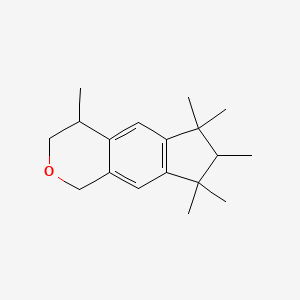
Galaxolide
Galaxolide is an organic heterotricyclic compound that is 1,3,4,6,7,8-hexahydrocyclopenta[g]isochromene substituted by methyl groups at positions 4, 6, 6, 7, 8 and 8 respectively. It is a synthetic musk used as a fragrance in cosmetics. It has a role as a fragrance. It is an organic heterotricyclic compound and a member of isochromenes. — ChEBI
- Nom IUPAC
- 4,6,6,7,8,8-hexamethyl-1,3,4,7-tetrahydrocyclopenta[g]isochromene
- Formule moléculaire
- C18H26O
- Masse moléculaire
- 258.4 g/mol
- Masse exacte
- 258.198365449 Da
- XLogP3
- 4,8
- Surface polaire topologique
- 9,2 Ų
- Donneurs de liaisons hydrogène
- 0
- Accepteurs de liaisons hydrogène
- 1
- Unités covalentes
- 1
- Stéréocentres définis
- 0
Également connu sous le nom de
16 autres noms signalés
Identifiants de bases de données externes
- ChEBI:CHEBI:83784
- ChEMBL:CHEMBL1883305
- EPA DTXSID:DTXSID8027373
- PubMed:37797914
- PubMed:34687775
- PubMed:29427707
- PubMed:23084589
- PubMed:22967629
- PubMed:22813076
- PubMed:22779714
- PubMed:22733515
- PubMed:22709983
- PubMed:22699026
- PubMed:22540536
- PubMed:22489002
Preuves issues de bases de données scientifiques complémentaires
NIH PubChem PUG-View
Attributed physical-property, hazard, environmental and use annotations.
- Boiling Point: BP: 128 °C at 0.8 mm Hg Source: Hazardous Substances Data Bank (HSDB)
- Color/Form: Colorless crystals from ethanol Source: Hazardous Substances Data Bank (HSDB)
- Color/Form: Viscous liquid[ECHA; Search for Chemicals. 1,3,4,6,7,8-hexahydro-4,6,6,7,8,8-hexmethylindeno Source: Hazardous Substances Data Bank (HSDB)
- Color/Form: Almost colorless viscous liquid Source: Hazardous Substances Data Bank (HSDB)
- Density: 1.0054 at 20 °C/4 °C Source: Hazardous Substances Data Bank (HSDB)
- Density: Density: 0.99 to 1.017 g/cu cm at 20 °C Source: Hazardous Substances Data Bank (HSDB)
- Density: Crystal density: 1.087 g/cu cm Source: Hazardous Substances Data Bank (HSDB)
- LogP: log Kow = 5.90 Source: Hazardous Substances Data Bank (HSDB)
- Melting Point: 57-58 °C Source: Hazardous Substances Data Bank (HSDB)
- Melting Point: MP: -10 to 0 °C (mixture of isomers) Source: Hazardous Substances Data Bank (HSDB)
- Odor: Strong musk odor Source: Hazardous Substances Data Bank (HSDB)
- Odor: Odor type: Musk Source: Hazardous Substances Data Bank (HSDB)
- Physical Description: Liquid; CBI; Other Solid Source: EPA Chemical Data Reporting (CDR)
- Physical Description: Colorless solid with a strong odor of musk; mp = 57-58 deg C; [Merck Index] Nearly colorless viscous liquid; [HSDB] Viscous liquid with a musk-like odor; mp = -5 deg C; [CHEMINFO] Viscous liquid; mp = -10-0 deg C; [eChemPortal: ESIS: RAR] Source: Haz-Map, Information on Hazardous Chemicals and Occupational Diseases
- Refractive Index: Index of refraction: 1.5342 at 20 °C/D Source: Hazardous Substances Data Bank (HSDB)
- Solubility: In water, 1.75 mg/L at 25 °C Source: Hazardous Substances Data Bank (HSDB)
- Solubility: In water, 1.65-1.99 mg/L at 25 °C and pH 5-9[ECHA; Search for Chemicals. 1,3,4,6,7,8-hexahydro-4,6,6,7,8,8-hexmethylindeno Source: Hazardous Substances Data Bank (HSDB)
- Vapor Pressure: 0.00054 [mmHg] Source: Haz-Map, Information on Hazardous Chemicals and Occupational Diseases
- Vapor Pressure: 5.45X10⁻⁴ mm Hg at 25 °C Source: Hazardous Substances Data Bank (HSDB)
- Viscosity: Dynamic viscosity: 12,914 mPa.s[ECHA; Search for Chemicals. 1,3,4,6,7,8-hexahydro-4,6,6,7,8,8-hexmethylindeno Source: Hazardous Substances Data Bank (HSDB)
- Signal: Warning Source: Regulation (EC) No 1272/2008 of the European Parliament and of the Council
- GHS Hazard Statements: H400: Very toxic to aquatic life [Warning Hazardous to the aquatic environment, acute hazard]; H410: Very toxic to aquatic life with long lasting effects [Warning Hazardous to the aquatic environment, long-term hazard] Source: Regulation (EC) No 1272/2008 of the European Parliament and of the Council
- Precautionary Statement Codes: P273, P391, and P501 (click each P-code to see the statement) Source: Regulation (EC) No 1272/2008 of the European Parliament and of the Council
- Signal: Warning Source: European Chemicals Agency (ECHA)
- GHS Hazard Statements: H400 (97.9%): Very toxic to aquatic life [Warning Hazardous to the aquatic environment, acute hazard]; H410 (100%): Very toxic to aquatic life with long lasting effects [Warning Hazardous to the aquatic environment, long-term hazard] Source: European Chemicals Agency (ECHA)
- Precautionary Statement Codes: P273, P391, and P501 (click each P-code to see the statement) Source: European Chemicals Agency (ECHA)
- ECHA C&L Notifications Summary: Aggregated GHS information provided per 2093 reports by companies from 18 notifications to the ECHA C&L Inventory. Each notification may be associated with multiple companies.; Information may vary between notifications depending on impurities, additives, and other factors. The percentage value in parenthesis indicates the notified classification ratio from companies that provide hazard codes. Only hazard codes with percentage values above 10% are shown. For more detailed information, please visit ECHA C&L website. Source: European Chemicals Agency (ECHA)
- Signal: Danger Source: NITE-CMC
- GHS Hazard Statements: H360: May damage fertility or the unborn child [Danger Reproductive toxicity]; H400: Very toxic to aquatic life [Warning Hazardous to the aquatic environment, acute hazard]; H410: Very toxic to aquatic life with long lasting effects [Warning Hazardous to the aquatic environment, long-term hazard] Source: NITE-CMC
- Precautionary Statement Codes: P203, P273, P280, P318, P391, P405, and P501 (click each P-code to see the statement) Source: NITE-CMC
- Signal: Warning Source: NITE-CMC
- GHS Hazard Statements: H361: Suspected of damaging fertility or the unborn child [Warning Reproductive toxicity]; H400: Very toxic to aquatic life [Warning Hazardous to the aquatic environment, acute hazard]; H410: Very toxic to aquatic life with long lasting effects [Warning Hazardous to the aquatic environment, long-term hazard] Source: NITE-CMC
- Toxicity Summary: IDENTIFICATION AND USE: Galaxolide (HHCB) is an almost colorless viscous liquid. It is a synthetic, artificial musk fragrance, which is used as a laundry detergent fragrance, as well as an ingredient in perfumes, soaps, and cosmetics. HUMAN STUDIES: No irritation was observed in any of the 42 subjects tested in human repeated insult patch test even after repeated occlusive applications of undiluted material. High concentrations of HHCB can affect steroidogenesis in vitro using the H295R cell line. HHCB was not genotoxic in the micronucleus test with human lymphocytes in vitro in the presence and absence of metabolic activation. ANIMAL STUDIES: HHCB was added to the diet of rats at levels calculated to result in mean daily doses of 5, 15, 50 or 150 mg HHCB/kg. On completion of the 90-day treatment period, three males and three females from the high dose and control groups were maintained for a treatment free period of 4 weeks. No adverse effects were revealed from clinical examination or following extensive histopathological examinations. There were no significant findings at any dose level. Developmental study in rats described axial skeletal malformations at 500 mg/kg per day. In Source: Hazardous Substances Data Bank (HSDB)
- Environmental Bioconcentration: A BCF of 1,584 was measured in fish for galaxolide(SRC), using bluegill sunfish (Lepomis macrochirus) which were exposed to concentrations of 1 and 10 mg/L over an 28-day period(1). According to a classification scheme(2), this BCF suggests the potential for bioconcentration in aquatic organisms is very high(SRC). A polar metabolite accounting for 9-24% of the total radioactivity in tissue was detected(1). Source: Hazardous Substances Data Bank (HSDB)
- Environmental Fate: TERRESTRIAL FATE: Based on a classification scheme(1), an estimated Koc value of 2.0X10+4(SRC), determined from a structure estimation method(2), indicates that galaxolide is expected to be immobile in soil(SRC). Volatilization of galaxolide from moist soil surfaces is expected to be an important fate process(SRC) given an estimated Henry's Law constant of 1.1X10⁻⁴ atm-cu m/mole(SRC), based upon its vapor pressure, 5.45X10⁻⁴ mm Hg(3), and water solubility, 1.75 mg/L(3). However, adsorption to soil is expected to attenuate volatilization(SRC).) Galaxolide is not expected to volatilize from dry soil surfaces(SRC) based upon its vapor pressure(4). A biodegradation half-life in soil of 4 months(3) indicates that biodegradation is not an important environmental fate process in soil(SRC). Source: Hazardous Substances Data Bank (HSDB)
- Environmental Fate: AQUATIC FATE: Based on a classification scheme(1), an estimated Koc value of 2.0X10+4(SRC), determined from a structure estimation method(2), indicates that galaxolide is expected to adsorb to suspended solids and sediment(SRC). Volatilization from water surfaces is expected(3) based upon an estimated Henry's Law constant of 1.1X10⁻⁴ atm-cu m/mole(SRC), derived from its vapor pressure, 5.45X10⁻⁴ mm Hg(4), and water solubility, 1.75 mg/L(4). Using this Henry's Law constant and an estimation method(3), volatilization half-lives for a model river and model lake are 18 hrs and 10 days, respectively(SRC). However, volatilization from water surfaces is expected to be attenuated by adsorption to suspended solids and sediment in the water column. The estimated volatilization half-life from a model pond is 31 months if adsorption is considered(5). According to a classification scheme(6), a BCF of 1584(4) suggests the potential for bioconcentration in aquatic organisms is very high(SRC). A release of 0% CO2 in four weeks using an effluent from a semi-continuous activated sludge (SCAS) in the OECD 302 test(4) indicates that biodegradation is not an important environmental fate process in wate Source: Hazardous Substances Data Bank (HSDB)
- Environmental Fate: ATMOSPHERIC FATE: According to a model of gas/particle partitioning of semivolatile organic compounds in the atmosphere(1), galaxolide, which has a vapor pressure of 5.45X10⁻⁴ mm Hg at 25 °C((SRC), determined from a fragment constant method(2)), will exist in both the vapor and particulate phases in the ambient atmosphere. Vapor-phase galaxolide is degraded in the atmosphere by reaction with photochemically-produced hydroxyl radicals(SRC); the half-life for this reaction in air is estimated to be approximately 10 hrs(SRC), calculated from its rate constant of 2.60X10⁻¹¹ cu cm/molecule-sec at 25 °C(3). Particulate-phase galaxolide may be removed from the air by wet and dry deposition(SRC). Galaxolide does not contain chromophores that absorb at wavelengths >290 nm(4) and, therefore, is not expected to be susceptible to direct photolysis by sunlight(SRC). Source: Hazardous Substances Data Bank (HSDB)
- Consumer Uses: Fragrance Source: EPA Chemical Data Reporting (CDR)
- Industry Uses: Fragrance Source: EPA Chemical Data Reporting (CDR)
- Sources/Uses: Used as fragrance agent in perfumes, soaps, cosmetics, and detergents; [Merck Index] Source: Haz-Map, Information on Hazardous Chemicals and Occupational Diseases
- Uses: Synthetic, artificial musk fragrance. Source: Hazardous Substances Data Bank (HSDB)
- Uses: Fragrance ingredient in perfumes, soaps, cosmetics, and detergents. Source: Hazardous Substances Data Bank (HSDB)
- Uses: HHCB is used to make a fragrance long lasting and have a positive technical effect on its balance bringing the initial and residual smell into harmony. Source: Hazardous Substances Data Bank (HSDB)
Mis en correspondance par: Existing checksum-valid CAS to unique PubChem CID match. Récupéré le: 2026-08-31. Ouvrir la fiche source
Les classifications scientifiques et les annotations de danger apportent du contexte et ne remplacent pas la décision réglementaire propre au marché indiquée ci-dessus.
Couverture des sources complémentaires et état des correspondances
| Source | Résultat | Vérifié |
|---|---|---|
| NIH PubChem PUG-View | Correspondance exacte | 2026-08-31 |
Une absence de correspondance enregistrée est une preuve utile que la source a été vérifiée ; ce n’est pas l’affirmation que la substance n’existe pas ailleurs.
Récupéré depuis NIH PubChem le 2026-09-02 par correspondance CAS à somme de contrôle valide. Les propriétés chimiques ne remplacent pas la décision réglementaire de cette page.
Preuves officielles sur le nom d’ingrédient de l’UE
Le nom de l’ingrédient correspond exactement au glossaire officiel 2025 de l’UE des dénominations communes d’ingrédients.
Preuves d’inventaire associées
Ingrédients ayant des fonctions de formulation communes
Sources officielles et scientifiques complémentaires
11 bases de données externes pour vérifier cette identité
Chaque lien lance une recherche de cette identité dans la source concernée. Ce qu’est chaque source et sa valeur juridique
Comment HEXAMETHYLINDANOPYRAN apparaît dans l’inventaire CosIng
L’inventaire CosIng répertorie HEXAMETHYLINDANOPYRAN comme ingrédient cosmétique et cette page l’associe à 1 fiche d’annexe. L’entrée d’inventaire reprend les noms et identifiants, tandis que la fiche d’annexe indique où la substance est interdite, soumise à restrictions ou inscrite sur une liste positive dans le droit de l’UE sur les cosmétiques.
HEXAMETHYLINDANOPYRAN est aussi associé à 2 fonctions cosmétiques dans les données officielles. Les désignations de fonction décrivent l’usage prévu, mais ne remplacent pas l’examen réglementaire des fiches d’annexe associées avant un travail de formulation ou d’étiquetage.
Questions fréquentes
Note de source pour HEXAMETHYLINDANOPYRAN
Cette page associe l’entrée d’inventaire CosIng de HEXAMETHYLINDANOPYRAN à 1 fiche liée des annexes II à VI de notre jeu de données, construit à partir de documents publics de la Commission européenne sur les ingrédients cosmétiques.
Utilisez cette page d’inventaire pour étudier HEXAMETHYLINDANOPYRAN et comparer les fiches associées, mais vérifiez les restrictions et le statut juridique auprès du texte officiel en vigueur et de la législation avant toute décision réglementaire.
Outils et étapes suivantes
Vérifiez votre formule
Analysez une liste INCI complète pour détecter HEXAMETHYLINDANOPYRAN et les éventuelles restrictions d’annexes de l’UE ou signalements d’allergènes associés.
Vérificateur INCIRechercher des ingrédients similaires
Trouvez d’autres ingrédients de l’inventaire et entrées d’annexe liés à HEXAMETHYLINDANOPYRAN, à ses identifiants ou à des variantes de nom proches.
Rechercher