Aller au contenu principal
CAS 1 fiche

CAS 1222-05-5

Le CAS 1222-05-5 correspond à 1 fiche d’annexe de l’UE dans les annexes II à VI du règlement (CE) n° 1223/2009.

Fiches pour le CAS 1222-05-5

1 au total
Annexe
III
Entrée
336

Hexamethylindanopyran

1,3,4,6,7,8-Hexahydro-4,6,6,7,8,8-hexamethylcyclopenta-γ-2-benzopyran

The presence of the substance shall be indicated in the list of ingredients referred to in Article 19(1), point (g), when its concentration exceeds: — 0,001 % in leave-on products — 0,01 % in rinse-off products

Identité et propriétés chimiques

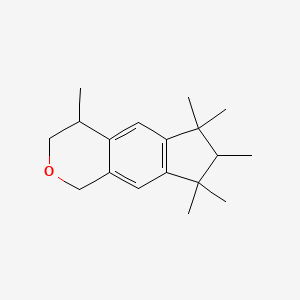
Structure chimique 2D PubChem pour le CAS 1222-05-5
CAS 1222-05-5PubChem CID 91497

Galaxolide

Galaxolide is an organic heterotricyclic compound that is 1,3,4,6,7,8-hexahydrocyclopenta[g]isochromene substituted by methyl groups at positions 4, 6, 6, 7, 8 and 8 respectively. It is a synthetic musk used as a fragrance in cosmetics. It has a role as a fragrance. It is an organic heterotricyclic compound and a member of isochromenes. — ChEBI

Nom IUPAC
4,6,6,7,8,8-hexamethyl-1,3,4,7-tetrahydrocyclopenta[g]isochromene
Formule moléculaire
C18H26O
Masse moléculaire
258.4 g/mol
Masse exacte
258.198365449 Da
XLogP3
4,8
Surface polaire topologique
9,2 Ų
Donneurs de liaisons hydrogène
0
Accepteurs de liaisons hydrogène
1
Unités covalentes
1
Stéréocentres définis
0

Également connu sous le nom de

AbbalideGaloxolideHHCBPearlideGalaxolide WhitehexamethylindanopyranCyclopenta[g]-2-benzopyran, 1,3,4,6,7,8-hexahydro-4,6,6,7,8,8-hexamethyl-Hexahydrohexamethyl cyclopentabenzopyran
16 autres noms signalés
1,3,4,6,7,8-Hexahydro-4,6,6,7,8,8-hexamethyl-cyclopenta-gamma-2-benzopyranCHEBI:83784Hexahydro-4,6,6,7,8,8-hexamethylcyclopenta-gamma-2-benzopyran1,3,4,6,7,8-Hexahydro-4,6,6,7,8,8-hexamethylindeno(5,6-c)pyranCyclopenta(g)-2-benzopyran, 1,3,4,6,7,8-hexahydro-4,6,6,7,8,8-hexamethyl-1,3,4,6,7,8-hexahydro-4,6,6,7,8,8-hexamethylindeno[5,6-c]pyranhexahydro-hexamethylcyclopenta-benzopyranRefChem:633508214-946-94,6,6,7,8,8-Hexamethyl-1,3,4,6,7,8-hexahydrocyclopenta[g]isochromene1,3,4,6,7,8-Hexahydro-4,6,6,7,8,8-hexamethylcyclopenta[g]-2-benzopyran4,6,6,7,8,8-Hexamethyl-1,3,4,6,7,8-hexahydroindeno[5,6-c]pyran1,3,4,6,7,8-Hexahydro-4,6,6,7,8,8-hexamethylcyclopenta(g)-2-benzopyranEINECS 214-946-9CCRIS 8402Galaxolide 1
Identifiants de bases de données externes

Preuves issues de bases de données scientifiques complémentaires

NIH PubChem PUG-View
Correspondance exacte d’identifiant91497

Attributed physical-property, hazard, environmental and use annotations.

  • Signal: Warning Source: Regulation (EC) No 1272/2008 of the European Parliament and of the Council
  • GHS Hazard Statements: H400: Very toxic to aquatic life [Warning Hazardous to the aquatic environment, acute hazard]; H410: Very toxic to aquatic life with long lasting effects [Warning Hazardous to the aquatic environment, long-term hazard] Source: Regulation (EC) No 1272/2008 of the European Parliament and of the Council
  • Precautionary Statement Codes: P273, P391, and P501 (click each P-code to see the statement) Source: Regulation (EC) No 1272/2008 of the European Parliament and of the Council
  • Signal: Warning Source: European Chemicals Agency (ECHA)
  • GHS Hazard Statements: H400 (97.9%): Very toxic to aquatic life [Warning Hazardous to the aquatic environment, acute hazard]; H410 (100%): Very toxic to aquatic life with long lasting effects [Warning Hazardous to the aquatic environment, long-term hazard] Source: European Chemicals Agency (ECHA)
  • Precautionary Statement Codes: P273, P391, and P501 (click each P-code to see the statement) Source: European Chemicals Agency (ECHA)
  • ECHA C&L Notifications Summary: Aggregated GHS information provided per 2093 reports by companies from 18 notifications to the ECHA C&L Inventory. Each notification may be associated with multiple companies.; Information may vary between notifications depending on impurities, additives, and other factors. The percentage value in parenthesis indicates the notified classification ratio from companies that provide hazard codes. Only hazard codes with percentage values above 10% are shown. For more detailed information, please visit ECHA C&L website. Source: European Chemicals Agency (ECHA)
  • Signal: Danger Source: NITE-CMC
  • GHS Hazard Statements: H360: May damage fertility or the unborn child [Danger Reproductive toxicity]; H400: Very toxic to aquatic life [Warning Hazardous to the aquatic environment, acute hazard]; H410: Very toxic to aquatic life with long lasting effects [Warning Hazardous to the aquatic environment, long-term hazard] Source: NITE-CMC
  • Precautionary Statement Codes: P203, P273, P280, P318, P391, P405, and P501 (click each P-code to see the statement) Source: NITE-CMC
  • Signal: Warning Source: NITE-CMC
  • GHS Hazard Statements: H361: Suspected of damaging fertility or the unborn child [Warning Reproductive toxicity]; H400: Very toxic to aquatic life [Warning Hazardous to the aquatic environment, acute hazard]; H410: Very toxic to aquatic life with long lasting effects [Warning Hazardous to the aquatic environment, long-term hazard] Source: NITE-CMC
  • Toxicity Summary: IDENTIFICATION AND USE: Galaxolide (HHCB) is an almost colorless viscous liquid. It is a synthetic, artificial musk fragrance, which is used as a laundry detergent fragrance, as well as an ingredient in perfumes, soaps, and cosmetics. HUMAN STUDIES: No irritation was observed in any of the 42 subjects tested in human repeated insult patch test even after repeated occlusive applications of undiluted material. High concentrations of HHCB can affect steroidogenesis in vitro using the H295R cell line. HHCB was not genotoxic in the micronucleus test with human lymphocytes in vitro in the presence and absence of metabolic activation. ANIMAL STUDIES: HHCB was added to the diet of rats at levels calculated to result in mean daily doses of 5, 15, 50 or 150 mg HHCB/kg. On completion of the 90-day treatment period, three males and three females from the high dose and control groups were maintained for a treatment free period of 4 weeks. No adverse effects were revealed from clinical examination or following extensive histopathological examinations. There were no significant findings at any dose level. Developmental study in rats described axial skeletal malformations at 500 mg/kg per day. In Source: Hazardous Substances Data Bank (HSDB)
  • Environmental Bioconcentration: A BCF of 1,584 was measured in fish for galaxolide(SRC), using bluegill sunfish (Lepomis macrochirus) which were exposed to concentrations of 1 and 10 mg/L over an 28-day period(1). According to a classification scheme(2), this BCF suggests the potential for bioconcentration in aquatic organisms is very high(SRC). A polar metabolite accounting for 9-24% of the total radioactivity in tissue was detected(1). Source: Hazardous Substances Data Bank (HSDB)
  • Environmental Fate: TERRESTRIAL FATE: Based on a classification scheme(1), an estimated Koc value of 2.0X10+4(SRC), determined from a structure estimation method(2), indicates that galaxolide is expected to be immobile in soil(SRC). Volatilization of galaxolide from moist soil surfaces is expected to be an important fate process(SRC) given an estimated Henry's Law constant of 1.1X10⁻⁴ atm-cu m/mole(SRC), based upon its vapor pressure, 5.45X10⁻⁴ mm Hg(3), and water solubility, 1.75 mg/L(3). However, adsorption to soil is expected to attenuate volatilization(SRC).) Galaxolide is not expected to volatilize from dry soil surfaces(SRC) based upon its vapor pressure(4). A biodegradation half-life in soil of 4 months(3) indicates that biodegradation is not an important environmental fate process in soil(SRC). Source: Hazardous Substances Data Bank (HSDB)
  • Environmental Fate: AQUATIC FATE: Based on a classification scheme(1), an estimated Koc value of 2.0X10+4(SRC), determined from a structure estimation method(2), indicates that galaxolide is expected to adsorb to suspended solids and sediment(SRC). Volatilization from water surfaces is expected(3) based upon an estimated Henry's Law constant of 1.1X10⁻⁴ atm-cu m/mole(SRC), derived from its vapor pressure, 5.45X10⁻⁴ mm Hg(4), and water solubility, 1.75 mg/L(4). Using this Henry's Law constant and an estimation method(3), volatilization half-lives for a model river and model lake are 18 hrs and 10 days, respectively(SRC). However, volatilization from water surfaces is expected to be attenuated by adsorption to suspended solids and sediment in the water column. The estimated volatilization half-life from a model pond is 31 months if adsorption is considered(5). According to a classification scheme(6), a BCF of 1584(4) suggests the potential for bioconcentration in aquatic organisms is very high(SRC). A release of 0% CO2 in four weeks using an effluent from a semi-continuous activated sludge (SCAS) in the OECD 302 test(4) indicates that biodegradation is not an important environmental fate process in wate Source: Hazardous Substances Data Bank (HSDB)
  • Environmental Fate: ATMOSPHERIC FATE: According to a model of gas/particle partitioning of semivolatile organic compounds in the atmosphere(1), galaxolide, which has a vapor pressure of 5.45X10⁻⁴ mm Hg at 25 °C((SRC), determined from a fragment constant method(2)), will exist in both the vapor and particulate phases in the ambient atmosphere. Vapor-phase galaxolide is degraded in the atmosphere by reaction with photochemically-produced hydroxyl radicals(SRC); the half-life for this reaction in air is estimated to be approximately 10 hrs(SRC), calculated from its rate constant of 2.60X10⁻¹¹ cu cm/molecule-sec at 25 °C(3). Particulate-phase galaxolide may be removed from the air by wet and dry deposition(SRC). Galaxolide does not contain chromophores that absorb at wavelengths >290 nm(4) and, therefore, is not expected to be susceptible to direct photolysis by sunlight(SRC). Source: Hazardous Substances Data Bank (HSDB)

Mis en correspondance par: Existing checksum-valid CAS to unique PubChem CID match. Récupéré le: 2026-08-31. Ouvrir la fiche source

Les classifications scientifiques et les annotations de danger apportent du contexte et ne remplacent pas la décision réglementaire propre au marché indiquée ci-dessus.

Couverture des sources complémentaires et état des correspondances
SourceRésultatVérifié
NIH PubChem PUG-ViewCorrespondance exacte2026-08-31

Une absence de correspondance enregistrée est une preuve utile que la source a été vérifiée ; ce n’est pas l’affirmation que la substance n’existe pas ailleurs.

Récupéré depuis NIH PubChem le 2026-09-02 par correspondance CAS à somme de contrôle valide. Les propriétés chimiques ne remplacent pas la décision réglementaire de cette page.

Comment le CAS 1222-05-5 est utilisé sur ce site

Le CAS 1222-05-5 est l’identifiant du Chemical Abstracts Service utilisé pour rattacher cette page à une substance précise. Dans le jeu de données actuel, 1 fiche d’annexe de l’UE partage cet identifiant, ce qui vous aide à vérifier si la même substance apparaît dans un seul contexte réglementaire ou dans plusieurs.

Utilisez cette page lorsqu’une spécification fournisseur, une FDS ou un dossier de matière première vous donne le CAS 1222-05-5 et que vous devez voir au même endroit toutes les fiches liées des annexes II à VI. Les cartes d’entrées ci-dessus sont le moyen le plus rapide d’accéder aux limites de concentration, aux avertissements, à l’annexe concernée et aux conditions par type de produit.

Questions fréquentes

Une substance identifiée par le CAS 1222-05-5 peut figurer dans plusieurs annexes du règlement de l’UE sur les cosmétiques lorsqu’elle est soumise à des conditions différentes selon les contextes. Par exemple, une substance peut être soumise à restrictions à l’annexe III avec des conditions précises, et le même CAS peut aussi figurer à l’annexe IV comme colorant autorisé, dans une entrée distincte avec ses propres conditions. Chaque entrée doit être examinée individuellement.

Recoupez le numéro CAS avec les fiches de spécification de vos matières premières et vos certificats d’analyse. Lorsqu’un CAS figure à l’annexe II, vérifiez son absence. Lorsqu’il figure à l’annexe III, vérifiez que les limites de concentration et les conditions de type de produit sont respectées dans votre formulation. Toutes les entrées d’annexe partageant ce numéro CAS sont énumérées ci-dessus.

Un numéro CAS est attribué par le Chemical Abstracts Service (États-Unis) et reconnu dans le monde entier. Un numéro CE est un identifiant de la Commission européenne issu d’inventaires tels que l’EINECS, l’ELINCS ou la liste NLP. Les deux identifiants peuvent figurer dans les entrées des annexes cosmétiques de l’UE. Certaines substances ont les deux, d’autres un seul, et certaines entrées plus anciennes peuvent n’en avoir aucun.

Le vérificateur INCI accepte les noms d’ingrédients, les numéros CAS et les numéros CE. Vérifiez directement ce numéro CAS, puis contrôlez le résultat auprès des fiches de spécification des fournisseurs et de toutes les conditions d’annexe associées.

Outils et étapes suivantes

Vérifiez votre formule

Analysez une liste INCI complète, puis utilisez le CAS 1222-05-5 pour recouper les documents fournisseurs relatifs aux substances identifiées.

Vérificateur INCI

Parcourir les annexes

Parcourez toutes les annexes du règlement de l’UE sur les cosmétiques par catégorie.

Toutes les annexes

Rechercher par nom

Recherchez les noms INCI, alias ou identifiants associés qui figurent à côté du CAS 1222-05-5 dans votre documentation.

Rechercher