
MICA
Mica is a series of silicate minerals of varying chemical composition but with similar physical properties. Mica may have well-defined cleavage and split into very thin sheets.
MICA est lié à 1 fiche d’annexe de l’UE sur cette page.
En un coup d’œil
- Fonction
- Anticaking, bulking, colorant, opacifying
- CAS
- 12001-26-2
- EC
- 310-127-6 (I)
- Annexes de l’UE
- Annexe IV/121
- Annexe IV/121: aucun maximum unique indiqué
Preuves réglementaires par marché
Cette matrice distingue les règles d’ingrédients vérifiées des sources cartographiées mais pas encore importées. L’absence de règle importée ne signifie pas que l’ingrédient est autorisé.
Balayez ou faites défiler horizontalement pour voir toutes les colonnes.
| Marché | Statut des preuves | Fiches | Langue de la source |
|---|---|---|---|
| European Union | Preuves associées Positive-list entry with conditions Ouvrir cette preuve | 1 | English and EU languages |
| Great Britain | Source cartographiée Official source mapped; ingredient rule not imported | 0 | English |
| Canada | Source cartographiée Official source mapped; ingredient rule not imported | 0 | English and French |
| New Zealand | Preuves associées Permitted list with conditions Ouvrir cette preuve | 1 | English |
| ASEAN | Source cartographiée Official source mapped; ingredient rule not imported | 0 | English and national languages |
| China | Source cartographiée Official source mapped; ingredient rule not imported | 0 | Chinese with selected English material |
| Japan | Source cartographiée Official source mapped; ingredient rule not imported | 0 | Japanese; official English translation available |
| South Korea | Source cartographiée Official source mapped; ingredient rule not imported | 0 | Korean with some English names |
| United States | Preuves associées Permitted list with conditions Ouvrir cette preuve | 1 | English |
| Australia | Source cartographiée Official source mapped; ingredient rule not imported | 0 | English |
| Brazil | Source cartographiée Official source mapped; ingredient rule not imported | 0 | Portuguese with INCI crosswalks |
| India | Source cartographiée Official source mapped; ingredient rule not imported | 0 | English and Hindi |
| Saudi Arabia | Source cartographiée Official source mapped; ingredient rule not imported | 0 | Arabic and English |
Détails d’inventaire pour MICA
Nom INCI
MICA
Description
Mica is a series of silicate minerals of varying chemical composition but with similar physical properties. Mica may have well-defined cleavage and split into very thin sheets.
Provenance de la fiche
- Référence d’inventaire
- 35360
- Identité importée
- MICA
- Mise à jour de la source
- 08/11/2018
Fiches d’annexe pour MICA
Données clés
- ANTICAKING
Preventing agglomeration of particulate solids into lumps or hard masses (cohesive cake), thus allowing free flow of particles.
- BULKING
Non-reactive (chemically inert), solid ingredients that dilute other solids and/or increase the volume of cosmetic products.
- COLORANT
Exclusively or mainly intended to colour the cosmetic product, the body as a whole or certain parts thereof, by absorption or reflection of visible light. All authorised colorants are substances in the positive list of Annex IV to the Cosmetics Regulation 1223/2009.
- OPACIFYING
Reducing transparency or translucency of cosmetics.
Identité et propriétés chimiques
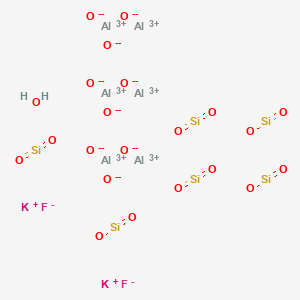
Mica-group minerals
MICA, a generic term, refers to any of a group of approximately 30 silicate minerals occurring as non-fibrous plates. Muscovite (hydrated aluminium potassium silicate[KAl2(AlSi3O10)(F, OH)2 ])and phlogopite (potassium magnesium aluminum silicate hydroxide) are the two major micas of commerce. Micas are commonly found in ordinary rocks. Inhalation of mica dust presents an occupational hazard. — CAMEO Chemicals
- Nom IUPAC
- hexaaluminum;dipotassium;hexakis(dioxosilane);nonakis(oxygen(2-));difluoride;hydrate
- Formule moléculaire
- Al6F2H2K2O22Si6
- Masse moléculaire
- 800.60 g/mol
- Masse exacte
- 799.578781 Da
- Surface polaire topologique
- 215,0 Ų
- Donneurs de liaisons hydrogène
- 1
- Accepteurs de liaisons hydrogène
- 24
- Unités covalentes
- 26
- Stéréocentres définis
- 0
Également connu sous le nom de
16 autres noms signalés
Identifiants de bases de données externes
- PubMed:24946801
Preuves issues de bases de données scientifiques complémentaires
NIH PubChem PUG-View
Attributed physical-property, hazard, environmental and use annotations.
- Color/Form: Light gray to dark flakes or particles Source: Hazardous Substances Data Bank (HSDB)
- Color/Form: Soft, translucent solid; colorless to slight red (ruby), brown to greenish yellow (amber)... thin sheets that are flexible and elastic Source: Hazardous Substances Data Bank (HSDB)
- Color/Form: Colorless flakes or sheets of hydrous silicates Source: Hazardous Substances Data Bank (HSDB)
- Density: 2.6 to 3.2 (NIOSH, 2024) Source: CAMEO Chemicals
- Density: 2.6-3.2 Source: Hazardous Substances Data Bank (HSDB)
- Density: 2.6-3.2 Source: Occupational Safety and Health Administration (OSHA)
- Density: 2.6-3.2 @25 °C Source: PAC Chemical Database, U.S. Department of Energy
- Density: 2.6-3.2 Source: The National Institute for Occupational Safety and Health (NIOSH)
- Melting Point: 1500 °C Source: Hazardous Substances Data Bank (HSDB)
- Melting Point: Melting point = 1387 °C /Synthetic fluorophlogopite/ Source: Hazardous Substances Data Bank (HSDB)
- Melting Point: 1387 °C Source: PAC Chemical Database, U.S. Department of Energy
- Odor: Odorless Source: Hazardous Substances Data Bank (HSDB)
- Physical Description: MICA, a generic term, refers to any of a group of approximately 30 silicate minerals occurring as non-fibrous plates. Muscovite (hydrated aluminium potassium silicate[KAl2(AlSi3O10)(F, OH)2 ])and phlogopite (potassium magnesium aluminum silicate hydroxide) are the two major micas of commerce. Micas are commonly found in ordinary rocks. Inhalation of mica dust presents an occupational hazard. Source: CAMEO Chemicals
- Physical Description: Dry Powder; Large Crystals; CBI Source: EPA Chemical Data Reporting (CDR)
- Physical Description: Colorless, odorless flakes or sheets of hydrous silicates; [NIOSH] Crystalline silica not bound to other minerals is "free" silica. Silicates are minerals in which silicon and oxygen are combined with other elements. [Rom, p. 364] Source: Haz-Map, Information on Hazardous Chemicals and Occupational Diseases
- Physical Description: Colorless, odorless flakes or sheets of hydrous silicates. Source: Occupational Safety and Health Administration (OSHA)
- Physical Description: Colorless, odorless flakes or sheets of hydrous silicates. Source: The National Institute for Occupational Safety and Health (NIOSH)
- Refractive Index: Refractive index: 1.56-1.60 Source: Hazardous Substances Data Bank (HSDB)
- Solubility: Insoluble (NIOSH, 2024) Source: CAMEO Chemicals
- Solubility: Insoluble in water Source: Hazardous Substances Data Bank (HSDB)
- Solubility: Insoluble Source: The National Institute for Occupational Safety and Health (NIOSH)
- Vapor Pressure: 0 mmHg (approx) (NIOSH, 2024) Source: CAMEO Chemicals
- Vapor Pressure: 0 mm Hg (approximate) Source: Hazardous Substances Data Bank (HSDB)
- Vapor Pressure: 0 mmHg (approx) Source: Occupational Safety and Health Administration (OSHA)
- Vapor Pressure: 0 mmHg (approx) Source: The National Institute for Occupational Safety and Health (NIOSH)
- Exposure Routes: inhalation, skin and/or eye contact Source: The National Institute for Occupational Safety and Health (NIOSH)
- First Aid: Excerpt from NIOSH Pocket Guide for Mica (containing less than 1% quartz):; Eye: IRRIGATE IMMEDIATELY - If this chemical contacts the eyes, immediately wash (irrigate) the eyes with large amounts of water, occasionally lifting the lower and upper lids. Get medical attention immediately.; Breathing: FRESH AIR - If a person breathes large amounts of this chemical, move the exposed person to fresh air at once. Other measures are usually unnecessary. (NIOSH, 2024) Source: CAMEO Chemicals
- First Aid: (General first aid procedures); Eye: Irrigate immediately - If this chemical contacts the eyes, immediately wash (irrigate) the eyes with large amounts of water, occasionally lifting the lower and upper lids. Get medical attention immediately.; Breathing: Fresh air Source: The National Institute for Occupational Safety and Health (NIOSH)
- Note: This chemical does not meet GHS hazard criteria for 71.3% (600 of 841) of all reports. Source: European Chemicals Agency (ECHA)
- Signal: Danger Source: European Chemicals Agency (ECHA)
- GHS Hazard Statements: H319 (17.5%): Causes serious eye irritation [Warning Serious eye damage/eye irritation]; H335 (17.5%): May cause respiratory irritation [Warning Specific target organ toxicity, single exposure; Respiratory tract irritation]; H372 (11.5%): Causes damage to organs through prolonged or repeated exposure [Danger Specific target organ toxicity, repeated exposure]; H373 (12.5%): May causes damage to organs through prolonged or repeated exposure [Warning Specific target organ toxicity, repeated exposure] Source: European Chemicals Agency (ECHA)
- Precautionary Statement Codes: P260, P261, P264, P264+P265, P270, P271, P280, P304+P340, P305+P351+P338, P319, P337+P317, P403+P233, P405, and P501 (click each P-code to see the statement) Source: European Chemicals Agency (ECHA)
- ECHA C&L Notifications Summary: Aggregated GHS information provided per 841 reports by companies from 22 notifications to the ECHA C&L Inventory. Each notification may be associated with multiple companies.; Reported as not meeting GHS hazard criteria per 600 of 841 reports by companies.; There are 20 notifications provided by 241 of 841 reports by companies with hazard statement code(s).; Information may vary between notifications depending on impurities, additives, and other factors. The percentage value in parenthesis indicates the notified classification ratio from companies that provide hazard codes. Only hazard codes with percentage values above 10% are shown. For more detailed information, please visit ECHA C&L website. Source: European Chemicals Agency (ECHA)
- Signal: Danger Source: NITE-CMC
- GHS Hazard Statements: H372: Causes damage to organs through prolonged or repeated exposure [Danger Specific target organ toxicity, repeated exposure] Source: NITE-CMC
- Precautionary Statement Codes: P260, P264, P270, P319, and P501 (click each P-code to see the statement) Source: NITE-CMC
- Target Organs: respiratory system Source: The National Institute for Occupational Safety and Health (NIOSH)
- Consumer Uses: Filler; Not Known or Reasonably Ascertainable; Pigment; Lubricating agent Source: EPA Chemical Data Reporting (CDR)
- Industry Uses: Other; Lubricating agent; Filler; Not Known or Reasonably Ascertainable; Pigment Source: EPA Chemical Data Reporting (CDR)
- Sources/Uses: Mica, mainly muscovite and phlogopite, contains less than 1% quartz. Other species of mica are biotite, lepidolite, zimmwaldite, and roscoelite. Used as a filler for paint, cement, asphalt, and insulation material for electrical cables; Also used in drilling muds, cosmetics, and vacuum tubes/condensers; [ACGIH] Sericite is a variety of white mica; it is similar to muscovite and is used as a filler, carrier, and lubricant; [Reference #1] Source: Haz-Map, Information on Hazardous Chemicals and Occupational Diseases
- Industrial Processes with risk of exposure: Petroleum Production and Refining [Category: Industry]; Mining [Category: Industry] Source: Haz-Map, Information on Hazardous Chemicals and Occupational Diseases
- Uses: In aircraft construction Source: Hazardous Substances Data Bank (HSDB)
- Uses: PAPER & PAINT MANUFACTURE, & IN ELECTRIC INDUSTRY Source: Hazardous Substances Data Bank (HSDB)
- Uses: Electrical equipment, vacuum tubes, incandescent lamps, dusting agent, lubricant, windows in high-temperature equipment, filler in exterior paints, cosmetics, glass and ceramic flux, roofing, rubber, mold-release- agent, specialty paper for insulation and filtration, wallpaper and wallboard joint cement, oil-well drilling muds. Source: Hazardous Substances Data Bank (HSDB)
- Uses: Large transparent sheets used to serve as window panes...still used for slow combustion stoves, lanterns or peep-hole furnances...mica powder is used in the mfg of electric cables, pneumatic tyres, welding electrodes, bitmunized cardboard, paints and plastics, dielectric dressings, and flameproof insulators; it is often compacted with alkyd resins; vermiculite is widely used as an insulating material in the building industry; lepidolite is used in the glass and ceramic industries Source: Hazardous Substances Data Bank (HSDB)
- Uses: For more Uses (Complete) data for MICA (6 total), please visit the HSDB record page. Source: Hazardous Substances Data Bank (HSDB)
Mis en correspondance par: Existing checksum-valid CAS to unique PubChem CID match. Récupéré le: 2026-08-31. Ouvrir la fiche source
Les classifications scientifiques et les annotations de danger apportent du contexte et ne remplacent pas la décision réglementaire propre au marché indiquée ci-dessus.
Couverture des sources complémentaires et état des correspondances
| Source | Résultat | Vérifié |
|---|---|---|
| NIH PubChem PUG-View | Correspondance exacte | 2026-08-31 |
Une absence de correspondance enregistrée est une preuve utile que la source a été vérifiée ; ce n’est pas l’affirmation que la substance n’existe pas ailleurs.
Récupéré depuis NIH PubChem le 2026-09-02 par correspondance CAS à somme de contrôle valide. Les propriétés chimiques ne remplacent pas la décision réglementaire de cette page.
Preuves officielles sur le nom d’ingrédient de l’UE
Le nom de l’ingrédient correspond exactement au glossaire officiel 2025 de l’UE des dénominations communes d’ingrédients.
Preuves d’inventaire associées
Ingrédients ayant des fonctions de formulation communes
Sources officielles et scientifiques complémentaires
11 bases de données externes pour vérifier cette identité
Chaque lien lance une recherche de cette identité dans la source concernée. Ce qu’est chaque source et sa valeur juridique
Comment MICA apparaît dans l’inventaire CosIng
L’inventaire CosIng répertorie MICA comme ingrédient cosmétique et cette page l’associe à 1 fiche d’annexe. L’entrée d’inventaire reprend les noms et identifiants, tandis que la fiche d’annexe indique où la substance est interdite, soumise à restrictions ou inscrite sur une liste positive dans le droit de l’UE sur les cosmétiques.
MICA est aussi associé à 4 fonctions cosmétiques dans les données officielles. Les désignations de fonction décrivent l’usage prévu, mais ne remplacent pas l’examen réglementaire des fiches d’annexe associées avant un travail de formulation ou d’étiquetage.
Questions fréquentes
Note de source pour MICA
Cette page associe l’entrée d’inventaire CosIng de MICA à 1 fiche liée des annexes II à VI de notre jeu de données, construit à partir de documents publics de la Commission européenne sur les ingrédients cosmétiques.
Utilisez cette page d’inventaire pour étudier MICA et comparer les fiches associées, mais vérifiez les restrictions et le statut juridique auprès du texte officiel en vigueur et de la législation avant toute décision réglementaire.
Outils et étapes suivantes
Vérifiez votre formule
Analysez une liste INCI complète pour détecter MICA et les éventuelles restrictions d’annexes de l’UE ou signalements d’allergènes associés.
Vérificateur INCIRechercher des ingrédients similaires
Trouvez d’autres ingrédients de l’inventaire et entrées d’annexe liés à MICA, à ses identifiants ou à des variantes de nom proches.
Rechercher