
Nom officiel d’étiquetage de l’UEEntrée 26302 du glossaire
SODIUM BORATE
Cette fiche confirme une dénomination commune officielle d’ingrédient pour l’étiquetage des produits cosmétiques de l’UE. Elle ne confirme pas à elle seule que la substance est autorisée, non restreinte ou sûre.
Aperçu des preuves mondiales
L’identité résolue présente des preuves réglementaires correspondantes dans 4 des 13 jeux de données de marchés indexés : 5 fiches de pays et 0 fiches d’annexes de l’UE. Chaque résultat et chaque lacune de preuves sont énumérés ci-dessous.
Marchés vérifiés
13
Marchés avec preuves
4
Lacunes de preuves
9
Identifiants résolus
5
Identité résolue de la substance
CAS:1330-43-41303-96-410377-81-868003-13-4
EC:215-540-4
Fiches de l’index des ingrédients :
SODIUM BORATE
Nom Ph. Eur. : borax
Fonctions cosmétiques : BUFFERING
Disodium tetraborate, anhydrous (boric acid, disodium salt); Disodium tetraborate decahydrate (borax decahydrate)
Note de restriction de l’inventaire : II/1396
8 noms correspondants ou signalés
SODIUM BORATEsodium borateboraxSodium borateSodium borate, disodium tetraborate anhydrous; boric acid, sodium salt [8]Disodium tetraborate decahydrate; borax decahydrate [11]硼酸盐和四硼酸盐 — Borates and tetraborates (CAS No. 1330-43-4 / CAS No. 1303-96-4 / CAS No. 10377-81-8 / CAS No. 68003-13-4)보레이트류(소듐보레이트, 테트라보레이트)
Preuves réglementaires dans les 13 marchés
Ouvrez chaque fiche correspondante pour connaître son champ d’application, sa concentration, ses conditions, ses avertissements et la version de la source officielle.
Balayez ou faites défiler horizontalement pour voir la couverture des jeux de données et les actions suivantes.
| Marché | Résultat | Fiches | Jeu de données | Signification / action suivante |
|---|---|---|---|---|
| European Union EU | Aucune correspondance trouvée | 0 | Complete annex dataset Regulation (EC) 1223/2009 consolidated to 1 May 2026 | No annex match only means that these five annexes did not return a match; CosIng identity data and other EU obligations still need review. |
| Great Britain GB | Aucune correspondance trouvée | 0 | Complete consolidated annex dataset GB retained Regulation 1223/2009 schedules, effective 15 August 2026 | No annex match is not approval and does not cover Northern Ireland, which follows the applicable EU framework. |
| Canada CA | Restricted | 1Ouvrir la fiche 1 | Complete Hotlist snapshot Health Canada Cosmetic Ingredient Hotlist, 13 August 2025 | Examinez chaque fiche associée et ses conditions exactes. |
| New Zealand NZ | Prohibited | 2Ouvrir la fiche 1Ouvrir la fiche 2 | Complete schedules dataset Cosmetic Products Group Standard schedules effective 1 January 2026 | Examinez chaque fiche associée et ses conditions exactes. |
| ASEAN ASEAN | Aucune correspondance trouvée | 0 | Complete regional annex dataset ASEAN Cosmetic Directive annexes 2026-1, 22 June 2026 | Regional annex coverage does not replace member-state implementation dates, notifications or national deviations. |
| China CN | Prohibited | 1Ouvrir la fiche 1 | Complete prohibited catalogues plus official-source workflow NMPA 2021 banned catalogues plus dynamic IECIC List I/List II system current since 2025 | Examinez chaque fiche associée et ses conditions exactes. |
| Japan JP | Aucune correspondance trouvée | 0 | Complete Standards appendices dataset MHLW Standards for Cosmetics official English source and Japanese amendments checked for the imported snapshot | The Japanese text and subsequent notices are canonical; no local match is not a product-compliance conclusion. |
| South Korea KR | Restricted | 1Ouvrir la fiche 1 | Complete current appendix dataset MFDS Notice 2026-19, effective 18 March 2026 | Examinez chaque fiche associée et ses conditions exactes. |
| United States US | Aucune correspondance trouvée | 0 | Complete enumerated federal ingredient rules eCFR Title 21 issue date 27 August 2026 | FDA has no general approved-cosmetic-ingredient catalogue; absence from these sections is not approval or proof of safety. |
| Australia AU | Aucune correspondance trouvée | 0 | Complete cosmetic-relevant Poisons Standard subset plus official workflow Therapeutic Goods (Poisons Standard—June 2026) Instrument 2026 | An AICIS Inventory match is not cosmetic approval; no Inventory match can indicate a new, exempted, reported or confidential introduction. |
| Brazil BR | Aucune correspondance trouvée | 0 | Complete prohibited dataset plus current restricted-list workflow ANVISA RDC 1.029/2026 and RDC 1.030/2026, published 15 June 2026 | RDC 1.030/2026 amends rather than replaces the prohibited baseline, and the second restricted-list revision was still under consultation in July 2026. |
| India IN | Aucune correspondance trouvée | 0 | Complete current Part 2 dataset plus official workflow for Parts 1, 3 and 4 Cosmetics Rules 2020 plus current BIS IS 4707 parts (1:2020, 2:2025, 3:2025, 4:2022) | The standards are separate controlled publications; absence from a locally indexed excerpt is not permission. |
| Saudi Arabia SA | Aucune correspondance trouvée | 0 | Complete official list index SFDA live prohibited/restricted lists, snapshot 30 August 2026 | No list match is not permission; Gulf/SFDA product, claim, notification and technical requirements still apply. |
Aucune ligne de marché ne correspond à ce filtre.
Fiches de marché correspondantes et conditions
New Zealand
Cosmetic Products Group Standard schedules effective 1 January 2026China
NMPA 2021 banned catalogues plus dynamic IECIC List I/List II system current since 2025South Korea
MFDS Notice 2026-19, effective 18 March 2026Identité et propriétés chimiques
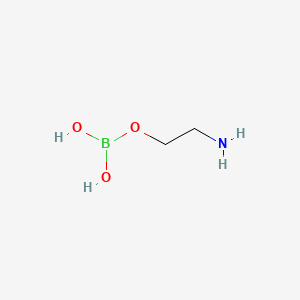
CAS 10377-81-8PubChem CID 82594
Monoethanolamine borate
- Nom IUPAC
- 2-aminoethoxyboronic acid
- Formule moléculaire
- C2H8BNO3
- Masse moléculaire
- 104.90 g/mol
- Masse exacte
- 105.0597233 Da
- Surface polaire topologique
- 75,7 Ų
- Donneurs de liaisons hydrogène
- 3
- Accepteurs de liaisons hydrogène
- 4
- Unités covalentes
- 1
- Stéréocentres définis
- 0
Également connu sous le nom de
Actracor MMEA-BorateEthanolamine borate (1:1)Ethanol, 2-amino-, monoester with boric acid (H3BO3)Ethanol, 2-amino-, ester with boric acid (H3BO3) (1:1)5I4T660488RefChem:1089826233-829-3
12 autres noms signalés
Ethanolamine borateTrigamine2-Aminoethanol, monoester with boric acidBoric acid, 2-aminoethyl ester2-aminoethyl dihydrogen borateUNII-5I4T660488EINECS 233-829-3EC 233-829-3boric acid-beta-aminoethylesterJCAYXDKNUSEQRT-UHFFFAOYSA-NBC 140Ethanol, 2-amino-, monoester with boric acid
Identifiants de bases de données externes
- EPA DTXSID:DTXSID3049673
Preuves issues de bases de données scientifiques complémentaires
NIH PubChem PUG-View
Correspondance exacte d’identifiant82594
Attributed physical-property, hazard, environmental and use annotations.
- Note: This chemical does not meet GHS hazard criteria for 29.7% (11 of 37) of reports. Source: European Chemicals Agency (ECHA)
- Signal: Warning Source: European Chemicals Agency (ECHA)
- GHS Hazard Statements: H315 (70.3%): Causes skin irritation [Warning Skin corrosion/irritation]; H319 (70.3%): Causes serious eye irritation [Warning Serious eye damage/eye irritation]; H335 (67.6%): May cause respiratory irritation [Warning Specific target organ toxicity, single exposure; Respiratory tract irritation] Source: European Chemicals Agency (ECHA)
- Precautionary Statement Codes: P261, P264, P264+P265, P271, P280, P302+P352, P304+P340, P305+P351+P338, P319, P321, P332+P317, P337+P317, P362+P364, P403+P233, P405, and P501 (click each P-code to see the statement) Source: European Chemicals Agency (ECHA)
- ECHA C&L Notifications Summary: Aggregated GHS information provided per 37 reports by companies from 3 notifications to the ECHA C&L Inventory. Each notification may be associated with multiple companies.; Reported as not meeting GHS hazard criteria per 11 of 37 reports by companies.; There are 2 notifications provided by 26 of 37 reports by companies with hazard statement code(s).; Information may vary between notifications depending on impurities, additives, and other factors. The percentage value in parenthesis indicates the notified classification ratio from companies that provide hazard codes. Only hazard codes with percentage values above 10% are shown. For more detailed information, please visit ECHA C&L website. Source: European Chemicals Agency (ECHA)
Mis en correspondance par: Existing checksum-valid CAS to unique PubChem CID match. Récupéré le: 2026-08-31. Ouvrir la fiche source
Les classifications scientifiques et les annotations de danger apportent du contexte et ne remplacent pas la décision réglementaire propre au marché indiquée ci-dessus.
Couverture des sources complémentaires et état des correspondances
| Source | Résultat | Vérifié |
|---|---|---|
| EMBL-EBI ChEBI | Aucune fiche exacte | 2026-08-31 |
| NIH PubChem PUG-View | Correspondance exacte | 2026-08-31 |
Une absence de correspondance enregistrée est une preuve utile que la source a été vérifiée ; ce n’est pas l’affirmation que la substance n’existe pas ailleurs.
Récupéré depuis NIH PubChem le 2026-09-02 par correspondance CAS à somme de contrôle valide. Les propriétés chimiques ne remplacent pas la décision réglementaire de cette page.
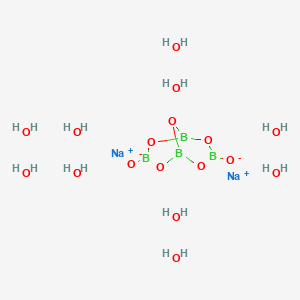
CAS 1303-96-4PubChem CID 16211214
Borax (B4Na2O7.10H2O)
Borax is a mineral with formula of Na2B4O5(OH)4·8H2O. The IMA symbol is Brx. — RRUFF Project
- Nom IUPAC
- disodium;3,7-dioxido-2,4,6,8,9-pentaoxa-1,3,5,7-tetraborabicyclo[3.3.1]nonane;decahydrate
- Formule moléculaire
- B4H20Na2O17
- Masse moléculaire
- 381.4 g/mol
- Masse exacte
- 382.0868084 Da
- Surface polaire topologique
- 102,0 Ų
- Donneurs de liaisons hydrogène
- 10
- Accepteurs de liaisons hydrogène
- 17
- Unités covalentes
- 13
- Stéréocentres définis
- 0
Également connu sous le nom de
BORAXBorax decahydrateSodium borate decahydrateSodium pyroborate decahydrateAntipyoninBorascuBoricinSolubor
16 autres noms signalés
TronaborJaikinNeoborBuraGerstley borateGertley borateBoro-spray91MBZ8H3QODisodium tetraborate decahydrateSodium borate, decahydrateSodium biborate decahydrateBoric acid (H2B4O7), disodium salt, decahydrateBoron sodium oxide (B4Na2O7), decahydratesodium diboratesodium meta borateBorax 200ck
Identifiants de bases de données externes
- ChEMBL:CHEMBL3833375
- EPA DTXSID:DTXSID701014356
- PubMed:10010
Preuves issues de bases de données scientifiques complémentaires
NIH PubChem PUG-View
Correspondance exacte d’identifiant16211214
Attributed physical-property, hazard, environmental and use annotations.
- Boiling Point: 608 °F Source: Occupational Safety and Health Administration (OSHA)
- Boiling Point: 608 °F Source: The National Institute for Occupational Safety and Health (NIOSH)
- Color/Form: White, monoclinic crystals Source: Hazardous Substances Data Bank (HSDB)
- Color/Form: Hard crystals, granules or crystalline powder; efflorescent in dry air, the crystals often being coated with white powder Source: Hazardous Substances Data Bank (HSDB)
- Color/Form: Crystalline granules or crystalline powder Source: Hazardous Substances Data Bank (HSDB)
- Color/Form: White, crystalline solid [Note: Becomes anhydrous at 608 degrees F] Source: Hazardous Substances Data Bank (HSDB)
- Density: 1.73 g/cu cm Source: Hazardous Substances Data Bank (HSDB)
- Density: Relative density (water = 1): 1.7 Source: ILO-WHO International Chemical Safety Cards (ICSCs)
- Density: 1.73 Source: Occupational Safety and Health Administration (OSHA)
- Density: 1.73 @25 °C Source: PAC Chemical Database, U.S. Department of Energy
- Density: 1.73 Source: The National Institute for Occupational Safety and Health (NIOSH)
- Melting Point: 75 °C (decomposes) Source: Hazardous Substances Data Bank (HSDB)
- Melting Point: 167 °F Source: Occupational Safety and Health Administration (OSHA)
- Melting Point: 167 °F Source: The National Institute for Occupational Safety and Health (NIOSH)
- Odor: Odorless Source: Hazardous Substances Data Bank (HSDB)
- Physical Description: Liquid; Other Solid; Large Crystals; Wet Solid; Dry Powder Source: EPA Chemical Data Reporting (CDR)
- Physical Description: White, odorless, crystalline solid; Becomes anhydrous at 608 degrees F; [NIOSH] Source: Haz-Map, Information on Hazardous Chemicals and Occupational Diseases
- Physical Description: WHITE CRYSTALS OR CRYSTALLINE POWDER. Source: ILO-WHO International Chemical Safety Cards (ICSCs)
- Physical Description: White, odorless, crystalline solid. Source: Occupational Safety and Health Administration (OSHA)
- Physical Description: White, odorless, crystalline solid. [herbicide] [Note: Becomes anhydrous at 608 °F.] Source: The National Institute for Occupational Safety and Health (NIOSH)
- Refractive Index: Index of refraction: 1.447 (alpha); 1.469 (beta); 1.472 (gamma) Source: Hazardous Substances Data Bank (HSDB)
- Solubility: Aqueous solution is alkaline to litmus and phenolphthalein; pH about pH = 9.5 Source: Hazardous Substances Data Bank (HSDB)
- Solubility: At 100 °C loses 5H2O; at 150 °C loses 9H2O; becomes anhydrous at 320 °C; borax dissolves many metallic oxides when fused with them Source: Hazardous Substances Data Bank (HSDB)
- Solubility: In water, 5.93X10+4 mg/L at 25 °C Source: Hazardous Substances Data Bank (HSDB)
- Solubility: 3.17 g/100 g water at 25 °C Source: Hazardous Substances Data Bank (HSDB)
- Solubility: 1 g/16 mL in water; 1 g/0.6 mL boiling water; 1 g/1 mL glycerol; insoluble in alcohol Source: Hazardous Substances Data Bank (HSDB)
- Solubility: Insoluble in ethanol Source: Hazardous Substances Data Bank (HSDB)
- Solubility: 0.60 g/100 g acetone Source: Hazardous Substances Data Bank (HSDB)
- Solubility: Solubility in water, g/100ml at 20 °C: 5.1 Source: ILO-WHO International Chemical Safety Cards (ICSCs)
- Solubility: 6% Source: The National Institute for Occupational Safety and Health (NIOSH)
- Vapor Pressure: Approximately 0 mm Hg Source: Hazardous Substances Data Bank (HSDB)
- Vapor Pressure: 0 mmHg (approx) Source: Occupational Safety and Health Administration (OSHA)
- Vapor Pressure: 0 mmHg (approx) Source: The National Institute for Occupational Safety and Health (NIOSH)
- pH: pH at 20 °C: 9.3 (0.1% solution); 9.2 (1.0% solution) Source: Hazardous Substances Data Bank (HSDB)
- Exposure Routes: The substance can be absorbed into the body by inhalation and by ingestion. Source: ILO-WHO International Chemical Safety Cards (ICSCs)
- Exposure Routes: inhalation, ingestion, skin and/or eye contact Source: The National Institute for Occupational Safety and Health (NIOSH)
- First Aid: (General first aid procedures); Eye: Irrigate immediately - If this chemical contacts the eyes, immediately wash (irrigate) the eyes with large amounts of water, occasionally lifting the lower and upper lids. Get medical attention immediately.; Skin: Soap wash - If this chemical contacts the skin, wash the contaminated skin with soap and water.; Breathing: Respiratory support; Swallow: Medical attention immediately - If this chemical has been swallowed, get medical attention immediately. Source: The National Institute for Occupational Safety and Health (NIOSH)
- Signal: Danger Source: Regulation (EC) No 1272/2008 of the European Parliament and of the Council
- GHS Hazard Statements: H360FD: May damage fertility; May damage the unborn child [Danger Reproductive toxicity] Source: Regulation (EC) No 1272/2008 of the European Parliament and of the Council
- Precautionary Statement Codes: P203, P280, P318, P405, and P501 (click each P-code to see the statement) Source: Regulation (EC) No 1272/2008 of the European Parliament and of the Council
- Note: This chemical does not meet GHS hazard criteria for < 0.1% (1 of 2865) of reports. Source: European Chemicals Agency (ECHA)
- Signal: Danger Source: European Chemicals Agency (ECHA)
- GHS Hazard Statements: H319 (12.6%): Causes serious eye irritation [Warning Serious eye damage/eye irritation]; H360 (93.2%): May damage fertility or the unborn child [Danger Reproductive toxicity] Source: European Chemicals Agency (ECHA)
- Precautionary Statement Codes: P203, P264+P265, P280, P305+P351+P338, P318, P337+P317, P405, and P501 (click each P-code to see the statement) Source: European Chemicals Agency (ECHA)
- ECHA C&L Notifications Summary: Aggregated GHS information provided per 2865 reports by companies from 31 notifications to the ECHA C&L Inventory. Each notification may be associated with multiple companies.; Reported as not meeting GHS hazard criteria per 1 of 2865 reports by companies.; There are 30 notifications provided by 2864 of 2865 reports by companies with hazard statement code(s).; Information may vary between notifications depending on impurities, additives, and other factors. The percentage value in parenthesis indicates the notified classification ratio from companies that provide hazard codes. Only hazard codes with percentage values above 10% are shown. For more detailed information, please visit ECHA C&L website. Source: European Chemicals Agency (ECHA)
- Signal: Danger Source: NITE-CMC
- GHS Hazard Statements: H315: Causes skin irritation [Warning Skin corrosion/irritation]; H319: Causes serious eye irritation [Warning Serious eye damage/eye irritation]; H335: May cause respiratory irritation [Warning Specific target organ toxicity, single exposure; Respiratory tract irritation]; H360: May damage fertility or the unborn child [Danger Reproductive toxicity]; H370: Causes damage to organs [Danger Specific target organ toxicity, single exposure]; H372: Causes damage to organs through prolonged or repeated exposure [Danger Specific target organ toxicity, repeated exposure]; H413: May cause long lasting harmful effects to aquatic life [Hazardous to the aquatic environment, long-term hazard] Source: NITE-CMC
- Precautionary Statement Codes: P203, P260, P261, P264, P264+P265, P270, P271, P273, P280, P302+P352, P304+P340, P305+P351+P338, P308+P316, P318, P319, P321, P332+P317, P337+P317, P362+P364, P403+P233, P405, and P501 (click each P-code to see the statement) Source: NITE-CMC
- GHS Hazard Statements: H303: May be harmful if swallowed [Warning Acute toxicity, oral]; H315: Causes skin irritation [Warning Skin corrosion/irritation]; H319: Causes serious eye irritation [Warning Serious eye damage/eye irritation]; H361: Suspected of damaging fertility or the unborn child [Warning Reproductive toxicity]; H370: Causes damage to organs [Danger Specific target organ toxicity, single exposure]; H372: Causes damage to organs through prolonged or repeated exposure [Danger Specific target organ toxicity, repeated exposure]; H373: May causes damage to organs through prolonged or repeated exposure [Warning Specific target organ toxicity, repeated exposure] Source: NITE-CMC
- Target Organs: Eyes, skin, respiratory system Source: The National Institute for Occupational Safety and Health (NIOSH)
- Cosmetic Ingredient Review Conclusion: The Expert Panel concludes that Sodium Borate and Boric Acid, in concentrations less than or equal to 5 percent, are safe as cosmetic ingredients when used as currently recommended; however, cosmetic formulations containing free Sodium Borate or Boric Acid at this concentration should not be used on infant skin or injured skin. Note: In 2003, the CIR Expert Panel considered available new data on these ingredients and reaffirmed the above conclusion. Source: Cosmetic Ingredient Review (CIR)
- Cosmetic Ingredient Review Finding(s): Safe for use in cosmetics, with qualifications Source: Cosmetic Ingredient Review (CIR)
- Environmental Bioconcentration: In a greenhouse experiment with sandy loam soil treated with 0-8.0 ppm boron as borax, boron toxicity symptoms appeared earliest in lentil plants and barley seedlings exposed to 8.0 ppm boron. In barley the severity of boron toxicity decreased with the decrease in boron levels, whereas in lentil the severity of the symptoms eventually reached the same level in 2 and 4 ppm boron treatments as with the highest concentration. Dry matter yield decreased 38.6% in lentil and 23.4% in barley exposed to 8.0 ppm boron in comparison with controls. Boron contents of lentil and barley plants on soil treated with 8 ppm boron were approximately 7- and approximately 8-fold those of control plants, respectively. Source: Hazardous Substances Data Bank (HSDB)
- Environmental Fate: TERRESTRIAL FATE: Boron is naturally occurring and ubiquitous in the environment. No microbial degradation. Disappearance from soil is by washing out. Persistence in soil is about 2 years, depending on rainfall and soil structure. Source: Hazardous Substances Data Bank (HSDB)
- Consumer Uses: Other; Adhesion/cohesion promoter; Soil amendments (fertilizers); Not Known or Reasonably Ascertainable; Flame retardant Source: EPA Chemical Data Reporting (CDR)
- Industry Uses: Abrasives; Plating agent; Etching agent; Chelating agent; Flame retardant; Soil amendments (fertilizers) Source: EPA Chemical Data Reporting (CDR)
- Cosmetic Ingredient Review Link: CIR ingredient: Sodium Borate Source: Cosmetic Ingredient Review (CIR)
- Sources/Uses: Used as a preservative, antiseptic and fungicide; also used to manufacture glazes, enamels, soldering fluxes and cleaning compounds and to fireproof textiles and wood; [ACGIH] Boric acid and borates as tablets or powder are used to kill larvae in barns and other insects in houses. Rarely, they are sprayed as herbicides. [EPA: Recognition of Pesticide Poisonings] Used in photo developing bath; [www.ci.tucson.az.us/arthazards/medium.html] Borax (borax decahydrate) is found naturally in some salt lakes and alkaline soils. Boric acid is formed by crystallizing a solution of hydrochloric acid or sulfuric acid and borax. [Hawley] Source: Haz-Map, Information on Hazardous Chemicals and Occupational Diseases
- Industrial Processes with risk of exposure: Soldering [Category: Heat or Machine]; Using Disinfectants or Biocides [Category: Clean]; Farming (Pesticides) [Category: Industry]; Photographic Processing [Category: Other]; Textiles (Printing, Dyeing, or Finishing) [Category: Industry] Source: Haz-Map, Information on Hazardous Chemicals and Occupational Diseases
- Uses: For borax (USEPA/OPP Pesticide Code: 011102) ACTIVE products with label matches. /SRP: Registered for use in the U.S. but approved pesticide uses may change periodically and so federal, state and local authorities must be consulted for currently approved uses./ Source: Hazardous Substances Data Bank (HSDB)
- Uses: Long been used as a mild antiseptic fungicide and as a herbicide ... Total control of vegetation on non-crop land, such as paths, giving long-term control. Also used in insect baits for food stores to control Formicidae. Source: Hazardous Substances Data Bank (HSDB)
- Uses: Soldering metals; manufacture of glazes and enamels; tanning; in cleaning compounds; artificially aging wood; as preservative, either alone or with other antiseptics against wood fungus; fireproofing fabrics and wood; curing and preserving skins; in cockroach control. In buffers; as a complexing or masking agent in analytical chemistry. Pharmaceutic aid (alkalizer). Source: Hazardous Substances Data Bank (HSDB)
- Uses: Used in ant poisons, for fly control around refuse and manure piles, as a larvicide, in manufacture of glazes, enamels, cleaning compounds, and in soldering metals Source: Hazardous Substances Data Bank (HSDB)
- Uses: For more Uses (Complete) data for BORAX (17 total), please visit the HSDB record page. Source: Hazardous Substances Data Bank (HSDB)
Mis en correspondance par: Existing checksum-valid CAS to unique PubChem CID match. Récupéré le: 2026-08-31. Ouvrir la fiche source
Les classifications scientifiques et les annotations de danger apportent du contexte et ne remplacent pas la décision réglementaire propre au marché indiquée ci-dessus.
Couverture des sources complémentaires et état des correspondances
| Source | Résultat | Vérifié |
|---|---|---|
| NIH PubChem PUG-View | Correspondance exacte | 2026-08-31 |
Une absence de correspondance enregistrée est une preuve utile que la source a été vérifiée ; ce n’est pas l’affirmation que la substance n’existe pas ailleurs.
Récupéré depuis NIH PubChem le 2026-09-02 par correspondance CAS à somme de contrôle valide. Les propriétés chimiques ne remplacent pas la décision réglementaire de cette page.
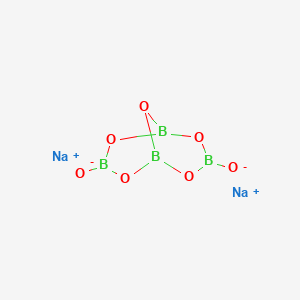
CAS 1330-43-4PubChem CID 10219853
Sodium Tetraborate
- Nom IUPAC
- disodium;3,7-dioxido-2,4,6,8,9-pentaoxa-1,3,5,7-tetraborabicyclo[3.3.1]nonane
- Formule moléculaire
- B4Na2O7
- Masse moléculaire
- 201.2 g/mol
- Masse exacte
- 201.9811616 Da
- Surface polaire topologique
- 92,3 Ų
- Donneurs de liaisons hydrogène
- 0
- Accepteurs de liaisons hydrogène
- 7
- Unités covalentes
- 3
- Stéréocentres définis
- 0
Également connu sous le nom de
Sodium Tetraborate, AnhydrousBorax glassBoron sodium oxide (B4Na2O7)Anhydrous boraxSodium biborateBorax AnhydrousFused boraxSodium borate anhydrous
16 autres noms signalés
Borax, fusedSodium pyroborateDehyborGranuborSprayborSodium borate, anhydrousBorax, dehydratedSodium boron oxideRasorite 658191EN8ZMDBoric acid, disodium saltBoric acid (H2B4O7), disodium saltSodium tetraborate anhydrousINS NO.285Sodium boron oxide (na2b4o7)INS-285
Identifiants de bases de données externes
- EPA DTXSID:DTXSID101014358
- PubMed:21774671
- PubMed:19059942
- PubMed:1432568
Récupéré depuis NIH PubChem le 2026-09-02 par correspondance CAS à somme de contrôle valide. Les propriétés chimiques ne remplacent pas la décision réglementaire de cette page.
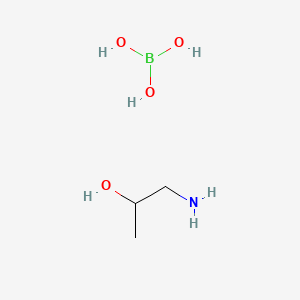
CAS 68003-13-4PubChem CID 161513
(2-Hydroxypropyl)ammonium dihydrogen orthoborate
- Nom IUPAC
- 1-aminopropan-2-ol;boric acid
- Formule moléculaire
- C3H12BNO4
- Masse moléculaire
- 136.95 g/mol
- Masse exacte
- 137.0859380 Da
- Surface polaire topologique
- 107,0 Ų
- Donneurs de liaisons hydrogène
- 5
- Accepteurs de liaisons hydrogène
- 5
- Unités covalentes
- 2
- Stéréocentres définis
- 0
Également connu sous le nom de
Orthoboric acid isopropanolamine saltYK5M7W95MCEINECS 247-422-31-Aminopropan-2-ol, compound with orthoboric acidRefChem:395926268-109-8Boric acid, monoisopropanolamine salt2-Hydroxypropylammonium orthoborate
5 autres noms signalés
Isopropanolamine borateUNII-YK5M7W95MCFWGLAJMZAXEFTA-UHFFFAOYSA-NEINECS 268-109-8Boric acid--1-aminopropan-2-ol (1/1)
Identifiants de bases de données externes
- EPA DTXSID:DTXSID10892195
Récupéré depuis NIH PubChem le 2026-09-02 par correspondance CAS à somme de contrôle valide. Les propriétés chimiques ne remplacent pas la décision réglementaire de cette page.
Recherche complémentaire sur la substance auprès de sources faisant autorité
Chaque lien lance une recherche de cette identité dans la source concernée. Un lien est une piste de recherche, et non l’affirmation que la source détient une fiche exacte. Ce qu’est chaque source et sa valeur juridique
Aller plus loin avec cette fiche
Source officielle et champ d’application
Importé de la décision d’exécution (UE) 2025/1175 de la Commission (version du jeu de données EU 2025/1175). Le glossaire fournit les dénominations communes des ingrédients pour la liste d’ingrédients exigée par l’article 19, paragraphe 1, point g) ; ce n’est ni une liste d’autorisation ni une liste de sécurité.
Ouvrir la décision officielle