
CAS
1 fiche
CAS 111-41-1
Le CAS 111-41-1 correspond à 1 fiche d’annexe de l’UE dans les annexes II à VI du règlement (CE) n° 1223/2009.
Fiches pour le CAS 111-41-1
1 au totalIdentité et propriétés chimiques
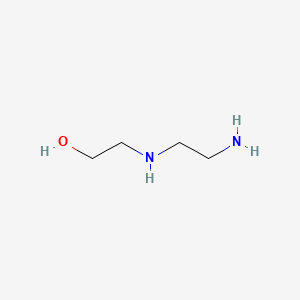
CAS 111-41-1PubChem CID 8112
N-(2-Hydroxyethyl)ethylenediamine
Aminoethylethanolamine appears as a clear colorless liquid with an ammonia-like odor. Corrosive to tissue. Combustible, but may be difficult to ignite. Less dense than water. Vapors heavier than air. Toxic oxides of nitrogen produced during combustion. Used to make other chemicals. — CAMEO Chemicals
- Nom IUPAC
- 2-(2-aminoethylamino)ethanol
- Formule moléculaire
- C4H12N2O
- Masse moléculaire
- 104.15 g/mol
- Masse exacte
- 104.094963011 Da
- XLogP3
- -1,7
- Surface polaire topologique
- 58,3 Ų
- Donneurs de liaisons hydrogène
- 3
- Accepteurs de liaisons hydrogène
- 3
- Unités covalentes
- 1
- Stéréocentres définis
- 0
Également connu sous le nom de
monoethanol ethylenediamineRefChem:112035Aminoethylethanolamine2-((2-Aminoethyl)amino)ethanolN-(Hydroxyethyl)ethylenediamineN-(2-Aminoethyl)ethanolamineN-(Aminoethyl)ethanolamine(2-Hydroxyethyl)ethylenediamine
16 autres noms signalés
MonoethanolethylenediamineEthanol, 2-[(2-aminoethyl)amino]-(2-Aminoethyl)ethanolamine2-[(2-Aminoethyl)amino]ethanolEthanolethylene diamineN-Hydroxyethyl-1,2-ethanediamineN-Hydroxyethylethylenediamine2-[(2-aminoethyl)amino]ethan-1-olN-(2-Hydroxyethyl)-1,2-ethanediamineNSC 461Ethanol, 2-((2-aminoethyl)amino)-2-((Aminoethyl)amino)ethanol2-[2-Aminoethylamino]ethanolTrimetazidine Impurity PRC78W6NPXT1-(2-(Hydroxyethyl)amino)-2-aminoethane
Identifiants de bases de données externes
Preuves issues de bases de données scientifiques complémentaires
NIH PubChem PUG-View
Correspondance exacte d’identifiant8112
Attributed physical-property, hazard, environmental and use annotations.
- Autoignition Temperature: 695 °F (USCG, 1999) Source: CAMEO Chemicals
- Autoignition Temperature: 695 °F (368 °C) Source: Hazardous Substances Data Bank (HSDB)
- Boiling Point: 460 to 464 °F at 760 mmHg (NTP, 1992) Source: CAMEO Chemicals
- Boiling Point: 238-40 °C Source: Hazardous Substances Data Bank (HSDB)
- Boiling Point: BP: 243.7 °C Source: Hazardous Substances Data Bank (HSDB)
- Boiling Point: 460-464 °F Source: Occupational Safety and Health Administration (OSHA)
- Boiling Point: 243 °C @760 [mm Hg] Source: PAC Chemical Database, U.S. Department of Energy
- Color/Form: COLORLESS LIQ Source: Hazardous Substances Data Bank (HSDB)
- Density: 1.028 at 77 °F (USCG, 1999) - Denser than water; will sink Source: CAMEO Chemicals
- Density: 1.0254 at 25 °C Source: Hazardous Substances Data Bank (HSDB)
- Density: 1.028 Source: Occupational Safety and Health Administration (OSHA)
- Density: 1.03 @25 °C Source: PAC Chemical Database, U.S. Department of Energy
- Dissociation Constants: pKa= 7.21 Source: Hazardous Substances Data Bank (HSDB)
- Flash Point: 216 °F (NTP, 1992) Source: CAMEO Chemicals
- Flash Point: 132 °C Source: Haz-Map, Information on Hazardous Chemicals and Occupational Diseases
- Flash Point: 132 °C (CLOSED CUP) Source: Hazardous Substances Data Bank (HSDB)
- Flash Point: 216 °F Source: Occupational Safety and Health Administration (OSHA)
- Melting Point: -33 °C Source: PAC Chemical Database, U.S. Department of Energy
- Odor: MILD AMMONIACAL ODOR Source: Hazardous Substances Data Bank (HSDB)
- Physical Description: Aminoethylethanolamine appears as a clear colorless liquid with an ammonia-like odor. Corrosive to tissue. Combustible, but may be difficult to ignite. Less dense than water. Vapors heavier than air. Toxic oxides of nitrogen produced during combustion. Used to make other chemicals. Source: CAMEO Chemicals
- Physical Description: CBI; Liquid Source: EPA Chemical Data Reporting (CDR)
- Physical Description: A clear colorless liquid with an ammonia-like odor; [CAMEO] Source: Haz-Map, Information on Hazardous Chemicals and Occupational Diseases
- Physical Description: A clear colorless liquid with an ammonia-like odor. Source: Occupational Safety and Health Administration (OSHA)
- Refractive Index: INDEX OF REFRACTION: 1.4861 @ 20 °C/D Source: Hazardous Substances Data Bank (HSDB)
- Solubility: greater than or equal to 100 mg/mL at 70 °F (NTP, 1992) Source: CAMEO Chemicals
- Solubility: VERY SOL IN WATER, ALCOHOL, ACETATE Source: Hazardous Substances Data Bank (HSDB)
- Vapor Pressure: less than 0.01 mmHg at 68 °F (NTP, 1992) Source: CAMEO Chemicals
- Vapor Pressure: 0.000819 [mmHg] Source: Haz-Map, Information on Hazardous Chemicals and Occupational Diseases
- Vapor Pressure: 8.19X10⁻⁴ mm Hg at 25 °C Source: Hazardous Substances Data Bank (HSDB)
- Vapor Pressure: <0.01 mmHg Source: Occupational Safety and Health Administration (OSHA)
- Vapor Pressure: 0.01 [mm Hg] @20 °C Source: PAC Chemical Database, U.S. Department of Energy
- First Aid: EYES: First check the victim for contact lenses and remove if present. Flush victim's eyes with water or normal saline solution for 20 to 30 minutes while simultaneously calling a hospital or poison control center. Do not put any ointments, oils, or medication in the victim's eyes without specific instructions from a physician. IMMEDIATELY transport the victim after flushing eyes to a hospital even if no symptoms (such as redness or irritation) develop.; SKIN: IMMEDIATELY flood affected skin with water while removing and isolating all contaminated clothing. Gently wash all affected skin areas thoroughly with soap and water. If symptoms such as redness or irritation develop, IMMEDIATELY call a physician and be prepared to transport the victim to a hospital for treatment.; INHALATION: IMMEDIATELY leave the contaminated area; take deep breaths of fresh air. If symptoms (such as wheezing, coughing, shortness of breath, or burning in the mouth, throat, or chest) develop, call a physician and be prepared to transport the victim to a hospital. Provide proper respiratory protection to rescuers entering an unknown atmosphere. Whenever possible, Self-Contained Breathing Apparatus (SCBA) shou Source: CAMEO Chemicals
- Signal: Danger Source: Regulation (EC) No 1272/2008 of the European Parliament and of the Council
- GHS Hazard Statements: H314: Causes severe skin burns and eye damage [Danger Skin corrosion/irritation]; H317: May cause an allergic skin reaction [Warning Sensitization, Skin]; H360Df: May damage the unborn child; Suspected of damaging fertility [Danger Reproductive toxicity] Source: Regulation (EC) No 1272/2008 of the European Parliament and of the Council
- Precautionary Statement Codes: P203, P260, P261, P264, P272, P280, P301+P330+P331, P302+P352, P302+P361+P354, P304+P340, P305+P354+P338, P316, P318, P321, P333+P317, P362+P364, P363, P405, and P501 (click each P-code to see the statement) Source: Regulation (EC) No 1272/2008 of the European Parliament and of the Council
- Signal: Danger Source: European Chemicals Agency (ECHA)
- GHS Hazard Statements: H290 (13.6%): May be corrosive to metals [Warning Corrosive to Metals]; H314 (99.4%): Causes severe skin burns and eye damage [Danger Skin corrosion/irritation]; H317 (> 99.9%): May cause an allergic skin reaction [Warning Sensitization, Skin]; H318 (19%): Causes serious eye damage [Danger Serious eye damage/eye irritation]; H335 (17.8%): May cause respiratory irritation [Warning Specific target organ toxicity, single exposure; Respiratory tract irritation]; H360 (99.8%): May damage fertility or the unborn child [Danger Reproductive toxicity] Source: European Chemicals Agency (ECHA)
- Precautionary Statement Codes: P203, P234, P260, P261, P264, P264+P265, P271, P272, P280, P301+P330+P331, P302+P352, P302+P361+P354, P304+P340, P305+P354+P338, P316, P317, P318, P319, P321, P333+P317, P362+P364, P363, P390, P403+P233, P405, P406, and P501 (click each P-code to see the statement) Source: European Chemicals Agency (ECHA)
- ECHA C&L Notifications Summary: Aggregated GHS information provided per 3278 reports by companies from 41 notifications to the ECHA C&L Inventory. Each notification may be associated with multiple companies.; Information may vary between notifications depending on impurities, additives, and other factors. The percentage value in parenthesis indicates the notified classification ratio from companies that provide hazard codes. Only hazard codes with percentage values above 10% are shown. For more detailed information, please visit ECHA C&L website. Source: European Chemicals Agency (ECHA)
- GHS Hazard Statements: H402: Harmful to aquatic life [Hazardous to the aquatic environment, acute hazard]; H412: Harmful to aquatic life with long lasting effects [Hazardous to the aquatic environment, long-term hazard] Source: NITE-CMC
- Precautionary Statement Codes: P273, and P501 (click each P-code to see the statement) Source: NITE-CMC
- Signal: Danger Source: NITE-CMC
- GHS Hazard Statements: H314: Causes severe skin burns and eye damage [Danger Skin corrosion/irritation]; H317: May cause an allergic skin reaction [Warning Sensitization, Skin]; H318: Causes serious eye damage [Danger Serious eye damage/eye irritation]; H334: May cause allergy or asthma symptoms or breathing difficulties if inhaled [Danger Sensitization, respiratory]; H360: May damage fertility or the unborn child [Danger Reproductive toxicity]; H373: May causes damage to organs through prolonged or repeated exposure [Warning Specific target organ toxicity, repeated exposure]; H402: Harmful to aquatic life [Hazardous to the aquatic environment, acute hazard]; H412: Harmful to aquatic life with long lasting effects [Hazardous to the aquatic environment, long-term hazard] Source: NITE-CMC
- Precautionary Statement Codes: P203, P233, P260, P261, P264, P264+P265, P271, P272, P273, P280, P284, P301+P330+P331, P302+P352, P302+P361+P354, P304+P340, P305+P354+P338, P316, P317, P318, P319, P321, P333+P317, P342+P316, P362+P364, P363, P403, P405, and P501 (click each P-code to see the statement) Source: NITE-CMC
- NFPA Health Rating: 2 - Materials that, under emergency conditions, can cause temporary incapacitation or residual injury. Source: Hazardous Substances Data Bank (HSDB)
- NFPA Fire Rating: 1 - Materials that must be preheated before ignition can occur. Materials require considerable preheating, under all ambient temperature conditions, before ignition and combustion can occur. Source: Hazardous Substances Data Bank (HSDB)
- NFPA Instability Rating: 0 - Materials that in themselves are normally stable, even under fire conditions. Source: Hazardous Substances Data Bank (HSDB)
- Environmental Bioconcentration: Based upon an estimated log Kow of -1.39(1), the BCF for aminoethyl ethanolamine can be estimated to be 0.05 from a recommended regression-derived equation(2,SRC). This estimated BCF value indicates that bioconcentration in aquatic organisms is not important. Aminoethyl ethanolamine is miscible in water(3) which also indicates that bioconcentration is not important(SRC). Source: Hazardous Substances Data Bank (HSDB)
- Environmental Fate: TERRESTRIAL FATE: The results of one biodegradation screening study have indicated that aminoethyl ethanolamine biodegrades readily(1); therefore, biodegradation may be an important transformation process in soil(SRC). Aminoethyl ethanolamine has a pKa of 7.21(2) that indicates it can exist in both the protonated and neutral forms in environmental media; neutral aminoethyl ethanolamine is expected to leach readily. However, the mobility of protonated aminoethyl ethanolamine in soil can not be predicted without additional experimental data(SRC). Source: Hazardous Substances Data Bank (HSDB)
- Environmental Fate: AQUATIC FATE: The results of one biodegradation screening study have indicated that aminoethyl ethanolamine biodegrades readily(1); therefore, biodegradation may be an important transformation process in water. Aquatic bioconcentration and volatilization are not expected to be important because of the high solubility of aminoethyl ethanolamine(SRC). Source: Hazardous Substances Data Bank (HSDB)
- Environmental Fate: ATMOSPHERIC FATE: Based upon a vapor pressure of 8.19X10⁻⁴ mm Hg at 25 °C(1), aminoethyl ethanolamine is expected to exist primarily in the vapor-phase in the ambient atmosphere(2,SRC). It will degrade rapidly in the atmosphere by the vapor-phase reaction with photochemically produced hydroxyl radicals with an estimated half-life of 3.3 hr(3,SRC). Aminoethyl ethanolamine is miscible with water(4), therefore, physical removal from air by wet deposition (dissolution in clouds, rainfall, etc) is possible(SRC). Source: Hazardous Substances Data Bank (HSDB)
- Industry Uses: Intermediate; Corrosion inhibitor; pH regulating agent; Processing aids not otherwise specified; CBI Source: EPA Chemical Data Reporting (CDR)
- Sources/Uses: Used as a chemical intermediate, textile finishing compound, and additive to oils in metal cutting; [HSDB] Occupational asthma reported in solderer and cable jointer; [Malo] Source: Haz-Map, Information on Hazardous Chemicals and Occupational Diseases
- Industrial Processes with risk of exposure: Metal Machining [Category: Heat or Machine]; Soldering [Category: Heat or Machine]; Semiconductor Manufacturing [Category: Industry]; Textiles (Printing, Dyeing, or Finishing) [Category: Industry] Source: Haz-Map, Information on Hazardous Chemicals and Occupational Diseases
- Uses: CHEM INT FOR CHELATING AGENTS, DETERGENTS & EMULSIFIERS, CORROSION INHIBITORS, MINING CHEMICALS, GASOLINE STABILIZERS, DYEING ASSISTANTS, MODIFYING AGENTS (TEXTILES), 2,4-D HERBICIDE SALTS, OILS USED IN TEXTILE PROCESSING, OILS USED IN METAL CUTTING, AND GAS PROCESSING CHEMICALS Source: Hazardous Substances Data Bank (HSDB)
- Uses: TEXTILE FINISHING CMPD (ANTIFUMING AGENTS, DYESTUFFS, CATIONIC SURFACTANTS); RESINS, RUBBER PRODUCTS; INSECTICIDES, CERTAIN MEDICINALS Source: Hazardous Substances Data Bank (HSDB)
Mis en correspondance par: Existing checksum-valid CAS to unique PubChem CID match. Récupéré le: 2026-08-31. Ouvrir la fiche source
Les classifications scientifiques et les annotations de danger apportent du contexte et ne remplacent pas la décision réglementaire propre au marché indiquée ci-dessus.
Couverture des sources complémentaires et état des correspondances
| Source | Résultat | Vérifié |
|---|---|---|
| NIH PubChem PUG-View | Correspondance exacte | 2026-08-31 |
Une absence de correspondance enregistrée est une preuve utile que la source a été vérifiée ; ce n’est pas l’affirmation que la substance n’existe pas ailleurs.
Récupéré depuis NIH PubChem le 2026-09-02 par correspondance CAS à somme de contrôle valide. Les propriétés chimiques ne remplacent pas la décision réglementaire de cette page.
Comment le CAS 111-41-1 est utilisé sur ce site
Le CAS 111-41-1 est l’identifiant du Chemical Abstracts Service utilisé pour rattacher cette page à une substance précise. Dans le jeu de données actuel, 1 fiche d’annexe de l’UE partage cet identifiant, ce qui vous aide à vérifier si la même substance apparaît dans un seul contexte réglementaire ou dans plusieurs.
Utilisez cette page lorsqu’une spécification fournisseur, une FDS ou un dossier de matière première vous donne le CAS 111-41-1 et que vous devez voir au même endroit toutes les fiches liées des annexes II à VI. Les cartes d’entrées ci-dessus sont le moyen le plus rapide d’accéder aux limites de concentration, aux avertissements, à l’annexe concernée et aux conditions par type de produit.
Questions fréquentes
Une substance identifiée par le CAS 111-41-1 peut figurer dans plusieurs annexes du règlement de l’UE sur les cosmétiques lorsqu’elle est soumise à des conditions différentes selon les contextes. Par exemple, une substance peut être soumise à restrictions à l’annexe III avec des conditions précises, et le même CAS peut aussi figurer à l’annexe IV comme colorant autorisé, dans une entrée distincte avec ses propres conditions. Chaque entrée doit être examinée individuellement.
Recoupez le numéro CAS avec les fiches de spécification de vos matières premières et vos certificats d’analyse. Lorsqu’un CAS figure à l’annexe II, vérifiez son absence. Lorsqu’il figure à l’annexe III, vérifiez que les limites de concentration et les conditions de type de produit sont respectées dans votre formulation. Toutes les entrées d’annexe partageant ce numéro CAS sont énumérées ci-dessus.
Un numéro CAS est attribué par le Chemical Abstracts Service (États-Unis) et reconnu dans le monde entier. Un numéro CE est un identifiant de la Commission européenne issu d’inventaires tels que l’EINECS, l’ELINCS ou la liste NLP. Les deux identifiants peuvent figurer dans les entrées des annexes cosmétiques de l’UE. Certaines substances ont les deux, d’autres un seul, et certaines entrées plus anciennes peuvent n’en avoir aucun.
Le vérificateur INCI accepte les noms d’ingrédients, les numéros CAS et les numéros CE. Vérifiez directement ce numéro CAS, puis contrôlez le résultat auprès des fiches de spécification des fournisseurs et de toutes les conditions d’annexe associées.
Outils et étapes suivantes
Vérifiez votre formule
Analysez une liste INCI complète, puis utilisez le CAS 111-41-1 pour recouper les documents fournisseurs relatifs aux substances identifiées.
Vérificateur INCIParcourir les annexes
Parcourez toutes les annexes du règlement de l’UE sur les cosmétiques par catégorie.
Toutes les annexesRechercher par nom
Recherchez les noms INCI, alias ou identifiants associés qui figurent à côté du CAS 111-41-1 dans votre documentation.
Rechercher