
Cinnamyl alcohol
Cinnamyl alcohol figure à l’annexe III et ne peut être utilisé que dans les conditions indiquées dans cette fiche.
Cette substance figure sur la liste de l’UE des allergènes de parfum qui doivent être nommés individuellement dans la liste des ingrédients, et non couverts par le mot « parfum », dès qu’ils dépassent 0,001 % dans un produit sans rinçage ou 0,01 % dans un produit rincé.
La déclaration est une obligation d’étiquetage au titre de l’article 19, et non une restriction d’usage. Voir la fiche de l’allergène
Détails de la fiche
Autres restrictions
The presence of the substance must be indicated in the list of ingredients referred to in Article 19(1)g when its concentration exceeds:
- 0.001% in leave-on products
- 0.01% in rinse-off products
Nom du glossaire INCI
Cinnamyl alcohol
Nom chimique
Cinnamyl alcohol
Informations réglementaires
Avis du SCCS
- Opinion concerning Essential Oils
- Opinion concerning Fragrance Allergy in Consumers - A Review of the Problem - Analysis of the need for appropriate Consumer Information and Identification of Consumer Allergens
- Opinion concerning the Interim Position on Fragrance Allergy
- Memorandum on the SCCNFP Opinion concerning Fragrance Allergy
Ingrédients identifiés
Allergène de parfum de l’UE
Cette substance est liée à une référence d’allergène de parfum de l’UE. Consultez l’entrée actuelle de l’annexe III pour le seuil de déclaration et les éventuelles conditions supplémentaires.
Données clés
Identité et propriétés chimiques
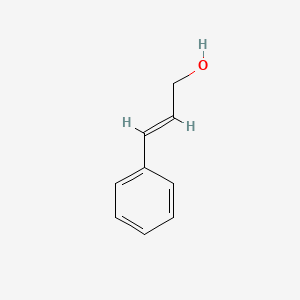
Cinnamyl Alcohol
Cinnamyl alcohol is a primary alcohol comprising an allyl core with a hydroxy substituent at the 1-position and a phenyl substituent at the 3-position (geometry of the C=C bond unspecified). It has a role as a plant metabolite. — ChEBI
- Nom IUPAC
- (E)-3-phenylprop-2-en-1-ol
- Formule moléculaire
- C9H10O
- Masse moléculaire
- 134.17 g/mol
- Masse exacte
- 134.073164938 Da
- XLogP3
- 1,9
- Surface polaire topologique
- 20,2 Ų
- Donneurs de liaisons hydrogène
- 1
- Accepteurs de liaisons hydrogène
- 1
- Unités covalentes
- 1
- Stéréocentres définis
- 0
Également connu sous le nom de
16 autres noms signalés
Identifiants de bases de données externes
- ChEBI:CHEBI:17177
- ChEBI:CHEBI:33227
- ChEMBL:CHEMBL324794
- EPA DTXSID:DTXSID301314144
- PubMed:18035463
Preuves issues de bases de données scientifiques complémentaires
NIH PubChem PUG-View
Attributed physical-property, hazard, environmental and use annotations.
- Boiling Point: 250.0 °C @ 760 MM HG Source: Hazardous Substances Data Bank (HSDB)
- Boiling Point: 247.00 to 250.00 °C. @ 760.00 mm Hg Source: Human Metabolome Database (HMDB)
- Boiling Point: 258 °C Source: Joint FAO/WHO Expert Committee on Food Additives (JECFA)
- Color/Form: NEEDLES OR CRYSTAL MASS Source: Hazardous Substances Data Bank (HSDB)
- Color/Form: WHITE TO YELLOWISH SOLID Source: Hazardous Substances Data Bank (HSDB)
- Color/Form: WHITE NEEDLES FROM PETROLEUM ETHER Source: Hazardous Substances Data Bank (HSDB)
- Density: 1.0397 @ 35 °C/35 °C Source: Hazardous Substances Data Bank (HSDB)
- Flash Point: 126 °C Source: Haz-Map, Information on Hazardous Chemicals and Occupational Diseases
- Flash Point: 126 °C Source: Hazardous Substances Data Bank (HSDB)
- LogP: 1.700 Source: Human Metabolome Database (HMDB)
- Melting Point: 33 °C Source: Hazardous Substances Data Bank (HSDB)
- Melting Point: 33 °C Source: Human Metabolome Database (HMDB)
- Odor: ODOR OF HYACINTH Source: Hazardous Substances Data Bank (HSDB)
- Odor: PLEASANT, FLORAL ODOR Source: Hazardous Substances Data Bank (HSDB)
- Physical Description: Liquid Source: EPA Chemical Data Reporting (CDR)
- Physical Description: White solid with a hyacinth-like odor; [Hawley] Pale yellow crystalline solid; mp = 33-35 deg C; [MSDSonline] Source: Haz-Map, Information on Hazardous Chemicals and Occupational Diseases
- Physical Description: Solid Source: Human Metabolome Database (HMDB)
- Physical Description: White to yellowish crystalline solid, warm-balsamic, floral, sweet odour Source: Joint FAO/WHO Expert Committee on Food Additives (JECFA)
- Solubility: FREELY SOL IN ALC, ETHER, OTHER COMMON ORGANIC SOLVENTS; SOL IN WATER, GLYCEROL; CLEARLY SOL IN 3 VOL 50% ALC Source: Hazardous Substances Data Bank (HSDB)
- Solubility: insoluble to slightly soluble in water; soluble in oils Source: Joint FAO/WHO Expert Committee on Food Additives (JECFA)
- Solubility: moderately soluble (in ethanol) Source: Joint FAO/WHO Expert Committee on Food Additives (JECFA)
- Note: This chemical does not meet GHS hazard criteria for < 0.1% (1 of 2033) of reports. Source: European Chemicals Agency (ECHA)
- Signal: Warning Source: European Chemicals Agency (ECHA)
- GHS Hazard Statements: H302 (15.5%): Harmful if swallowed [Warning Acute toxicity, oral]; H317 (99.7%): May cause an allergic skin reaction [Warning Sensitization, Skin] Source: European Chemicals Agency (ECHA)
- Precautionary Statement Codes: P261, P264, P270, P272, P280, P301+P317, P302+P352, P321, P330, P333+P317, P362+P364, and P501 (click each P-code to see the statement) Source: European Chemicals Agency (ECHA)
- ECHA C&L Notifications Summary: Aggregated GHS information provided per 2033 reports by companies from 21 notifications to the ECHA C&L Inventory. Each notification may be associated with multiple companies.; Reported as not meeting GHS hazard criteria per 1 of 2033 reports by companies.; There are 20 notifications provided by 2032 of 2033 reports by companies with hazard statement code(s).; Information may vary between notifications depending on impurities, additives, and other factors. The percentage value in parenthesis indicates the notified classification ratio from companies that provide hazard codes. Only hazard codes with percentage values above 10% are shown. For more detailed information, please visit ECHA C&L website. Source: European Chemicals Agency (ECHA)
- GHS Hazard Statements: H302 (100%): Harmful if swallowed [Warning Acute toxicity, oral]; H315 (12.5%): Causes skin irritation [Warning Skin corrosion/irritation]; H317 (100%): May cause an allergic skin reaction [Warning Sensitization, Skin]; H319 (100%): Causes serious eye irritation [Warning Serious eye damage/eye irritation]; H335 (12.5%): May cause respiratory irritation [Warning Specific target organ toxicity, single exposure; Respiratory tract irritation] Source: European Chemicals Agency (ECHA)
- Precautionary Statement Codes: P261, P264, P264+P265, P270, P271, P272, P280, P301+P317, P302+P352, P304+P340, P305+P351+P338, P319, P321, P330, P332+P317, P333+P317, P337+P317, P362+P364, P403+P233, P405, and P501 (click each P-code to see the statement) Source: European Chemicals Agency (ECHA)
- ECHA C&L Notifications Summary: Aggregated GHS information provided per 8 reports by companies from 2 notifications to the ECHA C&L Inventory. Each notification may be associated with multiple companies.; Information may vary between notifications depending on impurities, additives, and other factors. The percentage value in parenthesis indicates the notified classification ratio from companies that provide hazard codes. Only hazard codes with percentage values above 10% are shown. For more detailed information, please visit ECHA C&L website. Source: European Chemicals Agency (ECHA)
- Signal: Warning Source: Hazardous Chemical Information System (HCIS), Safe Work Australia
- GHS Hazard Statements: H317: May cause an allergic skin reaction [Warning Sensitization, Skin] Source: Hazardous Chemical Information System (HCIS), Safe Work Australia
- Precautionary Statement Codes: P261, P272, P280, P302+P352, P321, P333+P317, P362+P364, and P501 (click each P-code to see the statement) Source: Hazardous Chemical Information System (HCIS), Safe Work Australia
- Industry Uses: Fixing agent (mordant) Source: EPA Chemical Data Reporting (CDR)
- Cosmetic Ingredient Review Link: CIR ingredient: Cinnamyl Alcohol Source: Cosmetic Ingredient Review (CIR)
- Sources/Uses: Used as a fragrance, flavoring agent, deodorant, and chemical intermediate (chemical resistant coatings, photosensitive polymers, and lithographic plates); [HSDB] Source: Haz-Map, Information on Hazardous Chemicals and Occupational Diseases
- Uses: AS DEODORANT IN 12.5% SOLN IN GLYCEROL Source: Hazardous Substances Data Bank (HSDB)
- Uses: FRAGRANCE, EG, FOR COLOGNES, SOAPS, AND LOTIONS; FIXATIVE FOR PERFUME BLENDS; IN MFR OF CHEM RESISTANT COATINGS; FLAVORING AGENT FOR FOOD (EG, CANDY, GUM, BEVERAGES); CHEM INTERMEDIATE FOR CINNAMYL ESTERS USED IN PERFUMERY; IN MFG OF PHOTOSENSITIVE POLYMERS & LITHOGRAPHIC PLATES Source: Hazardous Substances Data Bank (HSDB)
Mis en correspondance par: Existing checksum-valid CAS to unique PubChem CID match. Récupéré le: 2026-08-31. Ouvrir la fiche source
Les classifications scientifiques et les annotations de danger apportent du contexte et ne remplacent pas la décision réglementaire propre au marché indiquée ci-dessus.
Couverture des sources complémentaires et état des correspondances
| Source | Résultat | Vérifié |
|---|---|---|
| EMBL-EBI ChEBI | À examiner | 2026-08-31 |
| NIH PubChem PUG-View | Correspondance exacte | 2026-08-31 |
Une absence de correspondance enregistrée est une preuve utile que la source a été vérifiée ; ce n’est pas l’affirmation que la substance n’existe pas ailleurs.
Récupéré depuis NIH PubChem le 2026-08-31 par correspondance CAS à somme de contrôle valide. Les propriétés chimiques ne remplacent pas la décision réglementaire de cette page.
Liens d’inventaire pour Cinnamyl alcohol
Fiches associées pour Cinnamyl alcohol
Les correspondances directes sont limitées pour cette fiche ; des entrées voisines de l’annexe III sont donc également affichées.
Citral; Geranial; Neral
BENZALKONIUM CHLORIDE / BENZALKONIUM BROMIDE / BENZALKONIUM SACCHARINATE
ISOEUGENOL
Ce que signifie l’annexe III pour Cinnamyl alcohol
Cinnamyl alcohol est une substance soumise à restrictions en vertu de l’annexe III du règlement (CE) n° 1223/2009 relatif aux produits cosmétiques. Son utilisation dans les cosmétiques n’est autorisée que dans les conditions précises énoncées dans l’entrée ci-dessus, y compris les limites de concentration, les restrictions de type de produit et les mentions d’avertissement requises.
Lorsque cette substance entre dans une formulation, toutes les conditions — concentration maximale, champ d’application du produit et mentions d’avertissement — doivent être respectées simultanément. Le respect d’une condition ne dispense pas des autres.
Cette fiche est liée à 1 ingrédient de l’inventaire CosIng pour le recoupement des noms et des identifiants. La page fait également apparaître 12 fiches d’annexe associées présentant des identifiants, une logique d’annexe ou des schémas de dénomination qui se recoupent.
Liste de contrôle de conformité
- Consignez les conditions d’emploi dans le dossier d’information produit (DIP).
- Cette substance est un allergène de parfum réglementé. Déclarez-le sur l’étiquette par son nom INCI au-delà de 0,001 % dans les produits sans rinçage ou de 0,01 % dans les produits rincés.
Questions fréquentes
Note de source pour la fiche Cinnamyl alcohol de l’annexe III
Cette page résume une fiche de l’annexe III pour Cinnamyl alcohol à partir de documents publics de la Commission européenne sur les cosmétiques et ajoute les correspondances d’inventaire ou d’identifiants associées lorsqu’elles sont disponibles.
Utilisez cette page de fiche pour examiner les conditions de l’annexe III pour Cinnamyl alcohol, mais confirmez toute décision réglementaire finale auprès du libellé officiel en vigueur de l’annexe et des fichiers sources.
Outils et étapes suivantes
Vérifiez votre formule
Collez une liste INCI complète pour détecter Cinnamyl alcohol et d’autres fiches d’annexe de l’UE signalées en une seule passe.
Vérificateur INCIComparer des entrées
Comparez Cinnamyl alcohol côte à côte avec une autre fiche d’annexe pour examiner les différences de restrictions, de concentrations et d’annexe.
ComparerParcourir l’annexe
Consultez toutes les fiches de l’annexe III et comparez les conditions réglementaires entre les substances de cette annexe.
Ouvrir l’annexe III