
Crocidolite
Crocidolite figure à l’annexe II en tant que substance interdite dans les produits cosmétiques mis sur le marché de l’UE.
Détails de la fiche
Nom chimique
Crocidolite
Nom chimique / IUPAC
Crocidolite
Informations réglementaires
Avis du SCCS
- Opinion concerning Chemical Ingredients in Cosmetic Products classified as Carcinogenic, Mutagenic or Toxic to Reproduction according to the Chemicals Directive 67/548/EECC
- Opinion concerning Chemical Ingredients in Cosmetic Products classified as Carcinogenic, Mutagenic or Toxic to Reproduction according to the Chemicals Directive 67/548/EEC
CMR
| Catégorie | Carcinogenic | Mutagenic | Reprotoxic |
|---|---|---|---|
| Cat. 1A | ✓ | — | — |
Données clés
Identité et propriétés chimiques
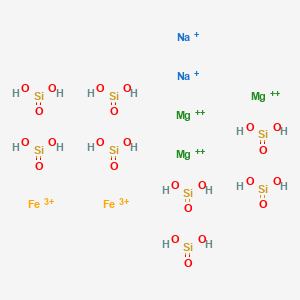
Crocidolite Asbestos
Asbestos is a slender, fine, flaxy fiber. Long term occupational exposure to the dust can result in lung cancer. Asbestos is resistant to fire and most solvents. The primary hazard is the threat to the environment. Immediate steps should be taken to limit its spread to the environment. It is used as a heat resistant material, in cement, furnace bricks, and brake linings. — CAMEO Chemicals
- Nom IUPAC
- trimagnesium;disodium;octakis(dihydroxy(oxo)silane);bis(iron(3+))
- Formule moléculaire
- Fe2H16Mg3Na2O24Si8+14
- Masse moléculaire
- 855.38 g/mol
- Masse exacte
- 853.623098 Da
- Surface polaire topologique
- 460,0 Ų
- Donneurs de liaisons hydrogène
- 16
- Accepteurs de liaisons hydrogène
- 24
- Unités covalentes
- 15
- Stéréocentres définis
- 0
Également connu sous le nom de
16 autres noms signalés
Preuves issues de bases de données scientifiques complémentaires
NIH PubChem PUG-View
Attributed physical-property, hazard, environmental and use annotations.
- Boiling Point: Decomposes (NIOSH, 2024) Source: CAMEO Chemicals
- Boiling Point: decomposes Source: Occupational Safety and Health Administration (OSHA)
- Density: Relative density (water = 1): 3.3-3.4 Source: ILO-WHO International Chemical Safety Cards (ICSCs)
- Melting Point: 1112 °F (Decomposes) (NIOSH, 2024) Source: CAMEO Chemicals
- Melting Point: 1112 °F (decomposes) Source: Occupational Safety and Health Administration (OSHA)
- Physical Description: Asbestos is a slender, fine, flaxy fiber. Long term occupational exposure to the dust can result in lung cancer. Asbestos is resistant to fire and most solvents. The primary hazard is the threat to the environment. Immediate steps should be taken to limit its spread to the environment. It is used as a heat resistant material, in cement, furnace bricks, and brake linings. Source: CAMEO Chemicals
- Physical Description: LAVENDER, BLUE OR GREENISH FIBROUS SOLID. Source: ILO-WHO International Chemical Safety Cards (ICSCs)
- Physical Description: Blue fibrous, odorless solid. Source: Occupational Safety and Health Administration (OSHA)
- Solubility: Insoluble (NIOSH, 2024) Source: CAMEO Chemicals
- Solubility: Solubility in water: none Source: ILO-WHO International Chemical Safety Cards (ICSCs)
- Vapor Pressure: 0 mmHg (approx) (NIOSH, 2024) Source: CAMEO Chemicals
- Vapor Pressure: 0 mmHg (approx) Source: Occupational Safety and Health Administration (OSHA)
- Substance: Asbestos, crocidolite Source: NTP Technical Reports
- NTP Technical Report: TR-280: Toxicology and Carcinogenesis Studies of Crocidolite Asbestos (CASRN 12001-28-4) In F344/N Rats (Feed Studies) (1988 ) Source: NTP Technical Reports
- Peer Review Date: 02/28/83 Source: NTP Technical Reports
- Conclusion for Male Rat: No Evidence Source: NTP Technical Reports
- Conclusion for Female Rat: No Evidence Source: NTP Technical Reports
- Conclusion for Male Mice: Chemical Not Tested in Species/Sex Source: NTP Technical Reports
- Conclusion for Female Mice: Chemical Not Tested in Species/Sex Source: NTP Technical Reports
- Summary: Under the conditions of these feed studies, crocidolite asbestos was not overtly toxic and did not cause a carcinogenic response when ingested at a concentration of 1% in the diet by male and female F344/N rats for their lifetime. Source: NTP Technical Reports
- Carcinogen Classification: 1, carcinogenic to humans. (L224) Source: Toxin and Toxin Target Database (T3DB)
- Exposure Routes: Exposure mainly occurs via inhalation. Source: ILO-WHO International Chemical Safety Cards (ICSCs)
- Exposure Routes: Inhalation (L222) ; injection (L222) Source: Toxin and Toxin Target Database (T3DB)
- First Aid: Excerpt from NIOSH Pocket Guide for Asbestos:; Eye: IRRIGATE IMMEDIATELY - If this chemical contacts the eyes, immediately wash (irrigate) the eyes with large amounts of water, occasionally lifting the lower and upper lids. Get medical attention immediately.; Breathing: FRESH AIR - If a person breathes large amounts of this chemical, move the exposed person to fresh air at once. Other measures are usually unnecessary. (NIOSH, 2024) Source: CAMEO Chemicals
- Signal: Danger Source: Regulation (EC) No 1272/2008 of the European Parliament and of the Council
- GHS Hazard Statements: H350: May cause cancer [Danger Carcinogenicity]; H372 **: Causes damage to organs through prolonged or repeated exposure [Danger Specific target organ toxicity, repeated exposure] Source: Regulation (EC) No 1272/2008 of the European Parliament and of the Council
- Precautionary Statement Codes: P203, P260, P264, P270, P280, P318, P319, P405, and P501 (click each P-code to see the statement) Source: Regulation (EC) No 1272/2008 of the European Parliament and of the Council
- Signal: Danger Source: NITE-CMC
- GHS Hazard Statements: H341: Suspected of causing genetic defects [Warning Germ cell mutagenicity]; H350: May cause cancer [Danger Carcinogenicity]; H370: Causes damage to organs [Danger Specific target organ toxicity, single exposure]; H372: Causes damage to organs through prolonged or repeated exposure [Danger Specific target organ toxicity, repeated exposure] Source: NITE-CMC
- Precautionary Statement Codes: P203, P260, P264, P270, P280, P308+P316, P318, P319, P321, P405, and P501 (click each P-code to see the statement) Source: NITE-CMC
- GHS Hazard Statements: H335: May cause respiratory irritation [Warning Specific target organ toxicity, single exposure; Respiratory tract irritation]; H341: Suspected of causing genetic defects [Warning Germ cell mutagenicity]; H350: May cause cancer [Danger Carcinogenicity]; H372: Causes damage to organs through prolonged or repeated exposure [Danger Specific target organ toxicity, repeated exposure] Source: NITE-CMC
- Precautionary Statement Codes: P203, P260, P261, P264, P270, P271, P280, P304+P340, P318, P319, P403+P233, P405, and P501 (click each P-code to see the statement) Source: NITE-CMC
- Signal: Danger Source: Hazardous Chemical Information System (HCIS), Safe Work Australia
- GHS Hazard Statements: H350: May cause cancer [Danger Carcinogenicity]; H372: Causes damage to organs through prolonged or repeated exposure [Danger Specific target organ toxicity, repeated exposure] Source: Hazardous Chemical Information System (HCIS), Safe Work Australia
- Precautionary Statement Codes: P203, P260, P264, P270, P280, P318, P319, P405, and P501 (click each P-code to see the statement) Source: Hazardous Chemical Information System (HCIS), Safe Work Australia
- Health Effects: Infected people develop a slow buildup of scar-like tissue in the lungs and in the membrane that surrounds the lungs, so breathing becomes difficult. Blood flow to the lung may also be decreased, and this causes the heart to enlarge. This disease is called asbestosis. Infected people have increased chances of getting two principal types of cancer: cancer of the lung tissue itself and mesothelioma, a cancer of the thin membrane that surrounds the lung and other internal organs. The cellular immune system of the patient can be depressed. Also, deletions of chromosome segments have been noted in human mesothelioma cells or cell lines. (L222) Source: Toxin and Toxin Target Database (T3DB)
- Toxicity Summary: When asbestos fibers are inhaled, many are deposited on the epithelial surface of the respiratory tree. Fibers that are retained in the lung or mesothelium for long periods of time are capable of producing chronic inflammation and fibrotic and tumorigenic effects. These effects may be mediated by direct interactions between the fiber and key cellular macromolecules, or they may be mediated by the production of reactive oxygen species and other cellular factors originating from alveolar macrophages. In addition, the physical-chemical nature of the fiber appears to be an important determinant of toxicity. It is generally agreed that exposure to amphibole fibers can produce mesothelioma, and that the potency of amphibole fibers to produce mesothelioma is greater than that of chrysotile. Asbestos fibers can adsorb to a variety of cellular macromolecules (e.g., proteins,membrane lipids, RNA, DNA). The coulombic forces between the asbestos fiber and some of these macromolecules may induce conformational changes, and these changes could affect protein function and chromosomal fidelity. Fibers found to be translocated near the nucleus can interact with the cytoskeleton and interfere with c Source: Toxin and Toxin Target Database (T3DB)
- Uses: Asbestos are used in building materials (roofing shingles, ceiling and floor tiles, paper products, and asbestos cement products), friction products (automobile clutch, brake, and transmission parts), heat-resistant fabrics, packaging, gaskets, and coatings. Some vermiculite or talc products may contain asbestos. Exposure most likely by breathing air containing asbestos fibers or by drinking asbestos fibers that are present in water. (L222) Source: Toxin and Toxin Target Database (T3DB)
Mis en correspondance par: Existing checksum-valid CAS to unique PubChem CID match. Récupéré le: 2026-08-31. Ouvrir la fiche source
Les classifications scientifiques et les annotations de danger apportent du contexte et ne remplacent pas la décision réglementaire propre au marché indiquée ci-dessus.
Couverture des sources complémentaires et état des correspondances
| Source | Résultat | Vérifié |
|---|---|---|
| NIH PubChem PUG-View | Correspondance exacte | 2026-08-31 |
Une absence de correspondance enregistrée est une preuve utile que la source a été vérifiée ; ce n’est pas l’affirmation que la substance n’existe pas ailleurs.
Récupéré depuis NIH PubChem le 2026-09-02 par correspondance CAS à somme de contrôle valide. Les propriétés chimiques ne remplacent pas la décision réglementaire de cette page.
Fiches associées pour Crocidolite
Les correspondances directes sont limitées pour cette fiche ; des entrées voisines de l’annexe II sont donc également affichées.
1,3,5-tris-[(2S and 2R)-2,3-Epoxypropyl]-1,3,5-triazine-2,4,6-(1H,3H,5H)-trione
Distillates (petroleum), heavy hydrocracked, if they contain > 3 % w/w DMSO extract
A mixture of: N-[3-hydroxy-2-(2-methylacryloylaminomethoxy)propoxymethyl]-2-methylacrylamide and N…
Distillates (petroleum), solvent-refined heavy paraffinic, if they contain > 3 % w/w DMSO extract
Trisodium [4'-(8-acetylamino-3,6-disulfonato-2-naphthylazo)-4''-(6-benzoylamino-3-sulfonato-2-napht…
Distillates (petroleum), solvent-refined light paraffinic, if they contain > 3% w/w DMSO extract
(6-(4-Hydroxy-3-(2-methoxyphenylazo)-2-sulfonato-7-naphthylamino)-1,3,5-triazine-2,4-diyl)bis[(amin…
Residual oils (petroleum), solvent deasphalted, if they contain > 3 % w/w DMSO extract
6-Hydroxy-1-(3-Isopropoxypropyl)-4-methyl-2-oxo-5-[4-(phenylazo)phenylazo]-1,2-dihydro-3-pyridineca…
Distillates (petroleum), solvent-refined heavy naphthenic, if they contain > 3 % w/w DMSO extract
Ce que signifie l’annexe II pour Crocidolite
Crocidolite figure comme substance interdite à l’annexe II du règlement (CE) n° 1223/2009 relatif aux produits cosmétiques et ne doit pas être ajouté intentionnellement. L’article 17 traite séparément des traces involontaires, techniquement inévitables dans le respect des bonnes pratiques de fabrication et compatibles avec l’exigence de sécurité de l’article 3.
Les formulateurs doivent contrôler leurs ingrédients et matières premières afin de s’assurer qu’aucun ne contient cette substance. Les fournisseurs doivent fournir, sur demande, une documentation confirmant son absence.
La page fait également apparaître 12 fiches d’annexe associées présentant des identifiants, une logique d’annexe ou des schémas de dénomination qui se recoupent.
Liste de contrôle de conformité
- Vérifiez que cette substance est absente de toutes les matières premières et formulations finies.
- Demandez aux fournisseurs de matières premières une attestation d’absence ou un certificat d’analyse.
- Consignez le résultat du contrôle dans le dossier d’information produit (DIP).
- Cette substance a une classification CMR. Examinez le tableau CMR ci-dessus et vérifiez le statut actuel dans les annexes II/III avant toute utilisation.
Questions fréquentes
Note de source pour la fiche Crocidolite de l’annexe II
Cette page résume une fiche de l’annexe II pour Crocidolite à partir de documents publics de la Commission européenne sur les cosmétiques et ajoute les correspondances d’inventaire ou d’identifiants associées lorsqu’elles sont disponibles.
Utilisez cette page de fiche pour examiner les conditions de l’annexe II pour Crocidolite, mais confirmez toute décision réglementaire finale auprès du libellé officiel en vigueur de l’annexe et des fichiers sources.
Outils et étapes suivantes
Vérifiez votre formule
Collez une liste INCI complète pour détecter Crocidolite et d’autres fiches d’annexe de l’UE signalées en une seule passe.
Vérificateur INCIComparer des entrées
Comparez Crocidolite côte à côte avec une autre fiche d’annexe pour examiner les différences de restrictions, de concentrations et d’annexe.
ComparerParcourir l’annexe
Consultez toutes les fiches de l’annexe II et comparez les conditions réglementaires entre les substances de cette annexe.
Ouvrir l’annexe II