
Crocidolite
Crocidolite ist in Anhang II als verbotener Stoff für kosmetische Mittel aufgeführt, die in der EU in Verkehr gebracht werden.
Eintragsdetails
Chemische Bezeichnung
Crocidolite
Chemische / IUPAC-Bezeichnung
Crocidolite
Regulatorische Informationen
SCCS-Gutachten
- Opinion concerning Chemical Ingredients in Cosmetic Products classified as Carcinogenic, Mutagenic or Toxic to Reproduction according to the Chemicals Directive 67/548/EECC
- Opinion concerning Chemical Ingredients in Cosmetic Products classified as Carcinogenic, Mutagenic or Toxic to Reproduction according to the Chemicals Directive 67/548/EEC
CMR
| Kategorie | Carcinogenic | Mutagenic | Reprotoxic |
|---|---|---|---|
| Cat. 1A | ✓ | — | — |
Kerndaten
Chemische Identität und Eigenschaften
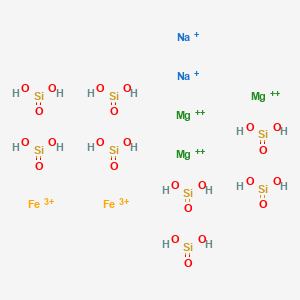
Crocidolite Asbestos
Asbestos is a slender, fine, flaxy fiber. Long term occupational exposure to the dust can result in lung cancer. Asbestos is resistant to fire and most solvents. The primary hazard is the threat to the environment. Immediate steps should be taken to limit its spread to the environment. It is used as a heat resistant material, in cement, furnace bricks, and brake linings. — CAMEO Chemicals
- IUPAC-Name
- trimagnesium;disodium;octakis(dihydroxy(oxo)silane);bis(iron(3+))
- Summenformel
- Fe2H16Mg3Na2O24Si8+14
- Molekulargewicht
- 855.38 g/mol
- Exakte Masse
- 853.623098 Da
- Topologische polare Oberfläche
- 460,0 Ų
- Wasserstoffbrücken-Donoren
- 16
- Wasserstoffbrücken-Akzeptoren
- 24
- Kovalente Einheiten
- 15
- Definierte Stereozentren
- 0
Auch bekannt als
16 weitere gemeldete Namen
Belege aus weiteren wissenschaftlichen Datenbanken
NIH PubChem PUG-View
Attributed physical-property, hazard, environmental and use annotations.
- Boiling Point: Decomposes (NIOSH, 2024) Quelle: CAMEO Chemicals
- Boiling Point: decomposes Quelle: Occupational Safety and Health Administration (OSHA)
- Density: Relative density (water = 1): 3.3-3.4 Quelle: ILO-WHO International Chemical Safety Cards (ICSCs)
- Melting Point: 1112 °F (Decomposes) (NIOSH, 2024) Quelle: CAMEO Chemicals
- Melting Point: 1112 °F (decomposes) Quelle: Occupational Safety and Health Administration (OSHA)
- Physical Description: Asbestos is a slender, fine, flaxy fiber. Long term occupational exposure to the dust can result in lung cancer. Asbestos is resistant to fire and most solvents. The primary hazard is the threat to the environment. Immediate steps should be taken to limit its spread to the environment. It is used as a heat resistant material, in cement, furnace bricks, and brake linings. Quelle: CAMEO Chemicals
- Physical Description: LAVENDER, BLUE OR GREENISH FIBROUS SOLID. Quelle: ILO-WHO International Chemical Safety Cards (ICSCs)
- Physical Description: Blue fibrous, odorless solid. Quelle: Occupational Safety and Health Administration (OSHA)
- Solubility: Insoluble (NIOSH, 2024) Quelle: CAMEO Chemicals
- Solubility: Solubility in water: none Quelle: ILO-WHO International Chemical Safety Cards (ICSCs)
- Vapor Pressure: 0 mmHg (approx) (NIOSH, 2024) Quelle: CAMEO Chemicals
- Vapor Pressure: 0 mmHg (approx) Quelle: Occupational Safety and Health Administration (OSHA)
- Substance: Asbestos, crocidolite Quelle: NTP Technical Reports
- NTP Technical Report: TR-280: Toxicology and Carcinogenesis Studies of Crocidolite Asbestos (CASRN 12001-28-4) In F344/N Rats (Feed Studies) (1988 ) Quelle: NTP Technical Reports
- Peer Review Date: 02/28/83 Quelle: NTP Technical Reports
- Conclusion for Male Rat: No Evidence Quelle: NTP Technical Reports
- Conclusion for Female Rat: No Evidence Quelle: NTP Technical Reports
- Conclusion for Male Mice: Chemical Not Tested in Species/Sex Quelle: NTP Technical Reports
- Conclusion for Female Mice: Chemical Not Tested in Species/Sex Quelle: NTP Technical Reports
- Summary: Under the conditions of these feed studies, crocidolite asbestos was not overtly toxic and did not cause a carcinogenic response when ingested at a concentration of 1% in the diet by male and female F344/N rats for their lifetime. Quelle: NTP Technical Reports
- Carcinogen Classification: 1, carcinogenic to humans. (L224) Quelle: Toxin and Toxin Target Database (T3DB)
- Exposure Routes: Exposure mainly occurs via inhalation. Quelle: ILO-WHO International Chemical Safety Cards (ICSCs)
- Exposure Routes: Inhalation (L222) ; injection (L222) Quelle: Toxin and Toxin Target Database (T3DB)
- First Aid: Excerpt from NIOSH Pocket Guide for Asbestos:; Eye: IRRIGATE IMMEDIATELY - If this chemical contacts the eyes, immediately wash (irrigate) the eyes with large amounts of water, occasionally lifting the lower and upper lids. Get medical attention immediately.; Breathing: FRESH AIR - If a person breathes large amounts of this chemical, move the exposed person to fresh air at once. Other measures are usually unnecessary. (NIOSH, 2024) Quelle: CAMEO Chemicals
- Signal: Danger Quelle: Regulation (EC) No 1272/2008 of the European Parliament and of the Council
- GHS Hazard Statements: H350: May cause cancer [Danger Carcinogenicity]; H372 **: Causes damage to organs through prolonged or repeated exposure [Danger Specific target organ toxicity, repeated exposure] Quelle: Regulation (EC) No 1272/2008 of the European Parliament and of the Council
- Precautionary Statement Codes: P203, P260, P264, P270, P280, P318, P319, P405, and P501 (click each P-code to see the statement) Quelle: Regulation (EC) No 1272/2008 of the European Parliament and of the Council
- Signal: Danger Quelle: NITE-CMC
- GHS Hazard Statements: H341: Suspected of causing genetic defects [Warning Germ cell mutagenicity]; H350: May cause cancer [Danger Carcinogenicity]; H370: Causes damage to organs [Danger Specific target organ toxicity, single exposure]; H372: Causes damage to organs through prolonged or repeated exposure [Danger Specific target organ toxicity, repeated exposure] Quelle: NITE-CMC
- Precautionary Statement Codes: P203, P260, P264, P270, P280, P308+P316, P318, P319, P321, P405, and P501 (click each P-code to see the statement) Quelle: NITE-CMC
- GHS Hazard Statements: H335: May cause respiratory irritation [Warning Specific target organ toxicity, single exposure; Respiratory tract irritation]; H341: Suspected of causing genetic defects [Warning Germ cell mutagenicity]; H350: May cause cancer [Danger Carcinogenicity]; H372: Causes damage to organs through prolonged or repeated exposure [Danger Specific target organ toxicity, repeated exposure] Quelle: NITE-CMC
- Precautionary Statement Codes: P203, P260, P261, P264, P270, P271, P280, P304+P340, P318, P319, P403+P233, P405, and P501 (click each P-code to see the statement) Quelle: NITE-CMC
- Signal: Danger Quelle: Hazardous Chemical Information System (HCIS), Safe Work Australia
- GHS Hazard Statements: H350: May cause cancer [Danger Carcinogenicity]; H372: Causes damage to organs through prolonged or repeated exposure [Danger Specific target organ toxicity, repeated exposure] Quelle: Hazardous Chemical Information System (HCIS), Safe Work Australia
- Precautionary Statement Codes: P203, P260, P264, P270, P280, P318, P319, P405, and P501 (click each P-code to see the statement) Quelle: Hazardous Chemical Information System (HCIS), Safe Work Australia
- Health Effects: Infected people develop a slow buildup of scar-like tissue in the lungs and in the membrane that surrounds the lungs, so breathing becomes difficult. Blood flow to the lung may also be decreased, and this causes the heart to enlarge. This disease is called asbestosis. Infected people have increased chances of getting two principal types of cancer: cancer of the lung tissue itself and mesothelioma, a cancer of the thin membrane that surrounds the lung and other internal organs. The cellular immune system of the patient can be depressed. Also, deletions of chromosome segments have been noted in human mesothelioma cells or cell lines. (L222) Quelle: Toxin and Toxin Target Database (T3DB)
- Toxicity Summary: When asbestos fibers are inhaled, many are deposited on the epithelial surface of the respiratory tree. Fibers that are retained in the lung or mesothelium for long periods of time are capable of producing chronic inflammation and fibrotic and tumorigenic effects. These effects may be mediated by direct interactions between the fiber and key cellular macromolecules, or they may be mediated by the production of reactive oxygen species and other cellular factors originating from alveolar macrophages. In addition, the physical-chemical nature of the fiber appears to be an important determinant of toxicity. It is generally agreed that exposure to amphibole fibers can produce mesothelioma, and that the potency of amphibole fibers to produce mesothelioma is greater than that of chrysotile. Asbestos fibers can adsorb to a variety of cellular macromolecules (e.g., proteins,membrane lipids, RNA, DNA). The coulombic forces between the asbestos fiber and some of these macromolecules may induce conformational changes, and these changes could affect protein function and chromosomal fidelity. Fibers found to be translocated near the nucleus can interact with the cytoskeleton and interfere with c Quelle: Toxin and Toxin Target Database (T3DB)
- Uses: Asbestos are used in building materials (roofing shingles, ceiling and floor tiles, paper products, and asbestos cement products), friction products (automobile clutch, brake, and transmission parts), heat-resistant fabrics, packaging, gaskets, and coatings. Some vermiculite or talc products may contain asbestos. Exposure most likely by breathing air containing asbestos fibers or by drinking asbestos fibers that are present in water. (L222) Quelle: Toxin and Toxin Target Database (T3DB)
Zugeordnet durch: Existing checksum-valid CAS to unique PubChem CID match. Abgerufen: 2026-08-31. Quelleneintrag öffnen
Wissenschaftliche Klassifizierungen und Gefahrenannotationen liefern Kontext und ersetzen nicht die oben gezeigte marktspezifische regulatorische Entscheidung.
Weitere Quellenabdeckung und Trefferstatus
| Quelle | Ergebnis | Geprüft |
|---|---|---|
| NIH PubChem PUG-View | Exakter Treffer | 2026-08-31 |
Ein erfasster Nicht-Treffer ist ein nützlicher Beleg dafür, dass die Quelle geprüft wurde; er ist keine Behauptung, dass der Stoff anderswo nicht existiert.
Am 2026-09-02 von NIH PubChem durch prüfsummengültigen CAS-Abgleich abgerufen. Chemische Eigenschaften ersetzen nicht die regulatorische Entscheidung auf dieser Seite.
Verwandte Einträge zu Crocidolite
Für diesen Eintrag gibt es nur wenige direkte Treffer; daher werden auch nahe liegende Einträge aus Anhang II angezeigt.
1,3,5-tris-[(2S and 2R)-2,3-Epoxypropyl]-1,3,5-triazine-2,4,6-(1H,3H,5H)-trione
Distillates (petroleum), heavy hydrocracked, if they contain > 3 % w/w DMSO extract
A mixture of: N-[3-hydroxy-2-(2-methylacryloylaminomethoxy)propoxymethyl]-2-methylacrylamide and N…
Distillates (petroleum), solvent-refined heavy paraffinic, if they contain > 3 % w/w DMSO extract
Trisodium [4'-(8-acetylamino-3,6-disulfonato-2-naphthylazo)-4''-(6-benzoylamino-3-sulfonato-2-napht…
Distillates (petroleum), solvent-refined light paraffinic, if they contain > 3% w/w DMSO extract
(6-(4-Hydroxy-3-(2-methoxyphenylazo)-2-sulfonato-7-naphthylamino)-1,3,5-triazine-2,4-diyl)bis[(amin…
Residual oils (petroleum), solvent deasphalted, if they contain > 3 % w/w DMSO extract
6-Hydroxy-1-(3-Isopropoxypropyl)-4-methyl-2-oxo-5-[4-(phenylazo)phenylazo]-1,2-dihydro-3-pyridineca…
Distillates (petroleum), solvent-refined heavy naphthenic, if they contain > 3 % w/w DMSO extract
Was Anhang II für Crocidolite bedeutet
Crocidolite ist in Anhang II der EU-Kosmetikverordnung (EG) Nr. 1223/2009 als verbotener Stoff aufgeführt und darf nicht absichtlich zugesetzt werden. Artikel 17 regelt gesondert unbeabsichtigte geringe Mengen, die bei guter Herstellungspraxis technisch unvermeidbar und mit der Sicherheitsanforderung nach Artikel 3 vereinbar sind.
Rezepturentwickler müssen ihre Inhaltsstoffe und Rohstoffe prüfen, um sicherzustellen, dass keiner davon diesen Stoff enthält. Lieferanten sollten auf Anfrage eine Dokumentation vorlegen, die die Abwesenheit bestätigt.
Die Seite zeigt außerdem 12 verwandte Anhangseinträge mit überschneidenden Kennungen, Anhangslogik oder Namensmustern.
Compliance-Checkliste
- Prüfen Sie, dass dieser Stoff in allen Rohstoffen und fertigen Rezepturen nicht enthalten ist.
- Fordern Sie von Rohstofflieferanten eine Abwesenheitsbestätigung oder ein Analysenzertifikat an.
- Dokumentieren Sie das Prüfergebnis in der Produktinformationsdatei (PIF).
- Dieser Stoff hat eine CMR-Einstufung. Prüfen Sie die CMR-Tabelle oben und den aktuellen Status nach Anhang II/III, bevor Sie ihn verwenden.
Häufig gestellte Fragen
Quellenhinweis zu Anhang II, Eintrag Crocidolite
Diese Seite fasst einen Eintrag aus Anhang II für Crocidolite aus öffentlichen Materialien der Europäischen Kommission zu kosmetischen Mitteln zusammen und ergänzt, soweit verfügbar, verknüpfte Treffer aus dem Verzeichnis oder bei Kennungen.
Nutzen Sie diese Eintragsseite, um die Bedingungen aus Anhang II für Crocidolite zu prüfen; bestätigen Sie jede endgültige regulatorische Entscheidung jedoch anhand des aktuellen amtlichen Anhangswortlauts und der Quelldateien.
Werkzeuge und nächste Schritte
Rezeptur prüfen
Fügen Sie eine vollständige INCI-Liste ein, um Crocidolite und andere markierte EU-Anhangseinträge in einem Durchgang zu finden.
INCI-CheckerEinträge vergleichen
Crocidolite nebeneinander mit einem anderen Anhangseintrag vergleichen, um Unterschiede bei Beschränkungen, Konzentrationen und Anhangszuordnung zu prüfen.
VergleichenDen Anhang durchsuchen
Alle Einträge in Anhang II ansehen und die regulatorischen Bedingungen der Stoffe in diesem Anhang vergleichen.
Anhang II öffnen