
Imazamox (ISO); (RS)-2-(4-isopropyl-4-methyl-5-oxo-2-imidazolin-2-yl)-5-methoxymethylnicotinic acid
Imazamox (ISO); (RS)-2-(4-isopropyl-4-methyl-5-oxo-2-imidazolin-2-yl)-5-methoxymethylnicotinic acid figure à l’annexe II en tant que substance interdite dans les produits cosmétiques mis sur le marché de l’UE.
Détails de la fiche
Nom chimique
Imazamox (ISO); (RS)-2-(4-isopropyl-4-methyl-5-oxo-2-imidazolin-2-yl)-5-methoxymethylnicotinic acid
Nom chimique / IUPAC
Imazamox (ISO); (RS)-2-(4-isopropyl-4-methyl-5-oxo-2-imidazolin-2-yl)-5-methoxymethylnicotinic acid
Informations réglementaires
CMR
| Catégorie | Carcinogenic | Mutagenic | Reprotoxic |
|---|---|---|---|
| Cat. 2 | — | — | ✓ |
Données clés
Identité et propriétés chimiques
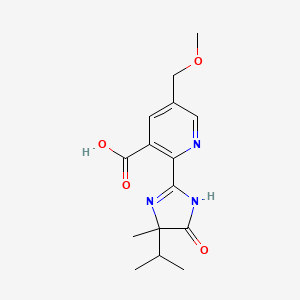
Imazamox
2-(4-isopropyl-4-methyl-5-oxo-4,5-dihydro-1H-imidazol-2-yl)-5-(methoxymethyl)nicotinic acid is a pyridinemonocarboxylic acid that is nicotinic acid which is substituted substituted at position 5 by a methoxymethyl group and at position 2 by a 4,5-dihydro-1H-imidazol-2-yl group, that in turn is substituted by isopropyl, methyl, and oxo groups at positions 4, 4, and 5, respectively. It is an imidazolone, an ether, a pyridinemonocarboxylic acid and a member of imidazolines. — ChEBI
- Nom IUPAC
- 5-(methoxymethyl)-2-(4-methyl-5-oxo-4-propan-2-yl-1H-imidazol-2-yl)pyridine-3-carboxylic acid
- Formule moléculaire
- C15H19N3O4
- Masse moléculaire
- 305.33 g/mol
- Masse exacte
- 305.13755610 Da
- XLogP3
- 0,9
- Surface polaire topologique
- 101,0 Ų
- Donneurs de liaisons hydrogène
- 2
- Accepteurs de liaisons hydrogène
- 6
- Unités covalentes
- 1
- Stéréocentres définis
- 0
Également connu sous le nom de
16 autres noms signalés
Identifiants de bases de données externes
- ChEBI:CHEBI:83742
- ChEMBL:CHEMBL1881028
- EPA DTXSID:DTXSID3034664
- PubMed:23611293
- PubMed:22565269
- PubMed:22431132
- PubMed:22307918
- PubMed:22290852
- PubMed:22287955
- PubMed:22110615
- PubMed:21421378
- PubMed:21365918
- PubMed:21308964
- PubMed:21251949
- PubMed:19763864
Preuves issues de bases de données scientifiques complémentaires
NIH PubChem PUG-View
Attributed physical-property, hazard, environmental and use annotations.
- Color/Form: Off-white powdered solid Source: Hazardous Substances Data Bank (HSDB)
- Density: 1.39 g/mL Source: Hazardous Substances Data Bank (HSDB)
- Dissociation Constants: pKa1 = 2.3; pKa2 = 3.3 Source: Hazardous Substances Data Bank (HSDB)
- Dissociation Constants: pKa = 2.3, 3.3 and 10.8; the active ingredient will exist primarily in the singly ionized form in the pH range 5-9 Source: Hazardous Substances Data Bank (HSDB)
- LogP: log Kow = 0.73 (pH 5 & 6, corrected) Source: Hazardous Substances Data Bank (HSDB)
- Melting Point: 166.0 to 166.7 °C Source: Hazardous Substances Data Bank (HSDB)
- Odor: Odorless Source: Hazardous Substances Data Bank (HSDB)
- Physical Description: Off-white odorless solid; [HSDB] Source: Haz-Map, Information on Hazardous Chemicals and Occupational Diseases
- Solubility: In water, 4,160 ppm (mg/L) at 20 °C /deionized water/ Source: Hazardous Substances Data Bank (HSDB)
- Solubility: In water, 116 (pH 5), >626 (pH 7), >628 (pH 9) (all in g/l, 25 °C) Source: Hazardous Substances Data Bank (HSDB)
- Solubility: In water, 4,113 (ppm) mg/L at 20 °C /deionized water/ Source: Hazardous Substances Data Bank (HSDB)
- Solubility: Hexane 0.0006; methanol 6.68; acetonitrile 1.85; toluene 0.21; acetone 2.93; dichloromethane 14.3; ethyl acetate 1.02 (all g/100 mL) Source: Hazardous Substances Data Bank (HSDB)
- Vapor Pressure: Vapor pressure: <1.3X10⁻² mPa at 25 °C (9.75X10⁻¹¹ mm Hg) Source: Hazardous Substances Data Bank (HSDB)
- pH: 2.35, 1% aqueous suspension (w:v) at 24.5 °C Source: Hazardous Substances Data Bank (HSDB)
- Carcinogen Classification: No indication of carcinogenicity to humans (not listed by IARC). Source: Toxin and Toxin Target Database (T3DB)
- Signal: Warning Source: Regulation (EC) No 1272/2008 of the European Parliament and of the Council
- GHS Hazard Statements: H361d: Suspected of damaging the unborn child [Warning Reproductive toxicity]; H400: Very toxic to aquatic life [Warning Hazardous to the aquatic environment, acute hazard]; H410: Very toxic to aquatic life with long lasting effects [Warning Hazardous to the aquatic environment, long-term hazard] Source: Regulation (EC) No 1272/2008 of the European Parliament and of the Council
- Precautionary Statement Codes: P203, P273, P280, P318, P391, P405, and P501 (click each P-code to see the statement) Source: Regulation (EC) No 1272/2008 of the European Parliament and of the Council
- Signal: Warning Source: European Chemicals Agency (ECHA)
- GHS Hazard Statements: H361 (16.8%): Suspected of damaging fertility or the unborn child [Warning Reproductive toxicity]; H361d (15.4%): Suspected of damaging the unborn child [Warning Reproductive toxicity]; H400 (100%): Very toxic to aquatic life [Warning Hazardous to the aquatic environment, acute hazard]; H410 (100%): Very toxic to aquatic life with long lasting effects [Warning Hazardous to the aquatic environment, long-term hazard] Source: European Chemicals Agency (ECHA)
- Precautionary Statement Codes: P203, P273, P280, P318, P391, P405, and P501 (click each P-code to see the statement) Source: European Chemicals Agency (ECHA)
- ECHA C&L Notifications Summary: Aggregated GHS information provided per 214 reports by companies from 7 notifications to the ECHA C&L Inventory. Each notification may be associated with multiple companies.; Information may vary between notifications depending on impurities, additives, and other factors. The percentage value in parenthesis indicates the notified classification ratio from companies that provide hazard codes. Only hazard codes with percentage values above 10% are shown. For more detailed information, please visit ECHA C&L website. Source: European Chemicals Agency (ECHA)
- Signal: Warning Source: Hazardous Chemical Information System (HCIS), Safe Work Australia
- GHS Hazard Statements: H361d: Suspected of damaging the unborn child [Warning Reproductive toxicity]; H410: Very toxic to aquatic life with long lasting effects [Warning Hazardous to the aquatic environment, long-term hazard] Source: Hazardous Chemical Information System (HCIS), Safe Work Australia
- Precautionary Statement Codes: P203, P273, P280, P318, P391, P405, and P501 (click each P-code to see the statement) Source: Hazardous Chemical Information System (HCIS), Safe Work Australia
- Signal: Warning Source: Hazardous Substances Data Bank (HSDB)
- GHS Hazard Statements: H400: Very toxic to aquatic life [Warning Hazardous to the aquatic environment, acute hazard]; H410: Very toxic to aquatic life with long lasting effects [Warning Hazardous to the aquatic environment, long-term hazard] Source: Hazardous Substances Data Bank (HSDB)
- Toxicity Summary: IDENTIFICATION AND USE: Imazamox is off-white powdered solid. It is a herbicide applied post-emergence in soybean. HUMAN STUDIES: In an in vitro study, human embryonic stem cells were treated with imazamox at a concentration of 0, 1, 10 or 100 umol/L, incubation did not induce cytotoxicity. ANIMAL STUDIES: In the acute toxicity studies, the substance has low acute toxicity when administered orally, dermally or by inhalation to rats. It is not a significant skin or eye irritant or a skin sensitizer. Imazamox showed no short-term and long-term toxicity after oral exposure to rats, mice and dogs up to the limit top dose level tested in each study. Based on available genotoxicity studies imazamox is unlikely to be genotoxic. The substance showed no carcinogenic potential in both species. In the multigeneration toxicity study, fertility and overall reproductive performance was not impaired. In developmental toxicity studies maternal toxicity in rats and in rabbits was observed. No developmental toxicity was observed in rats whereas agenesis of the intermediate lobe of lung and cervical hemivertebra was observed in rabbits. ECOTOXICITY STUDIES: Imazamox is practically nontoxic to avian s Source: Hazardous Substances Data Bank (HSDB)
- Environmental Bioconcentration: Imazamox concentrations in whole and edible bluegill fish tissue were below the quantification limit, and the BCF for inedible tissue was less than 1X the concentration tested(1). An estimated BCF of 3.2 was calculated in fish for imazamox(SRC), using a log Kow of 0.73(2) and a regression-derived equation(3). According to a classification scheme(4), this BCF data suggests the potential for bioconcentration in aquatic organisms is low(SRC). Source: Hazardous Substances Data Bank (HSDB)
- Environmental Fate: TERRESTRIAL FATE: Based on a classification scheme(1), Koc values ranging from 5 to 143(2) indicate that imazamox is expected to have very high mobility in soil(SRC). The pKa values of imazamox have been reported as 2.3, 3.3 and 10.8(3), indicating that this compound will exist entirely in anion form in the environment and anions generally do not adsorb as strongly to soils containing organic carbon and clay as their neutral counterparts(4). Volatilization of imazamox is not expected to be an important fate process(SRC) because this chemical expected to exist as an anion in the environment and anions do not volatilize. Imazamox is primarily degraded by microbes in soil under aerobic conditions(2,3); essentially no degradation occurs under anaerobic conditions(2). Imazamox is considered moderately persistent with half-lives ranging between 15 to 142 days(2,3); its limited persistence will restrict leaching of imazamox into groundwater(2). Source: Hazardous Substances Data Bank (HSDB)
- Environmental Fate: TERRESTRIAL FATE: In a field study with 5 soils, terrestrial dissipation half-lives ranged between 15 and 130 days(1). Leaching was found to be very limited in field studies(2). Source: Hazardous Substances Data Bank (HSDB)
- Environmental Fate: AQUATIC FATE: Based on a classification scheme(1), Koc values ranging from 5 to 143(2) indicate that imazamox is not expected to adsorb to suspended solids and sediment(SRC). The pKa values of imazamox have been reported as 2.3, 3.3 and 10.8(3) indicating imazamox will exist entirely in the anion form at pH values of 5 to 9 and, therefore, volatilization from water surfaces is not expected to be an important fate process(SRC). According to a classification scheme(4), an estimated BCF of 3.2(SRC), from its log Kow of 0.73(5) and a regression-derived equation(6), suggests the potential for bioconcentration in aquatic organisms is low(SRC). Photodegradation can be rapid with a half-life of 6.8 hours observed in laboratory studies(2,3); this rate is only applicable at the surface of the water with rates decreasing with water depth. Imazamox is stable to hydrolysis at pH 5, 7 and 9(2). Imazamox is considered moderately persistent in soil with half-lives ranging between 15 to 142 days(2,3). Source: Hazardous Substances Data Bank (HSDB)
- Environmental Fate: ATMOSPHERIC FATE: According to a model of gas/particle partitioning of semivolatile organic compounds in the atmosphere(1), imazamox, which has an estimated vapor pressure of 1.26X10⁻¹¹ mm Hg at 25 °C determined from a fragment constant method(2), is expected to exist solely in the particulate phase in the ambient atmosphere. Particulate-phase imazamox may be removed from the air by wet and dry deposition(SRC). Imazamox photolytically decays with reported half-lives of 6.8 hours (or 0.3 days)(5,6) and 78 minutes (or 3 days)(7) for primary degradation in aqueous media. Direct aqueous photolysis results in several stable degradates(7). Photolysis in soil is a slower process with a half-life of 65 days(6). The rate of photodegradation decreases in the presence of Cu(II) and Ca(II) salts which form stable complexes with imazamox(7). Source: Hazardous Substances Data Bank (HSDB)
- Sources/Uses: Used as broad spectrum post-emergence herbicide for soybeans; [HSDB] Source: Haz-Map, Information on Hazardous Chemicals and Occupational Diseases
- Industrial Processes with risk of exposure: Farming (Pesticides) [Category: Industry] Source: Haz-Map, Information on Hazardous Chemicals and Occupational Diseases
- Uses: For imazamox (USEPA/OPP Pesticide Code: 129171) ACTIVE products with label matches. /SRP: Registered for use in the U.S. but approved pesticide uses may change periodically and so federal, state and local authorities must be consulted for currently approved uses./ Source: Hazardous Substances Data Bank (HSDB)
- Uses: Herbicide Source: Hazardous Substances Data Bank (HSDB)
- Uses: This is a man-made compound that is used as a pesticide. Source: Toxin and Toxin Target Database (T3DB)
Mis en correspondance par: Existing checksum-valid CAS to unique PubChem CID match. Récupéré le: 2026-08-31. Ouvrir la fiche source
Les classifications scientifiques et les annotations de danger apportent du contexte et ne remplacent pas la décision réglementaire propre au marché indiquée ci-dessus.
Couverture des sources complémentaires et état des correspondances
| Source | Résultat | Vérifié |
|---|---|---|
| NIH PubChem PUG-View | Correspondance exacte | 2026-08-31 |
Une absence de correspondance enregistrée est une preuve utile que la source a été vérifiée ; ce n’est pas l’affirmation que la substance n’existe pas ailleurs.
Récupéré depuis NIH PubChem le 2026-09-02 par correspondance CAS à somme de contrôle valide. Les propriétés chimiques ne remplacent pas la décision réglementaire de cette page.
Fiches associées pour Imazamox (ISO); (RS)-2-(4-isopropyl-4-methyl-5-oxo-2-imidazolin-2-yl)-5-methoxymethylnicotinic acid
Les correspondances directes sont limitées pour cette fiche ; des entrées voisines de l’annexe II sont donc également affichées.
Dimethomorph (ISO); (E,Z)-4-(3-(4-chlorophenyl)-3-(3,4-dimethoxyphenyl)acryloyl)morpholine
Thiamethoxam (ISO); 3-(2-chloro-thiazol-5-ylmethyl)-5-methyl[1,3,5]oxadiazinan-4-ylidene-N-nitroami…
4-methylpentan-2-one; isobutyl methyl ketone (MIBK)
Triticonazole (ISO); (RS)-(E)-5-(4-chlorobenzylidene)-2,2-dimethyl-1-(1H-1,2,4-triazol-1-methyl)cyc…
N-{2-[[1,1'-bi(cyclopropyl)]-2-yl]phenyl}-3-(difluoromethyl)-1-methyl-1H-pyrazole-4-carboxamide; se…
Desmedipham (ISO); ethyl 3-phenylcarbamoyloxyphenylcarbamate
N-methoxy-N-[1-methyl-2-(2,4,6-trichlorophenyl)-ethyl]-3-(difluoromethyl)-1-methylpyrazole-4-carbox…
Dibutyltin bis(2-ethylhexanoate)
Azamethiphos (ISO); S-[(6-chloro-2-oxooxazolo[4,5-b]pyridin-3(2H)-yl)methyl] O,O-dimethyl thiophosp…
Ce que signifie l’annexe II pour Imazamox (ISO); (RS)-2-(4-isopropyl-4-methyl-5-oxo-2-imidazolin-2-yl)-5-methoxymethylnicotinic acid
Imazamox (ISO); (RS)-2-(4-isopropyl-4-methyl-5-oxo-2-imidazolin-2-yl)-5-methoxymethylnicotinic acid figure comme substance interdite à l’annexe II du règlement (CE) n° 1223/2009 relatif aux produits cosmétiques et ne doit pas être ajouté intentionnellement. L’article 17 traite séparément des traces involontaires, techniquement inévitables dans le respect des bonnes pratiques de fabrication et compatibles avec l’exigence de sécurité de l’article 3.
Les formulateurs doivent contrôler leurs ingrédients et matières premières afin de s’assurer qu’aucun ne contient cette substance. Les fournisseurs doivent fournir, sur demande, une documentation confirmant son absence.
La page fait également apparaître 12 fiches d’annexe associées présentant des identifiants, une logique d’annexe ou des schémas de dénomination qui se recoupent.
Liste de contrôle de conformité
- Vérifiez que cette substance est absente de toutes les matières premières et formulations finies.
- Demandez aux fournisseurs de matières premières une attestation d’absence ou un certificat d’analyse.
- Consignez le résultat du contrôle dans le dossier d’information produit (DIP).
- Cette substance a une classification CMR. Examinez le tableau CMR ci-dessus et vérifiez le statut actuel dans les annexes II/III avant toute utilisation.
Questions fréquentes
Note de source pour la fiche Imazamox (ISO); (RS)-2-(4-isopropyl-4-methyl-5-oxo-2-imidazolin-2-yl)-5-methoxymethylnicotinic acid de l’annexe II
Cette page résume une fiche de l’annexe II pour Imazamox (ISO); (RS)-2-(4-isopropyl-4-methyl-5-oxo-2-imidazolin-2-yl)-5-methoxymethylnicotinic acid à partir de documents publics de la Commission européenne sur les cosmétiques et ajoute les correspondances d’inventaire ou d’identifiants associées lorsqu’elles sont disponibles.
Utilisez cette page de fiche pour examiner les conditions de l’annexe II pour Imazamox (ISO); (RS)-2-(4-isopropyl-4-methyl-5-oxo-2-imidazolin-2-yl)-5-methoxymethylnicotinic acid, mais confirmez toute décision réglementaire finale auprès du libellé officiel en vigueur de l’annexe et des fichiers sources.
Outils et étapes suivantes
Vérifiez votre formule
Collez une liste INCI complète pour détecter Imazamox (ISO); (RS)-2-(4-isopropyl-4-methyl-5-oxo-2-imidazolin-2-yl)-5-methoxymethylnicotinic acid et d’autres fiches d’annexe de l’UE signalées en une seule passe.
Vérificateur INCIComparer des entrées
Comparez Imazamox (ISO); (RS)-2-(4-isopropyl-4-methyl-5-oxo-2-imidazolin-2-yl)-5-methoxymethylnicotinic acid côte à côte avec une autre fiche d’annexe pour examiner les différences de restrictions, de concentrations et d’annexe.
ComparerParcourir l’annexe
Consultez toutes les fiches de l’annexe II et comparez les conditions réglementaires entre les substances de cette annexe.
Ouvrir l’annexe II