
5,12-Dihydroquino[2,3-b]acridine-7,14-dione (Pigment Violet 19; CI 73900) when used as a substance in hair dye products
5,12-Dihydroquino[2,3-b]acridine-7,14-dione (Pigment Violet 19; CI 73900) when used as a substance in hair dye products figure à l’annexe II en tant que substance interdite dans les produits cosmétiques mis sur le marché de l’UE.
Détails de la fiche
Nom chimique
5,12-Dihydroquino[2,3-b]acridine-7,14-dione (Pigment Violet 19; CI 73900) when used as a substance in hair dye products
Informations réglementaires
Ingrédients identifiés
Données clés
Identité et propriétés chimiques
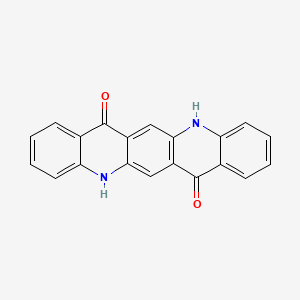
Quinacridone
Quinacridone is an organonitrogen heterocyclic compound and an organic heterotetracyclic compound. — ChEBI
- Nom IUPAC
- 5,12-dihydroquinolino[2,3-b]acridine-7,14-dione
- Formule moléculaire
- C20H12N2O2
- Masse moléculaire
- 312.3 g/mol
- Masse exacte
- 312.089877630 Da
- XLogP3
- 4,0
- Surface polaire topologique
- 58,2 Ų
- Donneurs de liaisons hydrogène
- 2
- Accepteurs de liaisons hydrogène
- 4
- Unités covalentes
- 1
- Stéréocentres définis
- 0
Également connu sous le nom de
16 autres noms signalés
Identifiants de bases de données externes
Preuves issues de bases de données scientifiques complémentaires
EMBL-EBI ChEBI
Quinacridone
- Formule
- C20H12N2O2
- Masse moyenne
- 312.328 g/mol
- Masse monoisotopique
- 312.08988 Da
- Charge formelle
- 0
- organonitrogen heterocyclic compound — is a (CHEBI:38101)
- organic heterotetracyclic compound — is a (CHEBI:38163)
- organonitrogen heterocyclic compound — is a (CHEBI:38101)
- organic heterotetracyclic compound — is a (CHEBI:38163)
Noms supplémentaires validés
Références croisées de cette source
- CAS: 1047-16-1 — ChemIDplus
- MANUAL_X_REF: 13369 — ChemSpider
- MANUAL_X_REF: HMDB0034058 — HMDB
Mis en correspondance par: Exact CAS cross-reference in the ChEBI compound record. Récupéré le: 2026-08-31. Ouvrir la fiche source
NIH PubChem PUG-View
Attributed physical-property, hazard, environmental and use annotations.
- Color/Form: Red to violet solid with blueish or yellowish tint depending upon crystalline form. Source: Hazardous Substances Data Bank (HSDB)
- Color/Form: particle characteristics: thin plates Source: Hazardous Substances Data Bank (HSDB)
- Density: 1.5 Source: Hazardous Substances Data Bank (HSDB)
- LogP: 1.9 (estimated) Source: Hazardous Substances Data Bank (HSDB)
- Melting Point: 390 °C Source: Human Metabolome Database (HMDB)
- Physical Description: Liquid; Other Solid; Dry Powder; Other Solid; CBI Source: EPA Chemical Data Reporting (CDR)
- Physical Description: Red to violet solid; Bluish or yellowish tint depending of form; [HSDB] Red odorless powder; [MSDSonline] Source: Haz-Map, Information on Hazardous Chemicals and Occupational Diseases
- Physical Description: Solid Source: Human Metabolome Database (HMDB)
- Refractive Index: Refractive index: quinacridine red (gamma), n(Na) Av. 2.04; quinacridine red (beta), Av. 2.02 Source: Hazardous Substances Data Bank (HSDB)
- Solubility: Insoluble in water Source: Hazardous Substances Data Bank (HSDB)
- Solubility: Insoluble in organic solvents and dispersion media. Source: Hazardous Substances Data Bank (HSDB)
- Note: This chemical does not meet GHS hazard criteria for 99.6% (760 of 763) of all reports. Source: European Chemicals Agency (ECHA)
- GHS Hazard Statements: Not Classified; Reported as not meeting GHS hazard criteria by 760 of 763 companies (only 0.4% companies provided GHS information). For more detailed information, please visit ECHA C&L website. Source: European Chemicals Agency (ECHA)
- ECHA C&L Notifications Summary: Aggregated GHS information provided per 763 reports by companies from 4 notifications to the ECHA C&L Inventory.; Reported as not meeting GHS hazard criteria per 760 of 763 reports by companies.; There are 2 notifications provided by 3 of 763 reports by companies with hazard statement code(s).; Information may vary between notifications depending on impurities, additives, and other factors. The percentage value in parenthesis indicates the notified classification ratio from companies that provide hazard codes. Only hazard codes with percentage values above 10% are shown. For more detailed information, please visit ECHA C&L website. Source: European Chemicals Agency (ECHA)
- Environmental Bioconcentration: Cinquasia red should not bioconcentrate, since it is insoluble, and therefore, will not be taken up into the body. Source: Hazardous Substances Data Bank (HSDB)
- Environmental Fate: Much of cinquasia red will be bound up in the components of landfills, junkyards, and general dump sites. Source: Hazardous Substances Data Bank (HSDB)
- Environmental Fate: Terrestrial: The insolubility of cinquasia red will cause it to collect in soils and sediments. Source: Hazardous Substances Data Bank (HSDB)
- Environmental Fate: Aquatic: Due to its insolubility, cinquasia red may reside in the water column for a substantial period, long enough to become part of deep sea sediments. Source: Hazardous Substances Data Bank (HSDB)
- Consumer Uses: Pigment Source: EPA Chemical Data Reporting (CDR)
- Industry Uses: Pigment Source: EPA Chemical Data Reporting (CDR)
- Sources/Uses: Used as pigment (paints, printing inks, plastics, rubber, alkyd resin enamels, textile emulsion inks, textiles, nitrocellulose, vinyl, and acrylic lacquers) and sensitizing dye in color photo electrophoresis; Used to tone and make other pigments; [HSDB] Source: Haz-Map, Information on Hazardous Chemicals and Occupational Diseases
- Industrial Processes with risk of exposure: Painting (Pigments, Binders, and Biocides) [Category: Paint]; Textiles (Printing, Dyeing, or Finishing) [Category: Industry] Source: Haz-Map, Information on Hazardous Chemicals and Occupational Diseases
- Uses: PAINTS, PRINTING INKS, PLASTICS, RUBBER Source: Hazardous Substances Data Bank (HSDB)
- Uses: Cinquasia red is used a sensitizing dye in color photoelectrophoresis. Source: Hazardous Substances Data Bank (HSDB)
- Uses: Pigment in textiles Source: Hazardous Substances Data Bank (HSDB)
- Uses: As colorants for plastics, quinacridone pigments may be used in all resins except nylon-66 and polystyrene./Quinacridone Pigments/ Source: Hazardous Substances Data Bank (HSDB)
- Uses: For more Uses (Complete) data for CINQUASIA RED (9 total), please visit the HSDB record page. Source: Hazardous Substances Data Bank (HSDB)
- Uses: Plastics -> Typical concentration range in plastic materials -> 2% Source: NORMAN Suspect List Exchange
Mis en correspondance par: Existing checksum-valid CAS to unique PubChem CID match. Récupéré le: 2026-08-31. Ouvrir la fiche source
Les classifications scientifiques et les annotations de danger apportent du contexte et ne remplacent pas la décision réglementaire propre au marché indiquée ci-dessus.
Couverture des sources complémentaires et état des correspondances
| Source | Résultat | Vérifié |
|---|---|---|
| EMBL-EBI ChEBI | Correspondance exacte | 2026-08-31 |
| NIH PubChem PUG-View | Correspondance exacte | 2026-08-31 |
Une absence de correspondance enregistrée est une preuve utile que la source a été vérifiée ; ce n’est pas l’affirmation que la substance n’existe pas ailleurs.
Récupéré depuis NIH PubChem le 2026-08-31 par correspondance CAS à somme de contrôle valide. Les propriétés chimiques ne remplacent pas la décision réglementaire de cette page.
Liens d’inventaire pour 5,12-Dihydroquino[2,3-b]acridine-7,14-dione (Pigment Violet 19; CI 73900) when used as a substance in hair dye products
Fiches associées pour 5,12-Dihydroquino[2,3-b]acridine-7,14-dione (Pigment Violet 19; CI 73900) when used as a substance in hair dye products
Les correspondances directes sont limitées pour cette fiche ; des entrées voisines de l’annexe II sont donc également affichées.
6-Chloro-2-(6-chloro-4-methyl-3-oxobenzo[b]thien-2(3H)-ylidene)-4-methylbenzo[b]thiophene-3(2H)-one…
(29H,31H-Phthalocyaninato(2-)-N29,N30,N31,N32)copper (Pigment Blue 15; CI 74160) when used as a sub…
1,4-bis(p-Tolylamino)anthraquinone (Solvent Green 3; CI 61565) when used as a substance in hair dye…
Disodium [29H,31H-phthalocyaninedisulphonato(4-)-N29,N30,N31,N32]cuprate(2-) (Direct Blue 86; CI 74…
1-Hydroxy-4-(p-toluidino)anthraquinone (Solvent Violet 13; CI 60725) when used as a substance in ha…
Polychloro copper phthalocyanine (Pigment Green 7; CI 74260) when used as a substance in hair dye p…
Trisodium 8-hydroxypyrene-1,3,6-trisulphonate (Solvent Green 7; CI 59040) when used as a substance …
Diethylene glycol (DEG); 2,2'-oxydiethanol for traces level, see Annex III
1,2-Dihydroxyanthraquinone (Pigment Red 83; CI 58000) when used as a substance in hair dye products
Phytonadione [INCI], phytomenadione [INN]
8,18-Dichloro-5,15-diethyl-5,15-dihydrodiindolo[3,2-b:3',2'-m]triphenodioxazine (Pigment Violet 23;…
Ce que signifie l’annexe II pour 5,12-Dihydroquino[2,3-b]acridine-7,14-dione (Pigment Violet 19; CI 73900) when used as a substance in hair dye products
5,12-Dihydroquino[2,3-b]acridine-7,14-dione (Pigment Violet 19; CI 73900) when used as a substance in hair dye products figure comme substance interdite à l’annexe II du règlement (CE) n° 1223/2009 relatif aux produits cosmétiques et ne doit pas être ajouté intentionnellement. L’article 17 traite séparément des traces involontaires, techniquement inévitables dans le respect des bonnes pratiques de fabrication et compatibles avec l’exigence de sécurité de l’article 3.
Les formulateurs doivent contrôler leurs ingrédients et matières premières afin de s’assurer qu’aucun ne contient cette substance. Les fournisseurs doivent fournir, sur demande, une documentation confirmant son absence.
Cette fiche est liée à 2 ingrédients de l’inventaire CosIng pour le recoupement des noms et des identifiants. La page fait également apparaître 12 fiches d’annexe associées présentant des identifiants, une logique d’annexe ou des schémas de dénomination qui se recoupent.
Liste de contrôle de conformité
- Vérifiez que cette substance est absente de toutes les matières premières et formulations finies.
- Demandez aux fournisseurs de matières premières une attestation d’absence ou un certificat d’analyse.
- Consignez le résultat du contrôle dans le dossier d’information produit (DIP).
Questions fréquentes
Note de source pour la fiche 5,12-Dihydroquino[2,3-b]acridine-7,14-dione (Pigment Violet 19; CI 73900) when used as a substance in hair dye products de l’annexe II
Cette page résume une fiche de l’annexe II pour 5,12-Dihydroquino[2,3-b]acridine-7,14-dione (Pigment Violet 19; CI 73900) when used as a substance in hair dye products à partir de documents publics de la Commission européenne sur les cosmétiques et ajoute les correspondances d’inventaire ou d’identifiants associées lorsqu’elles sont disponibles.
Utilisez cette page de fiche pour examiner les conditions de l’annexe II pour 5,12-Dihydroquino[2,3-b]acridine-7,14-dione (Pigment Violet 19; CI 73900) when used as a substance in hair dye products, mais confirmez toute décision réglementaire finale auprès du libellé officiel en vigueur de l’annexe et des fichiers sources.
Outils et étapes suivantes
Vérifiez votre formule
Collez une liste INCI complète pour détecter 5,12-Dihydroquino[2,3-b]acridine-7,14-dione (Pigment Violet 19; CI 73900) when used as a substance in hair dye products et d’autres fiches d’annexe de l’UE signalées en une seule passe.
Vérificateur INCIComparer des entrées
Comparez 5,12-Dihydroquino[2,3-b]acridine-7,14-dione (Pigment Violet 19; CI 73900) when used as a substance in hair dye products côte à côte avec une autre fiche d’annexe pour examiner les différences de restrictions, de concentrations et d’annexe.
ComparerParcourir l’annexe
Consultez toutes les fiches de l’annexe II et comparez les conditions réglementaires entre les substances de cette annexe.
Ouvrir l’annexe II