
5,12-Dihydroquino[2,3-b]acridine-7,14-dione (Pigment Violet 19; CI 73900) when used as a substance in hair dye products
5,12-Dihydroquino[2,3-b]acridine-7,14-dione (Pigment Violet 19; CI 73900) when used as a substance in hair dye products ist in Anhang II als verbotener Stoff für kosmetische Mittel aufgeführt, die in der EU in Verkehr gebracht werden.
Eintragsdetails
Chemische Bezeichnung
5,12-Dihydroquino[2,3-b]acridine-7,14-dione (Pigment Violet 19; CI 73900) when used as a substance in hair dye products
Regulatorische Informationen
Identifizierte Inhaltsstoffe
Kerndaten
Chemische Identität und Eigenschaften
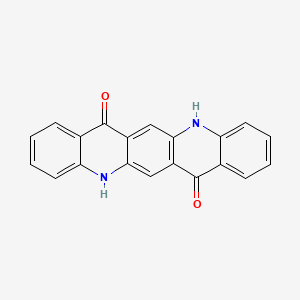
Quinacridone
Quinacridone is an organonitrogen heterocyclic compound and an organic heterotetracyclic compound. — ChEBI
- IUPAC-Name
- 5,12-dihydroquinolino[2,3-b]acridine-7,14-dione
- Summenformel
- C20H12N2O2
- Molekulargewicht
- 312.3 g/mol
- Exakte Masse
- 312.089877630 Da
- XLogP3
- 4,0
- Topologische polare Oberfläche
- 58,2 Ų
- Wasserstoffbrücken-Donoren
- 2
- Wasserstoffbrücken-Akzeptoren
- 4
- Kovalente Einheiten
- 1
- Definierte Stereozentren
- 0
Auch bekannt als
16 weitere gemeldete Namen
Kennungen in externen Datenbanken
Belege aus weiteren wissenschaftlichen Datenbanken
EMBL-EBI ChEBI
Quinacridone
- Rezeptur
- C20H12N2O2
- Durchschnittsmasse
- 312.328 g/mol
- Monoisotopische Masse
- 312.08988 Da
- Formale Ladung
- 0
- organonitrogen heterocyclic compound — is a (CHEBI:38101)
- organic heterotetracyclic compound — is a (CHEBI:38163)
- organonitrogen heterocyclic compound — is a (CHEBI:38101)
- organic heterotetracyclic compound — is a (CHEBI:38163)
Weitere kuratierte Namen
Querverweise aus dieser Quelle
- CAS: 1047-16-1 — ChemIDplus
- MANUAL_X_REF: 13369 — ChemSpider
- MANUAL_X_REF: HMDB0034058 — HMDB
Zugeordnet durch: Exact CAS cross-reference in the ChEBI compound record. Abgerufen: 2026-08-31. Quelleneintrag öffnen
NIH PubChem PUG-View
Attributed physical-property, hazard, environmental and use annotations.
- Color/Form: Red to violet solid with blueish or yellowish tint depending upon crystalline form. Quelle: Hazardous Substances Data Bank (HSDB)
- Color/Form: particle characteristics: thin plates Quelle: Hazardous Substances Data Bank (HSDB)
- Density: 1.5 Quelle: Hazardous Substances Data Bank (HSDB)
- LogP: 1.9 (estimated) Quelle: Hazardous Substances Data Bank (HSDB)
- Melting Point: 390 °C Quelle: Human Metabolome Database (HMDB)
- Physical Description: Liquid; Other Solid; Dry Powder; Other Solid; CBI Quelle: EPA Chemical Data Reporting (CDR)
- Physical Description: Red to violet solid; Bluish or yellowish tint depending of form; [HSDB] Red odorless powder; [MSDSonline] Quelle: Haz-Map, Information on Hazardous Chemicals and Occupational Diseases
- Physical Description: Solid Quelle: Human Metabolome Database (HMDB)
- Refractive Index: Refractive index: quinacridine red (gamma), n(Na) Av. 2.04; quinacridine red (beta), Av. 2.02 Quelle: Hazardous Substances Data Bank (HSDB)
- Solubility: Insoluble in water Quelle: Hazardous Substances Data Bank (HSDB)
- Solubility: Insoluble in organic solvents and dispersion media. Quelle: Hazardous Substances Data Bank (HSDB)
- Note: This chemical does not meet GHS hazard criteria for 99.6% (760 of 763) of all reports. Quelle: European Chemicals Agency (ECHA)
- GHS Hazard Statements: Not Classified; Reported as not meeting GHS hazard criteria by 760 of 763 companies (only 0.4% companies provided GHS information). For more detailed information, please visit ECHA C&L website. Quelle: European Chemicals Agency (ECHA)
- ECHA C&L Notifications Summary: Aggregated GHS information provided per 763 reports by companies from 4 notifications to the ECHA C&L Inventory.; Reported as not meeting GHS hazard criteria per 760 of 763 reports by companies.; There are 2 notifications provided by 3 of 763 reports by companies with hazard statement code(s).; Information may vary between notifications depending on impurities, additives, and other factors. The percentage value in parenthesis indicates the notified classification ratio from companies that provide hazard codes. Only hazard codes with percentage values above 10% are shown. For more detailed information, please visit ECHA C&L website. Quelle: European Chemicals Agency (ECHA)
- Environmental Bioconcentration: Cinquasia red should not bioconcentrate, since it is insoluble, and therefore, will not be taken up into the body. Quelle: Hazardous Substances Data Bank (HSDB)
- Environmental Fate: Much of cinquasia red will be bound up in the components of landfills, junkyards, and general dump sites. Quelle: Hazardous Substances Data Bank (HSDB)
- Environmental Fate: Terrestrial: The insolubility of cinquasia red will cause it to collect in soils and sediments. Quelle: Hazardous Substances Data Bank (HSDB)
- Environmental Fate: Aquatic: Due to its insolubility, cinquasia red may reside in the water column for a substantial period, long enough to become part of deep sea sediments. Quelle: Hazardous Substances Data Bank (HSDB)
- Consumer Uses: Pigment Quelle: EPA Chemical Data Reporting (CDR)
- Industry Uses: Pigment Quelle: EPA Chemical Data Reporting (CDR)
- Sources/Uses: Used as pigment (paints, printing inks, plastics, rubber, alkyd resin enamels, textile emulsion inks, textiles, nitrocellulose, vinyl, and acrylic lacquers) and sensitizing dye in color photo electrophoresis; Used to tone and make other pigments; [HSDB] Quelle: Haz-Map, Information on Hazardous Chemicals and Occupational Diseases
- Industrial Processes with risk of exposure: Painting (Pigments, Binders, and Biocides) [Category: Paint]; Textiles (Printing, Dyeing, or Finishing) [Category: Industry] Quelle: Haz-Map, Information on Hazardous Chemicals and Occupational Diseases
- Uses: PAINTS, PRINTING INKS, PLASTICS, RUBBER Quelle: Hazardous Substances Data Bank (HSDB)
- Uses: Cinquasia red is used a sensitizing dye in color photoelectrophoresis. Quelle: Hazardous Substances Data Bank (HSDB)
- Uses: Pigment in textiles Quelle: Hazardous Substances Data Bank (HSDB)
- Uses: As colorants for plastics, quinacridone pigments may be used in all resins except nylon-66 and polystyrene./Quinacridone Pigments/ Quelle: Hazardous Substances Data Bank (HSDB)
- Uses: For more Uses (Complete) data for CINQUASIA RED (9 total), please visit the HSDB record page. Quelle: Hazardous Substances Data Bank (HSDB)
- Uses: Plastics -> Typical concentration range in plastic materials -> 2% Quelle: NORMAN Suspect List Exchange
Zugeordnet durch: Existing checksum-valid CAS to unique PubChem CID match. Abgerufen: 2026-08-31. Quelleneintrag öffnen
Wissenschaftliche Klassifizierungen und Gefahrenannotationen liefern Kontext und ersetzen nicht die oben gezeigte marktspezifische regulatorische Entscheidung.
Weitere Quellenabdeckung und Trefferstatus
| Quelle | Ergebnis | Geprüft |
|---|---|---|
| EMBL-EBI ChEBI | Exakter Treffer | 2026-08-31 |
| NIH PubChem PUG-View | Exakter Treffer | 2026-08-31 |
Ein erfasster Nicht-Treffer ist ein nützlicher Beleg dafür, dass die Quelle geprüft wurde; er ist keine Behauptung, dass der Stoff anderswo nicht existiert.
Am 2026-08-31 von NIH PubChem durch prüfsummengültigen CAS-Abgleich abgerufen. Chemische Eigenschaften ersetzen nicht die regulatorische Entscheidung auf dieser Seite.
Verzeichnisverknüpfungen für 5,12-Dihydroquino[2,3-b]acridine-7,14-dione (Pigment Violet 19; CI 73900) when used as a substance in hair dye products
Verwandte Einträge zu 5,12-Dihydroquino[2,3-b]acridine-7,14-dione (Pigment Violet 19; CI 73900) when used as a substance in hair dye products
Für diesen Eintrag gibt es nur wenige direkte Treffer; daher werden auch nahe liegende Einträge aus Anhang II angezeigt.
6-Chloro-2-(6-chloro-4-methyl-3-oxobenzo[b]thien-2(3H)-ylidene)-4-methylbenzo[b]thiophene-3(2H)-one…
(29H,31H-Phthalocyaninato(2-)-N29,N30,N31,N32)copper (Pigment Blue 15; CI 74160) when used as a sub…
1,4-bis(p-Tolylamino)anthraquinone (Solvent Green 3; CI 61565) when used as a substance in hair dye…
Disodium [29H,31H-phthalocyaninedisulphonato(4-)-N29,N30,N31,N32]cuprate(2-) (Direct Blue 86; CI 74…
1-Hydroxy-4-(p-toluidino)anthraquinone (Solvent Violet 13; CI 60725) when used as a substance in ha…
Polychloro copper phthalocyanine (Pigment Green 7; CI 74260) when used as a substance in hair dye p…
Trisodium 8-hydroxypyrene-1,3,6-trisulphonate (Solvent Green 7; CI 59040) when used as a substance …
Diethylene glycol (DEG); 2,2'-oxydiethanol for traces level, see Annex III
1,2-Dihydroxyanthraquinone (Pigment Red 83; CI 58000) when used as a substance in hair dye products
Phytonadione [INCI], phytomenadione [INN]
8,18-Dichloro-5,15-diethyl-5,15-dihydrodiindolo[3,2-b:3',2'-m]triphenodioxazine (Pigment Violet 23;…
Was Anhang II für 5,12-Dihydroquino[2,3-b]acridine-7,14-dione (Pigment Violet 19; CI 73900) when used as a substance in hair dye products bedeutet
5,12-Dihydroquino[2,3-b]acridine-7,14-dione (Pigment Violet 19; CI 73900) when used as a substance in hair dye products ist in Anhang II der EU-Kosmetikverordnung (EG) Nr. 1223/2009 als verbotener Stoff aufgeführt und darf nicht absichtlich zugesetzt werden. Artikel 17 regelt gesondert unbeabsichtigte geringe Mengen, die bei guter Herstellungspraxis technisch unvermeidbar und mit der Sicherheitsanforderung nach Artikel 3 vereinbar sind.
Rezepturentwickler müssen ihre Inhaltsstoffe und Rohstoffe prüfen, um sicherzustellen, dass keiner davon diesen Stoff enthält. Lieferanten sollten auf Anfrage eine Dokumentation vorlegen, die die Abwesenheit bestätigt.
Dieser Eintrag ist zum Abgleich von Namen und Kennungen mit 2 Inhaltsstoffen des CosIng-Verzeichnisses verknüpft. Die Seite zeigt außerdem 12 verwandte Anhangseinträge mit überschneidenden Kennungen, Anhangslogik oder Namensmustern.
Compliance-Checkliste
- Prüfen Sie, dass dieser Stoff in allen Rohstoffen und fertigen Rezepturen nicht enthalten ist.
- Fordern Sie von Rohstofflieferanten eine Abwesenheitsbestätigung oder ein Analysenzertifikat an.
- Dokumentieren Sie das Prüfergebnis in der Produktinformationsdatei (PIF).
Häufig gestellte Fragen
Quellenhinweis zu Anhang II, Eintrag 5,12-Dihydroquino[2,3-b]acridine-7,14-dione (Pigment Violet 19; CI 73900) when used as a substance in hair dye products
Diese Seite fasst einen Eintrag aus Anhang II für 5,12-Dihydroquino[2,3-b]acridine-7,14-dione (Pigment Violet 19; CI 73900) when used as a substance in hair dye products aus öffentlichen Materialien der Europäischen Kommission zu kosmetischen Mitteln zusammen und ergänzt, soweit verfügbar, verknüpfte Treffer aus dem Verzeichnis oder bei Kennungen.
Nutzen Sie diese Eintragsseite, um die Bedingungen aus Anhang II für 5,12-Dihydroquino[2,3-b]acridine-7,14-dione (Pigment Violet 19; CI 73900) when used as a substance in hair dye products zu prüfen; bestätigen Sie jede endgültige regulatorische Entscheidung jedoch anhand des aktuellen amtlichen Anhangswortlauts und der Quelldateien.
Werkzeuge und nächste Schritte
Rezeptur prüfen
Fügen Sie eine vollständige INCI-Liste ein, um 5,12-Dihydroquino[2,3-b]acridine-7,14-dione (Pigment Violet 19; CI 73900) when used as a substance in hair dye products und andere markierte EU-Anhangseinträge in einem Durchgang zu finden.
INCI-CheckerEinträge vergleichen
5,12-Dihydroquino[2,3-b]acridine-7,14-dione (Pigment Violet 19; CI 73900) when used as a substance in hair dye products nebeneinander mit einem anderen Anhangseintrag vergleichen, um Unterschiede bei Beschränkungen, Konzentrationen und Anhangszuordnung zu prüfen.
VergleichenDen Anhang durchsuchen
Alle Einträge in Anhang II ansehen und die regulatorischen Bedingungen der Stoffe in diesem Anhang vergleichen.
Anhang II öffnen