
Triclocarban
1-(4-Chlorophenyl)-3-(3,4-dichlorophenyl)urea
Triclocarban steht in Anhang V als Eintrag der Positivliste für Konservierungsstoffe in kosmetischen Mitteln der EU. Höchstkonzentration in diesem Eintrag: 0,2 %.
Eintragsdetails
Höchstkonzentration
0,2 %
Sonstige Beschränkungen
Purity criteria:
3,3',4,4'-Tetrachloroazobenzene ≤ 1 ppm
3,3',4,4'-Tetrachloroazoxybenzene ≤ 1 ppm
Not to be used in toothpaste intended for children under 6 years of age.
Cosmetic products containing that substance that do not comply with the conditions may, provided that they comply with the conditions applicable on 23 April 2024, be placed on the Union market until 31 December 2024 and, if they have already been placed on the market before that date, continue to be made available on the Union market until 31 October 2025.
Warnhinweise
For toothpaste containing Triclocarban the following labelling is obligatory: ‘Not to be used for children under 6 years of age’.
INCI-Glossarname
Triclocarban
Chemische Bezeichnung
1-(4-Chlorophenyl)-3-(3,4-dichlorophenyl)urea
Regulatorische Informationen
SCCS-Gutachten
- Opinion concerning Restrictions on Materials listed in annex VI of Directive 76/768/EEC on Cosmetic Products
- Opinion on Triclocarban - For other uses than as a preservative
- Request for a scientific advice on the safety of triclocarban and triclosan as substances with potential endocrine disrupting properties
Identifizierte Inhaltsstoffe
Kerndaten
Chemische Identität und Eigenschaften
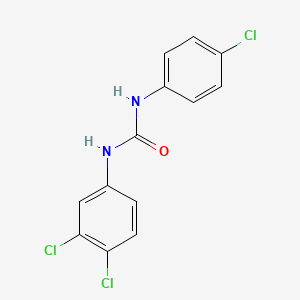
Triclocarban
Triclocarban is a member of the class of phenylureas that is urea substituted by a 4-chlorophenyl group and a 3,4-dichlorophenyl group at positions 1 and 3 respectively. It has a role as an antimicrobial agent, a xenobiotic, an antiseptic drug, a disinfectant and an environmental contaminant. It is a member of phenylureas, a dichlorobenzene and a member of monochlorobenzenes. It is functionally related to a 1,3-diphenylurea. — ChEBI
- IUPAC-Name
- 1-(4-chlorophenyl)-3-(3,4-dichlorophenyl)urea
- Summenformel
- C13H9Cl3N2O
- Molekulargewicht
- 315.6 g/mol
- Exakte Masse
- 313.978046 Da
- XLogP3
- 5,3
- Topologische polare Oberfläche
- 41,1 Ų
- Wasserstoffbrücken-Donoren
- 2
- Wasserstoffbrücken-Akzeptoren
- 1
- Kovalente Einheiten
- 1
- Definierte Stereozentren
- 0
Auch bekannt als
16 weitere gemeldete Namen
Kennungen in externen Datenbanken
- ChEBI:CHEBI:48347
- ChEMBL:CHEMBL1076347
- EPA DTXSID:DTXSID4026214
- PubMed:38631510
- PubMed:37385329
- PubMed:35413382
- PubMed:35164063
- PubMed:32065294
- PubMed:31868902
- PubMed:31576746
- PubMed:30940137
- PubMed:30657620
- PubMed:30592132
- PubMed:27979590
- PubMed:26827900
Belege aus weiteren wissenschaftlichen Datenbanken
EMBL-EBI ChEBI
triclocarban
A member of the class of phenylureas that is urea substituted by a 4-chlorophenyl group and a 3,4-dichlorophenyl group at positions 1 and 3 respectively.
- Rezeptur
- C13H9Cl3N2O
- Durchschnittsmasse
- 315.587 g/mol
- Monoisotopische Masse
- 313.97805 Da
- Formale Ladung
- 0
- phenylureas — is a (CHEBI:134043)
- dichlorobenzene — is a (CHEBI:23697)
- monochlorobenzenes — is a (CHEBI:83403)
- disinfectant — has role (CHEBI:48219)
- antiseptic drug — has role (CHEBI:48218)
- xenobiotic — has role (CHEBI:35703)
- antimicrobial agent — has role (CHEBI:33281)
- environmental contaminant — has role (CHEBI:78298)
- 1,3-diphenylurea — has functional parent (CHEBI:41320)
- disinfectant — has role (CHEBI:48219)
- antiseptic drug — has role (CHEBI:48218)
- xenobiotic — has role (CHEBI:35703)
- antimicrobial agent — has role (CHEBI:33281)
- environmental contaminant — has role (CHEBI:78298)
- phenylureas — is a (CHEBI:134043)
- dichlorobenzene — is a (CHEBI:23697)
- monochlorobenzenes — is a (CHEBI:83403)
Weitere kuratierte Namen
Querverweise aus dieser Quelle
Zugeordnet durch: Exact CAS cross-reference in the ChEBI compound record. Quelle aktualisiert: 2018-12-13. Abgerufen: 2026-08-31. Quelleneintrag öffnen
NIH PubChem PUG-View
Attributed physical-property, hazard, environmental and use annotations.
- Boiling Point: 250 °C at 97.8 kPa (733 mm Hg) Quelle: Hazardous Substances Data Bank (HSDB)
- Color/Form: Fine white plates Quelle: Hazardous Substances Data Bank (HSDB)
- Color/Form: Fine plates Quelle: Hazardous Substances Data Bank (HSDB)
- Color/Form: Fine, white to off-white powder Quelle: Hazardous Substances Data Bank (HSDB)
- Density: 0.336 g/cu cm at 20 °C Quelle: Hazardous Substances Data Bank (HSDB)
- Dissociation Constants: pKa = 12.7 Quelle: Hazardous Substances Data Bank (HSDB)
- LogP: log Kow = 4.342 at 25 °C, pH 8.1 Quelle: Hazardous Substances Data Bank (HSDB)
- Melting Point: 482 to 493 °F (NTP, 1992) Quelle: CAMEO Chemicals
- Melting Point: 491.2- 493 Quelle: DrugBank
- Melting Point: 254.4 °C Quelle: Hazardous Substances Data Bank (HSDB)
- Melting Point: MP: 255.2-256 °C Quelle: Hazardous Substances Data Bank (HSDB)
- Odor: Slight, characteristic odor Quelle: Hazardous Substances Data Bank (HSDB)
- Physical Description: Triclocarban appears as fine white plates or white powder. (NTP, 1992) Quelle: CAMEO Chemicals
- Physical Description: White solid; [Merck Index] Quelle: Haz-Map, Information on Hazardous Chemicals and Occupational Diseases
- Solubility: less than 1 mg/mL at 79 °F (NTP, 1992) Quelle: CAMEO Chemicals
- Solubility: Insoluble Quelle: DrugBank
- Solubility: In water, 0.11 mg/L at 20 °C Quelle: Hazardous Substances Data Bank (HSDB)
- Solubility: Practically insoluble in water Quelle: Hazardous Substances Data Bank (HSDB)
- Solubility: 1 g dissolves in 25 mL acetone; 3 mL dimethyl formamide Quelle: Hazardous Substances Data Bank (HSDB)
- Solubility: In methanol, 1.6 g/L at 35 °C Quelle: Hazardous Substances Data Bank (HSDB)
- First Aid: EYES: First check the victim for contact lenses and remove if present. Flush victim's eyes with water or normal saline solution for 20 to 30 minutes while simultaneously calling a hospital or poison control center. Do not put any ointments, oils, or medication in the victim's eyes without specific instructions from a physician. IMMEDIATELY transport the victim after flushing eyes to a hospital even if no symptoms (such as redness or irritation) develop.; SKIN: IMMEDIATELY flood affected skin with water while removing and isolating all contaminated clothing. Gently wash all affected skin areas thoroughly with soap and water. If symptoms such as redness or irritation develop, IMMEDIATELY call a physician and be prepared to transport the victim to a hospital for treatment.; INHALATION: IMMEDIATELY leave the contaminated area; take deep breaths of fresh air. If symptoms (such as wheezing, coughing, shortness of breath, or burning in the mouth, throat, or chest) develop, call a physician and be prepared to transport the victim to a hospital. Provide proper respiratory protection to rescuers entering an unknown atmosphere. Whenever possible, Self-Contained Breathing Apparatus (SCBA) shou Quelle: CAMEO Chemicals
- Signal: Warning Quelle: European Chemicals Agency (ECHA)
- GHS Hazard Statements: H400 (96.8%): Very toxic to aquatic life [Warning Hazardous to the aquatic environment, acute hazard]; H410 (100%): Very toxic to aquatic life with long lasting effects [Warning Hazardous to the aquatic environment, long-term hazard] Quelle: European Chemicals Agency (ECHA)
- Precautionary Statement Codes: P273, P391, and P501 (click each P-code to see the statement) Quelle: European Chemicals Agency (ECHA)
- ECHA C&L Notifications Summary: Aggregated GHS information provided per 185 reports by companies from 6 notifications to the ECHA C&L Inventory. Each notification may be associated with multiple companies.; Information may vary between notifications depending on impurities, additives, and other factors. The percentage value in parenthesis indicates the notified classification ratio from companies that provide hazard codes. Only hazard codes with percentage values above 10% are shown. For more detailed information, please visit ECHA C&L website. Quelle: European Chemicals Agency (ECHA)
- Signal: Warning Quelle: Hazardous Substances Data Bank (HSDB)
- GHS Hazard Statements: H400: Very toxic to aquatic life [Warning Hazardous to the aquatic environment, acute hazard]; H410: Very toxic to aquatic life with long lasting effects [Warning Hazardous to the aquatic environment, long-term hazard] Quelle: Hazardous Substances Data Bank (HSDB)
- Precautionary Statement Codes: P273, P391, and P501 (click each P-code to see the statement) Quelle: Hazardous Substances Data Bank (HSDB)
- Toxicity Summary: IDENTIFICATION AND USE: Triclocarban (TCC) is a solid. It has anti-microbial activity and is used globally in a wide range of personal cleansing products that include deodorant soaps, detergents, cleansing lotions, and wipes. In North America, TCC is used exclusively as an antimicrobial and preservative in bar and liquid soaps and body washes. HUMAN STUDIES: Studies in humans indicate no evidence of skin sensitization or severe irritation. Petrolatum (0.1mL) containing 0, 1, 3, 6, and 9% TCC was applied continuously for 21 days on ten males. Minimal skin irritation was observed with the 9% concentration. There was no evidence of skin sensitization in volunteers tested with TCC (1.5% and 10%). The potential impact of exposure to TCC on fetal abnormalities was studied in 39 pregnant women diagnosed with fetal or post-birth abnormalities. Significantly increased levels of TCC were detected in maternal sera from mothers with abnormal births. TCC was also studied for its endocrine-disrupting effects. TCC exerted estrogenic activities by inducing luciferase activities in an ER reporter gene assay, promoting the proliferation of the MCF-7 cells, up-regulating the expression of pS2 and dow Quelle: Hazardous Substances Data Bank (HSDB)
- Environmental Bioconcentration: BCF values for triclocarban in rice fish (Oryzias latipes), exposed for 28 days to 20 and 2.0 ug/L were 80 and 81, respectively(1). A log BCF of 2.86 (BCF = 724) was measured using medaka (Oryzias latipes) exposed to 20 ug/L of triclocarban for 24 hours(2). According to a classification scheme(3), these BCF values suggest bioconcentration in aquatic organisms is moderate to high(SRC). Triclocarban BAFs in algae of 1600 to 2700 from three locations downstream of a waste water treatment plant in Pecan Creek, TX(4). Triclocarban bioaccumulation peaked at day 5 of a 56 day study of worms (Lumbriculus variegatus) in soil containing 22.4 ug/g dry weight triclocarban(5). Body burdens of 25 and 133 ng/g wet wt, corresponding to a biota soil accumulation factor range of 0.22 to 0.7, were reported after 28 days in earthworm (Eisenia foetida) present in 2 soils (Ashkum heavy-textured silty clay loam; Chelsea light-textured fine sand). The soils were amended with municipal (Chicago, IL) biosolids containing an average triclocarban concentration of 9200 ng/g dry wt, resulting in an average trace level soil concentration of 9 ng/g dry wt(6). Quelle: Hazardous Substances Data Bank (HSDB)
- Environmental Fate: TERRESTRIAL FATE: Based on a classification scheme(1), Koc values of 12,000(2) to 71,687(3) indicate that triclocarban is expected to be immobile in soil(SRC). Volatilization of triclocarban from moist soil surfaces is not expected to be an important fate process(SRC) given an estimated Henry's Law constant of 4.5X10⁻¹¹ atm-cu m/mole(SRC), developed using a fragment constant estimation method(4). Triclocarban is not expected to volatilize from dry soil surfaces(SRC) based upon an estimated vapor pressure of 3.6X10⁻⁹ mm Hg at 25 °C(SRC), determined from a fragment constant method(5). Utilizing the Japanese MITI test, 1% of the Theoretical BOD was reached in 4 weeks(6) indicating that biodegradation is not an important environmental fate process in soil(SRC). However using a continuous flow activated sludge, 50-100% degradation was obtained in 12 weeks, following lag periods of up to two weeks(7). Quelle: Hazardous Substances Data Bank (HSDB)
- Environmental Fate: TERRESTRIAL FATE: Dewatered municipal biosolids (DMBs) were applied to a field at a rate of approximately 22 Mg dw/ha in October 2008. Pharmaceuticals and personal care products (PPCPs) were monitored in groundwater, tile drainage, soil, DMB aggregates incorporated into the soil post-land application, and in the grain of wheat grown on the field for a period of approximately 1 year following application. Over 80 PPCPs were analyzed in the source DMB. PPCPs selected for in-depth monitoring included ... triclocarban .... PPCPs in tile were observed twice, approximately 3 weeks and 2 months post-application. Of all PPCPs measured in tile drainage, only carbamazepine, ibuprofen, acetaminophen, triclosan, triclocarban, venlafaxine, and citalopram were detected (5-74 ng/L). PPCPs were not detected in groundwater >2 m depth below the soil surface, and concentrations above detection limits at 2 m depth were only observed once just after the first rain event post-application. In groundwater, all compounds found in tile, except carbamazepine, acetaminophen and citalopram, were detected (10-19 ng/L). PPCPs were detected in DMB aggregates incorporated in soil up to 1 year post-application, wit Quelle: Hazardous Substances Data Bank (HSDB)
- Environmental Fate: AQUATIC FATE: Based on a classification scheme(1), Koc values of 12,000(2) to 71687(3) indicate that triclocarban is expected to adsorb to suspended solids and sediment(SRC). Volatilization from water surfaces is not expected(4) based upon an estimated Henry's Law constant of 4.5X10⁻¹¹ atm-cu m/mole(SRC), developed using a fragment constant estimation method(5). According to a classification scheme(6), BCF values of 80(7) to 724(8) suggest the potential for bioconcentration in aquatic organisms is moderate to high(SRC). Utilizing the Japanese MITI test, 1% of the Theoretical BOD was reached in 4 weeks(7) indicating that biodegradation is not an important environmental fate process in water(SRC). However using a continuous flow activated sludge, 50-100% degradation was obtained in 12 weeks, following lag periods of up to two weeks(9). Quelle: Hazardous Substances Data Bank (HSDB)
- Environmental Fate: ATMOSPHERIC FATE: According to a model of gas/particle partitioning of semivolatile organic compounds in the atmosphere(1), triclocarban, which has an estimated vapor pressure of 3.6X10⁻⁹ mm Hg at 25 °C(SRC), determined from a fragment constant method(2), is expected to exist solely in the particulate phase in the ambient atmosphere. Particulate-phase triclocarban may be removed from the air by wet and dry deposition(SRC). Triclocarban contains chromophores that absorb at wavelengths >290 nm(3) and, therefore, may be susceptible to direct photolysis by sunlight(SRC). Quelle: Hazardous Substances Data Bank (HSDB)
- Sources/Uses: Used as an antiseptic in cleaning products; [Merck Index] Used for skin and mucous membrane disinfection; [Reference #1] Quelle: Haz-Map, Information on Hazardous Chemicals and Occupational Diseases
- Industrial Processes with risk of exposure: Using Disinfectants or Biocides [Category: Clean] Quelle: Haz-Map, Information on Hazardous Chemicals and Occupational Diseases
- Uses: For 3,4,4'-trichlorocarbanilide (USEPA/OPP Pesticide Code: 027901) there are 0 labels match. /SRP: Not registered for current use in the U.S., but approved pesticide uses may change periodically and so federal, state and local authorities must be consulted for currently approved uses./ Quelle: Hazardous Substances Data Bank (HSDB)
- Uses: Bacteriostat and antiseptic in soaps and other cleansing compositions. Quelle: Hazardous Substances Data Bank (HSDB)
- Uses: Bacteriostat in ... plastics. Quelle: Hazardous Substances Data Bank (HSDB)
- Uses: Triclocarban is an anti-microbial active ingredient used globally in a wide range of personal cleansing products that include deodorant soaps, detergents, cleansing lotions, and wipes. In North America, triclocarban is used exclusively as an antimicrobial and preservative in bar and liquid soaps and body washes. Quelle: Hazardous Substances Data Bank (HSDB)
- Uses: Deodorant soaps contain an active ingredient such as 3,4,4'-trichlorocarbanilide (trichlocarban) to inhibit the growth of skin bacteria responsible for the formation of odor-causing substances from perspiration Quelle: Hazardous Substances Data Bank (HSDB)
Zugeordnet durch: Existing checksum-valid CAS to unique PubChem CID match. Abgerufen: 2026-08-31. Quelleneintrag öffnen
Wissenschaftliche Klassifizierungen und Gefahrenannotationen liefern Kontext und ersetzen nicht die oben gezeigte marktspezifische regulatorische Entscheidung.
Weitere Quellenabdeckung und Trefferstatus
| Quelle | Ergebnis | Geprüft |
|---|---|---|
| EMBL-EBI ChEBI | Exakter Treffer | 2026-08-31 |
| NIH PubChem PUG-View | Exakter Treffer | 2026-08-31 |
Ein erfasster Nicht-Treffer ist ein nützlicher Beleg dafür, dass die Quelle geprüft wurde; er ist keine Behauptung, dass der Stoff anderswo nicht existiert.
Am 2026-08-31 von NIH PubChem durch prüfsummengültigen CAS-Abgleich abgerufen. Chemische Eigenschaften ersetzen nicht die regulatorische Entscheidung auf dieser Seite.
Verzeichnisverknüpfungen für Triclocarban
Verwandte Einträge zu Triclocarban
Für diesen Eintrag gibt es nur wenige direkte Treffer; daher werden auch nahe liegende Einträge aus Anhang V angezeigt.
DICHLOROBENZYL ALCOHOL
2-BROMO-2-NITROPROPANE-1,3-DIOL
5-BROMO-5-NITRO-1,3-DIOXANE
CHLOROXYLENOL
IMIDAZOLIDINYL UREA
UNDECYLENIC ACID / POTASSIUM UNDECYLENATE / SODIUM UNDECYLENATE / CALCIUM UNDECYLENATE / MEA-UNDECY…
POLYAMINOPROPYL BIGUANIDE
PHENYL MERCURIC ACETATE / PHENYL MERCURIC BENZOATE
Was Anhang V für Triclocarban bedeutet
Triclocarban ist ein zugelassener Konservierungsstoff, der in Anhang V der EU-Kosmetikverordnung (EG) Nr. 1223/2009 aufgeführt ist. Nur Stoffe dieser Positivliste dürfen in der EU als kosmetische Konservierungsstoffe verwendet werden.
Jeder Eintrag zu einem Konservierungsstoff legt zulässige Höchstkonzentrationen und den Anwendungsbereich fest. Die Konzentrationen dürfen das aufgeführte Maximum nicht überschreiten. Für einige Konservierungsstoffe sind Warnhinweise auf dem Produktetikett erforderlich.
Dieser Eintrag ist zum Abgleich von Namen und Kennungen mit 1 Inhaltsstoff des CosIng-Verzeichnisses verknüpft. Die Seite zeigt außerdem 12 verwandte Anhangseinträge mit überschneidenden Kennungen, Anhangslogik oder Namensmustern.
Compliance-Checkliste
- Die Einsatzkonzentration darf nicht überschreiten: 0,2 %
- Prüfen Sie, dass der Konservierungsstoff bei der zulässigen Konzentration in Ihrer Matrix wirksam ist.
- Bringen Sie den erforderlichen Warnhinweis auf dem Etikett an.
Häufig gestellte Fragen
Quellenhinweis zu Anhang V, Eintrag Triclocarban
Diese Seite fasst einen Eintrag aus Anhang V für Triclocarban aus öffentlichen Materialien der Europäischen Kommission zu kosmetischen Mitteln zusammen und ergänzt, soweit verfügbar, verknüpfte Treffer aus dem Verzeichnis oder bei Kennungen.
Nutzen Sie diese Eintragsseite, um die Bedingungen aus Anhang V für Triclocarban zu prüfen; bestätigen Sie jede endgültige regulatorische Entscheidung jedoch anhand des aktuellen amtlichen Anhangswortlauts und der Quelldateien.
Werkzeuge und nächste Schritte
Rezeptur prüfen
Fügen Sie eine vollständige INCI-Liste ein, um Triclocarban und andere markierte EU-Anhangseinträge in einem Durchgang zu finden.
INCI-CheckerEinträge vergleichen
Triclocarban nebeneinander mit einem anderen Anhangseintrag vergleichen, um Unterschiede bei Beschränkungen, Konzentrationen und Anhangszuordnung zu prüfen.
VergleichenDen Anhang durchsuchen
Alle Einträge in Anhang V ansehen und die regulatorischen Bedingungen der Stoffe in diesem Anhang vergleichen.
Anhang V öffnen