
Citronellol
Citronellol/ (±) 3,7-Dimethyl-6-octen-1-ol; (3R)-3,7-dimethyloct-6-en-1-ol; (3S)-3,7-dimethyloct-6-en-1-ol;
Citronellol ist in Anhang III aufgeführt und darf nur unter den in diesem Eintrag genannten Bedingungen verwendet werden.
Dieser Stoff steht auf der EU-Liste der Duftstoffallergene, die in der Inhaltsstoffliste einzeln genannt werden müssen und nicht durch das Wort „parfum“ abgedeckt sind, sobald sie in einem Produkt, das auf der Haut verbleibt, 0,001% oder in einem abzuspülenden Produkt 0,01% überschreiten.
Die Kennzeichnung ist eine Pflicht nach Artikel 19 und keine Verwendungsbeschränkung. Den Allergeneintrag ansehen
Eintragsdetails
Sonstige Beschränkungen
The presence of the substance shall be indicated in the list of ingredients referred to in Article 19(1), point (g), when its concentration exceeds:
— 0,001 % in leave-on products
— 0,01 % in rinse-off products.
INCI-Glossarname
Citronellol
Chemische Bezeichnung
Citronellol/ (±) 3,7-Dimethyl-6-octen-1-ol; (3R)-3,7-dimethyloct-6-en-1-ol; (3S)-3,7-dimethyloct-6-en-1-ol;
Regulatorische Informationen
Identifizierte Inhaltsstoffe
EU-Duftstoffallergen
Dieser Stoff ist mit einer EU-Referenz zu Duftstoffallergenen verknüpft. Prüfen Sie den aktuellen Eintrag in Anhang III auf den Kennzeichnungsschwellenwert und etwaige zusätzliche Bedingungen.
Kerndaten
Chemische Identität und Eigenschaften
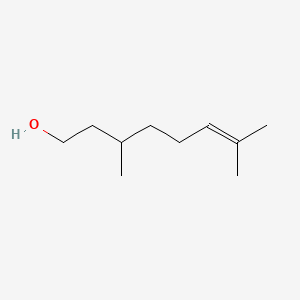
Citronellol
(±)-β-citronellol has been reported in Ambrosiozyma monospora, Artemisia princeps, and other organisms with data available. — LOTUS - the natural products occurrence database
- IUPAC-Name
- 3,7-dimethyloct-6-en-1-ol
- Summenformel
- C10H20O
- Molekulargewicht
- 156.26 g/mol
- Exakte Masse
- 156.151415257 Da
- XLogP3
- 3,2
- Topologische polare Oberfläche
- 20,2 Ų
- Wasserstoffbrücken-Donoren
- 1
- Wasserstoffbrücken-Akzeptoren
- 1
- Kovalente Einheiten
- 1
- Definierte Stereozentren
- 0
Auch bekannt als
16 weitere gemeldete Namen
Kennungen in externen Datenbanken
- ChEBI:CHEBI:50462
- ChEMBL:CHEMBL395827
- EPA DTXSID:DTXSID3026726
- PubMed:32513280
- PubMed:31926054
- PubMed:29445768
- PubMed:27607409
- PubMed:26944432
- PubMed:26795242
- PubMed:26456648
- PubMed:26141506
- PubMed:25414073
- PubMed:23449869
- PubMed:22945026
- PubMed:21819085
Belege aus weiteren wissenschaftlichen Datenbanken
EMBL-EBI ChEBI
citronellol
A monoterpenoid that is oct-6-ene substituted by a hydroxy group at position 1 and methyl groups at positions 3 and 7.
- Rezeptur
- C10H20O
- Durchschnittsmasse
- 156.269 g/mol
- Monoisotopische Masse
- 156.15142 Da
- Formale Ladung
- 0
- monoterpenoid — is a (CHEBI:25409)
- plant metabolite — has role (CHEBI:76924)
- plant metabolite — has role (CHEBI:76924)
- monoterpenoid — is a (CHEBI:25409)
- 20964319 Quelle: PubMed
Weitere kuratierte Namen
Querverweise aus dieser Quelle
- CAS: 106-22-9 — ChemIDplus
- CAS: 106-22-9 — NIST Chemistry WebBook
- REGISTRY_NUMBER: 1362474 — Reaxys
- MANUAL_X_REF: Citronellol — Wikipedia
Zugeordnet durch: Exact CAS cross-reference in the ChEBI compound record. Quelle aktualisiert: 2015-08-17. Abgerufen: 2026-08-31. Quelleneintrag öffnen
NIH PubChem PUG-View
Attributed physical-property, hazard, environmental and use annotations.
- Boiling Point: 224 °C Quelle: Hazardous Substances Data Bank (HSDB)
- Boiling Point: BP: 108-109 °C at 10 mm Hg; specific gravity: 1.4576 at 18/4 °C /(-)-Form/ Quelle: Hazardous Substances Data Bank (HSDB)
- Boiling Point: 225 °C Quelle: Joint FAO/WHO Expert Committee on Food Additives (JECFA)
- Color/Form: Colorless oily liquid Quelle: Hazardous Substances Data Bank (HSDB)
- Density: 0.8550 g/cu cm at 20 °C Quelle: Hazardous Substances Data Bank (HSDB)
- Density: 0.850-0.860 Quelle: Joint FAO/WHO Expert Committee on Food Additives (JECFA)
- LogP: log Kow = 3.91 Quelle: Hazardous Substances Data Bank (HSDB)
- Melting Point: <-20 °C Quelle: Hazardous Substances Data Bank (HSDB)
- Odor: Fresh rosy odor Quelle: Hazardous Substances Data Bank (HSDB)
- Odor: Rose odor Quelle: Hazardous Substances Data Bank (HSDB)
- Physical Description: CBI; Liquid; Dry Powder; Liquid Quelle: EPA Chemical Data Reporting (CDR)
- Physical Description: Colorless to pale yellow liquid with a sweet floral odor; [EPA BRADs] Colorless liquid with a rose-like odor; [Acros Organics MSDS] Quelle: Haz-Map, Information on Hazardous Chemicals and Occupational Diseases
- Physical Description: colourless oily liquid; rose-like aroma Quelle: Joint FAO/WHO Expert Committee on Food Additives (JECFA)
- Refractive Index: Index of refraction: 1.4559 at 20 °C Quelle: Hazardous Substances Data Bank (HSDB)
- Refractive Index: 1.454-1.462 Quelle: Joint FAO/WHO Expert Committee on Food Additives (JECFA)
- Solubility: In water, 200 mg/L at 25 °C Quelle: Hazardous Substances Data Bank (HSDB)
- Solubility: In water, 307 mg/L at 25 °C; 300 mg/L at 20 °C Quelle: Hazardous Substances Data Bank (HSDB)
- Solubility: Soluble in fixed oils, propylene glycol; insoluble in glycerin Quelle: Hazardous Substances Data Bank (HSDB)
- Solubility: Miscible in ethanol and ether /(+)-citronellol/; very soluble in ethanol and ether /(-)-citronellol/ Quelle: Hazardous Substances Data Bank (HSDB)
- Solubility: Insoluble in glycerol; slightly soluble in water; soluble in most fixed oils, propylene glycol Quelle: Joint FAO/WHO Expert Committee on Food Additives (JECFA)
- Solubility: soluble (in ethanol) Quelle: Joint FAO/WHO Expert Committee on Food Additives (JECFA)
- Vapor Pressure: 0.04 [mmHg] Quelle: Haz-Map, Information on Hazardous Chemicals and Occupational Diseases
- Vapor Pressure: 0.02 mm Hg at 25 °C Quelle: Hazardous Substances Data Bank (HSDB)
- Viscosity: 11.1 mPa s (dynamic) at 20 °C; 5.33 mPa s (dynamic) at 40 °C Quelle: Hazardous Substances Data Bank (HSDB)
- Signal: Warning Quelle: European Chemicals Agency (ECHA)
- GHS Hazard Statements: H315 (95.7%): Causes skin irritation [Warning Skin corrosion/irritation]; H317 (99.6%): May cause an allergic skin reaction [Warning Sensitization, Skin]; H319 (65.1%): Causes serious eye irritation [Warning Serious eye damage/eye irritation]; H411 (15.8%): Toxic to aquatic life with long lasting effects [Hazardous to the aquatic environment, long-term hazard] Quelle: European Chemicals Agency (ECHA)
- Precautionary Statement Codes: P261, P264, P264+P265, P272, P273, P280, P302+P352, P305+P351+P338, P321, P332+P317, P333+P317, P337+P317, P362+P364, P391, and P501 (click each P-code to see the statement) Quelle: European Chemicals Agency (ECHA)
- ECHA C&L Notifications Summary: Aggregated GHS information provided per 1657 reports by companies from 29 notifications to the ECHA C&L Inventory. Each notification may be associated with multiple companies.; Information may vary between notifications depending on impurities, additives, and other factors. The percentage value in parenthesis indicates the notified classification ratio from companies that provide hazard codes. Only hazard codes with percentage values above 10% are shown. For more detailed information, please visit ECHA C&L website. Quelle: European Chemicals Agency (ECHA)
- GHS Hazard Statements: H315 (100%): Causes skin irritation [Warning Skin corrosion/irritation]; H317 (100%): May cause an allergic skin reaction [Warning Sensitization, Skin]; H319 (17.5%): Causes serious eye irritation [Warning Serious eye damage/eye irritation] Quelle: European Chemicals Agency (ECHA)
- Precautionary Statement Codes: P261, P264, P264+P265, P272, P280, P302+P352, P305+P351+P338, P321, P332+P317, P333+P317, P337+P317, P362+P364, and P501 (click each P-code to see the statement) Quelle: European Chemicals Agency (ECHA)
- ECHA C&L Notifications Summary: Aggregated GHS information provided per 103 reports by companies from 4 notifications to the ECHA C&L Inventory. Each notification may be associated with multiple companies.; Information may vary between notifications depending on impurities, additives, and other factors. The percentage value in parenthesis indicates the notified classification ratio from companies that provide hazard codes. Only hazard codes with percentage values above 10% are shown. For more detailed information, please visit ECHA C&L website. Quelle: European Chemicals Agency (ECHA)
- Signal: Warning Quelle: Hazardous Substances Data Bank (HSDB)
- GHS Hazard Statements: H315: Causes skin irritation [Warning Skin corrosion/irritation]; H317: May cause an allergic skin reaction [Warning Sensitization, Skin]; H319: Causes serious eye irritation [Warning Serious eye damage/eye irritation]; H401: Toxic to aquatic life [Hazardous to the aquatic environment, acute hazard] Quelle: Hazardous Substances Data Bank (HSDB)
- Precautionary Statement Codes: P261, P264, P264+P265, P272, P273, P280, P302+P352, P305+P351+P338, P321, P332+P317, P333+P317, P337+P317, P362+P364, and P501 (click each P-code to see the statement) Quelle: Hazardous Substances Data Bank (HSDB)
- Toxicity Summary: IDENTIFICATION AND USE: Citronellol has been found in nature, and it has been reported in about 70 essential oils. It is registered for pesticide use in the USA but approved pesticide uses may change periodically and so federal, state and local authorities must be consulted for currently approved uses. It is also used in perfumery. HUMAN EXPOSURE AND TOXICITY: Adult male volunteers with no known allergic reactions were patch-tested on their back for 48 hr with 32% citronellol. After 48 hr, patches were removed and the skin was cleaned of any residual test material. Moderate irritation was observed. A patch test using a 1% concentration of citronellol in acetone gave a positive reaction in subjects allergic to citronella oil. ANIMAL STUDIES: Citronellol applied full strength to intact or abraded rabbit skin for 24 hr under occlusion was moderately irritating. Severe irritation was observed in rabbits and guinea pigs exposed to 100% compound (unoccluded) for 24, 48 or 72 hr. Citronellol was not mutagenic when tested in Salmonella typhimurium strains TA98 and TA100 in the presence and absence of metabolic activation. ECOTOXICITY STUDIES: Golden Orfe (Leuciscus idus) were exposed to th Quelle: Hazardous Substances Data Bank (HSDB)
- Environmental Bioconcentration: An estimated BCF of 177 was calculated in fish for citronellol(SRC), using a log Kow of 3.91(1) and a regression-derived equation(2). According to a classification scheme(3), this BCF suggests the potential for bioconcentration in aquatic organisms is high(SRC), provided the compound is not metabolized by the organism(SRC). Quelle: Hazardous Substances Data Bank (HSDB)
- Environmental Fate: TERRESTRIAL FATE: Based on a classification scheme(1), an estimated Koc value of 94(SRC), determined from a structure estimation method(2), indicates that citronellol is expected to have high mobility in soil(SRC). Volatilization of citronellol from moist soil surfaces is expected to be an important fate process(SRC) given an estimated Henry's Law constant of 2.1X10⁻⁵ atm-cu m/mole(SRC), derived from its vapor pressure, 0.02 mm Hg(3), and water solubility, 200 mg/L(4). Even though the vapor pressure is low environmentally at standard temperature and pressure, there is a detectable odor; therefore, citronellol may volatilize from dry soil(SRC). An 80-90% of Theoretical BOD using activated sludge in the OECD 301F test(5) suggests that biodegradation is an important environmental fate process in soil(SRC). Citronellol was also classified as readily biodegradable by the results of the OECD 301C test (modified MITI) with 65% degradation in 4 weeks(6) and by a DOC Method F test (100% biodegradation in 15 days)(6). Citronellol absorbs at wavelengths >290 nm(7) and, therefore, may be susceptible to direct photolysis on soil surfaces exposed to sunlight(SRC). Quelle: Hazardous Substances Data Bank (HSDB)
- Environmental Fate: AQUATIC FATE: Based on a classification scheme(1), an estimated Koc value of 94(SRC), determined from a structure estimation method(2), indicates that citronellol is not expected to adsorb to suspended solids and sediment(SRC). Volatilization from water surfaces is expected(3) based upon an estimated Henry's Law constant of 2.1X10⁻⁵ atm-cu m/mole(SRC), derived from its vapor pressure, 0.02 mm Hg(4), and water solubility, 200 mg/L(5). Using this Henry's Law constant and an estimation method(3), volatilization half-lives for a model river and model lake are 2.4 and 21 days, respectively(SRC). According to a classification scheme(6), an estimated BCF of 177(SRC), from its log Kow of 3.91(7) and a regression-derived equation(2), suggests the potential for bioconcentration in aquatic organisms is high(SRC). An 80-90% of Theoretical BOD using activated sludge in the OECD 301F test(8) suggests that biodegradation is an important environmental fate process in water(SRC). Citronellol was also classified as readily biodegradable by the results of the OECD 301C test (modified MITI) with 65% degradation in 4 weeks(9) and by a DOC Method F test (100% biodegradation in 15 days)(9). Citronellol i Quelle: Hazardous Substances Data Bank (HSDB)
- Environmental Fate: ATMOSPHERIC FATE: According to a model of gas/particle partitioning of semivolatile organic compounds in the atmosphere(1), citronellol, which has a vapor pressure of 0.02 mm Hg at 25 °C(2), is expected to exist solely as a vapor in the ambient atmosphere. Vapor-phase citronellol is degraded in the atmosphere by reaction with photochemically-produced hydroxyl radicals(SRC); the half-life for this reaction in air is estimated to be 2.3 hours(SRC), calculated from its rate constant of 1.70X10⁻¹⁰ cu cm/molecule-sec at 24 deg(3). Citronellol is also degraded in the atmosphere by reaction with ozone and nitrate radicals. The half-life for the reaction with ozone is estimated to be 1.1 hours(SRC), calculated from its rate constant of 2.4X10⁻¹⁶ cu cm/molecule-sec at 24 °C(3). The half-life for the reaction with nitrate radicals is estimated to be 4 minutes(SRC), calculated from its rate constant of 1.21X10⁻¹¹ cu cm/molecule-sec at 24 °C(4). The nitrate radical (NO3) is the dominant atmospheric oxidant during the night-time in most atmospheric environments(5), therefore, night-time degradation appears to be a major fate process for citronellol(SRC). Citronellol absorbs at wavelengths >290 Quelle: Hazardous Substances Data Bank (HSDB)
- Consumer Uses: Fragrance; Odor agents Quelle: EPA Chemical Data Reporting (CDR)
- Industry Uses: Other; Intermediate; Odor agents; Fragrance Quelle: EPA Chemical Data Reporting (CDR)
- Sources/Uses: l-Form: in rose and geranium oils; d-Form: in Ceylon and Java citronella oils; Used in perfumery; [Merck Index] Permitted for use as an inert ingredient in non-food pesticide products; [EPA] Present in over 30 essential oils, fruits, edible plants, wine, beer, and black tea; Active ingredient in pesticide used to control mites on agricultural crops, ornamentals, and landscapes; Also extensively used as fragrance (detergents, soaps, lotions, perfumes, etc.), as a flavoring agent, and component of citronella oil (used in candles, sprays, oils, and insect repellents); [EPA BRADs] Quelle: Haz-Map, Information on Hazardous Chemicals and Occupational Diseases
- Industrial Processes with risk of exposure: Farming (Pesticides) [Category: Industry] Quelle: Haz-Map, Information on Hazardous Chemicals and Occupational Diseases
- Uses: For citronellol (USEPA/OPP Pesticide Code: 167004) ACTIVE products with label matches. /SRP: Registered for use in the USA but approved pesticide uses may change periodically and so federal, state and local authorities must be consulted for currently approved uses./ Quelle: Hazardous Substances Data Bank (HSDB)
- Uses: Reported uses (ppm):; Table: Reported uses (ppm): (Flavor and Extract Manufacturers' Association, 1994) [Table#6302] Quelle: Hazardous Substances Data Bank (HSDB)
- Uses: In perfumery Quelle: Hazardous Substances Data Bank (HSDB)
- Uses: Citronellol is one of the components responsible for the insect repellent properties of citronella oil ... Citronellol finds extensive use in floral fragrances and in flavors for citrus and other fruit notes. Its stability makes it particularly useful in fragrances for soaps, detergents, and other household products. Citronellol is also important as an intermediate in the synthesis of a number of other aroma chemicals ... Citronellol is the key feedstock for the synthesis of rose oxide. Quelle: Hazardous Substances Data Bank (HSDB)
- Uses: Citronellol is one of the most widely used fragrance materials, particularly for rose notes and for floral compositions in general. As flavor material, citronellol is added for bouquetting purposes to citrus compositions. It is the starting material for numerous citronellyl esters and for hydroxydihydrocitronellol, an intermediate in the production of hydroxydihydrocitronellal. Quelle: Hazardous Substances Data Bank (HSDB)
Zugeordnet durch: Existing checksum-valid CAS to unique PubChem CID match. Abgerufen: 2026-08-31. Quelleneintrag öffnen
Wissenschaftliche Klassifizierungen und Gefahrenannotationen liefern Kontext und ersetzen nicht die oben gezeigte marktspezifische regulatorische Entscheidung.
Weitere Quellenabdeckung und Trefferstatus
| Quelle | Ergebnis | Geprüft |
|---|---|---|
| EMBL-EBI ChEBI | Exakter Treffer | 2026-08-31 |
| NIH PubChem PUG-View | Exakter Treffer | 2026-08-31 |
Ein erfasster Nicht-Treffer ist ein nützlicher Beleg dafür, dass die Quelle geprüft wurde; er ist keine Behauptung, dass der Stoff anderswo nicht existiert.
Am 2026-09-02 von NIH PubChem durch prüfsummengültigen CAS-Abgleich abgerufen. Chemische Eigenschaften ersetzen nicht die regulatorische Entscheidung auf dieser Seite.
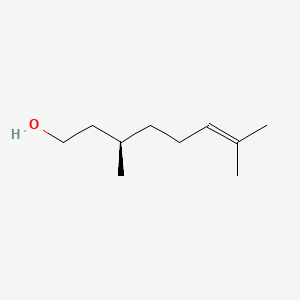
beta-CITRONELLOL, (R)-
(R)-(+)-citronellol is a citronellol that is oct-6-ene substituted by a hydroxy group at position 1 and methyl groups at positions 3 and 7 (the 3R-enantiomer). It is an enantiomer of a (S)-(-)-citronellol. — ChEBI
- IUPAC-Name
- (3R)-3,7-dimethyloct-6-en-1-ol
- Summenformel
- C10H20O
- Molekulargewicht
- 156.26 g/mol
- Exakte Masse
- 156.151415257 Da
- XLogP3
- 3,2
- Topologische polare Oberfläche
- 20,2 Ų
- Wasserstoffbrücken-Donoren
- 1
- Wasserstoffbrücken-Akzeptoren
- 1
- Kovalente Einheiten
- 1
- Definierte Stereozentren
- 1
Auch bekannt als
16 weitere gemeldete Namen
Kennungen in externen Datenbanken
- ChEBI:CHEBI:10360
- ChEMBL:CHEMBL1907993
- EPA DTXSID:DTXSID00880647
- PubMed:23074914
- PubMed:23030436
- PubMed:22945026
- PubMed:22816268
- PubMed:22805839
- PubMed:22675581
- PubMed:22606039
- PubMed:22553389
- PubMed:22510493
- PubMed:22493851
- PubMed:22408409
- PubMed:22393330
Belege aus weiteren wissenschaftlichen Datenbanken
NIH PubChem PUG-View
Attributed physical-property, hazard, environmental and use annotations.
- Boiling Point: 221.00 to 224.00 °C. @ 760.00 mm Hg Quelle: Human Metabolome Database (HMDB)
- Physical Description: Liquid Quelle: EPA Chemical Data Reporting (CDR)
- Physical Description: Colorless viscous liquid; [Sigma-Aldrich MSDS] Quelle: Haz-Map, Information on Hazardous Chemicals and Occupational Diseases
- Vapor Pressure: 0.02 [mmHg] Quelle: Haz-Map, Information on Hazardous Chemicals and Occupational Diseases
- Signal: Warning Quelle: European Chemicals Agency (ECHA)
- GHS Hazard Statements: H315 (100%): Causes skin irritation [Warning Skin corrosion/irritation]; H317 (86%): May cause an allergic skin reaction [Warning Sensitization, Skin]; H319 (36.2%): Causes serious eye irritation [Warning Serious eye damage/eye irritation]; H335 (14%): May cause respiratory irritation [Warning Specific target organ toxicity, single exposure; Respiratory tract irritation] Quelle: European Chemicals Agency (ECHA)
- Precautionary Statement Codes: P261, P264, P264+P265, P271, P272, P280, P302+P352, P304+P340, P305+P351+P338, P319, P321, P332+P317, P333+P317, P337+P317, P362+P364, P403+P233, P405, and P501 (click each P-code to see the statement) Quelle: European Chemicals Agency (ECHA)
- ECHA C&L Notifications Summary: Aggregated GHS information provided per 279 reports by companies from 6 notifications to the ECHA C&L Inventory. Each notification may be associated with multiple companies.; Information may vary between notifications depending on impurities, additives, and other factors. The percentage value in parenthesis indicates the notified classification ratio from companies that provide hazard codes. Only hazard codes with percentage values above 10% are shown. For more detailed information, please visit ECHA C&L website. Quelle: European Chemicals Agency (ECHA)
- Consumer Uses: Odor agents Quelle: EPA Chemical Data Reporting (CDR)
- Industry Uses: Odor agents Quelle: EPA Chemical Data Reporting (CDR)
Zugeordnet durch: Existing checksum-valid CAS to unique PubChem CID match. Abgerufen: 2026-08-31. Quelleneintrag öffnen
Wissenschaftliche Klassifizierungen und Gefahrenannotationen liefern Kontext und ersetzen nicht die oben gezeigte marktspezifische regulatorische Entscheidung.
Weitere Quellenabdeckung und Trefferstatus
| Quelle | Ergebnis | Geprüft |
|---|---|---|
| NIH PubChem PUG-View | Exakter Treffer | 2026-08-31 |
Ein erfasster Nicht-Treffer ist ein nützlicher Beleg dafür, dass die Quelle geprüft wurde; er ist keine Behauptung, dass der Stoff anderswo nicht existiert.
Am 2026-09-02 von NIH PubChem durch prüfsummengültigen CAS-Abgleich abgerufen. Chemische Eigenschaften ersetzen nicht die regulatorische Entscheidung auf dieser Seite.
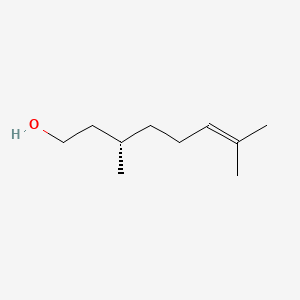
Beta-citronellol, (S)-
(S)-(-)-citronellol is a citronellol that is oct-6-ene substituted by a hydroxy group at position 1 and methyl groups at positions 3 and 7 (the 3S-enantiomer). It is an enantiomer of a (R)-(+)-citronellol. — ChEBI
- IUPAC-Name
- (3S)-3,7-dimethyloct-6-en-1-ol
- Summenformel
- C10H20O
- Molekulargewicht
- 156.26 g/mol
- Exakte Masse
- 156.151415257 Da
- XLogP3
- 3,2
- Topologische polare Oberfläche
- 20,2 Ų
- Wasserstoffbrücken-Donoren
- 1
- Wasserstoffbrücken-Akzeptoren
- 1
- Kovalente Einheiten
- 1
- Definierte Stereozentren
- 1
Auch bekannt als
16 weitere gemeldete Namen
Kennungen in externen Datenbanken
Am 2026-09-02 von NIH PubChem durch prüfsummengültigen CAS-Abgleich abgerufen. Chemische Eigenschaften ersetzen nicht die regulatorische Entscheidung auf dieser Seite.
Verzeichnisverknüpfungen für Citronellol
CITRONELLOL
Verwandte Einträge zu Citronellol
Für diesen Eintrag gibt es nur wenige direkte Treffer; daher werden auch nahe liegende Einträge aus Anhang III angezeigt.
Limonene
ALPHA-ISOMETHYL IONONE
EVERNIA PRUNASTRI EXTRACT
EVERNIA FURFURACEA EXTRACT
Was Anhang III für Citronellol bedeutet
Citronellol ist ein beschränkter Stoff nach Anhang III der EU-Kosmetikverordnung (EG) Nr. 1223/2009. Seine Verwendung in kosmetischen Mitteln ist nur unter den im obigen Eintrag genannten besonderen Bedingungen zulässig, einschließlich geltender Konzentrationsgrenzen, Beschränkungen der Produktart und erforderlicher Warnhinweise.
Wird dieser Stoff in einer Rezeptur verwendet, müssen alle Bedingungen – Höchstkonzentration, Produktbereich und Warnhinweise – gleichzeitig erfüllt sein. Die Einhaltung einer Bedingung hebt die anderen nicht auf.
Dieser Eintrag ist zum Abgleich von Namen und Kennungen mit 3 Inhaltsstoffen des CosIng-Verzeichnisses verknüpft. Die Seite zeigt außerdem 12 verwandte Anhangseinträge mit überschneidenden Kennungen, Anhangslogik oder Namensmustern.
Compliance-Checkliste
- Dokumentieren Sie die Verwendungsbedingungen in der Produktinformationsdatei (PIF).
- Dieser Stoff ist ein regulierter Duftstoffallergen. Geben Sie ihn mit seinem INCI-Namen auf dem Etikett an, wenn er in Produkten, die auf der Haut verbleiben, in mehr als 0,001% oder in abzuspülenden Produkten in mehr als 0,01% enthalten ist.
Häufig gestellte Fragen
Quellenhinweis zu Anhang III, Eintrag Citronellol
Diese Seite fasst einen Eintrag aus Anhang III für Citronellol aus öffentlichen Materialien der Europäischen Kommission zu kosmetischen Mitteln zusammen und ergänzt, soweit verfügbar, verknüpfte Treffer aus dem Verzeichnis oder bei Kennungen.
Nutzen Sie diese Eintragsseite, um die Bedingungen aus Anhang III für Citronellol zu prüfen; bestätigen Sie jede endgültige regulatorische Entscheidung jedoch anhand des aktuellen amtlichen Anhangswortlauts und der Quelldateien.
Werkzeuge und nächste Schritte
Rezeptur prüfen
Fügen Sie eine vollständige INCI-Liste ein, um Citronellol und andere markierte EU-Anhangseinträge in einem Durchgang zu finden.
INCI-CheckerEinträge vergleichen
Citronellol nebeneinander mit einem anderen Anhangseintrag vergleichen, um Unterschiede bei Beschränkungen, Konzentrationen und Anhangszuordnung zu prüfen.
VergleichenDen Anhang durchsuchen
Alle Einträge in Anhang III ansehen und die regulatorischen Bedingungen der Stoffe in diesem Anhang vergleichen.
Anhang III öffnen