
Benzyl benzoate
Benzyl benzoate ist in Anhang III aufgeführt und darf nur unter den in diesem Eintrag genannten Bedingungen verwendet werden.
Dieser Stoff steht auf der EU-Liste der Duftstoffallergene, die in der Inhaltsstoffliste einzeln genannt werden müssen und nicht durch das Wort „parfum“ abgedeckt sind, sobald sie in einem Produkt, das auf der Haut verbleibt, 0,001% oder in einem abzuspülenden Produkt 0,01% überschreiten.
Die Kennzeichnung ist eine Pflicht nach Artikel 19 und keine Verwendungsbeschränkung. Den Allergeneintrag ansehen
Eintragsdetails
Sonstige Beschränkungen
The presence of the substance must be indicated in the list of ingredients referred to in Article 19(1)g when its concentration exceeds:
- 0.001% in leave-on products
- 0.01% in rinse-off products
INCI-Glossarname
Benzyl benzoate
Chemische Bezeichnung
Benzyl benzoate
Regulatorische Informationen
SCCS-Gutachten
- Opinion concerning Essential Oils
- Opinion concerning Fragrance Allergy in Consumers - A Review of the Problem - Analysis of the need for appropriate Consumer Information and Identification of Consumer Allergens
- Opinion concerning the Interim Position on Fragrance Allergy
- Memorandum on the SCCNFP Opinion concerning Fragrance Allergy
Identifizierte Inhaltsstoffe
EU-Duftstoffallergen
Dieser Stoff ist mit einer EU-Referenz zu Duftstoffallergenen verknüpft. Prüfen Sie den aktuellen Eintrag in Anhang III auf den Kennzeichnungsschwellenwert und etwaige zusätzliche Bedingungen.
Kerndaten
Chemische Identität und Eigenschaften
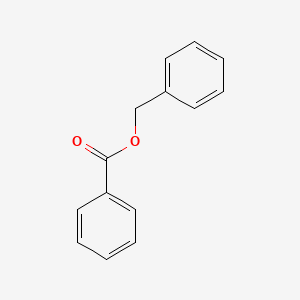
Benzyl Benzoate
Benzyl benzoate is a benzoate ester obtained by the formal condensation of benzoic acid with benzyl alcohol. It has been isolated from the plant species of the genus Polyalthia. It has a role as an acaricide, a scabicide and a plant metabolite. It is a benzoate ester and a benzyl ester. It is functionally related to a benzoic acid. — ChEBI
- IUPAC-Name
- benzyl benzoate
- Summenformel
- C14H12O2
- Molekulargewicht
- 212.24 g/mol
- Exakte Masse
- 212.083729621 Da
- XLogP3
- 4,0
- Topologische polare Oberfläche
- 26,3 Ų
- Wasserstoffbrücken-Donoren
- 0
- Wasserstoffbrücken-Akzeptoren
- 2
- Kovalente Einheiten
- 1
- Definierte Stereozentren
- 0
Auch bekannt als
16 weitere gemeldete Namen
Kennungen in externen Datenbanken
- ChEBI:CHEBI:41237
- ChEMBL:CHEMBL1239
- EPA DTXSID:DTXSID8029153
- PubMed:29540657
- PubMed:27965148
- PubMed:27270453
- PubMed:26795242
- PubMed:23001898
- PubMed:22980009
- PubMed:22954530
- PubMed:22833176
- PubMed:22799103
- PubMed:22721474
- PubMed:22701601
- PubMed:22619691
Belege aus weiteren wissenschaftlichen Datenbanken
NIH PubChem PUG-View
Attributed physical-property, hazard, environmental and use annotations.
- Autoignition Temperature: 896 °F (480 °C) Quelle: Hazardous Substances Data Bank (HSDB)
- Autoignition Temperature: 480 °C Quelle: ILO-WHO International Chemical Safety Cards (ICSCs)
- Boiling Point: 323.5 °C Quelle: DrugBank
- Boiling Point: 321.3 °C Quelle: Hazardous Substances Data Bank (HSDB)
- Boiling Point: BP: 323-324 °C Quelle: Hazardous Substances Data Bank (HSDB)
- Boiling Point: 323.00 to 324.00 °C. @ 760.00 mm Hg Quelle: Human Metabolome Database (HMDB)
- Boiling Point: 324 °C Quelle: ILO-WHO International Chemical Safety Cards (ICSCs)
- Boiling Point: 323-324 °C Quelle: Joint FAO/WHO Expert Committee on Food Additives (JECFA)
- Boiling Point: 324 °C @760 [mm Hg] Quelle: PAC Chemical Database, U.S. Department of Energy
- Color/Form: Leaflets or oily liquid Quelle: Hazardous Substances Data Bank (HSDB)
- Color/Form: Water-white liquid Quelle: Hazardous Substances Data Bank (HSDB)
- Color/Form: Colorless, oily liquid Quelle: Hazardous Substances Data Bank (HSDB)
- Color/Form: Clear, colorless liquid Quelle: Hazardous Substances Data Bank (HSDB)
- Density: 1.1121 g/cu cm at 25 °C Quelle: Hazardous Substances Data Bank (HSDB)
- Density: Relative density (water = 1): 1.1 Quelle: ILO-WHO International Chemical Safety Cards (ICSCs)
- Density: 1.113-1.121 Quelle: Joint FAO/WHO Expert Committee on Food Additives (JECFA)
- Density: 1.116 @25 °C Quelle: PAC Chemical Database, U.S. Department of Energy
- Flash Point: 148 °C Quelle: Haz-Map, Information on Hazardous Chemicals and Occupational Diseases
- Flash Point: 158 °C (316 °F) - closed cup Quelle: Hazardous Substances Data Bank (HSDB)
- Flash Point: 298 °F (148 °C) - closed cup Quelle: Hazardous Substances Data Bank (HSDB)
- Flash Point: 148 °C Quelle: ILO-WHO International Chemical Safety Cards (ICSCs)
- LogP: 3.97 Quelle: DrugBank
- LogP: log Kow = 3.97 Quelle: Hazardous Substances Data Bank (HSDB)
- LogP: 3.7 Quelle: Human Metabolome Database (HMDB)
- LogP: 3.97 Quelle: ILO-WHO International Chemical Safety Cards (ICSCs)
- Melting Point: 21 °C Quelle: DrugBank
- Melting Point: 19 °C Quelle: Hazardous Substances Data Bank (HSDB)
- Melting Point: 21 °C Quelle: Human Metabolome Database (HMDB)
- Melting Point: 21 °C Quelle: ILO-WHO International Chemical Safety Cards (ICSCs)
- Odor: Light, balsamic odor reminiscent of almond Quelle: Hazardous Substances Data Bank (HSDB)
- Odor: Faint, pleasant, aromatic odor Quelle: Hazardous Substances Data Bank (HSDB)
- Physical Description: CBI; Other Solid; Dry Powder; Other Solid; Liquid Quelle: EPA Chemical Data Reporting (CDR)
- Physical Description: Colorless liquid or white solid; [ICSC] Not miscible or difficult to mix in water; [MSDSonline] Pleasant odor; Slightly volatile in steam and insoluble in water; [Ullmann] Quelle: Haz-Map, Information on Hazardous Chemicals and Occupational Diseases
- Physical Description: Solid Quelle: Human Metabolome Database (HMDB)
- Physical Description: COLOURLESS LIQUID OR WHITE SOLID WITH CHARACTERISTIC ODOUR. Quelle: ILO-WHO International Chemical Safety Cards (ICSCs)
- Physical Description: leaflets or oily liquid with a faint, sweet, balsamic odour Quelle: Joint FAO/WHO Expert Committee on Food Additives (JECFA)
- Refractive Index: Index of refraction: 1.5680 at 20 °C/D Quelle: Hazardous Substances Data Bank (HSDB)
- Refractive Index: Index of refraction: 1.5681 at 21 °C/D Quelle: Hazardous Substances Data Bank (HSDB)
- Refractive Index: 1.566-1.571 Quelle: Joint FAO/WHO Expert Committee on Food Additives (JECFA)
- Solubility: 15.4 mg/L Quelle: DrugBank
- Solubility: Insoluble in water Quelle: Hazardous Substances Data Bank (HSDB)
- Solubility: Insoluble in glycerol; miscible with alcohol, chloroform, ether, oils Quelle: Hazardous Substances Data Bank (HSDB)
- Solubility: Soluble in ethanol, ethyl ether, acetone, benzene, methanol, chloroform Quelle: Hazardous Substances Data Bank (HSDB)
- Solubility: 1.98e-02 g/L Quelle: Human Metabolome Database (HMDB)
- Solubility: Solubility in water: none Quelle: ILO-WHO International Chemical Safety Cards (ICSCs)
- Solubility: insoluble in water; soluble in organic solvents, oils Quelle: Joint FAO/WHO Expert Committee on Food Additives (JECFA)
- Solubility: miscible at room temperature (in ethanol) Quelle: Joint FAO/WHO Expert Committee on Food Additives (JECFA)
- Vapor Pressure: 0.000224 [mmHg] Quelle: Haz-Map, Information on Hazardous Chemicals and Occupational Diseases
- Vapor Pressure: 0.000224 mm Hg at 25 °C Quelle: Hazardous Substances Data Bank (HSDB)
- Vapor Pressure: 0.00022 [mm Hg] @25 °C Quelle: PAC Chemical Database, U.S. Department of Energy
- Viscosity: 8.292 cP at 25 °C Quelle: Hazardous Substances Data Bank (HSDB)
- pH: Solution in alcohol practically neutral to moistened litmus paper Quelle: Hazardous Substances Data Bank (HSDB)
- Exposure Routes: The substance can be absorbed into the body by inhalation of its aerosol, through the skin and by ingestion. Quelle: ILO-WHO International Chemical Safety Cards (ICSCs)
- Signal: Warning Quelle: Regulation (EC) No 1272/2008 of the European Parliament and of the Council
- GHS Hazard Statements: H302: Harmful if swallowed [Warning Acute toxicity, oral]; H411: Toxic to aquatic life with long lasting effects [Hazardous to the aquatic environment, long-term hazard] Quelle: Regulation (EC) No 1272/2008 of the European Parliament and of the Council
- Precautionary Statement Codes: P264, P270, P273, P301+P317, P330, P391, and P501 (click each P-code to see the statement) Quelle: Regulation (EC) No 1272/2008 of the European Parliament and of the Council
- Signal: Warning Quelle: European Chemicals Agency (ECHA)
- GHS Hazard Statements: H302 (100%): Harmful if swallowed [Warning Acute toxicity, oral]; H400 (21.1%): Very toxic to aquatic life [Warning Hazardous to the aquatic environment, acute hazard]; H411 (99.4%): Toxic to aquatic life with long lasting effects [Hazardous to the aquatic environment, long-term hazard] Quelle: European Chemicals Agency (ECHA)
- Precautionary Statement Codes: P264, P270, P273, P301+P317, P330, P391, and P501 (click each P-code to see the statement) Quelle: European Chemicals Agency (ECHA)
- ECHA C&L Notifications Summary: Aggregated GHS information provided per 2822 reports by companies from 24 notifications to the ECHA C&L Inventory. Each notification may be associated with multiple companies.; Information may vary between notifications depending on impurities, additives, and other factors. The percentage value in parenthesis indicates the notified classification ratio from companies that provide hazard codes. Only hazard codes with percentage values above 10% are shown. For more detailed information, please visit ECHA C&L website. Quelle: European Chemicals Agency (ECHA)
- Signal: Warning Quelle: NITE-CMC
- GHS Hazard Statements: H371: May cause damage to organs [Warning Specific target organ toxicity, single exposure]; H400: Very toxic to aquatic life [Warning Hazardous to the aquatic environment, acute hazard]; H411: Toxic to aquatic life with long lasting effects [Hazardous to the aquatic environment, long-term hazard] Quelle: NITE-CMC
- Precautionary Statement Codes: P260, P264, P270, P273, P308+P316, P391, P405, and P501 (click each P-code to see the statement) Quelle: NITE-CMC
- GHS Hazard Statements: H302: Harmful if swallowed [Warning Acute toxicity, oral] Quelle: NITE-CMC
- Precautionary Statement Codes: P264, P270, P301+P317, P330, and P501 (click each P-code to see the statement) Quelle: NITE-CMC
- NFPA Health Rating: 1 - Materials that, under emergency conditions, can cause significant irritation. Quelle: Hazardous Substances Data Bank (HSDB)
- NFPA Fire Rating: 1 - Materials that must be preheated before ignition can occur. Materials require considerable preheating, under all ambient temperature conditions, before ignition and combustion can occur. Quelle: Hazardous Substances Data Bank (HSDB)
- NFPA Instability Rating: 0 - Materials that in themselves are normally stable, even under fire conditions. Quelle: Hazardous Substances Data Bank (HSDB)
- Cosmetic Ingredient Review Finding(s): Safe in the present practices of use and concentration. Ingredient, concentration, and use information are available in documents discoverable at https://cir-reports.cir-safety.org Quelle: Cosmetic Ingredient Review (CIR)
- Toxicity Summary: IDENTIFICATION AND USE: Benzyl benzoate is a liquid. It is used as solvent of cellulose acetate, nitrocellulose and artificial musk, substitute for camphor in celluloid and plastic pyroxylin compounds, perfume fixative, in confectionary and chewing gum flavors. As an insecticide/miticide, it was used to control dust mites in carpets, mattresses, upholstery, and on furniture. Benzyl benzoate is used as an alternative agent for the topical treatment of scabies and also has been used for the topical treatment of pediculosis (lice infestation). It is also used in veterinary medicine as acaricide and pediculicide, but is contraindicated in cats. It was used in the Vietnam War to eradicate and repel certain ticks and mites. HUMAN STUDIES: Direct contact may cause skin irritation. Liquid is irritating to eyes on direct contact, but no damage has been reported. There was no evidence of adverse effects on pregnancy outcome due to topical benzyl benzoate lotion. Benzyl benzoate gave estrogenic responses in a human breast cancer cell line in culture. ANIMAL STUDIES: 13-week study in rats demonstrated decreased body weight gain and mortality at 800 mg/kg/day. Neurotoxicity signs noted such as Quelle: Hazardous Substances Data Bank (HSDB)
- Environmental Bioconcentration: An estimated BCF of 190 was calculated in fish for benzyl benzoate(SRC), using a log Kow of 3.97(1) and a regression-derived equation(1). According to a classification scheme(2), this BCF suggests the potential for bioconcentration in aquatic organisms is high(SRC). Quelle: Hazardous Substances Data Bank (HSDB)
- Environmental Fate: TERRESTRIAL FATE: Based on a classification scheme(1), an estimated Koc value of 2500(SRC), determined from a structure estimation method(2), indicates that benzyl benzoate is expected to have slight mobility in soil(SRC). Volatilization of benzyl benzoate from moist soil surfaces is not expected to be an important fate process(SRC) given an estimated Henry's Law constant of 2.3X10⁻⁷ atm-cu m/mole(SRC), developed using a fragment constant estimation method(3). Benzyl benzoate is not expected to volatilize from dry soil surfaces(SRC) based upon a vapor pressure of 2.24X10⁻⁴ mm Hg at 25 °C(3). Utilizing the Japanese MITI test, 90% of the Theoretical BOD was reached in 4 weeks(4) indicating that biodegradation is an important environmental fate process in soil(SRC). Quelle: Hazardous Substances Data Bank (HSDB)
- Environmental Fate: AQUATIC FATE: Based on a classification scheme(1), an estimated Koc value of 2500(SRC), determined from a structure estimation method(2), indicates that benzyl benzoate is expected to adsorb to suspended solids and sediment(SRC). Volatilization from water surfaces is not expected(3) based upon an estimated Henry's Law constant of 2.3X10⁻⁷ atm-cu m/mole(SRC), developed using a fragment constant estimation method(2). According to a classification scheme(4), an estimated BCF of 190(SRC), from its log Kow of 3.97(5) and a regression-derived equation(2), suggests the potential for bioconcentration in aquatic organisms is high(SRC). Hydrolysis is not expected to be an important environmental fate process as suggested by estimated acid-base hydrolysis half-lives of 1.7 years and 63 days at pH 7 and pH 8, respectively(1). Utilizing the Japanese MITI test, 90% of the Theoretical BOD was reached in 4 weeks(6) indicating that biodegradation is an important environmental fate process in water(SRC). Quelle: Hazardous Substances Data Bank (HSDB)
- Environmental Fate: ATMOSPHERIC FATE: According to a model of gas/particle partitioning of semivolatile organic compounds in the atmosphere(1), benzyl benzoate, which has a vapor pressure of 2.25X10⁻⁴ mm Hg at 25 °C(2), will exist in both the vapor and particulate phases in the ambient atmosphere. Vapor-phase benzyl benzoate is degraded in the atmosphere by reaction with photochemically-produced hydroxyl radicals(SRC); the half-life for this reaction in air is estimated to be 55 hrs(SRC), calculated from its rate constant of 7.0X10⁻¹² cu cm/molecule-sec at 25 °C(SRC) that was derived using a structure estimation method(3). Particulate-phase benzyl benzoate may be removed from the air by wet and dry deposition(SRC). Benzyl benzoate contains chromophores that absorb at wavelengths >290 nm(4) and, therefore, may be susceptible to direct photolysis by sunlight(SRC). Quelle: Hazardous Substances Data Bank (HSDB)
- Consumer Uses: Fragrance; Plasticizer; Not Known or Reasonably Ascertainable Quelle: EPA Chemical Data Reporting (CDR)
- Industry Uses: Flavoring and nutrient; Solvent; Not Known or Reasonably Ascertainable; Fixing agent (mordant); Fragrance Quelle: EPA Chemical Data Reporting (CDR)
- Cosmetic Ingredient Review Link: CIR ingredient: Benzyl Benzoate Quelle: Cosmetic Ingredient Review (CIR)
- Sources/Uses: Used in plastic pyroxylin compounds, flavors, perfumes, plasticizers, dye carriers, antispasmodic drugs, insect repellants, scabicides , and pediculicides; [HSDB] Used as a dye carrier and a solvent for cellulose derivatives, plasticizers, and perfume fixatives; It is the main constituent in Peru balsam; Used in drugs for asthma; [Ullmann] Quelle: Haz-Map, Information on Hazardous Chemicals and Occupational Diseases
- Uses: For benzyl benzoate (USEPA/OPP Pesticide Code: 009501) ACTIVE products with label matches. /SRP: Registered for use in the USA but approved pesticide uses may change periodically and so federal, state and local authorities must be consulted for currently approved uses./ Quelle: Hazardous Substances Data Bank (HSDB)
- Uses: As solvent of cellulose acetate, nitrocellulose and artificual musk; substitute for camphor in celluloid and plastic pyroxylin compounds; perfume fixative; in confectionary and chewing gum flavors. Quelle: Hazardous Substances Data Bank (HSDB)
- Uses: Fixative and solvent for musk in perfumes and flavors; medicine (external); plasticizer for nitrocellulose and cellulose acetate, miticide. Quelle: Hazardous Substances Data Bank (HSDB)
- Uses: Reported uses (ppm):; Table: Reported uses (ppm): (Flavor and Extract Manufacturers' Association, 1994) [Table#818] Quelle: Hazardous Substances Data Bank (HSDB)
- Uses: For more Uses (Complete) data for Benzyl benzoate (8 total), please visit the HSDB record page. Quelle: Hazardous Substances Data Bank (HSDB)
- Uses: Use (kg; approx.) in Germany (2009): >750; Consumption (g per capita; approx.) in Germany (2009): 0.00916; Excretion rate: 1; Calculated removal (%): 94.9 Quelle: NORMAN Suspect List Exchange
Zugeordnet durch: Existing checksum-valid CAS to unique PubChem CID match. Abgerufen: 2026-08-31. Quelleneintrag öffnen
Wissenschaftliche Klassifizierungen und Gefahrenannotationen liefern Kontext und ersetzen nicht die oben gezeigte marktspezifische regulatorische Entscheidung.
Weitere Quellenabdeckung und Trefferstatus
| Quelle | Ergebnis | Geprüft |
|---|---|---|
| NIH PubChem PUG-View | Exakter Treffer | 2026-08-31 |
Ein erfasster Nicht-Treffer ist ein nützlicher Beleg dafür, dass die Quelle geprüft wurde; er ist keine Behauptung, dass der Stoff anderswo nicht existiert.
Am 2026-09-02 von NIH PubChem durch prüfsummengültigen CAS-Abgleich abgerufen. Chemische Eigenschaften ersetzen nicht die regulatorische Entscheidung auf dieser Seite.
Verzeichnisverknüpfungen für Benzyl benzoate
Verwandte Einträge zu Benzyl benzoate
Für diesen Eintrag gibt es nur wenige direkte Treffer; daher werden auch nahe liegende Einträge aus Anhang III angezeigt.
Citronellol
Limonene
ALPHA-ISOMETHYL IONONE
EVERNIA PRUNASTRI EXTRACT
Was Anhang III für Benzyl benzoate bedeutet
Benzyl benzoate ist ein beschränkter Stoff nach Anhang III der EU-Kosmetikverordnung (EG) Nr. 1223/2009. Seine Verwendung in kosmetischen Mitteln ist nur unter den im obigen Eintrag genannten besonderen Bedingungen zulässig, einschließlich geltender Konzentrationsgrenzen, Beschränkungen der Produktart und erforderlicher Warnhinweise.
Wird dieser Stoff in einer Rezeptur verwendet, müssen alle Bedingungen – Höchstkonzentration, Produktbereich und Warnhinweise – gleichzeitig erfüllt sein. Die Einhaltung einer Bedingung hebt die anderen nicht auf.
Dieser Eintrag ist zum Abgleich von Namen und Kennungen mit 1 Inhaltsstoff des CosIng-Verzeichnisses verknüpft. Die Seite zeigt außerdem 12 verwandte Anhangseinträge mit überschneidenden Kennungen, Anhangslogik oder Namensmustern.
Compliance-Checkliste
- Dokumentieren Sie die Verwendungsbedingungen in der Produktinformationsdatei (PIF).
- Dieser Stoff ist ein regulierter Duftstoffallergen. Geben Sie ihn mit seinem INCI-Namen auf dem Etikett an, wenn er in Produkten, die auf der Haut verbleiben, in mehr als 0,001% oder in abzuspülenden Produkten in mehr als 0,01% enthalten ist.
Häufig gestellte Fragen
Quellenhinweis zu Anhang III, Eintrag Benzyl benzoate
Diese Seite fasst einen Eintrag aus Anhang III für Benzyl benzoate aus öffentlichen Materialien der Europäischen Kommission zu kosmetischen Mitteln zusammen und ergänzt, soweit verfügbar, verknüpfte Treffer aus dem Verzeichnis oder bei Kennungen.
Nutzen Sie diese Eintragsseite, um die Bedingungen aus Anhang III für Benzyl benzoate zu prüfen; bestätigen Sie jede endgültige regulatorische Entscheidung jedoch anhand des aktuellen amtlichen Anhangswortlauts und der Quelldateien.
Werkzeuge und nächste Schritte
Rezeptur prüfen
Fügen Sie eine vollständige INCI-Liste ein, um Benzyl benzoate und andere markierte EU-Anhangseinträge in einem Durchgang zu finden.
INCI-CheckerEinträge vergleichen
Benzyl benzoate nebeneinander mit einem anderen Anhangseintrag vergleichen, um Unterschiede bei Beschränkungen, Konzentrationen und Anhangszuordnung zu prüfen.
VergleichenDen Anhang durchsuchen
Alle Einträge in Anhang III ansehen und die regulatorischen Bedingungen der Stoffe in diesem Anhang vergleichen.
Anhang III öffnen