
4-methylpentan-2-one; isobutyl methyl ketone (MIBK)
4-methylpentan-2-one; isobutyl methyl ketone (MIBK) ist in Anhang II als verbotener Stoff für kosmetische Mittel aufgeführt, die in der EU in Verkehr gebracht werden.
Eintragsdetails
Chemische Bezeichnung
4-methylpentan-2-one; isobutyl methyl ketone (MIBK)
Chemische / IUPAC-Bezeichnung
4-methylpentan-2-one; isobutyl methyl ketone (MIBK)
Regulatorische Informationen
CMR
| Kategorie | Carcinogenic | Mutagenic | Reprotoxic |
|---|---|---|---|
| Cat. 2 | ✓ | — | — |
Kerndaten
Chemische Identität und Eigenschaften
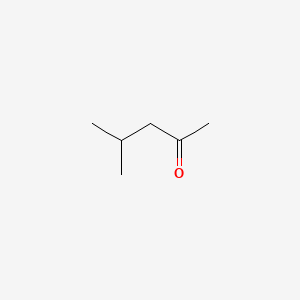
- IUPAC-Name
- 4-methylpentan-2-one
- Summenformel
- C6H12O
- Molekulargewicht
- 100.16 g/mol
- Exakte Masse
- 100.088815002 Da
- XLogP3
- 1,3
- Topologische polare Oberfläche
- 17,1 Ų
- Wasserstoffbrücken-Donoren
- 0
- Wasserstoffbrücken-Akzeptoren
- 1
- Kovalente Einheiten
- 1
- Definierte Stereozentren
- 0
Auch bekannt als
16 weitere gemeldete Namen
Kennungen in externen Datenbanken
- ChEBI:CHEBI:82344
- ChEMBL:CHEMBL285323
- EPA DTXSID:DTXSID5021889
- PubMed:25797582
- PubMed:23065996
- PubMed:22993718
- PubMed:22827098
- PubMed:22684032
- PubMed:22654610
- PubMed:22654606
- PubMed:22586250
- PubMed:22573008
- PubMed:22486673
- PubMed:22482743
- PubMed:22468653
Belege aus weiteren wissenschaftlichen Datenbanken
NIH PubChem PUG-View
Attributed physical-property, hazard, environmental and use annotations.
- Autoignition Temperature: 854 °F (USCG, 1999) Quelle: CAMEO Chemicals
- Autoignition Temperature: 840 °F (448 °C) Quelle: Hazardous Substances Data Bank (HSDB)
- Autoignition Temperature: 460 °C Quelle: ILO-WHO International Chemical Safety Cards (ICSCs)
- Boiling Point: 243 to 244 °F at 760 mmHg (NTP, 1992) Quelle: CAMEO Chemicals
- Boiling Point: 115.7 °C Quelle: Hazardous Substances Data Bank (HSDB)
- Boiling Point: 116.50 °C. @ 760.00 mm Hg Quelle: Human Metabolome Database (HMDB)
- Boiling Point: 117-118 °C Quelle: ILO-WHO International Chemical Safety Cards (ICSCs)
- Boiling Point: 117 °C Quelle: Joint FAO/WHO Expert Committee on Food Additives (JECFA)
- Boiling Point: 242 °F Quelle: Occupational Safety and Health Administration (OSHA)
- Boiling Point: 116.5 °C @760 [mm Hg] Quelle: PAC Chemical Database, U.S. Department of Energy
- Boiling Point: 242 °F Quelle: The National Institute for Occupational Safety and Health (NIOSH)
- Color/Form: Liquid Quelle: Hazardous Substances Data Bank (HSDB)
- Color/Form: Colorless liquid Quelle: Hazardous Substances Data Bank (HSDB)
- Density: 0.802 at 68 °F (USCG, 1999) - Less dense than water; will float Quelle: CAMEO Chemicals
- Density: 0.7965 g/cu cm at 25 °C Quelle: Hazardous Substances Data Bank (HSDB)
- Density: Density: 0.8042 at 20 °C/20 °C Quelle: Hazardous Substances Data Bank (HSDB)
- Density: Bulk density: 6.68 lb/gal at 20 °C Quelle: Hazardous Substances Data Bank (HSDB)
- Density: Relative density (water = 1): 0.80 Quelle: ILO-WHO International Chemical Safety Cards (ICSCs)
- Density: 0.796-0.799 Quelle: Joint FAO/WHO Expert Committee on Food Additives (JECFA)
- Density: 0.8 Quelle: Occupational Safety and Health Administration (OSHA)
- Density: 0.7965 @25 °C Quelle: PAC Chemical Database, U.S. Department of Energy
- Density: 0.80 Quelle: The National Institute for Occupational Safety and Health (NIOSH)
- Flash Point: 73 °F (NTP, 1992) Quelle: CAMEO Chemicals
- Flash Point: 23 °C Quelle: Haz-Map, Information on Hazardous Chemicals and Occupational Diseases
- Flash Point: 64 °F (18 °C) (Closed cup) Quelle: Hazardous Substances Data Bank (HSDB)
- Flash Point: 14 °C c.c. Quelle: ILO-WHO International Chemical Safety Cards (ICSCs)
- Flash Point: 73 °F Quelle: Occupational Safety and Health Administration (OSHA)
- Flash Point: 64 °F Quelle: The National Institute for Occupational Safety and Health (NIOSH)
- LogP: log Kow = 1.31 Quelle: Hazardous Substances Data Bank (HSDB)
- LogP: 1.31 Quelle: Human Metabolome Database (HMDB)
- LogP: 1.38 Quelle: ILO-WHO International Chemical Safety Cards (ICSCs)
- Melting Point: -120.5 °F (NTP, 1992) Quelle: CAMEO Chemicals
- Melting Point: -85 °C Quelle: Hazardous Substances Data Bank (HSDB)
- Melting Point: -84 °C Quelle: Human Metabolome Database (HMDB)
- Melting Point: -84.7 °C Quelle: ILO-WHO International Chemical Safety Cards (ICSCs)
- Melting Point: -120.5 °F Quelle: Occupational Safety and Health Administration (OSHA)
- Melting Point: -84 °C Quelle: PAC Chemical Database, U.S. Department of Energy
- Melting Point: -120 °F Quelle: The National Institute for Occupational Safety and Health (NIOSH)
- Odor: Pleasant odor Quelle: Hazardous Substances Data Bank (HSDB)
- Odor: Faint, ketonic and camphor odor Quelle: Hazardous Substances Data Bank (HSDB)
- Odor: Fruity, ethereal odor Quelle: Hazardous Substances Data Bank (HSDB)
- Physical Description: Methyl isobutyl ketone appears as a clear colorless liquid with a pleasant odor. Flash point 73 °F. Less dense than water. Vapors heavier than air. Quelle: CAMEO Chemicals
- Physical Description: CBI; Liquid Quelle: EPA Chemical Data Reporting (CDR)
- Physical Description: Colorless liquid with a pleasant odor; [NIOSH] Quelle: Haz-Map, Information on Hazardous Chemicals and Occupational Diseases
- Physical Description: Liquid Quelle: Human Metabolome Database (HMDB)
- Physical Description: COLOURLESS LIQUID WITH CHARACTERISTIC ODOUR. Quelle: ILO-WHO International Chemical Safety Cards (ICSCs)
- Physical Description: colourless, mobile liquid with a fruity, ethereal odour Quelle: Joint FAO/WHO Expert Committee on Food Additives (JECFA)
- Physical Description: Colorless liquid with a pleasant odor. Quelle: Occupational Safety and Health Administration (OSHA)
- Physical Description: Colorless liquid with a pleasant odor. Quelle: The National Institute for Occupational Safety and Health (NIOSH)
- Refractive Index: Index of refraction: 1.3962 at 20 °C/D Quelle: Hazardous Substances Data Bank (HSDB)
- Refractive Index: 1.391-1.396 Quelle: Joint FAO/WHO Expert Committee on Food Additives (JECFA)
- Solubility: 1 to 5 mg/mL at 70 °F (NTP, 1992) Quelle: CAMEO Chemicals
- Solubility: Water/air, blood/air, oil (olive oil)/air, oil/water, and oil/blood partition (or solubility) coefficients of methyl isobutyl ketone were measured by vial-equilibration in combination with gas chromatography. Partition coefficients for methyl isobutyl ketone: water/air: 79; blood/air: 90; oil/air: 926. The blood/air partition coefficients for ketones are almost in the same range as the water/air, irrespective of the oil/air partition coefficients. Quelle: Hazardous Substances Data Bank (HSDB)
- Solubility: In water, 19,000 mg/L at 25 °C Quelle: Hazardous Substances Data Bank (HSDB)
- Solubility: Slightly soluble in water Quelle: Hazardous Substances Data Bank (HSDB)
- Solubility: Miscible with ethanol, ether, acetone, benzene; soluble in chloroform Quelle: Hazardous Substances Data Bank (HSDB)
- Solubility: Miscible with most organic solvents Quelle: Hazardous Substances Data Bank (HSDB)
- Solubility: 19 mg/mL at 25 °C Quelle: Human Metabolome Database (HMDB)
- Solubility: Solubility in water, g/100ml at 20 °C: 1.91 Quelle: ILO-WHO International Chemical Safety Cards (ICSCs)
- Solubility: miscible with alcohol, ether, and to 1 ml in 50 ml of water Quelle: Joint FAO/WHO Expert Committee on Food Additives (JECFA)
- Solubility: (in ethanol) Quelle: Joint FAO/WHO Expert Committee on Food Additives (JECFA)
- Solubility: 2% Quelle: The National Institute for Occupational Safety and Health (NIOSH)
- Vapor Pressure: 5 mmHg at 67.5 °F ; 10 mmHg at 86.0 °F (NTP, 1992) Quelle: CAMEO Chemicals
- Vapor Pressure: 19.9 [mmHg] Quelle: Haz-Map, Information on Hazardous Chemicals and Occupational Diseases
- Vapor Pressure: 19.9 mm Hg at 25 °C Quelle: Hazardous Substances Data Bank (HSDB)
- Vapor Pressure: Vapor pressure, kPa at 20 °C: 2.1 Quelle: ILO-WHO International Chemical Safety Cards (ICSCs)
- Vapor Pressure: 16 mmHg Quelle: Occupational Safety and Health Administration (OSHA)
- Vapor Pressure: 7.5 [mm Hg] @9 °C Quelle: PAC Chemical Database, U.S. Department of Energy
- Vapor Pressure: 16 mmHg Quelle: The National Institute for Occupational Safety and Health (NIOSH)
- IARC Carcinogenic Agent: Methyl isobutyl ketone Quelle: International Agency for Research on Cancer (IARC)
- IARC Carcinogenic Classes: Group 2B: Possibly carcinogenic to humans Quelle: International Agency for Research on Cancer (IARC)
- IARC Monographs: Volume 101: (2012) Some Chemicals Present in Industrial and Consumer Products, Food and Drinking-water Quelle: International Agency for Research on Cancer (IARC)
- Publication Year: 2013 Quelle: International Agency for Research on Cancer (IARC)
- Evaluation Year: 2011 Quelle: International Agency for Research on Cancer (IARC)
- Substance: Methyl isobutyl ketone Quelle: NTP Technical Reports
- NTP Technical Report: TR-538: Toxicology and Carcinogenesis Studies of Methyl Isobutyl Ketone (CASRN 108-10-1) in F344/N Rats and B6C3F1 Mice (Inhalation Studies) (2007 ) Quelle: NTP Technical Reports
- Peer Review Date: 09/27/05 Quelle: NTP Technical Reports
- Conclusion for Male Rat: Some Evidence Quelle: NTP Technical Reports
- Conclusion for Female Rat: Equivocal Evidence Quelle: NTP Technical Reports
- Conclusion for Male Mice: Some Evidence Quelle: NTP Technical Reports
- Conclusion for Female Mice: Some Evidence Quelle: NTP Technical Reports
- Exposure Routes: The substance can be absorbed into the body by inhalation of its vapour and by ingestion. Quelle: ILO-WHO International Chemical Safety Cards (ICSCs)
- Exposure Routes: inhalation, ingestion, skin and/or eye contact Quelle: The National Institute for Occupational Safety and Health (NIOSH)
- First Aid: EYES: First check the victim for contact lenses and remove if present. Flush victim's eyes with water or normal saline solution for 20 to 30 minutes while simultaneously calling a hospital or poison control center. Do not put any ointments, oils, or medication in the victim's eyes without specific instructions from a physician. IMMEDIATELY transport the victim after flushing eyes to a hospital even if no symptoms (such as redness or irritation) develop.; SKIN: IMMEDIATELY flood affected skin with water while removing and isolating all contaminated clothing. Gently wash all affected skin areas thoroughly with soap and water. If symptoms such as redness or irritation develop, IMMEDIATELY call a physician and be prepared to transport the victim to a hospital for treatment.; INHALATION: IMMEDIATELY leave the contaminated area; take deep breaths of fresh air. If symptoms (such as wheezing, coughing, shortness of breath, or burning in the mouth, throat, or chest) develop, call a physician and be prepared to transport the victim to a hospital. Provide proper respiratory protection to rescuers entering an unknown atmosphere. Whenever possible, Self-Contained Breathing Apparatus (SCBA) shou Quelle: CAMEO Chemicals
- ERG2024, Guide 127 (Methyl isobutyl ketone): General First Aid:; · Call 911 or emergency medical service.; · Ensure that medical personnel are aware of the material(s) involved, take precautions to protect themselves and avoid contamination.; · Move victim to fresh air if it can be done safely.; · Administer oxygen if breathing is difficult.; · If victim is not breathing:; -- DO NOT perform mouth-to-mouth resuscitation; the victim may have ingested or inhaled the substance.; -- If equipped and pulse detected, wash face and mouth, then give artificial respiration using a proper respiratory medical device (bag-valve mask, pocket mask equipped with a one-way valve or other device).; -- If no pulse detected or no respiratory medical device available, provide continuous compressions. Conduct a pulse check every two minutes or monitor for any signs of spontaneous respirations.; · Remove and isolate contaminated clothing and shoes.; · For minor skin contact, avoid spreading material on unaffected skin.; · In case of contact with substance, remove immediately by flushing skin or eyes with running water for at least 20 minutes.; · For severe burns, immediate medical attention is required.; · Effects of exposure (inhalation, ingestion, Quelle: Emergency Response Guidebook (ERG)
- First Aid: (General first aid procedures); Eye: Irrigate immediately - If this chemical contacts the eyes, immediately wash (irrigate) the eyes with large amounts of water, occasionally lifting the lower and upper lids. Get medical attention immediately.; Skin: Water flush promptly - If this chemical contacts the skin, flush the contaminated skin with water promptly. If this chemical penetrates the clothing, immediately remove the clothing and flush the skin with water promptly. If irritation persists after washing, get medical attention.; Breathing: Respiratory support; Swallow: Medical attention immediately - If this chemical has been swallowed, get medical attention immediately. Quelle: The National Institute for Occupational Safety and Health (NIOSH)
- Signal: Danger Quelle: Regulation (EC) No 1272/2008 of the European Parliament and of the Council
- GHS Hazard Statements: H225: Highly Flammable liquid and vapor [Danger Flammable liquids]; H319: Causes serious eye irritation [Warning Serious eye damage/eye irritation]; H332: Harmful if inhaled [Warning Acute toxicity, inhalation]; H336: May cause drowsiness or dizziness [Warning Specific target organ toxicity, single exposure; Narcotic effects]; H351: Suspected of causing cancer [Warning Carcinogenicity] Quelle: Regulation (EC) No 1272/2008 of the European Parliament and of the Council
- Precautionary Statement Codes: P203, P210, P233, P240, P241, P242, P243, P261, P264+P265, P271, P280, P303+P361+P353, P304+P340, P305+P351+P338, P317, P318, P319, P337+P317, P370+P378, P403+P233, P403+P235, P405, and P501 (click each P-code to see the statement) Quelle: Regulation (EC) No 1272/2008 of the European Parliament and of the Council
- Note: This chemical does not meet GHS hazard criteria for < 0.1% (2 of 4455) of reports. Quelle: European Chemicals Agency (ECHA)
- Signal: Danger Quelle: European Chemicals Agency (ECHA)
- GHS Hazard Statements: H225 (> 99.9%): Highly Flammable liquid and vapor [Danger Flammable liquids]; H319 (> 99.9%): Causes serious eye irritation [Warning Serious eye damage/eye irritation]; H332 (97.1%): Harmful if inhaled [Warning Acute toxicity, inhalation]; H335 (93.7%): May cause respiratory irritation [Warning Specific target organ toxicity, single exposure; Respiratory tract irritation]; H336 (11.5%): May cause drowsiness or dizziness [Warning Specific target organ toxicity, single exposure; Narcotic effects]; H351 (11.8%): Suspected of causing cancer [Warning Carcinogenicity] Quelle: European Chemicals Agency (ECHA)
- Precautionary Statement Codes: P203, P210, P233, P240, P241, P242, P243, P261, P264+P265, P271, P280, P303+P361+P353, P304+P340, P305+P351+P338, P317, P318, P319, P337+P317, P370+P378, P403+P233, P403+P235, P405, and P501 (click each P-code to see the statement) Quelle: European Chemicals Agency (ECHA)
- ECHA C&L Notifications Summary: Aggregated GHS information provided per 4455 reports by companies from 80 notifications to the ECHA C&L Inventory. Each notification may be associated with multiple companies.; Reported as not meeting GHS hazard criteria per 2 of 4455 reports by companies.; There are 79 notifications provided by 4453 of 4455 reports by companies with hazard statement code(s).; Information may vary between notifications depending on impurities, additives, and other factors. The percentage value in parenthesis indicates the notified classification ratio from companies that provide hazard codes. Only hazard codes with percentage values above 10% are shown. For more detailed information, please visit ECHA C&L website. Quelle: European Chemicals Agency (ECHA)
- Signal: Danger Quelle: NITE-CMC
- GHS Hazard Statements: H350: May cause cancer [Danger Carcinogenicity] Quelle: NITE-CMC
- Precautionary Statement Codes: P203, P280, P318, P405, and P501 (click each P-code to see the statement) Quelle: NITE-CMC
- GHS Hazard Statements: H225: Highly Flammable liquid and vapor [Danger Flammable liquids]; H320: Causes eye irritation [Warning Serious eye damage/eye irritation]; H331: Toxic if inhaled [Danger Acute toxicity, inhalation]; H335: May cause respiratory irritation [Warning Specific target organ toxicity, single exposure; Respiratory tract irritation]; H336: May cause drowsiness or dizziness [Warning Specific target organ toxicity, single exposure; Narcotic effects]; H351: Suspected of causing cancer [Warning Carcinogenicity]; H372: Causes damage to organs through prolonged or repeated exposure [Danger Specific target organ toxicity, repeated exposure] Quelle: NITE-CMC
- NFPA Health Rating: 1 - Materials that, under emergency conditions, can cause significant irritation. Quelle: Hazardous Substances Data Bank (HSDB)
- NFPA Fire Rating: 3 - Liquids and solids that can be ignited under almost all ambient temperature conditions. Materials produce hazardous atmospheres with air under almost all ambient temperatures or, though unaffected by ambient temperatures, are readily ignited under almost all conditions. Quelle: Hazardous Substances Data Bank (HSDB)
- NFPA Instability Rating: 0 - Materials that in themselves are normally stable, even under fire conditions. Quelle: Hazardous Substances Data Bank (HSDB)
- Target Organs: Developmental; Musculoskeletal Quelle: EPA Integrated Risk Information System (IRIS)
- Target Organs: Eyes, skin, respiratory system, central nervous system, liver, kidneys Quelle: The National Institute for Occupational Safety and Health (NIOSH)
- Cosmetic Ingredient Review Conclusion: Based on the available animal and clinical data in this report, the CIR Expert Panel concludes that MIBK is safe as used in nail polish removers and as an alcohol denaturant in cosmetic products. Quelle: Cosmetic Ingredient Review (CIR)
- Cosmetic Ingredient Review Finding(s): Safe for use in cosmetics, with qualifications Quelle: Cosmetic Ingredient Review (CIR)
- Toxicity Summary: IDENTIFICATION AND USE: Methyl isobutyl ketone (MIBK) is a colorless liquid. It is used as a solvent for gums, resins, nitrocellulose, paints, varnishes, and lacquers. It is also used as denaturant for rubbing alcohol, in the manufacture of methyl amyl alcohol, and in dry-cleaning preparations. It is also widely used in rubber chemicals for the production of tyres. HUMAN STUDIES: Symptoms and signs of poisoning include: irritation of the eyes, skin, and respiratory tract, as well as CNS depression. Gastrointestinal pain and hepatic toxicity may occur with exposure to high concentrations. In workers exposed to up to 2050 mg MIBK/cu m (500 ppm) for 20-30 min per day and to 328 mg/cu m (80 ppm) for much of the remainder of the working day, over half of the 19 workers complained of weakness, loss of appetite, headache, eye irritation, stomach ache, nausea, vomiting, and sore throat. A few of the workers experienced insomnia, somnolence, heartburn, intestinal pain, and some unsteadiness. Four workers had slightly enlarged livers and six had a nonspecific colitis. Prolonged or repeated skin contact may cause drying and flaking of the skin. Accidental aspiration of liquid MIBK can cause c Quelle: Hazardous Substances Data Bank (HSDB)
- Environmental Bioconcentration: An estimated BCF of 3 was calculated in fish for methyl isobutyl ketone(SRC), using a log Kow of 1.31(1) and a regression-derived equation(2). According to a classification scheme(3), this BCF suggests the potential for bioconcentration in aquatic organisms is low(SRC). Quelle: Hazardous Substances Data Bank (HSDB)
- Environmental Fate: TERRESTRIAL FATE: Based on a classification scheme(1), an estimated Koc value of 70(SRC), determined from a log Kow of 1.31(2) and a regression-derived equation(3), indicates that methyl isobutyl ketone is expected to have high mobility in soil(SRC). Volatilization of methyl isobutyl ketone from moist soil surfaces is expected to be an important fate process(SRC) given an estimated Henry's Law constant of 1.4X10⁻⁴ atm-cu m/mole(SRC) derived from its vapor pressure, 19.9 mm Hg(4), and water solubility, 19,000 mg/L(5). Methyl isobutyl ketone is expected to volatilize from dry soil surfaces(SRC) based upon its vapor pressure(4). An 84% of theoretical BOD using activated sludge in the Japanese MITI test(6) suggests that biodegradation is an important environmental fate process in soil(SRC). Quelle: Hazardous Substances Data Bank (HSDB)
- Environmental Fate: AQUATIC FATE: Based on a classification scheme(1), an estimated Koc value of 70(SRC), determined from a log Kow of 1.31(2) and a regression-derived equation(3), indicates that methyl isobutyl ketone is not expected to adsorb to suspended solids and sediment(SRC). Volatilization from water surfaces is expected(3) based upon an estimated Henry's Law constant of 1.4X10⁻⁴ atm-cu m/mole(SRC), derived from its vapor pressure, 19.9 mm Hg(4), and water solubility, 19,000 mg/L(5). Using this Henry's Law constant and an estimation method(3), volatilization half-lives for a model river and model lake are 9 hours and 6 days, respectively(SRC). According to a classification scheme(6), an estimated BCF of 3(SRC), from its log Kow(2) and a regression-derived equation(7), suggests the potential for bioconcentration in aquatic organisms is low(SRC). An 84% of theoretical BOD using activated sludge in the Japanese MITI test(8) suggests that biodegradation is an important environmental fate process in water(SRC). Quelle: Hazardous Substances Data Bank (HSDB)
- Environmental Fate: ATMOSPHERIC FATE: According to a model of gas/particle partitioning of semivolatile organic compounds in the atmosphere(1), methyl isobutyl ketone, which has a vapor pressure of 19.9 mm Hg at 25 °C(2), is expected to exist solely as a vapor in the ambient atmosphere. Vapor-phase methyl isobutyl ketone is degraded in the atmosphere by reaction with photochemically-produced hydroxyl radicals(SRC); the half-life for this reaction in air is estimated to be 30(SRC), calculated from its rate constant of 1.3X10⁻¹¹ cu cm/molecule-sec at 25 °C(3). Methyl isobutyl ketone absorbs UV at wavelengths >290 nm(3) and, therefore, may be susceptible to direct photolysis by sunlight(SRC). Quelle: Hazardous Substances Data Bank (HSDB)
- Consumer Uses: Sealant (barrier); Not Known or Reasonably Ascertainable; Diluent; Solvent; Other Quelle: EPA Chemical Data Reporting (CDR)
- Industry Uses: Sealant (barrier); Not Known or Reasonably Ascertainable; Intermediate; Surface modifier; Solvent; Other; Fuel Quelle: EPA Chemical Data Reporting (CDR)
- Cosmetic Ingredient Review Link: CIR ingredient: MIBK Quelle: Cosmetic Ingredient Review (CIR)
- Uses: Methyl isobutyl ketone is used as a solvent for gums, resins, paints, varnishes, lacquers, and nitrocellulose, as an alcohol denaturant, in the extraction of rare metals, and as a synthetic flavoring adjuvant. Quelle: EPA Hazardous Air Pollutants
- Sources/Uses: Used as a solvent in the paint, synthetic resin, adhesive, aircraft, and pharmaceutical manufacturing industries; [ACGIH] Quelle: Haz-Map, Information on Hazardous Chemicals and Occupational Diseases
- Industrial Processes with risk of exposure: Textiles (Fiber & Fabric Manufacturing) [Category: Industry]; Painting (Solvents) [Category: Paint]; Working with Glues and Adhesives [Category: Other]; Plastic Composites Manufacturing [Category: Industry] Quelle: Haz-Map, Information on Hazardous Chemicals and Occupational Diseases
- Uses: Solvent for gums, resins, nitrocellulose, paints, varnishes, and lacquers. Denaturant for rubbing alcohol. In manufacture of methyl amyl alcohol. In dry-cleaning preparations. Quelle: Hazardous Substances Data Bank (HSDB)
- Uses: ... Extraction processes including extraction of uranium from fission products; organic synthesis ... . Quelle: Hazardous Substances Data Bank (HSDB)
- Uses: ... Denaturant and solvent in cosmetic products. Quelle: Hazardous Substances Data Bank (HSDB)
- Uses: The major application of 4-methyl-2-pentanone is as a solvent for vinyl, epoxy, and acrylic resins, for natural resins, and for nitrocellulose. A further use is as a solvent for dyes in the printing industry. 4-Methyl-2-pentanone is also a versatile extracting agent, e.g., for the production of antibiotics, or the removal of paraffins from mineral oil for the production of lubricating oils. Quelle: Hazardous Substances Data Bank (HSDB)
- Uses: For more Uses (Complete) data for Methyl isobutyl ketone (9 total), please visit the HSDB record page. Quelle: Hazardous Substances Data Bank (HSDB)
Zugeordnet durch: Existing checksum-valid CAS to unique PubChem CID match. Abgerufen: 2026-08-31. Quelleneintrag öffnen
Wissenschaftliche Klassifizierungen und Gefahrenannotationen liefern Kontext und ersetzen nicht die oben gezeigte marktspezifische regulatorische Entscheidung.
Weitere Quellenabdeckung und Trefferstatus
| Quelle | Ergebnis | Geprüft |
|---|---|---|
| NIH PubChem PUG-View | Exakter Treffer | 2026-08-31 |
Ein erfasster Nicht-Treffer ist ein nützlicher Beleg dafür, dass die Quelle geprüft wurde; er ist keine Behauptung, dass der Stoff anderswo nicht existiert.
Am 2026-09-02 von NIH PubChem durch prüfsummengültigen CAS-Abgleich abgerufen. Chemische Eigenschaften ersetzen nicht die regulatorische Entscheidung auf dieser Seite.
Verzeichnisverknüpfungen für 4-methylpentan-2-one; isobutyl methyl ketone (MIBK)
Verwandte Einträge zu 4-methylpentan-2-one; isobutyl methyl ketone (MIBK)
Für diesen Eintrag gibt es nur wenige direkte Treffer; daher werden auch nahe liegende Einträge aus Anhang II angezeigt.
N-{2-[[1,1'-bi(cyclopropyl)]-2-yl]phenyl}-3-(difluoromethyl)-1-methyl-1H-pyrazole-4-carboxamide; se…
Dimethomorph (ISO); (E,Z)-4-(3-(4-chlorophenyl)-3-(3,4-dimethoxyphenyl)acryloyl)morpholine
N-methoxy-N-[1-methyl-2-(2,4,6-trichlorophenyl)-ethyl]-3-(difluoromethyl)-1-methylpyrazole-4-carbox…
Imazamox (ISO); (RS)-2-(4-isopropyl-4-methyl-5-oxo-2-imidazolin-2-yl)-5-methoxymethylnicotinic acid
Thiamethoxam (ISO); 3-(2-chloro-thiazol-5-ylmethyl)-5-methyl[1,3,5]oxadiazinan-4-ylidene-N-nitroami…
Azamethiphos (ISO); S-[(6-chloro-2-oxooxazolo[4,5-b]pyridin-3(2H)-yl)methyl] O,O-dimethyl thiophosp…
Triticonazole (ISO); (RS)-(E)-5-(4-chlorobenzylidene)-2,2-dimethyl-1-(1H-1,2,4-triazol-1-methyl)cyc…
(RS)-1-{1-ethyl-4-[4-mesyl-3-(2-methoxyethoxy)-o-toluoyl]pyrazol-5-yloxy}ethyl methyl carbonate; to…
Desmedipham (ISO); ethyl 3-phenylcarbamoyloxyphenylcarbamate
(5-chloro-2-methoxy-4-methyl-3-pyridyl)(4,5,6-trimethoxy-o-tolyl)methanone; pyriofenone
Ammonium bromide
Was Anhang II für 4-methylpentan-2-one; isobutyl methyl ketone (MIBK) bedeutet
4-methylpentan-2-one; isobutyl methyl ketone (MIBK) ist in Anhang II der EU-Kosmetikverordnung (EG) Nr. 1223/2009 als verbotener Stoff aufgeführt und darf nicht absichtlich zugesetzt werden. Artikel 17 regelt gesondert unbeabsichtigte geringe Mengen, die bei guter Herstellungspraxis technisch unvermeidbar und mit der Sicherheitsanforderung nach Artikel 3 vereinbar sind.
Rezepturentwickler müssen ihre Inhaltsstoffe und Rohstoffe prüfen, um sicherzustellen, dass keiner davon diesen Stoff enthält. Lieferanten sollten auf Anfrage eine Dokumentation vorlegen, die die Abwesenheit bestätigt.
Dieser Eintrag ist zum Abgleich von Namen und Kennungen mit 1 Inhaltsstoff des CosIng-Verzeichnisses verknüpft. Die Seite zeigt außerdem 12 verwandte Anhangseinträge mit überschneidenden Kennungen, Anhangslogik oder Namensmustern.
Compliance-Checkliste
- Prüfen Sie, dass dieser Stoff in allen Rohstoffen und fertigen Rezepturen nicht enthalten ist.
- Fordern Sie von Rohstofflieferanten eine Abwesenheitsbestätigung oder ein Analysenzertifikat an.
- Dokumentieren Sie das Prüfergebnis in der Produktinformationsdatei (PIF).
- Dieser Stoff hat eine CMR-Einstufung. Prüfen Sie die CMR-Tabelle oben und den aktuellen Status nach Anhang II/III, bevor Sie ihn verwenden.
Häufig gestellte Fragen
Quellenhinweis zu Anhang II, Eintrag 4-methylpentan-2-one; isobutyl methyl ketone (MIBK)
Diese Seite fasst einen Eintrag aus Anhang II für 4-methylpentan-2-one; isobutyl methyl ketone (MIBK) aus öffentlichen Materialien der Europäischen Kommission zu kosmetischen Mitteln zusammen und ergänzt, soweit verfügbar, verknüpfte Treffer aus dem Verzeichnis oder bei Kennungen.
Nutzen Sie diese Eintragsseite, um die Bedingungen aus Anhang II für 4-methylpentan-2-one; isobutyl methyl ketone (MIBK) zu prüfen; bestätigen Sie jede endgültige regulatorische Entscheidung jedoch anhand des aktuellen amtlichen Anhangswortlauts und der Quelldateien.
Werkzeuge und nächste Schritte
Rezeptur prüfen
Fügen Sie eine vollständige INCI-Liste ein, um 4-methylpentan-2-one; isobutyl methyl ketone (MIBK) und andere markierte EU-Anhangseinträge in einem Durchgang zu finden.
INCI-CheckerEinträge vergleichen
4-methylpentan-2-one; isobutyl methyl ketone (MIBK) nebeneinander mit einem anderen Anhangseintrag vergleichen, um Unterschiede bei Beschränkungen, Konzentrationen und Anhangszuordnung zu prüfen.
VergleichenDen Anhang durchsuchen
Alle Einträge in Anhang II ansehen und die regulatorischen Bedingungen der Stoffe in diesem Anhang vergleichen.
Anhang II öffnen