
CAS 1047-16-1
CAS 1047-16-1 entspricht 2 EU-Anhangseinträgen in den Anhängen II–VI der Verordnung (EG) Nr. 1223/2009.
Einträge zu CAS 1047-16-1
2 insgesamtChemische Identität und Eigenschaften
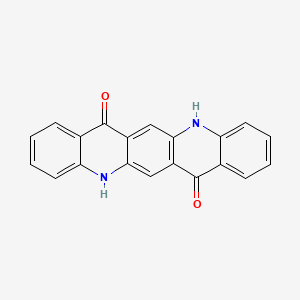
Quinacridone
Quinacridone is an organonitrogen heterocyclic compound and an organic heterotetracyclic compound. — ChEBI
- IUPAC-Name
- 5,12-dihydroquinolino[2,3-b]acridine-7,14-dione
- Summenformel
- C20H12N2O2
- Molekulargewicht
- 312.3 g/mol
- Exakte Masse
- 312.089877630 Da
- XLogP3
- 4,0
- Topologische polare Oberfläche
- 58,2 Ų
- Wasserstoffbrücken-Donoren
- 2
- Wasserstoffbrücken-Akzeptoren
- 4
- Kovalente Einheiten
- 1
- Definierte Stereozentren
- 0
Auch bekannt als
16 weitere gemeldete Namen
Kennungen in externen Datenbanken
Belege aus weiteren wissenschaftlichen Datenbanken
EMBL-EBI ChEBI
Quinacridone
- Rezeptur
- C20H12N2O2
- Durchschnittsmasse
- 312.328 g/mol
- Monoisotopische Masse
- 312.08988 Da
- Formale Ladung
- 0
- organonitrogen heterocyclic compound — is a (CHEBI:38101)
- organic heterotetracyclic compound — is a (CHEBI:38163)
- organonitrogen heterocyclic compound — is a (CHEBI:38101)
- organic heterotetracyclic compound — is a (CHEBI:38163)
Weitere kuratierte Namen
Querverweise aus dieser Quelle
- CAS: 1047-16-1 — ChemIDplus
- MANUAL_X_REF: 13369 — ChemSpider
- MANUAL_X_REF: HMDB0034058 — HMDB
Zugeordnet durch: Exact CAS cross-reference in the ChEBI compound record. Abgerufen: 2026-08-31. Quelleneintrag öffnen
NIH PubChem PUG-View
Attributed physical-property, hazard, environmental and use annotations.
- Color/Form: Red to violet solid with blueish or yellowish tint depending upon crystalline form. Quelle: Hazardous Substances Data Bank (HSDB)
- Color/Form: particle characteristics: thin plates Quelle: Hazardous Substances Data Bank (HSDB)
- Density: 1.5 Quelle: Hazardous Substances Data Bank (HSDB)
- LogP: 1.9 (estimated) Quelle: Hazardous Substances Data Bank (HSDB)
- Melting Point: 390 °C Quelle: Human Metabolome Database (HMDB)
- Physical Description: Liquid; Other Solid; Dry Powder; Other Solid; CBI Quelle: EPA Chemical Data Reporting (CDR)
- Physical Description: Red to violet solid; Bluish or yellowish tint depending of form; [HSDB] Red odorless powder; [MSDSonline] Quelle: Haz-Map, Information on Hazardous Chemicals and Occupational Diseases
- Physical Description: Solid Quelle: Human Metabolome Database (HMDB)
- Refractive Index: Refractive index: quinacridine red (gamma), n(Na) Av. 2.04; quinacridine red (beta), Av. 2.02 Quelle: Hazardous Substances Data Bank (HSDB)
- Solubility: Insoluble in water Quelle: Hazardous Substances Data Bank (HSDB)
- Solubility: Insoluble in organic solvents and dispersion media. Quelle: Hazardous Substances Data Bank (HSDB)
- Note: This chemical does not meet GHS hazard criteria for 99.6% (760 of 763) of all reports. Quelle: European Chemicals Agency (ECHA)
- GHS Hazard Statements: Not Classified; Reported as not meeting GHS hazard criteria by 760 of 763 companies (only 0.4% companies provided GHS information). For more detailed information, please visit ECHA C&L website. Quelle: European Chemicals Agency (ECHA)
- ECHA C&L Notifications Summary: Aggregated GHS information provided per 763 reports by companies from 4 notifications to the ECHA C&L Inventory.; Reported as not meeting GHS hazard criteria per 760 of 763 reports by companies.; There are 2 notifications provided by 3 of 763 reports by companies with hazard statement code(s).; Information may vary between notifications depending on impurities, additives, and other factors. The percentage value in parenthesis indicates the notified classification ratio from companies that provide hazard codes. Only hazard codes with percentage values above 10% are shown. For more detailed information, please visit ECHA C&L website. Quelle: European Chemicals Agency (ECHA)
- Environmental Bioconcentration: Cinquasia red should not bioconcentrate, since it is insoluble, and therefore, will not be taken up into the body. Quelle: Hazardous Substances Data Bank (HSDB)
- Environmental Fate: Much of cinquasia red will be bound up in the components of landfills, junkyards, and general dump sites. Quelle: Hazardous Substances Data Bank (HSDB)
- Environmental Fate: Terrestrial: The insolubility of cinquasia red will cause it to collect in soils and sediments. Quelle: Hazardous Substances Data Bank (HSDB)
- Environmental Fate: Aquatic: Due to its insolubility, cinquasia red may reside in the water column for a substantial period, long enough to become part of deep sea sediments. Quelle: Hazardous Substances Data Bank (HSDB)
- Consumer Uses: Pigment Quelle: EPA Chemical Data Reporting (CDR)
- Industry Uses: Pigment Quelle: EPA Chemical Data Reporting (CDR)
- Sources/Uses: Used as pigment (paints, printing inks, plastics, rubber, alkyd resin enamels, textile emulsion inks, textiles, nitrocellulose, vinyl, and acrylic lacquers) and sensitizing dye in color photo electrophoresis; Used to tone and make other pigments; [HSDB] Quelle: Haz-Map, Information on Hazardous Chemicals and Occupational Diseases
- Industrial Processes with risk of exposure: Painting (Pigments, Binders, and Biocides) [Category: Paint]; Textiles (Printing, Dyeing, or Finishing) [Category: Industry] Quelle: Haz-Map, Information on Hazardous Chemicals and Occupational Diseases
- Uses: PAINTS, PRINTING INKS, PLASTICS, RUBBER Quelle: Hazardous Substances Data Bank (HSDB)
- Uses: Cinquasia red is used a sensitizing dye in color photoelectrophoresis. Quelle: Hazardous Substances Data Bank (HSDB)
- Uses: Pigment in textiles Quelle: Hazardous Substances Data Bank (HSDB)
- Uses: As colorants for plastics, quinacridone pigments may be used in all resins except nylon-66 and polystyrene./Quinacridone Pigments/ Quelle: Hazardous Substances Data Bank (HSDB)
- Uses: For more Uses (Complete) data for CINQUASIA RED (9 total), please visit the HSDB record page. Quelle: Hazardous Substances Data Bank (HSDB)
- Uses: Plastics -> Typical concentration range in plastic materials -> 2% Quelle: NORMAN Suspect List Exchange
Zugeordnet durch: Existing checksum-valid CAS to unique PubChem CID match. Abgerufen: 2026-08-31. Quelleneintrag öffnen
Wissenschaftliche Klassifizierungen und Gefahrenannotationen liefern Kontext und ersetzen nicht die oben gezeigte marktspezifische regulatorische Entscheidung.
Weitere Quellenabdeckung und Trefferstatus
| Quelle | Ergebnis | Geprüft |
|---|---|---|
| EMBL-EBI ChEBI | Exakter Treffer | 2026-08-31 |
| NIH PubChem PUG-View | Exakter Treffer | 2026-08-31 |
Ein erfasster Nicht-Treffer ist ein nützlicher Beleg dafür, dass die Quelle geprüft wurde; er ist keine Behauptung, dass der Stoff anderswo nicht existiert.
Am 2026-08-31 von NIH PubChem durch prüfsummengültigen CAS-Abgleich abgerufen. Chemische Eigenschaften ersetzen nicht die regulatorische Entscheidung auf dieser Seite.
Wie CAS 1047-16-1 auf dieser Website verwendet wird
CAS 1047-16-1 ist die Kennung des Chemical Abstracts Service, mit der diese Seite einem bestimmten Stoff zugeordnet wird. Im aktuellen Datenbestand haben 2 EU-Anhangseinträge diese Kennung; so können Sie gegenprüfen, ob derselbe Stoff in einem oder in mehreren regulatorischen Zusammenhängen auftaucht.
Nutzen Sie diese Seite, wenn eine Lieferantenspezifikation, ein Sicherheitsdatenblatt oder ein Rohstoffdossier CAS 1047-16-1 nennt und Sie alle verknüpften Einträge der Anhänge II–VI an einem Ort sehen möchten. Die Eintragskarten oben sind der schnellste Weg zu Konzentrationsgrenzen, Warnhinweisen, Anhangszuordnung und Produktartbedingungen.
Häufig gestellte Fragen
Werkzeuge und nächste Schritte
Rezeptur prüfen
Eine vollständige INCI-Liste prüfen und anschließend mit CAS 1047-16-1 Lieferantendokumente zu den gefundenen Stoffen gegenprüfen.
INCI-CheckerNach Name suchen
Nach INCI-Namen, Aliasen oder verwandten Kennungen suchen, die in Ihrer Dokumentation neben CAS 1047-16-1 stehen.
Suche