
Shedding Light on Sun Safety - Part Two
Learn the difference between chemical and physical sunscreens and whether oxybenzone is safe. Understand UV filters, skin reactions, and how to choose the best sunscreen.
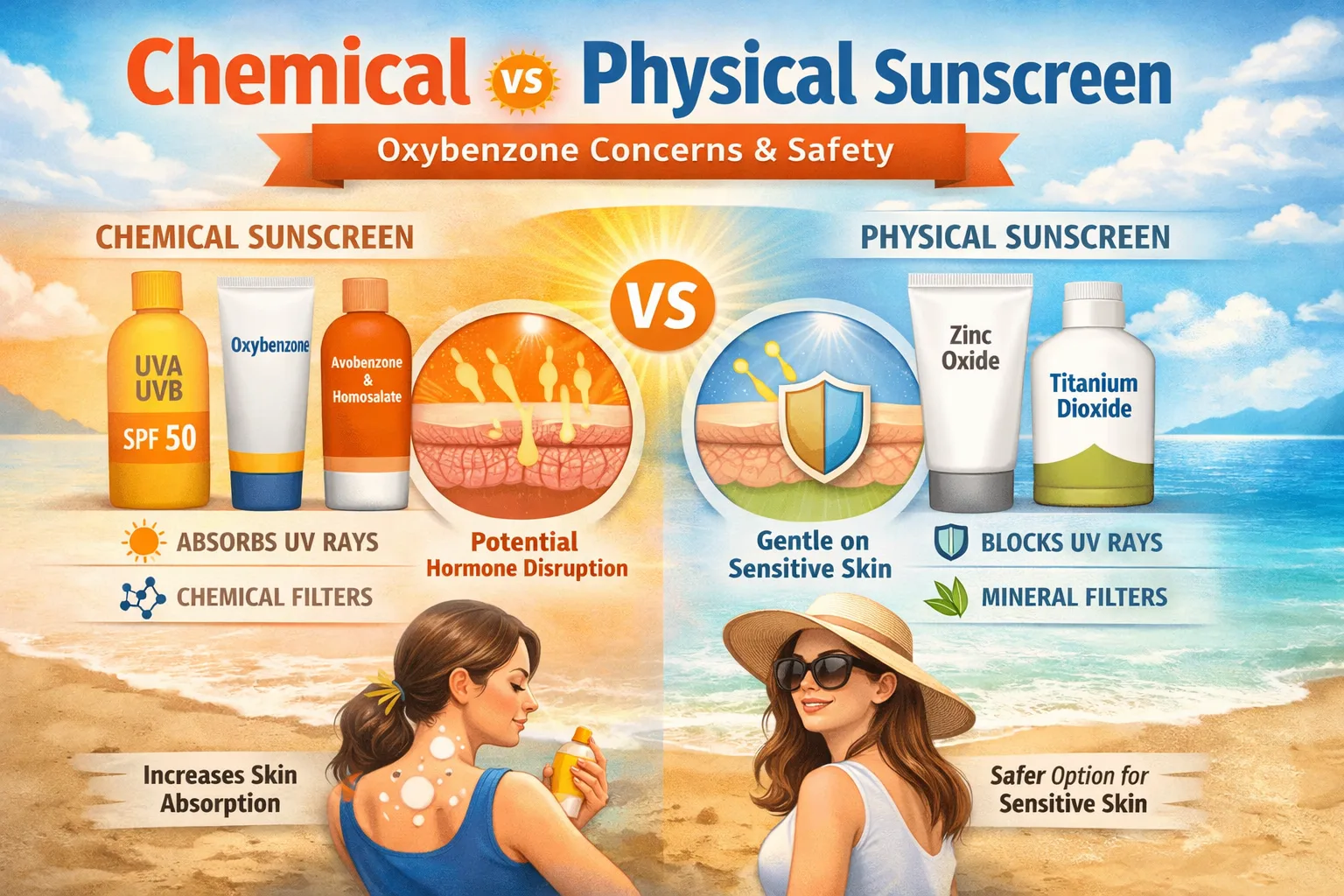
Currently, there are a variety of sunscreen options. You may choose physical blockers of UV rays, different chemical ingredients that absorb UVA and UVB rays, or a combination of both. There are some distinctions between them, and recently the chemical ingredient Oxybenzone has been in the spotlight as something to avoid. Before we move into the topic of Oxybenzone, let’s briefly review the main differences between chemical and physical sunscreens.
Chemical vs. Physical
To make things even more confusing, there are several ways to describe the different types of sunscreens available today. In the scientific field, these sunscreens are referred to as organic or inorganic filters. No, this does not refer to whether you’ll find them at your local natural store. Instead, it relates to whether or not the compound contains a carbon atom. So if any compound includes carbon atoms, it is called ‘organic.’ Organic filters include the chemical sunscreens found in many products. Inorganic filters are more commonly known as physical or mineral sunscreens. These include compounds such as zinc oxide and titanium dioxide. These physical sunscreens stay on the skin and scatter or reflect UV radiation. On the other hand, chemical sunscreens typically absorb UV rays. These include ingredients such as Avobenzone, Oxybenzone and Homosalate, among others.
OK But Which Is Better?
There are many sunscreen options, and most formulations use a mix of physical and chemical filters. All of the previously mentioned ingredients have been approved by the FDA. There isn’t a clearly better option because they are all quite different. However, in some cases, certain chemical compounds may cause skin reactions such as dermatitis, whereas physical blockers usually do not. Keep in mind that the reaction is often caused by high levels of fragrance or alcohol used in sunscreen products. For sensitive skin, it may be more appropriate to use a physical sunscreen. So is physical better than chemical? Not necessarily. It depends on the formulation and personal preference. Chemical sunscreens were developed to provide flexibility in formulations, allowing for invisible coverage while offering UV protection. Physical sunscreens are great for sensitive skin, provide strong coverage but can leave a white cast on the skin.
What’s The Issue with Oxybenzone?
Good question. A recent report published online by the Environmental Working Group (EWG) has listed Oxybenzone as a hormone disruptor that penetrates deeply into the skin. What exactly is a hormone disruptor? Also known as an endocrine disruptor, it refers to an external compound that interferes with the natural hormonal functions of the body. This term appeared in the 90s and has usually referred to environmental chemicals, such as pollutants. However, this term includes a wide range of chemicals that all living beings are exposed to through air, food, water, or contact.
The EWG report suggests that Oxybenzone is a potential hormone disruptor, although it relies on data extrapolated from scientific studies. One study they cited (Schlumpf et al 2001) showed estrogenic effects in rats after ingestion of Oxybenzone. However, it is important to note that these animals were exposed to very large amounts (higher than recommended for human use) and via routes not used by humans, namely oral intake. So these results only apply to rodents consuming large quantities of Oxybenzone, not humans applying a cream on the skin. Another study on humans under more realistic conditions could not confirm this data (Janjua et al 2004).
In 2001, the Scientific Committee on Consumer Products and Non-food Products (SCCNFP) concluded that sunscreens do not show estrogenic effects that impact human health. Let’s assume there is a potential risk of Oxybenzone acting as a hormone disruptor. For this to happen, it would need to penetrate deeply into the living dermis. The EWG claims this is possible, citing a study on penetration (Hayden 1997). However, they do not mention that this study was conducted in vitro, meaning on skin samples in a lab, not on actual humans. Another study by the same group reported negative effects, but participants used about 6 times the recommended amount of sunscreen. Again, these findings do not prove penetration at normal usage levels.
There is also scientific research supporting the safety of this compound for human use. These studies confirm that sunscreen products containing 1–6% Oxybenzone do not show significant sensitization potential or toxicity to human keratinocytes after topical application. The Scientific Committee on Consumer Products (SCCP) of the European Commission concluded in 2008 that it does not pose a significant risk to consumers, except for possible contact allergies.
So What Should I Do?
Scientific studies and committees have provided evidence that it is safe for consumer use. However, it should be noted that babies do not eliminate toxins as efficiently as adults, and their skin may be more permeable. That is why the FDA requires a warning on all sunscreens not to be used on children under 6 months of age. If you are someone who experiences irritation or breakouts from chemical sunscreens, it may be better to choose a physical blocker to protect your skin.
Sunscreen Isn’t Fail-Safe
Sunscreens are only one method of protecting yourself from harmful UV rays. Using more sunscreen does not mean you can safely stay longer in the sun, nor should you avoid the sun completely due to misinformation. In fact, there is no clear evidence that sunscreens prevent malignant melanoma, the most dangerous type of skin cancer. However, sunburns are linked to melanoma, and sunscreens have been shown to prevent sunburns. So be sun smart—don’t avoid the sun completely, but protect yourself by seeking shade, wearing protective clothing, and choosing from the range of approved sunscreens.
References:
1. Agin P et al. Photodermatol, Photoimmunol & Photomedicine (2008) 24:211-217
2. Gonzalez H. Percutaneous absorption with emphasis on sunscreens. Photochemical & Photobiological Sciences (2010) 9: 482–488
3. Hayden C et al. Lancet (1997) 350:863-864
4. Hayden, CGJ et al. Skin Pharmacol Physiol (2005) 18:170–174
5. Janjua NR et al. J Invest Dermatol (2004) 123:57-61
6. https://www.cancer.org/cancer/risk-prevention/sun-and-uv.html
7. https://seer.cancer.gov/statfacts/html/melan.html
8. https://www.who.int/news-room/fact-sheets/detail/ultraviolet-(uv)-radiation
About this article
This article is part of the CosIng Checker blog, where we publish guides, notes and practical explainers about EU cosmetic ingredients, Annex II–VI restrictions, warnings, preservatives, UV filters, colorants and related compliance topics.