
Learn how different types of alcohols in cosmetics work, their benefits, risks, and how to choose safe skincare products. Understand simple, polyhydric, fatty, and aromatic alcohol
Alcohols in Cosmetics
Contents
- Why is alcohol added to cosmetics?
- Types of alcohols in cosmetic formulas 2.1. Simple (monohydric) 2.2. Polyhydric 2.3. Fatty 2.4. Aromatic
- Alcohols in hair care products
- Can alcohol in cosmetics be harmful?
- Conclusion
How often do you see the word “alcohol” or “Alcohol” near the top of an ingredients list and immediately put the product back on the shelf? Yet not all alcohols are the same. Some look like white solid granules you can even shake in a jar, while others are clear liquids that resemble water. Their functions in cosmetics are also completely different. Alcohols can act as emulsifiers, solvents, preservatives, or humectants. Let’s explore how they differ from one another and how to recognize them. The table below clearly shows the differences in the properties of alcohols from different classes.
Why is alcohol added to cosmetics? Most people associate the word “alcohol” only with ethyl alcohol (ethanol). But from a chemistry perspective, there are many different types of alcohols, and each class has unique properties not found in the others.
Table: “Classification and Properties of Alcohols”
| Chemical nature | Examples | Purpose, properties and use in cosmetics |
|---|---|---|
| Simple (monohydric) | Ethyl (ethanol), isopropyl | Dissolving substances, introducing components into formulas, preservative. Isopropyl is most often used in antiseptic products. |
| Polyhydric | Glycerin, butylene glycol, propylene glycol, pentylene glycol Panthenol | Effectively retain moisture, dissolve resins and pigments, extract active substances from plants. Panthenol is a biologically active alcohol with restorative properties — not just a solvent or humectant. |
| Fatty | Cetyl, behenyl, batyl, cetearyl, myristyl, lauryl, isostearyl, oleyl | Co-emulsifiers, emulsion stabilizers, emollient actives. They are fundamentally different from the well-known ethanol. |
| Aromatic | Benzyl alcohol | Fragrance ingredient and fragrance fixative in perfumery. A favorite preservative among “green” and natural cosmetic brands. Maximum permitted concentration is 1 %. |
Types of alcohols in cosmetic formulas
In cosmetology, it’s crucial to know exactly which alcohol is in the formula. Let’s look at each group in more detail.
Simple (monohydric) alcohols There is a common belief that ethyl alcohol in cosmetics (listed as Alcohol, Alcohol denat., or Ethanol) has a drying effect and dissolves the skin’s own lipids. In reality, everything depends on the type of product, the percentage of alcohol, your skin’s reaction (especially dry or sensitive skin is at higher risk), and how long you use it.
- In facial toners/lotions where ethanol is the second ingredient after water, it shows its negative side: the skin becomes dehydrated, some lipids are dissolved, and the skin barrier is compromised. The same applies to alcohol-based tinctures. These are only suitable for spot, short-term use to dry out blemishes. In general, it’s better to avoid such products (especially water-based formulas with ethanol) and choose alternatives instead. For example, hydrosols work wonderfully in place of alcohol toners. They have a natural mildly acidic environment that helps restore the skin’s pH after cleansing. Hydrosols are completely natural and contain no foreign additives.
- According to many formulators, ethanol in emulsions (creams, milks, fluids) is not as harmful and does not dry out the skin. It is acceptable at concentrations of up to 5 % for dry skin and up to 10 % for oily skin. The best guide is always your own skin’s reaction, especially with long-term use. Short-term or spot use may be fine, but constant application can be too much for the skin.
- Ethanol also acts as a solvent-carrier for other ingredients (such as plant extracts) and as a penetration enhancer, helping active ingredients reach deeper layers of the skin.
- At concentrations above 10 %, ethyl alcohol functions as a preservative. This is why it is often found in natural and organic formulas. Ten percent is a borderline value for sensitive skin and increases the penetration of other components. On the other hand, this concentration allows manufacturers to reduce the amount of other preservatives, which can be beneficial for the overall formula.
Thus, ethanol has real benefits when included in formulas and is considered safe under certain conditions. However, there are risks for the skin. If you use products containing alcohol, always monitor your skin’s reactions.
Polyhydric alcohols
The most common representative is glycerin. You’ll find it in almost every product on the shelf. It’s very convenient for formulators because it: • mixes easily with water, • is inert, • does not oxidize, • enhances the antimicrobial effect of cosmetics, • is inexpensive (plant-derived versions are more expensive), • softens and moisturizes the skin at concentrations up to 10 %.
Glycerin occurs naturally on the skin, so it is a physiological and skin-friendly ingredient in skincare (when used in proper dosages). Dryness caused by glycerin only occurs when its concentration exceeds 20 % and the relative humidity of the air is below 60 %. Such high concentrations are almost never used in cosmetics. Still, it’s always important to monitor air humidity — something we keep reminding you about. You can use a humidifier or even an aroma diffuser. Pair it with your favorite essential oil and you’ll get both a therapeutic and moisturizing effect.
Other polyhydric alcohols (propylene glycol and butylene glycol — listed as Propylene Glycol and Butylene Glycol) are favorites of mass-market brands. They are inexpensive humectants and solvents for other ingredients. They can also act as penetration enhancers (the safety depends on the rest of the formula and how rich it is in actives). These ingredients are often not used in pure form but as solvents to create plant extracts.
Propylene glycol is usually derived from petrochemical sources and frequently causes reactions, especially on sensitive skin, even when other actives are supposed to offset its potential irritation. Butylene glycol can be obtained from plant sources. In that case it is gentler, safer, and less likely to cause reactions, while still effectively retaining moisture and improving the penetration of actives. Its molecular structure is more “stretched” and closer to what the skin naturally recognizes.
Pentylene glycol (INCI: Pentylene Glycol) is considered one of the safest and mildest glycols. Its larger molecule means lower penetration and irritation potential. It also functions as a humectant, co-preservative (helps the main preservative do its job), and mild penetration enhancer. It can serve as a carrier for plant extracts.
Panthenol (also written as dexpanthenol, D-panthenol, or Panthenol) is chemically an alcohol (a derivative of pantothenic acid — vitamin B5). In terms of cosmetic action, it is a powerful anti-inflammatory and restorative active: • moisturizes, • soothes the skin, • promotes healing, • supports the skin barrier, • is very gentle and suitable even for babies.
Fatty alcohols
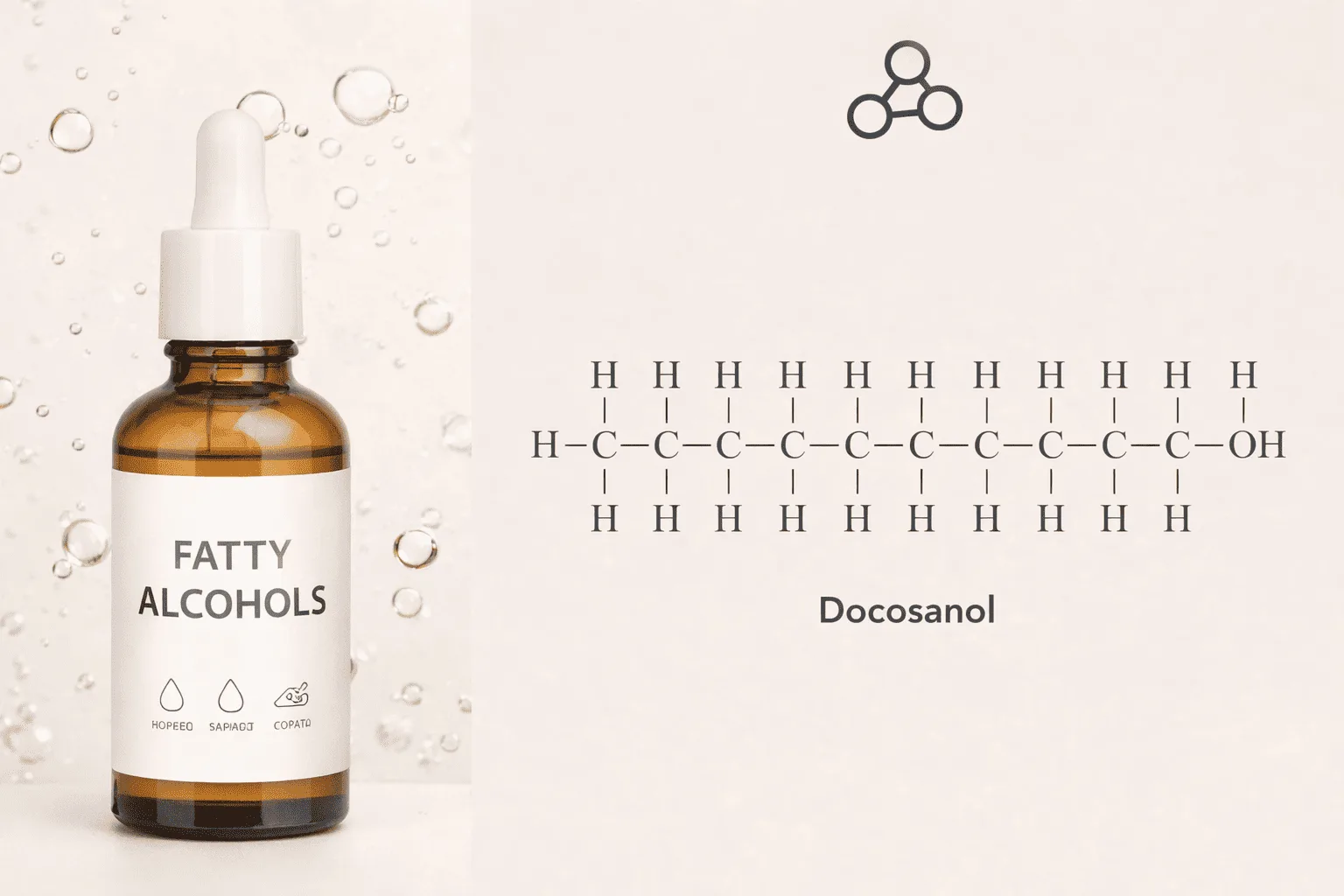
Fatty alcohols are obtained from fatty acids and esters. For example, stearyl alcohol comes from stearic acid, oleyl alcohol from oleic acid. Cetearyl alcohol is a mixture of cetyl and stearyl alcohols. They are usually solid at room temperature and come in the form of granules or flakes.
In cosmetic formulas they are added to support the main emulsifier — they help stabilize and thicken the emulsion, giving a smoother texture. Today, ready-made emulsifying systems that already contain fatty alcohols are widely available. These complex emulsifiers are easy to work with and produce very stable emulsions.
Being lipophilic by nature, these ingredients reduce transepidermal water loss and provide a softening and skin-replenishing effect (without the excessive greasiness you sometimes get from plant butters). They also improve slip during application.
You’ll find them in practically every emulsion-type facial product: creams, milks, fluids, and emulsions.
Aromatic alcohols
The most widely used aromatic alcohol is benzyl alcohol (Benzyl Alcohol). It is a natural component of Peruvian balsam essential oil (up to 9 %) and has a light, characteristic scent. It is a mild preservative — one of the safest used in cosmetics.
It is part of many complex preservative systems approved by ECOCERT, COSMOS, and NaTrue. At high concentrations it may cause irritation on sensitive skin, but in recommended dosages it is generally considered safe.
Alcohols in hair care products
Different types of alcohols are also found in hair cosmetics.
- Simple (monohydric) alcohols Hair is a non-living structure, so the rules that apply to skin do not work the same way here. Ethyl and isopropyl alcohols are most often found in heat-protectant products, and the word “alcohol” frequently appears in the first three ingredients even in expensive, reputable brands. The reason is simple: alcohol has roughly half the specific heat capacity of water, so when heat is applied (hairdryer, straightener), moisture evaporates from the hair more slowly. Ethanol in this case helps preserve the hair’s moisture and elasticity, providing extra protection from high temperatures. The same benefit helps protect hair on hot days and at the seaside. That said, lipids are also present between the hair cuticle scales, and ethanol is a solvent. Therefore, you should evaluate the overall effect and use such products in moderation rather than daily.
- Fatty alcohols In masks and conditioners, fatty alcohols (cetyl, cetearyl, etc.) often appear near the top of the ingredients list. They create soft, creamy emulsions without making the product itself greasy — which is important for hair. They work excellently with cationic surfactants, which are essential in these products to close the hair cuticle and prevent damage.
- Polyhydric alcohols Glycerin is almost always present in hair products (shampoos, conditioners, root-strengthening lotions) as an affordable humectant and carrier for plant extracts. Glycols can serve as carriers for active ingredients and extracts in strengthening lotions and also act as humectants and penetration enhancers. In rinse-off products their negative effects are minimal. They appear less frequently than glycerin.
Can alcohol in cosmetics be harmful?
When any alcohol is added to a formula, the dosage must be strictly observed. Harm usually occurs only when this rule is broken.
The “layering” of modern skincare routines can sometimes play a nasty trick. Make sure that not every product you apply contains ethanol or glycols (some individual products may contain them, but not all). Otherwise you can end up with an overload that disrupts the skin barrier, leading to dehydration and flaking.
Conclusion
Cosmetics use several groups of alcohols: simple/monohydric (most often ethanol), polyhydric (glycerin, glycols), fatty (cetyl, cetearyl, etc.).
They are added to both skincare and haircare products.
The most controversial ones in terms of their effect on the skin’s lipid barrier are simple alcohols and glycols — in excess they can dry out the skin.
We recommend carefully studying the ingredients list: don’t just look for the word “Alcohol,” but understand exactly which alcohol is used, why it’s there, and what its role is. Once you do, alcohols and their use in cosmetics will stop being so controversial. We hope the fear of this word will now fade into the background and be replaced by common sense.
About this article
This article is part of the CosIng Checker blog, where we publish guides, notes and practical explainers about EU cosmetic ingredients, Annex II–VI restrictions, warnings, preservatives, UV filters, colorants and related compliance topics.