
Boric acid
Japan Standards for Cosmetics: Boric acid
The provisional English translation of the MHLW Standards for Cosmetics lists this material in Appendix 1.
监管决定及完整条件
- 状态
- Prohibited
- 法律地位
- Binding rule
- 监管摘要
- The provisional English translation of the MHLW Standards for Cosmetics lists this material in Appendix 1.
- 条件与限制
Prohibited material
物质身份
- 官方来源名称
- Boric acid
- CAS
- 10043-35-3 / 11113-50-1
- EC
- 233-139-2 / 234-343-4
- 身份映射
- exact INCI name
- 关联成分
- BORIC ACID
关联的 CosIng 身份数据
名称和别名
CosIng 描述: Boric acid
已记录的化妆品功能: ANTIMICROBIAL, BUFFERING, DENATURANT
功能页面:ANTIMICROBIAL, BUFFERING, DENATURANT
查看完整的成分档案该身份的跨市场概览
本站目前已有的精确关联记录。某市场缺失表示没有已导入的精确匹配,并不表示准许使用该物质。
European Union
1 条关联记录
打开支持记录Canada
1 条关联记录 · 1 条含特定条件
打开支持记录New Zealand
2 条关联记录
打开支持记录ASEAN
1 条关联记录 · 1 条含特定条件
打开支持记录China
1 条关联记录 · 1 条含特定条件
打开支持记录Japan
当前记录1 条关联记录 · 1 条含特定条件
打开支持记录South Korea
1 条关联记录
打开支持记录Australia
1 条关联记录 · 1 条含特定条件
打开支持记录Brazil
1 条关联记录 · 1 条含特定条件
打开支持记录India
1 条关联记录 · 1 条含特定条件
打开支持记录Saudi Arabia
1 条关联记录
打开支持记录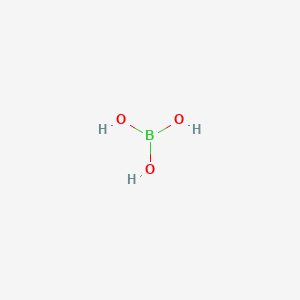
CAS 10043-35-3 的已核实化学信息
Boric Acid
Boric acid is a member of boric acids. It has a role as an astringent. It is a conjugate acid of a dihydrogenborate. — ChEBI
- IUPAC 名称
- boric acid
- 分子式
- BH3O3
- 分子量
- 61.84 g/mol
- 精确质量
- 62.0175241 Da
- 单同位素质量
- 62.0175241 Da
- 拓扑极性表面积
- 60.7 Ų
- 分子复杂度
- 8.0
- 形式电荷
- 0
- 氢键供体
- 3
- 氢键受体
- 3
- 可旋转键
- 0
- 重原子
- 4
- 共价单元
- 1
向 PubChem 报告的名称和同义词
另有 16 个已报告名称
外部数据库标识符
- ChEBI:CHEBI:33118
- ChEMBL:CHEMBL42403
- EPA DTXSID:DTXSID1020194
- PubMed:40682482
- PubMed:38108610
- PubMed:37572183
- PubMed:37045926
- PubMed:35020164
- PubMed:34175401
- PubMed:33137424
- PubMed:32553615
- PubMed:32179172
- PubMed:31823256
- PubMed:31368021
- PubMed:30997025
高级结构统计
- 已定义的原子立体中心
- 0
- 未定义的原子立体中心
- 0
- 已定义的键立体中心
- 0
- 未定义的键立体中心
- 0
- 三维构象异构体
- 0
机器可读的结构标识符
- SMILES
B(O)(O)O- InChI
InChI=1S/BH3O3/c2-1(3)4/h2-4H- InChIKey
KGBXLFKZBHKPEV-UHFFFAOYSA-N
来自其他科学数据库的证据
EMBL-EBI ChEBI
boric acid
- 配方
- H3BO3
- 平均质量
- 61.833 g/mol
- 单同位素质量
- 62.01752 Da
- 形式电荷
- 0
- boric acids — is a (CHEBI:59765)
- astringent — has role (CHEBI:74783)
- plastic heat stabilizer — has role (CHEBI:747338)
- astringent — has role (CHEBI:74783)
- plastic heat stabilizer — has role (CHEBI:747338)
- boric acids — is a (CHEBI:59765)
- dihydrogenborate — is conjugate acid of (CHEBI:29254)
其他整理的名称
来自此来源的交叉引用
- CAS: 10043-35-3 — KEGG COMPOUND
- CAS: 10043-35-3 — NIST Chemistry WebBook
- CAS: 10043-35-3 — ChemIDplus
- CAS: 11113-50-1 — ChemIDplus
- REGISTRY_NUMBER: 1585 — Gmelin
- MANUAL_X_REF: 1644 — MolBase
- MANUAL_X_REF: 2136 — PPDB
- MANUAL_X_REF: 2136 — BPDB
- MANUAL_X_REF: 3035 — DrugCentral
- MANUAL_X_REF: BO3 — PDBeChem
- MANUAL_X_REF: C12486 — KEGG COMPOUND
- MANUAL_X_REF: D01089 — KEGG DRUG
映射方: Exact CAS cross-reference in the ChEBI compound record. 来源更新: 2025-09-18. 检索时间: 2026-08-31. 打开来源记录
NIH PubChem PUG-View
Attributed physical-property, hazard, environmental and use annotations.
- Boiling Point: 572 °F at 760 mmHg (decomposes) (NTP, 1992) 来源: CAMEO Chemicals
- Boiling Point: 300 来源: DrugBank
- Boiling Point: 572 °F 来源: Occupational Safety and Health Administration (OSHA)
- Color/Form: Colorless, transparent crystals or white granules or powder 来源: Hazardous Substances Data Bank (HSDB)
- Color/Form: Colorless triclinic crystals 来源: Hazardous Substances Data Bank (HSDB)
- Color/Form: White waxy triclinic solid plates 来源: Hazardous Substances Data Bank (HSDB)
- Density: 1.435 at 68 °F (USCG, 1999) - Denser than water; will sink 来源: CAMEO Chemicals
- Density: 1.5 g/cu cm 来源: Hazardous Substances Data Bank (HSDB)
- Density: Relative density (water = 1): 1.5 来源: ILO-WHO International Chemical Safety Cards (ICSCs)
- Density: 1.435 来源: Occupational Safety and Health Administration (OSHA)
- Density: 1.435 @25 °C 来源: PAC Chemical Database, U.S. Department of Energy
- Dissociation Constants: Ka = 5.80X10⁻¹⁰ at 25 °C (pKa = 9.24) 来源: Hazardous Substances Data Bank (HSDB)
- LogP: log Kow = 0.175 来源: Hazardous Substances Data Bank (HSDB)
- LogP: 0.18 来源: Human Metabolome Database (HMDB)
- LogP: -1.09 来源: ILO-WHO International Chemical Safety Cards (ICSCs)
- Melting Point: 340 °F (NTP, 1992) 来源: CAMEO Chemicals
- Melting Point: 169 来源: DrugBank
- Melting Point: 171 °C 来源: Haz-Map, Information on Hazardous Chemicals and Occupational Diseases
- Melting Point: 170.9 °C 来源: Hazardous Substances Data Bank (HSDB)
- Melting Point: 171 °C 来源: Human Metabolome Database (HMDB)
- Melting Point: 340 °F 来源: Occupational Safety and Health Administration (OSHA)
- Melting Point: 170.9 °C 来源: PAC Chemical Database, U.S. Department of Energy
- Odor: Odorless 来源: Hazardous Substances Data Bank (HSDB)
- Physical Description: Boric acid is an odorless white solid. Melting point 171 °C. Sinks and mixes with water. (USCG, 1999) 来源: CAMEO Chemicals
- Physical Description: Dry Powder; Other Solid; Large Crystals; Dry Powder; Large Crystals; Liquid; Other Solid 来源: EPA Chemical Data Reporting (CDR)
- Physical Description: Colourless, odourless, transparent crystals or white granules or powder; slightly unctuous to the touch; occurs in nature as the mineral sassolite 来源: EU Food Improvement Agents
- Physical Description: Colorless crystals or white powder or granules; odorless; [Merck Index] White odorless powder; [Alfa Aesar MSDS] 来源: Haz-Map, Information on Hazardous Chemicals and Occupational Diseases
- Physical Description: Solid 来源: Human Metabolome Database (HMDB)
- Physical Description: ODOURLESS COLOURLESS CRYSTALS OR WHITE POWDER. 来源: ILO-WHO International Chemical Safety Cards (ICSCs)
- Physical Description: Odorless white solid. 来源: Occupational Safety and Health Administration (OSHA)
- Refractive Index: Index of refraction: 1.337, 1.461, 1.462 来源: Hazardous Substances Data Bank (HSDB)
- Solubility: 10 to 50 mg/mL at 66 °F (NTP, 1992) 来源: CAMEO Chemicals
- Solubility: Soluble in hot water, partially soluble in cold water 来源: DrugBank
- Solubility: Slightly unctuous to touch; volatile with steam; solubility in water increased by hydrochloric, citric or tartaric acids 来源: Hazardous Substances Data Bank (HSDB)
- Solubility: Solubility: in glycerol 17.5% at 25 °C; ethylene glycol 18.5% at 25 °C; in methanol 173.9 g/L at 25 °C; in ethanol 94.4 g/L at 25 °C; in acetone 0.6% at 25 °C; ethyl acetate 1.5% at 25 °C 来源: Hazardous Substances Data Bank (HSDB)
- Solubility: Water solubility: 2.52% at 0 °C; 3.49% at 10 °C; 4.72% at 20 °C; 6.23% at 30 °C; 8.08% at 40 °C; 10.27% at 50 °C; 12.97% at 60 °C; 15.75% at 70 °C; 19.10% at 80 °C; 23.27% at 90 °C; 27.53% at 100 °C 来源: Hazardous Substances Data Bank (HSDB)
- Solubility: Solubility in water is increased by hydrochloric acid 来源: Hazardous Substances Data Bank (HSDB)
- Solubility: In water, 5.0X10+4 mg/L at 25 °C 来源: Hazardous Substances Data Bank (HSDB)
- Solubility: 50 mg/mL at 25 °C 来源: Human Metabolome Database (HMDB)
- Solubility: Solubility in water, g/100ml at 20 °C: 5.6 来源: ILO-WHO International Chemical Safety Cards (ICSCs)
- Vapor Pressure: 1.6X10⁻⁶ mm Hg at 25 °C (2.136X10⁻⁴ Pa); log P (in Pa) = 26.83 - 9094/T where T is deg K 来源: Hazardous Substances Data Bank (HSDB)
- Vapor Pressure: Vapor pressure at 20 °C: negligible 来源: ILO-WHO International Chemical Safety Cards (ICSCs)
- pH: 3,8-4,8 (3,3 % aqueous solution) 来源: EU Food Improvement Agents
- pH: pH = 5.1 (0.1 Molar) 来源: Hazardous Substances Data Bank (HSDB)
- Substance: Boric Acid 来源: NTP Technical Reports
- NTP Technical Report: TR-324: Toxicology and Carcinogenesis Studies of Boric Acid (CASRN 10043-35-3) in B6C3F1 Mice (Feed Studies) (1987 ) 来源: NTP Technical Reports
- Peer Review Date: 03/26/86 来源: NTP Technical Reports
- Conclusion for Male Rat: Chemical Not Tested in Species/Sex 来源: NTP Technical Reports
- Conclusion for Female Rat: Chemical Not Tested in Species/Sex 来源: NTP Technical Reports
- Conclusion for Male Mice: No Evidence 来源: NTP Technical Reports
- Conclusion for Female Mice: No Evidence 来源: NTP Technical Reports
- Summary: Under the conditions of these 2--year feed studies, there was no evidence of carcinogenicity of boric acid at doses of 2,500 or 5,000 ppm for male or female B6C3F1 mice. Testicular atrophy and interstitial cell hyperplasia were observed in high dose male mice. The decrease in survival of dosed male mice may have reduced the sensitivity of this study. 来源: NTP Technical Reports
- Carcinogen Classification: No indication of carcinogenicity to humans (not listed by IARC). 来源: Toxin and Toxin Target Database (T3DB)
- Exposure Routes: The substance can be absorbed into the body by inhalation of dust and by ingestion. 来源: ILO-WHO International Chemical Safety Cards (ICSCs)
- First Aid: EYES: First check the victim for contact lenses and remove if present. Flush victim's eyes with water or normal saline solution for 20 to 30 minutes while simultaneously calling a hospital or poison control center. Do not put any ointments, oils, or medication in the victim's eyes without specific instructions from a physician. IMMEDIATELY transport the victim after flushing eyes to a hospital even if no symptoms (such as redness or irritation) develop.; SKIN: IMMEDIATELY flood affected skin with water while removing and isolating all contaminated clothing. Gently wash all affected skin areas thoroughly with soap and water. If symptoms such as redness or irritation develop, IMMEDIATELY call a physician and be prepared to transport the victim to a hospital for treatment.; INHALATION: IMMEDIATELY leave the contaminated area; take deep breaths of fresh air. If symptoms (such as wheezing, coughing, shortness of breath, or burning in the mouth, throat, or chest) develop, call a physician and be prepared to transport the victim to a hospital. Provide proper respiratory protection to rescuers entering an unknown atmosphere. Whenever possible, Self-Contained Breathing Apparatus (SCBA) shou 来源: CAMEO Chemicals
- Signal: Danger 来源: Regulation (EC) No 1272/2008 of the European Parliament and of the Council
- GHS Hazard Statements: H360FD: May damage fertility; May damage the unborn child [Danger Reproductive toxicity] 来源: Regulation (EC) No 1272/2008 of the European Parliament and of the Council
- Precautionary Statement Codes: P203, P280, P318, P405, and P501 (click each P-code to see the statement) 来源: Regulation (EC) No 1272/2008 of the European Parliament and of the Council
- Note: This chemical does not meet GHS hazard criteria for < 0.1% (1 of 2123) of reports. 来源: European Chemicals Agency (ECHA)
- Signal: Danger 来源: European Chemicals Agency (ECHA)
- GHS Hazard Statements: H360 (88.7%): May damage fertility or the unborn child [Danger Reproductive toxicity]; H360FD (11.2%): May damage fertility; May damage the unborn child [Danger Reproductive toxicity] 来源: European Chemicals Agency (ECHA)
- Precautionary Statement Codes: P203, P280, P318, P405, and P501 (click each P-code to see the statement) 来源: European Chemicals Agency (ECHA)
- ECHA C&L Notifications Summary: Aggregated GHS information provided per 2123 reports by companies from 49 notifications to the ECHA C&L Inventory. Each notification may be associated with multiple companies.; Reported as not meeting GHS hazard criteria per 1 of 2123 reports by companies.; There are 48 notifications provided by 2122 of 2123 reports by companies with hazard statement code(s).; Information may vary between notifications depending on impurities, additives, and other factors. The percentage value in parenthesis indicates the notified classification ratio from companies that provide hazard codes. Only hazard codes with percentage values above 10% are shown. For more detailed information, please visit ECHA C&L website. 来源: European Chemicals Agency (ECHA)
- GHS Hazard Statements: H360 (100%): May damage fertility or the unborn child [Danger Reproductive toxicity] 来源: European Chemicals Agency (ECHA)
- ECHA C&L Notifications Summary: Aggregated GHS information provided per 241 reports by companies from 5 notifications to the ECHA C&L Inventory.; Information may vary between notifications depending on impurities, additives, and other factors. The percentage value in parenthesis indicates the notified classification ratio from companies that provide hazard codes. Only hazard codes with percentage values above 10% are shown. For more detailed information, please visit ECHA C&L website. 来源: European Chemicals Agency (ECHA)
- Signal: Danger 来源: NITE-CMC
- GHS Hazard Statements: H315: Causes skin irritation [Warning Skin corrosion/irritation]; H319: Causes serious eye irritation [Warning Serious eye damage/eye irritation]; H335: May cause respiratory irritation [Warning Specific target organ toxicity, single exposure; Respiratory tract irritation]; H360: May damage fertility or the unborn child [Danger Reproductive toxicity]; H370: Causes damage to organs [Danger Specific target organ toxicity, single exposure]; H402: Harmful to aquatic life [Hazardous to the aquatic environment, acute hazard] 来源: NITE-CMC
- Cosmetic Ingredient Review Conclusion: The Expert Panel concludes that Sodium Borate and Boric Acid, in concentrations less than or equal to 5 percent, are safe as cosmetic ingredients when used as currently recommended; however, cosmetic formulations containing free Sodium Borate or Boric Acid at this concentration should not be used on infant skin or injured skin. Note: In 2003, the CIR Expert Panel considered available new data on these ingredients and reaffirmed the above conclusion. 来源: Cosmetic Ingredient Review (CIR)
- Cosmetic Ingredient Review Finding(s): Safe for use in cosmetics, with qualifications 来源: Cosmetic Ingredient Review (CIR)
- Environmental Bioconcentration: Highly water soluble materials are unlikely to bioaccumulate to any significant degree, and borate species are all present essentially as undissociated boric acid at neutral pH(1). The octanol/water partition coefficient for boric acid has been measured as 0.175(1), indicating low bioaccumulation potential(1). Boron did not bioaccumulate in 47-day and 21-day exposure tests using oysters and sockeye salmon respectively(1). 来源: Hazardous Substances Data Bank (HSDB)
- Environmental Fate: TERRESTRIAL FATE: The pKa of boric acid is 9.24 at 25 °C(1), indicating that this compound will exist primarily in the undissociated form at an environmental pH range between pH 5 and pH 9, although the anion form will partially exist in alkaline soils(SRC). Adsorption of boron in soils depends on pH, organic content and types of clay and minerals in the soil(1). At acidic pH, boron exists in solutions in the form of undissociated boric acid; at alkaline pH, presence of borate ion occurs, which reaches maximum adsorption at pH 8.5-9(2). Field studies have observed boron to leach readily in soil(1); undissociated boric acid is transported in soil with little adsorption(2). Volatilization of boric acid from moist soil surfaces is not expected to be an important fate process(SRC) given an estimated Henry's Law constant of 2.6X10⁻¹² atm-cu m/mole(SRC), based upon its vapor pressure, 1.6X10⁻⁶ mm Hg(3), and water solubility, 5X10+4 mg/L(4). Boric acid is not expected to volatilize from dry soil surfaces(SRC) based upon its vapor pressure. No biotransformation processes have been reported for boron compounds, including boric acid(2). 来源: Hazardous Substances Data Bank (HSDB)
- Environmental Fate: AQUATIC FATE: The pKa of boric acid is 9.24 at 25 °C(1), indicating that this compound will exist primarily in the undissociated form at an environmental pH range between 5 and 9, although the anion form will partially exist in alkaline waters(SRC). Boric acid leaches readily in soils(2) which indicates adsorption to suspended solids and sediment in water will not be an important fate process(SRC). Volatilization from water surfaces is not expected(3) based upon an estimated Henry's Law constant of 2.6X10⁻¹² atm-cu m/mole(SRC), derived from its vapor pressure, 1.6X10⁻⁶ mm Hg(4), and water solubility, 5X10+4 mg/L(5). However, evaporation of seawater itself is reported to be the biggest environmental contribution of boric acid to air(2). No biotransformation processes have been reported for boron compounds, including boric acid(2). 来源: Hazardous Substances Data Bank (HSDB)
- Environmental Fate: ATMOSPHERIC FATE: According to a model of gas/particle partitioning of semivolatile organic compounds in the atmosphere(1), boric acid, which has a vapor pressure of 1.6X10⁻⁶ mm Hg at 25 °C(2), will exist in both the vapor and particulate phases in the ambient atmosphere. One monitoring study found that approximately 90% of boric acid in the atmosphere is in gaseous form and 10% in particulate form(3). Vapor-phase boric acid is degraded in the atmosphere by reaction with photochemically-produced hydroxyl radicals(SRC); the half-life for this reaction in air is estimated to be about 38 days(SRC), calculated from its rate constant of 4.2X10⁻¹³ cu cm/molecule-sec at 25 °C(SRC) that was derived using a structure estimation method(4). Particulate-phase boric acid may be removed from the air by wet or dry deposition(SRC). 来源: Hazardous Substances Data Bank (HSDB)
- Consumer Uses: Chemical reaction regulator; pH regulating agent; Bleaching agent; Tanning agents not otherwise specified; Other; Lubricating agent; Anti-adhesive/cohesive; Adhesion/cohesion promoter; Anti-scaling agent; Viscosity modifiers; Soil amendments (fertilizers); Corrosion inhibitor; Not Known or Reasonably Ascertainable 来源: EPA Chemical Data Reporting (CDR)
- Industry Uses: Processing aids not otherwise specified; Plating agent; Chemical reaction regulator; Bleaching agent; Fuel agents; pH regulating agent; Binder; Other; Lubricating agent; Anti-static agent; Chelating agent; Etching agent; Adhesion/cohesion promoter; Surface modifier; Dye; Flux agent; Flame retardant; Cleaning agent; Stabilizing agent; Not Known or Reasonably Ascertainable; Soil amendments (fertilizers) 来源: EPA Chemical Data Reporting (CDR)
- Cosmetic Ingredient Review Link: CIR ingredient: Boric Acid 来源: Cosmetic Ingredient Review (CIR)
- Sources/Uses: Used as an insecticide to kill ants and roaches, as a soldering flux, a flame retardant and weatherproofing agent; also used as an additive to dyes, nickeling baths, film developers, glass, enamels, soaps, paints, paper, adhesives, and steel; [HSDB] Used as a flux, an additive for heat-resistant borosilcate glass and glass fibers, a flame retardant for textile and insulation products, a fungicide for citrus fruits, an eye medicine, and a solute for nickel electroplating baths; Boric acid is formed by crystallizing a solution of hydrochloric acid or sulfuric acid and borax. [Hawley] Used for weatherproofing wood, as a preservative, in cosmetics, printing and dyeing, electric condensers, photography, and painting, for impregnating wicks and hardening steel, and to make cements, crockery, porcelain, borates, leather, carpets, hats, and artificial gems; Used therapeutically as an astringent and antiseptic and as a veterinary antibacterial and antifungal; [Merck Index] Registered US pesticide uses include insecticides (stomach poisons for ants, cockroaches, silverfish, and termites), fungicides (wood preservatives), and herbicides (desiccants, photosynthesis interrupters, and algae cont 来源: Haz-Map, Information on Hazardous Chemicals and Occupational Diseases
- Industrial Processes with risk of exposure: Steel Producing [Category: Industry]; Welding [Category: Weld]; Brazing [Category: Heat or Machine]; Electroplating [Category: Plate]; Textiles (Fiber & Fabric Manufacturing) [Category: Industry]; Painting (Pigments, Binders, and Biocides) [Category: Paint]; Applying Wood Preservatives [Category: Other]; Using Disinfectants or Biocides [Category: Clean]; Farming (Pesticides) [Category: Industry]; Sewer and Wastewater Treatment [Category: Industry]; Leather Tanning and Processing [Category: Industry]; Photographic Processing [Category: Other]; Cement Producing [Category: Industry]; Textiles (Printing, Dyeing, or Finishing) [Category: Industry]; Glass Manufacturing [Category: Industry] 来源: Haz-Map, Information on Hazardous Chemicals and Occupational Diseases
- Uses: Both oil base and water base fracturing fluids are being used in the fracturing industry. Water base, which includes alcohol-water mixtures and low strength acids, make up the majority of treating fluids. The common chemicals added to these fluids are polymers for viscosity development, crosslinkers for viscosity enhancement, pH control chemicals, gel breakers for polymer degradation following the treatment, surfactants, clay stabilizers, alcohol, bactericides, fluid loss additives and friction reducer. /Hydraulic fracturing/ 来源: Hazardous Substances Data Bank (HSDB)
- Uses: Hydraulic fracturing uses a specially blended liquid which is pumped into a well under extreme pressure causing cracks in rock formations underground. These cracks in the rock then allow oil and natural gas to flow, increasing resource production. ... Chemical Name: Boric acid; Chemical Purpose: Maintains fluid viscosity as temperature increases; Product Function: Crosslinker. 来源: Hazardous Substances Data Bank (HSDB)
- Uses: For boric acid (USEPA/OPP Pesticide Code: 011001) ACTIVE products with label matches. /SRP: Registered for use in the U.S. but approved pesticide uses may change periodically and so federal, state and local authorities must be consulted for currently approved uses./ 来源: Hazardous Substances Data Bank (HSDB)
- Uses: For weatherproofing wood and fireproofing fabrics; as a preservative; manufacture of cements, crockery, porcelain, enamels, glass, borates, leather, carpets, hats, soaps, artificial gems; in nickeling baths; cosmetics; printing and dyeing, painting; photography; for impregnating wicks; electric condensers; hardening steel. Also used as insecticide for cockroaches and black carpet beetles. 来源: Hazardous Substances Data Bank (HSDB)
- Uses: For more Uses (Complete) data for BORIC ACID (20 total), please visit the HSDB record page. 来源: Hazardous Substances Data Bank (HSDB)
映射方: Existing checksum-valid CAS to unique PubChem CID match. 检索时间: 2026-08-31. 打开来源记录
科学分类和危害注释仅提供背景信息,不能取代上方所示针对具体市场的监管决定。
其他来源的覆盖范围和匹配状态
| 来源 | 结果 | 已检查 |
|---|---|---|
| EMBL-EBI ChEBI | 精确匹配 | 2026-08-31 |
| NIH PubChem PUG-View | 精确匹配 | 2026-08-31 |
已记录的无匹配结果是该来源已被检查的有效证据;这并不表示该物质在别处不存在。
于 2026-08-31 通过校验和有效的 CAS 匹配从美国国立卫生研究院 (NIH) PubChem 检索。化学性质不能取代本页的监管决定。
官方来源与出处
- 已登记来源
- Japan MHLW Standards for Cosmetics
- 来源参考
- Appendix 1, entry 28
- 来源记录 ID
appendix-1:28- 来源版本
- MHLW Notification No. 331 provisional translation, retrieved 2026-08-30
- 来源语言
- English provisional translation; Japanese text is canonical
- 翻译状态
- Regulator-hosted provisional English translation · 英文译文
- 快照检查时间
- 2026-08-30 04:11 UTC
- 验证方法
- pdftotext -layout plus strict per-table row counts
- SHA-256
117fc949a82789ca66017163f19041cf2fcf6b5902708077c8e4f56c482dc8e2
已登记的数据集备注
- 数据集覆盖范围
- Prohibited and restricted ingredient appendices with concentration and use conditions
- 权威性说明
- Official MHLW standard; validate later Japanese updates before presenting current status
本记录在市场数据集中的位置
Japan 市场背景
Complete Standards appendices dataset
覆盖版本: MHLW Standards for Cosmetics official English source and Japanese amendments checked for the imported snapshot
Prohibited ingredients, restricted ingredients and permitted preservative/UV/colourant appendices present in the official standard source.
核实清单
- Search Japanese/English identity and CAS where present.
- Apply category and maximum-amount conditions.
- Check later MHLW notices against the Japanese source.
- Verify marketing licence, notification, labelling and quasi-drug classification.
官方市场来源
- Japan MHLW Standards for CosmeticsOfficial MHLW standard; validate later Japanese updates before presenting current status
核实工作流程与记录完整性
在将此结果用于合规决定之前
- 确认“Boric acid”及每个 CAS/EC 标识符所指的物料与您的供应商规格一致。
- Search Japanese/English identity and CAS where present.
- Apply category and maximum-amount conditions.
- Check later MHLW notices against the Japanese source.
- Verify marketing licence, notification, labelling and quasi-drug classification.
- 记录来源版本,并在生产、备案或上市之前重新核查监管机构。
本记录中的可用字段
- 官方物质名称可用
- CAS可用
- EC可用
- 单独的条件文本可用
- 生效日期未提供
- 快照哈希与方法可用
本页回答的问题
稳定引用
Boric acid. Appendix 1, entry 28. Japan. Source version MHLW Notification No. 331 provisional translation, retrieved 2026-08-30. CosIng Checker regulatory record: https://cosingchecker.com/zh-hans/regulations/jp/records/625/
请将监管机构作为法律依据来引用。本页是结构化的证据索引和核实辅助工具,不能替代官方文本或专业法律评估。
Japan 的解读与局限
This official record identifies the substance as prohibited for cosmetic use in the stated market scope.
Do not rely on a formulation containing this identity until the cited source, effective date and exact substance match have been verified.
如何解读法律地位
The cited row forms part of a binding rule or legally incorporated list for this market.
本页证据
- 记录结果:Prohibited
- 法律地位:Binding rule
- 来源版本:MHLW Notification No. 331 provisional translation, retrieved 2026-08-30
它不能证明什么
The Japanese text and subsequent notices are canonical; no local match is not a product-compliance conclusion.
进一步的权威物质研究
这些来源均不能推翻上述市场决定。
Cosmetic Ingredient Review safety assessments
Expert Panel conclusions, assessed ingredient groups, use conditions, dates and report documents
Independent expert review considered by FDA; not a government approval or binding market rule
在来源处研究此身份FDA Global Substance Registration System
UNII identifiers, preferred names, substance types, codes and public substance relationships
Identity registry only; UNII availability does not imply FDA review or approval
在来源处研究此身份ILO/WHO International Chemical Safety Cards
Hazards, symptoms, first aid, storage, incompatibilities and physical properties for covered chemicals
International occupational chemical-safety reference; not cosmetic-use approval
在来源处研究此身份Japan NITE-CHRIP
Chemical identity, Japanese and foreign legal lists, GHS hazards and exposure-related information
Chemical-management evidence; cosmetic status remains governed by the applicable MHLW standard and market rules
在来源处研究此身份NIOSH Pocket Guide to Chemical Hazards
REL, PEL, IDLH, properties, exposure routes, symptoms, target organs, first aid and measurement methods for covered workplace chemicals
US occupational-health guidance and limits; not a cosmetic ingredient decision
在来源处研究此身份OECD eChemPortal
Gateway to authority-owned physical-property, fate, ecotoxicity, toxicity, exposure and GHS records
Discovery gateway; each linked authority remains responsible for its data
在来源处研究此身份US EPA CompTox CTX APIs
导入需要 API 密钥DTXSID identity, experimental and predicted properties, toxicity, bioactivity, exposure and environmental data
Scientific and computational evidence; predictions must remain labelled and do not determine cosmetic legality
在来源处研究此身份