
Epóxido de heptacloro
ANVISA lists this substance among materials that may not be used in personal-hygiene products, cosmetics or perfumes in Brazil.
监管决定及完整条件
- 状态
- Prohibited
- 法律地位
- Binding rule
- 监管摘要
- ANVISA lists this substance among materials that may not be used in personal-hygiene products, cosmetics or perfumes in Brazil.
- 条件与限制
Epóxido de heptacloro
物质身份
- 官方来源名称
- Epóxido de heptacloro
- CAS
- 1024-57-3
- EC
- 213-831-0
- 身份映射
- standalone:official_anvisa_record
该身份的跨市场概览
本站目前已有的精确关联记录。某市场缺失表示没有已导入的精确匹配,并不表示准许使用该物质。
European Union
1 条关联记录
打开支持记录Great Britain
1 条关联记录
打开支持记录New Zealand
1 条关联记录
打开支持记录ASEAN
1 条关联记录
打开支持记录China
1 条关联记录 · 1 条含特定条件
打开支持记录South Korea
1 条关联记录
打开支持记录Brazil
当前记录1 条关联记录 · 1 条含特定条件
打开支持记录India
1 条关联记录 · 1 条含特定条件
打开支持记录Saudi Arabia
1 条关联记录
打开支持记录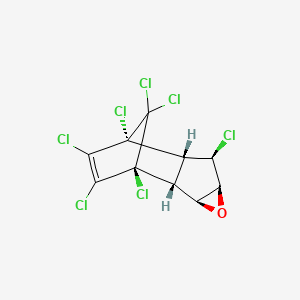
CAS 1024-57-3 的已核实化学信息
Heptachlor Epoxide
Heptachlor Epoxide can cause cancer according to an independent committee of scientific and health experts. — California Office of Environmental Health Hazard Assessment (OEHHA)
- IUPAC 名称
- (1S,2R,3S,5S,6R,7S,8R)-1,6,8,9,10,11,11-heptachloro-4-oxatetracyclo[6.2.1.02,7.03,5]undec-9-ene
- 分子式
- C10H5Cl7O
- 分子量
- 389.3 g/mol
- 精确质量
- 387.813059 Da
- 单同位素质量
- 385.816009 Da
- XLogP3
- 3.7
- 拓扑极性表面积
- 12.5 Ų
- 分子复杂度
- 504.0
- 形式电荷
- 0
- 氢键供体
- 0
- 氢键受体
- 1
- 可旋转键
- 0
- 重原子
- 18
- 共价单元
- 1
向 PubChem 报告的名称和同义词
另有 16 个已报告名称
外部数据库标识符
高级结构统计
- 已定义的原子立体中心
- 7
- 未定义的原子立体中心
- 0
- 已定义的键立体中心
- 0
- 未定义的键立体中心
- 0
- 三维药效团特征
- 3
- 三维环
- 2
- 三维疏水基团
- 0
- 三维受体特征
- 1
- 三维供体特征
- 0
- 三维阴离子中心
- 0
- 三维阳离子中心
- 0
- 三维构象异构体
- 1
- 有效三维可旋转键
- 0.6
机器可读的结构标识符
- SMILES
[C@@H]12[C@@H]([C@H]([C@@H]3[C@H]1O3)Cl)[C@]4(C(=C([C@@]2(C4(Cl)Cl)Cl)Cl)Cl)Cl- InChI
InChI=1S/C10H5Cl7O/c11-3-1-2(4-5(3)18-4)9(15)7(13)6(12)8(1,14)10(9,16)17/h1-5H/t1-,2+,3+,4-,5+,8+,9-/m0/s1- InChIKey
ZXFXBSWRVIQKOD-UOFFAGTMSA-N
来自其他科学数据库的证据
EMBL-EBI ChEBI
Heptachlor epoxide
- 配方
- C10H5Cl7O
- 平均质量
- 389.320 g/mol
- 单同位素质量
- 385.81601 Da
- 形式电荷
- 0
- oxanes — is a (CHEBI:46942)
- oxanes — is a (CHEBI:46942)
其他整理的名称
来自此来源的交叉引用
- CAS: 1024-57-3 — KEGG COMPOUND
- MANUAL_X_REF: C14327 — KEGG COMPOUND
映射方: Exact CAS cross-reference in the ChEBI compound record. 来源更新: 2014-07-28. 检索时间: 2026-08-31. 打开来源记录
NIH PubChem PUG-View
Attributed physical-property, hazard, environmental and use annotations.
- LogP: log Kow= 5.40 来源: Hazardous Substances Data Bank (HSDB)
- Melting Point: 160-161.5 °C 来源: Hazardous Substances Data Bank (HSDB)
- Melting Point: 160 °C 来源: PAC Chemical Database, U.S. Department of Energy
- Physical Description: Heptachlor epoxide appears as a degradation product of heptachlor that occurs in soil and in or on crops when treatments with heptachlor, an insecticide, have been made. Forms readily upon exposing heptachlor to air. 来源: CAMEO Chemicals
- Physical Description: Crystalline solid; [MSDSonline] 来源: Haz-Map, Information on Hazardous Chemicals and Occupational Diseases
- Solubility: 0.350 PPM IN WATER 来源: Hazardous Substances Data Bank (HSDB)
- Carcinogen Classification: No indication of carcinogenicity (not listed by IARC). (L135) 来源: Toxin and Toxin Target Database (T3DB)
- Exposure Routes: Oral (L118) ; inhalation (L118) ; dermal (L118) 来源: Toxin and Toxin Target Database (T3DB)
- First Aid: EYES: First check the victim for contact lenses and remove if present. Flush victim's eyes with water or normal saline solution for 20 to 30 minutes while simultaneously calling a hospital or poison control center. Do not put any ointments, oils, or medication in the victim's eyes without specific instructions from a physician. IMMEDIATELY transport the victim after flushing eyes to a hospital even if no symptoms (such as redness or irritation) develop.; SKIN: IMMEDIATELY flood affected skin with water while removing and isolating all contaminated clothing. Gently wash all affected skin areas thoroughly with soap and water. IMMEDIATELY call a hospital or poison control center even if no symptoms (such as redness or irritation) develop. IMMEDIATELY transport the victim to a hospital for treatment after washing the affected areas.; INHALATION: IMMEDIATELY leave the contaminated area; take deep breaths of fresh air. IMMEDIATELY call a physician and be prepared to transport the victim to a hospital even if no symptoms (such as wheezing, coughing, shortness of breath, or burning in the mouth, throat, or chest) develop. Provide proper respiratory protection to rescuers entering an unknow 来源: CAMEO Chemicals
- Signal: Danger 来源: Regulation (EC) No 1272/2008 of the European Parliament and of the Council
- GHS Hazard Statements: H301: Toxic if swallowed [Danger Acute toxicity, oral]; H351: Suspected of causing cancer [Warning Carcinogenicity]; H373 **: May causes damage to organs through prolonged or repeated exposure [Warning Specific target organ toxicity, repeated exposure]; H400: Very toxic to aquatic life [Warning Hazardous to the aquatic environment, acute hazard]; H410: Very toxic to aquatic life with long lasting effects [Warning Hazardous to the aquatic environment, long-term hazard] 来源: Regulation (EC) No 1272/2008 of the European Parliament and of the Council
- Precautionary Statement Codes: P203, P260, P264, P270, P273, P280, P301+P316, P318, P319, P321, P330, P391, P405, and P501 (click each P-code to see the statement) 来源: Regulation (EC) No 1272/2008 of the European Parliament and of the Council
- Signal: Danger 来源: European Chemicals Agency (ECHA)
- GHS Hazard Statements: H300 (58.3%): Fatal if swallowed [Danger Acute toxicity, oral]; H301 (41.7%): Toxic if swallowed [Danger Acute toxicity, oral]; H351 (100%): Suspected of causing cancer [Warning Carcinogenicity]; H373 (100%): May causes damage to organs through prolonged or repeated exposure [Warning Specific target organ toxicity, repeated exposure]; H400 (100%): Very toxic to aquatic life [Warning Hazardous to the aquatic environment, acute hazard]; H410 (100%): Very toxic to aquatic life with long lasting effects [Warning Hazardous to the aquatic environment, long-term hazard] 来源: European Chemicals Agency (ECHA)
- Precautionary Statement Codes: P203, P260, P264, P270, P273, P280, P301+P316, P318, P319, P321, P330, P391, P405, and P501 (click each P-code to see the statement) 来源: European Chemicals Agency (ECHA)
- ECHA C&L Notifications Summary: Aggregated GHS information provided per 12 reports by companies from 6 notifications to the ECHA C&L Inventory. Each notification may be associated with multiple companies.; Information may vary between notifications depending on impurities, additives, and other factors. The percentage value in parenthesis indicates the notified classification ratio from companies that provide hazard codes. Only hazard codes with percentage values above 10% are shown. For more detailed information, please visit ECHA C&L website. 来源: European Chemicals Agency (ECHA)
- Signal: Danger 来源: NITE-CMC
- GHS Hazard Statements: H300: Fatal if swallowed [Danger Acute toxicity, oral]; H351: Suspected of causing cancer [Warning Carcinogenicity]; H360: May damage fertility or the unborn child [Danger Reproductive toxicity]; H372: Causes damage to organs through prolonged or repeated exposure [Danger Specific target organ toxicity, repeated exposure]; H400: Very toxic to aquatic life [Warning Hazardous to the aquatic environment, acute hazard]; H410: Very toxic to aquatic life with long lasting effects [Warning Hazardous to the aquatic environment, long-term hazard] 来源: NITE-CMC
- Precautionary Statement Codes: P203, P260, P264, P270, P273, P280, P301+P316, P318, P319, P321, P330, P391, P405, and P501 (click each P-code to see the statement) 来源: NITE-CMC
- GHS Hazard Statements: H300: Fatal if swallowed [Danger Acute toxicity, oral]; H351: Suspected of causing cancer [Warning Carcinogenicity]; H360: May damage fertility or the unborn child [Danger Reproductive toxicity]; H372: Causes damage to organs through prolonged or repeated exposure [Danger Specific target organ toxicity, repeated exposure] 来源: NITE-CMC
- Precautionary Statement Codes: P203, P260, P264, P270, P280, P301+P316, P318, P319, P321, P330, P405, and P501 (click each P-code to see the statement) 来源: NITE-CMC
- Health Effects: Exposure to heptachlor epoxide may cause damage to liver, nervous system, and immune system. (L118) 来源: Toxin and Toxin Target Database (T3DB)
- Target Organs: Hepatic 来源: EPA Integrated Risk Information System (IRIS)
- Toxicity Summary: Heptachlor epoxide is a central nervous system stimulant. It non-competitively blocks neurotransmitter action at gamma-amino butyric acid receptors, resulting in overstimulation of the nervous system. Heptachlor epoxide is also believed to exert carcinogenic effects by activating key kinases in signalling pathways and inhibiting apoptosis. (L118, A81, A82) 来源: Toxin and Toxin Target Database (T3DB)
- Environmental Bioconcentration: EIGHT PESTICIDES, INCLUDING HEPTACHLOR EPOXIDE, WERE BIOCONCENTRATED IN THE FAT OF CLAMS IMPLANTED IN CAGES ANCHORED TO THE BOTTOM OF THE KASKASKIA RIVER NEAR TUSCOLA, ILLINOIS OVER 72 DAYS. 来源: Hazardous Substances Data Bank (HSDB)
- Environmental Bioconcentration: STUDY PLOTS WERE TREATED AT 0.56, 2.24, OR 8.97 KG ACTIVE INGREDIENT/HA WITH HEPTACHLOR. EARTHWORMS & SOILS WERE SAMPLED FROM EACH PLOT WHEN TREATED & 0.5 TO 24 MO THEREAFTER. IN SOILS & EARTHWORMS, HEPTACHLOR EPOXIDE INCREASED SIGNIFICANTLY DURING THE 2 YR STUDY. 来源: Hazardous Substances Data Bank (HSDB)
- Environmental Bioconcentration: ... /IT PASSES/ THROUGH FOOD CHAINS & UNDERGOES BIOLOGIC MAGNIFICATION. 来源: Hazardous Substances Data Bank (HSDB)
- Environmental Bioconcentration: Heptachlor exhibits a tendency for bioaccumulation, with bioconcentration factors on the order of 1X10+4 for several organisms. ... /Heptachlor/ 来源: Hazardous Substances Data Bank (HSDB)
- Environmental Bioconcentration: The bioconcentration of heptachlor epoxide in freshwater clam (Corbicula manilensis) fat was 2330 as determined in a 72 day experiment(1). In fathead minnows the BCF was 14400 as determined in a 32 day test in a flow-through aquarium(2). The steady state BCF for sheepshead minnow (Cyprinodon variegatus), pinfish (Lagodon rhomboides), mussels (Mytilus edulis), and oyster (Crassostrea virginica) is 4500, 2900, 1700, and 851, respectively(3). In a 33 day model ecosystem, the BCF was 4900 in fish (Gambusia), 66000 in snail (Physa), and 1600 in alga (Oedogonium)(6). Based on the log octanol/water partition coefficient of 5.40(4), one would estimate a BCF of 7500 in fish using a recommended regression equation(5,SRC). 来源: Hazardous Substances Data Bank (HSDB)
- Environmental Fate: TERRESTRIAL FATE: LABELED HEPTACHLOR WAS APPLIED TO ... SOIL. ANALYSES ... INDICATED PRESENCE OF 1-HYDROXYCHLORDENE, HEPTACHLOR EPOXIDE & A METABOLITE LESS HYDROPHILIC THAN HEPTACHLOR EPOXIDE. 来源: Hazardous Substances Data Bank (HSDB)
- Environmental Fate: TERRESTRIAL FATE: Heptachlor epoxide adsorbs strongly to soil and is extemely resistant to biodegradation. Monitoring studies reveal that it persists for many years in soil and does not appear to leach significantly into the lower soil layers. On the soil surface, heptachlor epoxide may slowly photodegrade, particularly during the summer months (1% per month). Heptachlor epoxide loss from soil in a microagricultural chamber is observed after application, but the rate of loss decreases over the course of a few days. This loss may be due to volatilization or photolysis of the chemical from the surface microlayer. (SRC) 来源: Hazardous Substances Data Bank (HSDB)
- Environmental Fate: AQUATIC FATE: If released into water, heptachlor epoxide will adsorb strongly to suspended and bottom sediment. Little biodegradation would be expected and photolysis probably would only be significant in surface waters in the presence of photosensitizers. While slow volatilization of the free molecule (half-life 60 hr from a model river) would be expected, since heptachlor epoxide would be mainly adsorbed to particulate matter, this would not be a primary loss mechanism. No measureable degradation occurred when 10 ppb of heptachlor epoxide was incubated in water of the Little Miami River, a stream receiving domestic, industrial, and agricultural wastes, for 8 wks in sealed jars under sunlight and artificial lights(1). Heptachlor epoxide was very persistant in a model ecosystem, having approximately the same environmental stability as dieldrin(2). Its estimated half-life in the lower Rhine River based on concentration differences between sampling points was 35 days(3). 来源: Hazardous Substances Data Bank (HSDB)
- Environmental Fate: ATMOSPHERIC FATE: Based upon the vapor pressure, heptachlor epoxide is expected to exist in both vapor and particulate phases in ambient air. In the atmosphere, vapor phases reactions with photochemically produced hydroxyl radicals may be an important fate process. The rate constant for the vapor-phase reaction of heptachlor epoxide with photochemically produced hydroxyl radicals has been estimated to be 1.09X10⁻¹¹ cu cm/molecule-sec at 25 °C, which corresponds to an atmospheric half-life of about 1.5 days at an atmospheric concentration of 5X10+5 hydroxyl radicals per cu cm(2). Heptachlor epoxide that is associated with particulate matter and aerosols and should be subject to gravitational settling and washout by rain. Contamination of lakes with heptachlor epoxide is believed to occur primarily by wet deposition. Under the proper conditions, heptachlor epoxide bearing dust can be transported for thousands of miles. Photolysis would be expected to occur but there are no data on the extent of heptachlor epoxide degradation in dispersed dust and aerosols(SRC). 来源: Hazardous Substances Data Bank (HSDB)
- Sources/Uses: An environmental contaminant; Not available as a commercial product; [ACGIH] 来源: Haz-Map, Information on Hazardous Chemicals and Occupational Diseases
- Industrial Processes with risk of exposure: Farming (Pesticides) [Category: Industry] 来源: Haz-Map, Information on Hazardous Chemicals and Occupational Diseases
- Uses: ... NOT AVAIL AS COMMERCIAL PRODUCT IN USA, & IT IS NOT NORMALLY PRESENT IN COMMERCIAL HEPTACHLOR ... /SRP: HEPTACHLOR EPOXIDE IS FORMED FROM HEPTACHLOR IN THE ENVIRONMENT/. 来源: Hazardous Substances Data Bank (HSDB)
- Uses: Heptachlor epoxide is a chemical produced when heptachlor is broken down by bacteria and animals. Heptachlor was originally widely produced as an insecticide, but is now used only in fire and control in underground transformers. (L118) 来源: Toxin and Toxin Target Database (T3DB)
映射方: Existing checksum-valid CAS to unique PubChem CID match. 检索时间: 2026-08-31. 打开来源记录
科学分类和危害注释仅提供背景信息,不能取代上方所示针对具体市场的监管决定。
其他来源的覆盖范围和匹配状态
| 来源 | 结果 | 已检查 |
|---|---|---|
| EMBL-EBI ChEBI | 精确匹配 | 2026-08-31 |
| NIH PubChem PUG-View | 精确匹配 | 2026-08-31 |
已记录的无匹配结果是该来源已被检查的有效证据;这并不表示该物质在别处不存在。
于 2026-08-31 通过校验和有效的 CAS 匹配从美国国立卫生研究院 (NIH) PubChem 检索。化学性质不能取代本页的监管决定。
官方来源与出处
- 已登记来源
- Brazil ANVISA consolidated prohibited substances — RDC 529/2021 through RDC 1.030/2026
- 来源参考
- RDC 529/2021 consolidated annex, entry 994 (through RDC 1.030/2026)
- 来源记录 ID
annex:994- 来源版本
- RDC 529/2021 consolidated through RDC 1.030/2026
- 来源语言
- Portuguese with official English identity where published
- 翻译状态
- Official English translation · 英文译文
- 生效日期
- 2026-06-15
- 来源更新
- 2026-06-15
- 快照检查时间
- 2026-08-31 15:26 UTC
- 验证方法
- pdfplumber government baseline + 4 RDC 1.030 exclusions + 15 additions; 1,387 substantive rows
- SHA-256
a212e85540a186a842664fbdd4f351af0b1b4baeeb0c4765b9b52c6ce91c1e84
已登记的数据集备注
- 数据集覆盖范围
- All 1,387 substantive current prohibited rows after applying RDC 1.030/2026 additions, amendments and exclusions to RDC 529/2021
- 权威性说明
- Binding consolidated prohibited list for personal-hygiene products, cosmetics and perfumes
本记录在市场数据集中的位置
Brazil 市场背景
Complete prohibited dataset plus current restricted-list workflow
覆盖版本: ANVISA RDC 1.029/2026 and RDC 1.030/2026, published 15 June 2026
All 1,387 substantive current prohibited rows in RDC 529/2021 consolidated through RDC 1.030/2026, plus the current RDC 1.029 restricted-list and identity workflow.
核实清单
- Resolve Portuguese, INCI and CAS identity with the ANVISA crosswalk.
- Check the consolidated prohibited list including RDC 1.030/2026 changes.
- Apply RDC 1.029/2026 restrictions and the still-effective complementary rules.
- Verify Mercosur incorporation, regularisation, labelling and transition periods.
官方市场来源
- Brazil ANVISA INCI translation panelIdentity and labelling crosswalk only; regulatory lists must be sourced separately
- Brazil ANVISA restricted substances — RDC 1.029/2026Binding ANVISA resolution effective on publication; replaced RDC 530/2021 for this list part
- Brazil ANVISA consolidated prohibited substances — RDC 529/2021 through RDC 1.030/2026Binding consolidated prohibited list for personal-hygiene products, cosmetics and perfumes
核实工作流程与记录完整性
在将此结果用于合规决定之前
- 确认“Epóxido de heptacloro”及每个 CAS/EC 标识符所指的物料与您的供应商规格一致。
- Resolve Portuguese, INCI and CAS identity with the ANVISA crosswalk.
- Check the consolidated prohibited list including RDC 1.030/2026 changes.
- Apply RDC 1.029/2026 restrictions and the still-effective complementary rules.
- Verify Mercosur incorporation, regularisation, labelling and transition periods.
- 记录来源版本,并在生产、备案或上市之前重新核查监管机构。
本记录中的可用字段
- 官方物质名称可用
- CAS可用
- EC可用
- 单独的条件文本可用
- 生效日期可用
- 快照哈希与方法可用
本页回答的问题
稳定引用
Epóxido de heptacloro. RDC 529/2021 consolidated annex, entry 994 (through RDC 1.030/2026). Brazil. Source version RDC 529/2021 consolidated through RDC 1.030/2026. CosIng Checker regulatory record: https://cosingchecker.com/zh-hans/regulations/br/records/14194/
请将监管机构作为法律依据来引用。本页是结构化的证据索引和核实辅助工具,不能替代官方文本或专业法律评估。
Brazil 的解读与局限
This official record identifies the substance as prohibited for cosmetic use in the stated market scope.
Do not rely on a formulation containing this identity until the cited source, effective date and exact substance match have been verified.
如何解读法律地位
The cited row forms part of a binding rule or legally incorporated list for this market.
本页证据
- 记录结果:Prohibited
- 法律地位:Binding rule
- 来源版本:RDC 529/2021 consolidated through RDC 1.030/2026
- 生效日期:2026-06-15
它不能证明什么
RDC 1.030/2026 amends rather than replaces the prohibited baseline, and the second restricted-list revision was still under consultation in July 2026.
进一步的权威物质研究
这些来源均不能推翻上述市场决定。
Cosmetic Ingredient Review safety assessments
Expert Panel conclusions, assessed ingredient groups, use conditions, dates and report documents
Independent expert review considered by FDA; not a government approval or binding market rule
在来源处研究此身份FDA Global Substance Registration System
UNII identifiers, preferred names, substance types, codes and public substance relationships
Identity registry only; UNII availability does not imply FDA review or approval
在来源处研究此身份ILO/WHO International Chemical Safety Cards
Hazards, symptoms, first aid, storage, incompatibilities and physical properties for covered chemicals
International occupational chemical-safety reference; not cosmetic-use approval
在来源处研究此身份Japan NITE-CHRIP
Chemical identity, Japanese and foreign legal lists, GHS hazards and exposure-related information
Chemical-management evidence; cosmetic status remains governed by the applicable MHLW standard and market rules
在来源处研究此身份NIOSH Pocket Guide to Chemical Hazards
REL, PEL, IDLH, properties, exposure routes, symptoms, target organs, first aid and measurement methods for covered workplace chemicals
US occupational-health guidance and limits; not a cosmetic ingredient decision
在来源处研究此身份OECD eChemPortal
Gateway to authority-owned physical-property, fate, ecotoxicity, toxicity, exposure and GHS records
Discovery gateway; each linked authority remains responsible for its data
在来源处研究此身份US EPA CompTox CTX APIs
导入需要 API 密钥DTXSID identity, experimental and predicted properties, toxicity, bioactivity, exposure and environmental data
Scientific and computational evidence; predictions must remain labelled and do not determine cosmetic legality
在来源处研究此身份