
SPERMIDINE
1,4-Butanediamine, N1-(3-aminopropyl)-
SPERMIDINE 列于欧盟 CosIng 清单,但本页尚未关联任何直接的附件记录。
按市场划分的监管证据
此处跟踪的 13 个市场均未导入该成分的规则。
这描述的是本清单,而非法律。没有已导入的规则并不能证明某成分获准使用:规则可能以其他名称或标识符存在,或存在于尚未在此导入的数据集中。
SPERMIDINE 的清单详情
INCI 名称
SPERMIDINE
说明
1,4-Butanediamine, N1-(3-aminopropyl)-
SPERMIDINE 的附件记录
关键数据
- ANTIOXIDANT
Inhibiting reactions promoted by oxygen, thus avoiding oxidation and rancidity.
- HAIR CONDITIONING
Enhancing the appearance and feel of hair. Leaving the hair easy to comb, supple, soft and shiny and/or imparting volume, lightness, gloss, texture, etc.
化学身份与性质
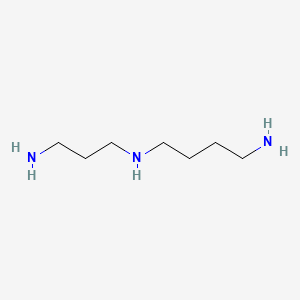
Spermidine
Spermidine is a triamine that is the 1,5,10-triaza derivative of decane. It has a role as an autophagy inducer, a geroprotector and a fundamental metabolite. It is a triamine and a polyazaalkane. It is a conjugate base of a spermidine(3+). — ChEBI
- IUPAC 名称
- N'-(3-aminopropyl)butane-1,4-diamine
- 分子式
- C7H19N3
- 分子量
- 145.25 g/mol
- 精确质量
- 145.157897619 Da
- XLogP3
- -1.0
- 拓扑极性表面积
- 64.1 Ų
- 氢键供体
- 3
- 氢键受体
- 3
- 共价单元
- 1
- 已定义的立体中心
- 0
又称
另有 16 个已报告名称
外部数据库标识符
- ChEBI:CHEBI:16610
- ChEMBL:CHEMBL19612
- EPA DTXSID:DTXSID4036645
- PubMed:25355561
- PubMed:24709313
- PubMed:23707493
- PubMed:23124758
- PubMed:23097746
- PubMed:23076119
- PubMed:23071598
- PubMed:23059820
- PubMed:23056524
- PubMed:23054439
- PubMed:23022686
- PubMed:23021806
来自其他科学数据库的证据
NIH PubChem PUG-View
Attributed physical-property, hazard, environmental and use annotations.
- Boiling Point: 129 °C at 1.40E+01 mm Hg 来源: DrugBank
- Melting Point: < 25 °C 来源: DrugBank
- Melting Point: < 25 °C 来源: Human Metabolome Database (HMDB)
- Physical Description: Solid 来源: Human Metabolome Database (HMDB)
- Carcinogen Classification: No indication of carcinogenicity to humans (not listed by IARC). 来源: Toxin and Toxin Target Database (T3DB)
- Exposure Routes: Endogenous, Ingestion, Dermal (contact) 来源: Toxin and Toxin Target Database (T3DB)
- Signal: Danger 来源: European Chemicals Agency (ECHA)
- GHS Hazard Statements: H314 (100%): Causes severe skin burns and eye damage [Danger Skin corrosion/irritation]; H318 (81.9%): Causes serious eye damage [Danger Serious eye damage/eye irritation] 来源: European Chemicals Agency (ECHA)
- Precautionary Statement Codes: P260, P264, P264+P265, P280, P301+P330+P331, P302+P361+P354, P304+P340, P305+P354+P338, P316, P317, P321, P363, P405, and P501 (click each P-code to see the statement) 来源: European Chemicals Agency (ECHA)
- ECHA C&L Notifications Summary: Aggregated GHS information provided per 83 reports by companies from 4 notifications to the ECHA C&L Inventory. Each notification may be associated with multiple companies.; Information may vary between notifications depending on impurities, additives, and other factors. The percentage value in parenthesis indicates the notified classification ratio from companies that provide hazard codes. Only hazard codes with percentage values above 10% are shown. For more detailed information, please visit ECHA C&L website. 来源: European Chemicals Agency (ECHA)
- Health Effects: Chronic exposure to uremic toxins can lead to a number of conditions including renal damage, chronic kidney disease and cardiovascular disease. 来源: Toxin and Toxin Target Database (T3DB)
- Toxicity Summary: Uremic toxins such as spermidine are actively transported into the kidneys via organic ion transporters (especially OAT3). Increased levels of uremic toxins can stimulate the production of reactive oxygen species. This seems to be mediated by the direct binding or inhibition by uremic toxins of the enzyme NADPH oxidase (especially NOX4 which is abundant in the kidneys and heart) (A7868). Reactive oxygen species can induce several different DNA methyltransferases (DNMTs) which are involved in the silencing of a protein known as KLOTHO. KLOTHO has been identified as having important roles in anti-aging, mineral metabolism, and vitamin D metabolism. A number of studies have indicated that KLOTHO mRNA and protein levels are reduced during acute or chronic kidney diseases in response to high local levels of reactive oxygen species (A7869). 来源: Toxin and Toxin Target Database (T3DB)
- Uses: Naturally produced by the body (endogenous). 来源: Toxin and Toxin Target Database (T3DB)
映射方: Existing checksum-valid CAS to unique PubChem CID match. 检索时间: 2026-08-31. 打开来源记录
科学分类和危害注释仅提供背景信息,不能取代上方所示针对具体市场的监管决定。
其他来源的覆盖范围和匹配状态
| 来源 | 结果 | 已检查 |
|---|---|---|
| NIH PubChem PUG-View | 精确匹配 | 2026-08-31 |
已记录的无匹配结果是该来源已被检查的有效证据;这并不表示该物质在别处不存在。
于 2026-08-31 通过校验和有效的 CAS 匹配从美国国立卫生研究院 (NIH) PubChem 检索。化学性质不能取代本页的监管决定。
欧盟官方成分名称证据
该成分名称与 2025 年欧盟官方通用成分名称词汇表完全匹配。
相关清单证据
配方功能重叠的成分
其他官方和科学来源
11 个可用于核查此身份的外部数据库
每个链接都会在该来源中搜索此身份。 各来源是什么及其法律效力
SPERMIDINE 在 CosIng 清单中的呈现方式
CosIng 清单将 SPERMIDINE 列为化妆品成分,本页将其关联到 0 条附件记录。清单条目记录名称和标识符,而附件记录显示该物质在欧盟化妆品法规中被禁用、限用或列入准用清单的情况。
在官方数据中,SPERMIDINE 还被标记了 2 项化妆品功能。功能标识描述预期用途,但不能取代在配方或标签工作之前对关联附件记录的监管审查。