
METHYLTRIMETHOXYSILANE
Silane, Trimethoxymethyl-
METHYLTRIMETHOXYSILANE 列于欧盟 CosIng 清单,但本页尚未关联任何直接的附件记录。
按市场划分的监管证据
此处跟踪的 13 个市场均未导入该成分的规则。
这描述的是本清单,而非法律。没有已导入的规则并不能证明某成分获准使用:规则可能以其他名称或标识符存在,或存在于尚未在此导入的数据集中。
METHYLTRIMETHOXYSILANE 的清单详情
INCI 名称
METHYLTRIMETHOXYSILANE
说明
Silane, Trimethoxymethyl-
METHYLTRIMETHOXYSILANE 的附件记录
关键数据
化学身份与性质
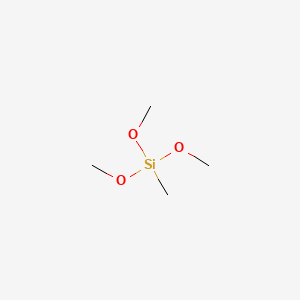
Methyltrimethoxysilane
- IUPAC 名称
- trimethoxy(methyl)silane
- 分子式
- C4H12O3Si
- 分子量
- 136.22 g/mol
- 精确质量
- 136.05557077 Da
- 拓扑极性表面积
- 27.7 Ų
- 氢键供体
- 0
- 氢键受体
- 3
- 共价单元
- 1
- 已定义的立体中心
- 0
又称
另有 16 个已报告名称
外部数据库标识符
来自其他科学数据库的证据
NIH PubChem PUG-View
Attributed physical-property, hazard, environmental and use annotations.
- Boiling Point: 103.5 °C @760 [mm Hg] 来源: PAC Chemical Database, U.S. Department of Energy
- Density: 0.949 @ 20°C 来源: PAC Chemical Database, U.S. Department of Energy
- Physical Description: Liquid; Liquid; Other Solid; CBI 来源: EPA Chemical Data Reporting (CDR)
- Physical Description: Colorless liquid; [Sigma-Aldrich MSDS] 来源: Haz-Map, Information on Hazardous Chemicals and Occupational Diseases
- Note: This chemical does not meet GHS hazard criteria for 1.7% (22 of 1271) of reports. 来源: European Chemicals Agency (ECHA)
- Signal: Danger 来源: European Chemicals Agency (ECHA)
- GHS Hazard Statements: H225 (97.6%): Highly Flammable liquid and vapor [Danger Flammable liquids]; H315 (57.2%): Causes skin irritation [Warning Skin corrosion/irritation]; H317 (14.8%): May cause an allergic skin reaction [Warning Sensitization, Skin]; H319 (53.7%): Causes serious eye irritation [Warning Serious eye damage/eye irritation]; H335 (43.4%): May cause respiratory irritation [Warning Specific target organ toxicity, single exposure; Respiratory tract irritation] 来源: European Chemicals Agency (ECHA)
- Precautionary Statement Codes: P210, P233, P240, P241, P242, P243, P261, P264, P264+P265, P271, P272, P280, P302+P352, P303+P361+P353, P304+P340, P305+P351+P338, P319, P321, P332+P317, P333+P317, P337+P317, P362+P364, P370+P378, P403+P233, P403+P235, P405, and P501 (click each P-code to see the statement) 来源: European Chemicals Agency (ECHA)
- ECHA C&L Notifications Summary: Aggregated GHS information provided per 1271 reports by companies from 23 notifications to the ECHA C&L Inventory. Each notification may be associated with multiple companies.; Reported as not meeting GHS hazard criteria per 22 of 1271 reports by companies.; There are 22 notifications provided by 1249 of 1271 reports by companies with hazard statement code(s).; Information may vary between notifications depending on impurities, additives, and other factors. The percentage value in parenthesis indicates the notified classification ratio from companies that provide hazard codes. Only hazard codes with percentage values above 10% are shown. For more detailed information, please visit ECHA C&L website. 来源: European Chemicals Agency (ECHA)
- GHS Hazard Statements: H225 (33.3%): Highly Flammable liquid and vapor [Danger Flammable liquids]; H315 (66.7%): Causes skin irritation [Warning Skin corrosion/irritation]; H318 (66.7%): Causes serious eye damage [Danger Serious eye damage/eye irritation]; H319 (33.3%): Causes serious eye irritation [Warning Serious eye damage/eye irritation]; H335 (66.7%): May cause respiratory irritation [Warning Specific target organ toxicity, single exposure; Respiratory tract irritation] 来源: European Chemicals Agency (ECHA)
- Precautionary Statement Codes: P210, P233, P240, P241, P242, P243, P261, P264, P264+P265, P271, P280, P302+P352, P303+P361+P353, P304+P340, P305+P351+P338, P305+P354+P338, P317, P319, P321, P332+P317, P337+P317, P362+P364, P370+P378, P403+P233, P403+P235, P405, and P501 (click each P-code to see the statement) 来源: European Chemicals Agency (ECHA)
- ECHA C&L Notifications Summary: Aggregated GHS information provided per 3 reports by companies from 2 notifications to the ECHA C&L Inventory. Each notification may be associated with multiple companies.; Information may vary between notifications depending on impurities, additives, and other factors. The percentage value in parenthesis indicates the notified classification ratio from companies that provide hazard codes. Only hazard codes with percentage values above 10% are shown. For more detailed information, please visit ECHA C&L website. 来源: European Chemicals Agency (ECHA)
- GHS Hazard Statements: Not Classified 来源: NITE-CMC
- Signal: Danger 来源: NITE-CMC
- GHS Hazard Statements: H225: Highly Flammable liquid and vapor [Danger Flammable liquids]; H320: Causes eye irritation [Warning Serious eye damage/eye irritation]; H332: Harmful if inhaled [Warning Acute toxicity, inhalation]; H336: May cause drowsiness or dizziness [Warning Specific target organ toxicity, single exposure; Narcotic effects]; H373: May causes damage to organs through prolonged or repeated exposure [Warning Specific target organ toxicity, repeated exposure] 来源: NITE-CMC
- Precautionary Statement Codes: P210, P233, P240, P241, P242, P243, P260, P261, P264+P265, P271, P280, P303+P361+P353, P304+P340, P305+P351+P338, P317, P319, P337+P317, P370+P378, P403+P233, P403+P235, P405, and P501 (click each P-code to see the statement) 来源: NITE-CMC
- Toxicity Summary: Studies showed a low order of acute toxicity for MTMS. MTMS was slightly irritating to both eyes and skin in rabbits, and a weight of evidence assessment supports that MTMS is not a dermal sensitizer. In vitro and in vivo assays indicated MTMS has a low potential for genotoxicity. MTMS did not produce any changes in reproductive or developmental parameters in a rat study. In a 90-day inhalation study in rats, MTMS was associated with urinary bladder epithelial hyperplasia, calculi formation, and moderate kidney dilation with hyperplasia of the pelvic epithelium and granulomatous inflammation; however, an expert panel review concluded that changes in the bladder and kidney were adaptive responses to a physical or chemical irritant present within the urine and were not considered to represent a preneoplastic change. 来源: Pertti (Bert) Hakkinen's Toxicology and Other Annotations
- Consumer Uses: Other; Catalyst 来源: EPA Chemical Data Reporting (CDR)
- Industry Uses: Monomers; Not Known or Reasonably Ascertainable; Catalyst; Sealant (barrier); Surface modifier; Intermediate; Adhesion/cohesion promoter 来源: EPA Chemical Data Reporting (CDR)
- Sources/Uses: Used in household products for conditioning and waterproofing leather; [REPROTOX] 来源: Haz-Map, Information on Hazardous Chemicals and Occupational Diseases
- Uses: The uses of Methyltrimethoxysilane (MTMS) include as a coupling agent in thermoplastics and thermosetting resins, a cross-linker in silicone sealants, a water repellent component, and in silicone hard-coats for plastics. 来源: Pertti (Bert) Hakkinen's Toxicology and Other Annotations
映射方: Existing checksum-valid CAS to unique PubChem CID match. 检索时间: 2026-08-31. 打开来源记录
科学分类和危害注释仅提供背景信息,不能取代上方所示针对具体市场的监管决定。
其他来源的覆盖范围和匹配状态
| 来源 | 结果 | 已检查 |
|---|---|---|
| NIH PubChem PUG-View | 精确匹配 | 2026-08-31 |
已记录的无匹配结果是该来源已被检查的有效证据;这并不表示该物质在别处不存在。
于 2026-08-31 通过校验和有效的 CAS 匹配从美国国立卫生研究院 (NIH) PubChem 检索。化学性质不能取代本页的监管决定。
欧盟官方成分名称证据
该成分名称与 2025 年欧盟官方通用成分名称词汇表完全匹配。
相关清单证据
配方功能重叠的成分
其他官方和科学来源
11 个可用于核查此身份的外部数据库
每个链接都会在该来源中搜索此身份。 各来源是什么及其法律效力
METHYLTRIMETHOXYSILANE 在 CosIng 清单中的呈现方式
CosIng 清单将 METHYLTRIMETHOXYSILANE 列为化妆品成分,本页将其关联到 0 条附件记录。清单条目记录名称和标识符,而附件记录显示该物质在欧盟化妆品法规中被禁用、限用或列入准用清单的情况。
在官方数据中,METHYLTRIMETHOXYSILANE 还被标记了 1 项化妆品功能。功能标识描述预期用途,但不能取代在配方或标签工作之前对关联附件记录的监管审查。