
BUTYL STEARATE
Butyl stearate
BUTYL STEARATE 列于欧盟 CosIng 清单,但本页尚未关联任何直接的附件记录。
按市场划分的监管证据
此处跟踪的 13 个市场均未导入该成分的规则。
这描述的是本清单,而非法律。没有已导入的规则并不能证明某成分获准使用:规则可能以其他名称或标识符存在,或存在于尚未在此导入的数据集中。
BUTYL STEARATE 的清单详情
INCI 名称
BUTYL STEARATE
说明
Butyl stearate
BUTYL STEARATE 的附件记录
关键数据
- FRAGRANCE
Imparting an odour or taste. Creating a perceivable pleasant smell and/or masking a bad smell.
- SKIN CONDITIONING
Maintaining the skin in good condition.
- SKIN CONDITIONING - EMOLLIENT
Acting as lubricants on the skin surface providing the skin with a soft and smooth appearance.
化学身份与性质
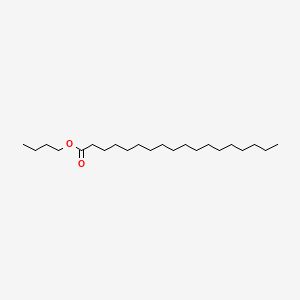
Butyl Stearate
Butyl octadecanoate is a fatty acid ester that is the butyl ester of stearic acid. It has a role as an algal metabolite. It is functionally related to an octadecanoic acid. — ChEBI
- IUPAC 名称
- butyl octadecanoate
- 分子式
- C22H44O2
- 分子量
- 340.6 g/mol
- 精确质量
- 340.334130642 Da
- XLogP3
- 9.8
- 拓扑极性表面积
- 26.3 Ų
- 氢键供体
- 0
- 氢键受体
- 2
- 共价单元
- 1
- 已定义的立体中心
- 0
又称
另有 16 个已报告名称
外部数据库标识符
- ChEBI:CHEBI:85983
- EPA DTXSID:DTXSID5027013
- PubMed:22125769
- PubMed:18058303
- PubMed:15919187
来自其他科学数据库的证据
NIH PubChem PUG-View
Attributed physical-property, hazard, environmental and use annotations.
- Autoignition Temperature: 671 °F (355 °C) 来源: Hazardous Substances Data Bank (HSDB)
- Boiling Point: 343 °C 来源: Hazardous Substances Data Bank (HSDB)
- Boiling Point: 343.00 °C. @ 25.00 mm Hg 来源: Human Metabolome Database (HMDB)
- Boiling Point: 343 °C; 220-225 °C (25 mm Hg) 来源: Joint FAO/WHO Expert Committee on Food Additives (JECFA)
- Color/Form: Crystals from alcohol, propanol, or ether 来源: Hazardous Substances Data Bank (HSDB)
- Color/Form: WAXY OR OILY (ABOVE 20 °C) 来源: Hazardous Substances Data Bank (HSDB)
- Color/Form: COLORLESS OR VERY PALE YELLOW LIQUID ABOVE 20 °C 来源: Hazardous Substances Data Bank (HSDB)
- Density: 0.854 @ 25 °C/4 °C 来源: Hazardous Substances Data Bank (HSDB)
- Density: 0.855-0.875 来源: Joint FAO/WHO Expert Committee on Food Additives (JECFA)
- Flash Point: 320 °F (160 °C) (CLOSED CUP) 来源: Hazardous Substances Data Bank (HSDB)
- Melting Point: 27 °C 来源: Hazardous Substances Data Bank (HSDB)
- Melting Point: 27.5 °C 来源: Human Metabolome Database (HMDB)
- Odor: ODORLESS OR FAINTLY FATTY ODOR 来源: Hazardous Substances Data Bank (HSDB)
- Odor: FATTY FRUITY ODOR 来源: Hazardous Substances Data Bank (HSDB)
- Physical Description: Wet Solid; Liquid 来源: EPA Chemical Data Reporting (CDR)
- Physical Description: Colorless liquid; m[ = 19.5-20 deg C; [Hawley] Solid or colorless or very pale liquid (above 20 deg C); mp = 27 deg C; [HSDB] Odorless oily liquid; mp approximately 23 deg C; [MSDSonline] 来源: Haz-Map, Information on Hazardous Chemicals and Occupational Diseases
- Physical Description: Solid 来源: Human Metabolome Database (HMDB)
- Physical Description: colourless, waxy solid, odourless or with a faintly fatty odour 来源: Joint FAO/WHO Expert Committee on Food Additives (JECFA)
- Refractive Index: Index of refraction: 1.4328 @ 50 °C/D 来源: Hazardous Substances Data Bank (HSDB)
- Solubility: Insoluble in water; soluble in ethanol; very soluble in acetone 来源: Hazardous Substances Data Bank (HSDB)
- Solubility: SOL IN MINERAL OR VEGETABLE OILS 来源: Hazardous Substances Data Bank (HSDB)
- Solubility: SOLUBILITY IN WATER: 0.29% @ 25 °C 来源: Hazardous Substances Data Bank (HSDB)
- Solubility: 1.7 mg/mL at 25 °C 来源: Human Metabolome Database (HMDB)
- Solubility: (in ethanol) 来源: Joint FAO/WHO Expert Committee on Food Additives (JECFA)
- Vapor Pressure: 0.0000058 [mmHg] 来源: Haz-Map, Information on Hazardous Chemicals and Occupational Diseases
- Vapor Pressure: 5.80X10⁻⁶ mm Hg @ 25 °C 来源: Hazardous Substances Data Bank (HSDB)
- Note: This chemical does not meet GHS hazard criteria for 91.6% (901 of 984) of all reports. 来源: European Chemicals Agency (ECHA)
- GHS Hazard Statements: Not Classified; Reported as not meeting GHS hazard criteria by 901 of 984 companies (only 8.4% companies provided GHS information). For more detailed information, please visit ECHA C&L website. 来源: European Chemicals Agency (ECHA)
- ECHA C&L Notifications Summary: Aggregated GHS information provided per 984 reports by companies from 8 notifications to the ECHA C&L Inventory.; Reported as not meeting GHS hazard criteria per 901 of 984 reports by companies.; There are 6 notifications provided by 83 of 984 reports by companies with hazard statement code(s).; Information may vary between notifications depending on impurities, additives, and other factors. The percentage value in parenthesis indicates the notified classification ratio from companies that provide hazard codes. Only hazard codes with percentage values above 10% are shown. For more detailed information, please visit ECHA C&L website. 来源: European Chemicals Agency (ECHA)
- NFPA Health Rating: 1 - Materials that, under emergency conditions, can cause significant irritation. 来源: Hazardous Substances Data Bank (HSDB)
- NFPA Fire Rating: 1 - Materials that must be preheated before ignition can occur. Materials require considerable preheating, under all ambient temperature conditions, before ignition and combustion can occur. 来源: Hazardous Substances Data Bank (HSDB)
- NFPA Instability Rating: 0 - Materials that in themselves are normally stable, even under fire conditions. 来源: Hazardous Substances Data Bank (HSDB)
- Cosmetic Ingredient Review Conclusion: The CIR Expert Panel concluded that the alkyl esters, listed subsequently, are safe in the present practices of use and concentration described in this safety assessment when formulated to be non-irritating. 来源: Cosmetic Ingredient Review (CIR)
- Cosmetic Ingredient Review Finding(s): Safe for use in cosmetics, with qualifications 来源: Cosmetic Ingredient Review (CIR)
- Environmental Bioconcentration: An estimated BCF of 1 was calculated for n-butyl stearate(SRC), using an estimated log Kow of 9.70(1,SRC) and a regression-derived equation(2). According to a classification scheme(3), the estimated BCF suggests the potential for bioconcentration in aquatic organisms is low. 来源: Hazardous Substances Data Bank (HSDB)
- Environmental Fate: TERRESTRIAL FATE: Based on a classification scheme(1), an estimated Koc value of 39,000(SRC), determined from a structure estimation method(2), indicates that n-butyl stearate is expected to be immobile in soil(SRC). Volatilization of n-butyl stearate from moist soil surfaces is expected to be an important fate process(SRC) given an estimated Henry's Law constant of 0.038 atm-cu m/mole(SRC), using a fragment constant estimation method(3). However, adsorption to soil is expected to attenuate volatilization(SRC). n-Butyl stearate is not expected to volatilize from dry soil surfaces(SRC) based upon a vapor pressure of 5.8X10⁻⁶ mm Hg(4). n-Butyl stearate is expected to rapidly biodegrade in aerobic soils as suggested by the rapid biodegradation of structurally similar long-chain fatty acid esters(5-7). 来源: Hazardous Substances Data Bank (HSDB)
- Environmental Fate: AQUATIC FATE: Based on a classification scheme(1), an estimated Koc value of 39,000(SRC), determined from a structure estimation method(2), indicates that n-butyl stearate is expected to adsorb to suspended solids and sediment in water(SRC). Volatilization from water surfaces is expected(3) based upon an estimated Henry's Law constant of 0.038 atm-cu m/mole(SRC), developed using a fragment constant estimation method(4). Volatilization half-lives for a model river and model lake are 5 hours and 7 days, respectively(SRC), using an estimation method(3). However, volatilization from water surfaces is expected to be attenuated by adsorption to suspended solids and sediment in the water column(SRC). The volatilization half-life from a model pond is estimated to be about 64 hours ignoring adsorption; when considering maximum adsorption the volatilization half-life increases to 12 months(5). According to a classification scheme(6), a estimated BCF of 3, from an estimated log Kow of 7.90(12) and a regression-derived equation(7), suggests the potential for bioconcentration in aquatic organisms is low. n-Butyl stearate is expected to rapidly biodegrade in aerobic waters as suggested by the ra 来源: Hazardous Substances Data Bank (HSDB)
- Environmental Fate: ATMOSPHERIC FATE: According to a model of gas/particle partitioning of semivolatile organic compounds in the atmosphere(1), n-butyl stearate, which has a vapor pressure of 5.8X10⁻⁶ mm Hg at 25 °C(2), will exist in both the vapor and particulate phases in the ambient atmosphere. Vapor-phase n-butyl stearate is degraded in the atmosphere by reaction with photochemically-produced hydroxyl radicals(SRC); the half-life for this reaction in air is estimated to be 15 hours(SRC) from its estimated rate constant of 2.6X10⁻¹¹ cu cm/molecule-sec at 25 °C(3). Particulate-phase n-butyl stearate may be removed from the air by wet and dry deposition(SRC). 来源: Hazardous Substances Data Bank (HSDB)
- Consumer Uses: Not Known or Reasonably Ascertainable; Processing aids not otherwise specified; Surfactant (surface active agent); Anti-adhesive/cohesive 来源: EPA Chemical Data Reporting (CDR)
- Industry Uses: Processing aids not otherwise specified; Surfactant (surface active agent); Lubricating agent; Anti-adhesive/cohesive; Intermediate 来源: EPA Chemical Data Reporting (CDR)
- Cosmetic Ingredient Review Link: CIR ingredient: Butyl Stearate 来源: Cosmetic Ingredient Review (CIR)
- Sources/Uses: Used as a flavor and solvent for flavors; as plasticizer for cellulose acetate butyrate, cellulose nitrate, ethyl cellulose, polystyrene, and laminated fiber products; as lubricant in extrusion and molding of polyvinyl chloride; as emollient in creams, lotions, and lipsticks; as solvent, spreading agent, and softening agent in plastics, textiles, cosmetics, and rubber industries; to make leather cloth and leather varnishes; in polishes, special lubricants, and coatings; in carbon paper and inks; as damp-proofer for concrete; in propellants; as water proofing agent and defoamer; [HSBD] 来源: Haz-Map, Information on Hazardous Chemicals and Occupational Diseases
- Industrial Processes with risk of exposure: Pulp and Paper Processing [Category: Industry]; Textiles (Fiber & Fabric Manufacturing) [Category: Industry]; Painting (Pigments, Binders, and Biocides) [Category: Paint]; Plastic Composites Manufacturing [Category: Industry]; Leather Tanning and Processing [Category: Industry]; Cement Producing [Category: Industry] 来源: Haz-Map, Information on Hazardous Chemicals and Occupational Diseases
- Uses: DIRECT FOOD ADDITIVE AS SYNTHETIC FLAVOR. 来源: Hazardous Substances Data Bank (HSDB)
- Uses: PLASTICIZER FOR CELLULOSE ACETATE BUTYRATE, CELLULOSE NITRATE, ETHYL CELLULOSE, POLYSTYRENE; LUBRICANT IN EXTRUSION & MOLDING OF POLYVINYL CHLORIDE; EMOLLIENT IN CREAMS, LOTIONS, & LIPSTICKS. 来源: Hazardous Substances Data Bank (HSDB)
- Uses: SOLVENT FOR FLAVORS--BUTTER, BANANA. 来源: Hazardous Substances Data Bank (HSDB)
- Uses: Solvent, spreading and softening agent in plastics, textiles, cosmetics, rubber industries. 来源: Hazardous Substances Data Bank (HSDB)
- Uses: For more Uses (Complete) data for N-BUTYL STEARATE (11 total), please visit the HSDB record page. 来源: Hazardous Substances Data Bank (HSDB)
映射方: Existing checksum-valid CAS to unique PubChem CID match. 检索时间: 2026-08-31. 打开来源记录
科学分类和危害注释仅提供背景信息,不能取代上方所示针对具体市场的监管决定。
其他来源的覆盖范围和匹配状态
| 来源 | 结果 | 已检查 |
|---|---|---|
| NIH PubChem PUG-View | 精确匹配 | 2026-08-31 |
已记录的无匹配结果是该来源已被检查的有效证据;这并不表示该物质在别处不存在。
于 2026-08-31 通过校验和有效的 CAS 匹配从美国国立卫生研究院 (NIH) PubChem 检索。化学性质不能取代本页的监管决定。
欧盟官方成分名称证据
该成分名称与 2025 年欧盟官方通用成分名称词汇表完全匹配。
相关清单证据
配方功能重叠的成分
其他官方和科学来源
11 个可用于核查此身份的外部数据库
每个链接都会在该来源中搜索此身份。 各来源是什么及其法律效力
BUTYL STEARATE 在 CosIng 清单中的呈现方式
CosIng 清单将 BUTYL STEARATE 列为化妆品成分,本页将其关联到 0 条附件记录。清单条目记录名称和标识符,而附件记录显示该物质在欧盟化妆品法规中被禁用、限用或列入准用清单的情况。
在官方数据中,BUTYL STEARATE 还被标记了 3 项化妆品功能。功能标识描述预期用途,但不能取代在配方或标签工作之前对关联附件记录的监管审查。