
NONANAL
Nonanal
NONANAL 列于欧盟 CosIng 清单,但本页尚未关联任何直接的附件记录。
按市场划分的监管证据
此处跟踪的 13 个市场均未导入该成分的规则。
这描述的是本清单,而非法律。没有已导入的规则并不能证明某成分获准使用:规则可能以其他名称或标识符存在,或存在于尚未在此导入的数据集中。
NONANAL 的清单详情
INCI 名称
NONANAL
说明
Nonanal
NONANAL 的附件记录
关键数据
化学身份与性质
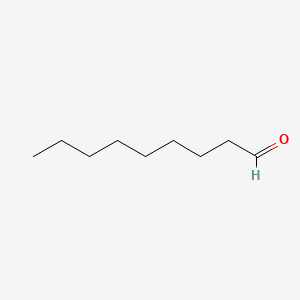
Nonanal
Nonanal is a saturated fatty aldehyde formally arising from reduction of the carboxy group of nonanoic acid. Metabolite observed in cancer metabolism. It has a role as a plant metabolite and a human metabolite. It is a n-alkanal, a saturated fatty aldehyde and a medium-chain fatty aldehyde. It is functionally related to a nonanoic acid. — ChEBI
- IUPAC 名称
- nonanal
- 分子式
- C9H18O
- 分子量
- 142.24 g/mol
- 精确质量
- 142.135765193 Da
- XLogP3
- 3.3
- 拓扑极性表面积
- 17.1 Ų
- 氢键供体
- 0
- 氢键受体
- 1
- 共价单元
- 1
- 已定义的立体中心
- 0
又称
另有 16 个已报告名称
外部数据库标识符
- ChEBI:CHEBI:84268
- ChEMBL:CHEMBL2228376
- EPA DTXSID:DTXSID9021639
- PubMed:30002397
- PubMed:22981431
- PubMed:22970999
- PubMed:22938606
- PubMed:22925715
- PubMed:22888540
- PubMed:22883207
- PubMed:22796674
- PubMed:22790779
- PubMed:22757696
- PubMed:22732233
- PubMed:22730107
来自其他科学数据库的证据
NIH PubChem PUG-View
Attributed physical-property, hazard, environmental and use annotations.
- Boiling Point: 374 to 378 °F at 760 mmHg (NTP, 1992) 来源: CAMEO Chemicals
- Boiling Point: 195 °C 来源: Hazardous Substances Data Bank (HSDB)
- Boiling Point: 93 °C (23 mm Hg); 191 °C 来源: Joint FAO/WHO Expert Committee on Food Additives (JECFA)
- Color/Form: Colorless liquid 来源: Hazardous Substances Data Bank (HSDB)
- Density: 0.8264 at 72 °F (NTP, 1992) - Less dense than water; will float 来源: CAMEO Chemicals
- Density: 0.8264 g/cu cm at 22 °C 来源: Hazardous Substances Data Bank (HSDB)
- Density: 0.820-0.830 来源: Joint FAO/WHO Expert Committee on Food Additives (JECFA)
- Density: 0.820-0.830 @25 °C 来源: PAC Chemical Database, U.S. Department of Energy
- Flash Point: 182 °F (NTP, 1992) 来源: CAMEO Chemicals
- Flash Point: 64 °C (147 °F) - closed cup 来源: Hazardous Substances Data Bank (HSDB)
- Melting Point: 145 °F (NTP, 1992) 来源: CAMEO Chemicals
- Melting Point: -19.3 °C 来源: Hazardous Substances Data Bank (HSDB)
- Odor: Orange-rose odor 来源: Hazardous Substances Data Bank (HSDB)
- Odor: Floral, waxy, green 来源: Hazardous Substances Data Bank (HSDB)
- Physical Description: Nonanal is a clear brown liquid characterized by a rose-orange odor. Insoluble in water. Found in at least 20 essential oils, including rose and citrus oils and several species of pine oil. 来源: CAMEO Chemicals
- Physical Description: Liquid; CBI 来源: EPA Chemical Data Reporting (CDR)
- Physical Description: Colorless liquid with a floral odor; Insoluble in water (96 mg/L at 25 deg C); [HSDB] Brown liquid; [CAMEO] Colorless liquid; [MSDSonline] 来源: Haz-Map, Information on Hazardous Chemicals and Occupational Diseases
- Physical Description: colourless to yellow liquid/fruity odour 来源: Joint FAO/WHO Expert Committee on Food Additives (JECFA)
- Refractive Index: Index of refraction = 1.4273 at 20 °C/D 来源: Hazardous Substances Data Bank (HSDB)
- Refractive Index: 1.422-1.429 来源: Joint FAO/WHO Expert Committee on Food Additives (JECFA)
- Solubility: Insoluble (<1mg/ml) (NTP, 1992) 来源: CAMEO Chemicals
- Solubility: In water, 96 mg/L at 25 °C 来源: Hazardous Substances Data Bank (HSDB)
- Solubility: Soluble in ethyl ether, chloroform 来源: Hazardous Substances Data Bank (HSDB)
- Solubility: Soluble in three volumes 70% alcohol, in mineral oil; insoluble in glycerol 来源: Hazardous Substances Data Bank (HSDB)
- Solubility: soluble in alcohol, most fixed oils, propylene glycol; insoluble in glycerol 来源: Joint FAO/WHO Expert Committee on Food Additives (JECFA)
- Solubility: 1 ml in 3 ml of 70% alcohol (in ethanol) 来源: Joint FAO/WHO Expert Committee on Food Additives (JECFA)
- Vapor Pressure: 0.37 [mmHg] 来源: Haz-Map, Information on Hazardous Chemicals and Occupational Diseases
- Vapor Pressure: 3.7X10⁻¹ mm Hg at 25 °C /Extrapolated/ 来源: Hazardous Substances Data Bank (HSDB)
- Carcinogen Classification: No indication of carcinogenicity to humans (not listed by IARC). 来源: Toxin and Toxin Target Database (T3DB)
- Exposure Routes: Endogenous, Ingestion, Dermal (contact) 来源: Toxin and Toxin Target Database (T3DB)
- First Aid: EYES: First check the victim for contact lenses and remove if present. Flush victim's eyes with water or normal saline solution for 20 to 30 minutes while simultaneously calling a hospital or poison control center. Do not put any ointments, oils, or medication in the victim's eyes without specific instructions from a physician. IMMEDIATELY transport the victim after flushing eyes to a hospital even if no symptoms (such as redness or irritation) develop.; SKIN: IMMEDIATELY flood affected skin with water while removing and isolating all contaminated clothing. Gently wash all affected skin areas thoroughly with soap and water. If symptoms such as redness or irritation develop, IMMEDIATELY call a physician and be prepared to transport the victim to a hospital for treatment.; INHALATION: IMMEDIATELY leave the contaminated area; take deep breaths of fresh air. If symptoms (such as wheezing, coughing, shortness of breath, or burning in the mouth, throat, or chest) develop, call a physician and be prepared to transport the victim to a hospital. Provide proper respiratory protection to rescuers entering an unknown atmosphere. Whenever possible, Self-Contained Breathing Apparatus (SCBA) shou 来源: CAMEO Chemicals
- Note: This chemical does not meet GHS hazard criteria for 4.2% (83 of 1956) of reports. 来源: European Chemicals Agency (ECHA)
- Signal: Warning 来源: European Chemicals Agency (ECHA)
- GHS Hazard Statements: H315 (19.3%): Causes skin irritation [Warning Skin corrosion/irritation]; H319 (18.5%): Causes serious eye irritation [Warning Serious eye damage/eye irritation]; H412 (92.9%): Harmful to aquatic life with long lasting effects [Hazardous to the aquatic environment, long-term hazard] 来源: European Chemicals Agency (ECHA)
- Precautionary Statement Codes: P264, P264+P265, P273, P280, P302+P352, P305+P351+P338, P321, P332+P317, P337+P317, P362+P364, and P501 (click each P-code to see the statement) 来源: European Chemicals Agency (ECHA)
- ECHA C&L Notifications Summary: Aggregated GHS information provided per 1956 reports by companies from 21 notifications to the ECHA C&L Inventory. Each notification may be associated with multiple companies.; Reported as not meeting GHS hazard criteria per 83 of 1956 reports by companies.; There are 19 notifications provided by 1873 of 1956 reports by companies with hazard statement code(s).; Information may vary between notifications depending on impurities, additives, and other factors. The percentage value in parenthesis indicates the notified classification ratio from companies that provide hazard codes. Only hazard codes with percentage values above 10% are shown. For more detailed information, please visit ECHA C&L website. 来源: European Chemicals Agency (ECHA)
- Signal: Warning 来源: NITE-CMC
- GHS Hazard Statements: H227: Combustible liquid [Warning Flammable liquids]; H315: Causes skin irritation [Warning Skin corrosion/irritation]; H336: May cause drowsiness or dizziness [Warning Specific target organ toxicity, single exposure; Narcotic effects]; H401: Toxic to aquatic life [Hazardous to the aquatic environment, acute hazard] 来源: NITE-CMC
- Precautionary Statement Codes: P210, P261, P264, P271, P273, P280, P302+P352, P304+P340, P319, P321, P332+P317, P362+P364, P370+P378, P403, P403+P233, P405, and P501 (click each P-code to see the statement) 来源: NITE-CMC
- Signal: Warning 来源: Hazardous Substances Data Bank (HSDB)
- GHS Hazard Statements: H227: Combustible liquid [Warning Flammable liquids]; H315: Causes skin irritation [Warning Skin corrosion/irritation]; H319: Causes serious eye irritation [Warning Serious eye damage/eye irritation]; H335: May cause respiratory irritation [Warning Specific target organ toxicity, single exposure; Respiratory tract irritation] 来源: Hazardous Substances Data Bank (HSDB)
- Precautionary Statement Codes: P210, P261, P264, P264+P265, P271, P280, P302+P352, P304+P340, P305+P351+P338, P319, P321, P332+P317, P337+P317, P362+P364, P370+P378, P403, P403+P233, P405, and P501 (click each P-code to see the statement) 来源: Hazardous Substances Data Bank (HSDB)
- Health Effects: Chronic exposure to uremic toxins can lead to a number of conditions including renal damage, chronic kidney disease and cardiovascular disease. 来源: Toxin and Toxin Target Database (T3DB)
- Toxicity Summary: IDENTIFICATION AND USE: Nonanal is a colorless liquid. It is not registered for current use in the U.S., but approved pesticide uses may change periodically and so federal, state and local authorities must be consulted for currently approved uses. It is used in perfume industry and as a flavoring agent. HUMAN EXPOSURE AND TOXICITY: Ozone exposure resulted in a significant early increase in nonanal in the airway epithelial lining fluid of humans. Nonanal levels returned to baseline by 18 hr after exposure. Nonanal produced in vitro by ozonation of liposomes induced hemolysis of human red blood cells, and combination of nonanal and H2O2 was significantly more hemolytic than nonanal alone. It was negative for unscheduled DNA synthesis in adult human hepatocytes assay at 3-100 mM. ANIMAL STUDIES: Single dermal dose of nonanal 5 g/kg applied on 3 rabbits with intact skin and 3 rabbits with abraded skin produced one death and severe edema and burns at site of application. There was no evidence of embryotoxicity, fetal toxicity, or teratogenesis when pregnant female rats were given 1500 mg/kg bw/day of nonanoic acid (metabolite of nonanal on days 6-15 of pregnancy. It was positive for sis 来源: Hazardous Substances Data Bank (HSDB)
- Toxicity Summary: Uremic toxins such as nonanal are actively transported into the kidneys via organic ion transporters (especially OAT3). Increased levels of uremic toxins can stimulate the production of reactive oxygen species. This seems to be mediated by the direct binding or inhibition by uremic toxins of the enzyme NADPH oxidase (especially NOX4 which is abundant in the kidneys and heart) (A7868). Reactive oxygen species can induce several different DNA methyltransferases (DNMTs) which are involved in the silencing of a protein known as KLOTHO. KLOTHO has been identified as having important roles in anti-aging, mineral metabolism, and vitamin D metabolism. A number of studies have indicated that KLOTHO mRNA and protein levels are reduced during acute or chronic kidney diseases in response to high local levels of reactive oxygen species (A7869). 来源: Toxin and Toxin Target Database (T3DB)
- Environmental Bioconcentration: An estimated BCF of 67 was calculated in fish for nonanal(SRC), using an estimated log Kow of 3.27(1) and a regression-derived equation(1). According to a classification scheme(2), this BCF suggests the potential for bioconcentration in aquatic organisms is moderate(SRC). 来源: Hazardous Substances Data Bank (HSDB)
- Environmental Fate: TERRESTRIAL FATE: Based on a classification scheme(1), an estimated Koc value of 40(SRC), determined from a structure estimation method(2), indicates that nonanal is expected to have very high mobility in soil(SRC). Volatilization of nonanal from moist soil surfaces is expected to be an important fate process(SRC) given a Henry's Law constant of 7.3X10⁻⁴ atm-cu m/mole(3). Even though the vapor pressure is low environmentally at standard temperature and pressure, 0.37 mm Hg(4), there is a detectable odor; therefore, nonanal may volatilize from dry soil. Utilizing the Japanese MITI test, 44% of the Theoretical BOD was reached in 4 weeks(5) indicating that biodegradation is an important environmental fate process in soil(SRC). 来源: Hazardous Substances Data Bank (HSDB)
- Environmental Fate: AQUATIC FATE: Based on a classification scheme(1), an estimated Koc value of 40(SRC), determined from a structure estimation method(2), indicates that nonanal is not expected to adsorb to suspended solids and sediment(SRC). Volatilization from water surfaces is expected(3) based upon a Henry's Law constant of 7.34X10⁻⁴ atm-cu m/mole(4). Using this Henry's Law constant and an estimation method(3), volatilization half-lives for a model river and model lake are 2 hours and 5 days, respectively(SRC). According to a classification scheme(5), an estimated BCF of 67(SRC), from an estimated log Kow of 3.27(2) and a regression-derived equation(2), suggests the potential for bioconcentration in aquatic organisms is moderate(SRC). Utilizing the Warburg respirometry test, a theoretical BOD range of 8 to 21% using activated sludge(6) indicating that biodegradation is an important environmental fate process in water(SRC). 来源: Hazardous Substances Data Bank (HSDB)
- Environmental Fate: ATMOSPHERIC FATE: According to a model of gas/particle partitioning of semivolatile organic compounds in the atmosphere(1), nonanal, which has a vapor pressure of 0.37 mm Hg at 25 °C(2), is expected to exist solely as a vapor in the ambient atmosphere. Vapor-phase nonanal is degraded in the atmosphere by reaction with photochemically-produced hydroxyl radicals(SRC); the half-life for this reaction in air is estimated to be 1 day(SRC), calculated from its rate constant of 3.31X10⁻¹¹ cu cm/molecule-sec at 25 °C(SRC) Nonanal does not contain chromophores that absorb at wavelengths >290 nm(3) and, therefore, is not expected to be susceptible to direct photolysis by sunlight(SRC). 来源: Hazardous Substances Data Bank (HSDB)
- Consumer Uses: Fragrance 来源: EPA Chemical Data Reporting (CDR)
- Industry Uses: Intermediate 来源: EPA Chemical Data Reporting (CDR)
- Sources/Uses: Used in perfumes and foods (flavoring agent); [Hawley] Occurs in essential oils; [CAMEO] Occurs in citrus and rose oils; [Ullmann] 来源: Haz-Map, Information on Hazardous Chemicals and Occupational Diseases
- Uses: ... used in the perfume industry. 来源: Hazardous Substances Data Bank (HSDB)
- Uses: Flavoring agent. 来源: Hazardous Substances Data Bank (HSDB)
- Uses: ... used in floral compositions, particularly those with rose characteristics. 来源: Hazardous Substances Data Bank (HSDB)
- Uses: Nonanal is a synthetic flavoring substance and adjuvant permitted for direct addition to food for human consumption. 来源: Hazardous Substances Data Bank (HSDB)
- Uses: Reported uses (ppm):; Table: Reported uses (ppm): (Flavor and Extract Manufacturers' Association, 1994) [Table#6836] 来源: Hazardous Substances Data Bank (HSDB)
- Uses: Naturally produced by the body (endogenous). 来源: Toxin and Toxin Target Database (T3DB)
映射方: Existing checksum-valid CAS to unique PubChem CID match. 检索时间: 2026-08-31. 打开来源记录
科学分类和危害注释仅提供背景信息,不能取代上方所示针对具体市场的监管决定。
其他来源的覆盖范围和匹配状态
| 来源 | 结果 | 已检查 |
|---|---|---|
| NIH PubChem PUG-View | 精确匹配 | 2026-08-31 |
已记录的无匹配结果是该来源已被检查的有效证据;这并不表示该物质在别处不存在。
于 2026-08-31 通过校验和有效的 CAS 匹配从美国国立卫生研究院 (NIH) PubChem 检索。化学性质不能取代本页的监管决定。
相关清单证据
配方功能重叠的成分
其他官方和科学来源
11 个可用于核查此身份的外部数据库
每个链接都会在该来源中搜索此身份。 各来源是什么及其法律效力
NONANAL 在 CosIng 清单中的呈现方式
CosIng 清单将 NONANAL 列为化妆品成分,本页将其关联到 0 条附件记录。清单条目记录名称和标识符,而附件记录显示该物质在欧盟化妆品法规中被禁用、限用或列入准用清单的情况。
在官方数据中,NONANAL 还被标记了 1 项化妆品功能。功能标识描述预期用途,但不能取代在配方或标签工作之前对关联附件记录的监管审查。