
GAMMA-NONALACTONE
Nonan-4-olide; Dihydro-5-pentyl-2(3H)-furanone
GAMMA-NONALACTONE 列于欧盟 CosIng 清单,但本页尚未关联任何直接的附件记录。
按市场划分的监管证据
此处跟踪的 13 个市场均未导入该成分的规则。
这描述的是本清单,而非法律。没有已导入的规则并不能证明某成分获准使用:规则可能以其他名称或标识符存在,或存在于尚未在此导入的数据集中。
GAMMA-NONALACTONE 的清单详情
INCI 名称
GAMMA-NONALACTONE
说明
Nonan-4-olide; Dihydro-5-pentyl-2(3H)-furanone
GAMMA-NONALACTONE 的附件记录
关键数据
- FRAGRANCE
Imparting an odour or taste. Creating a perceivable pleasant smell and/or masking a bad smell.
- PERFUMING
Used for perfume and aromatic raw materials.
- SKIN CONDITIONING
Maintaining the skin in good condition.
化学身份与性质
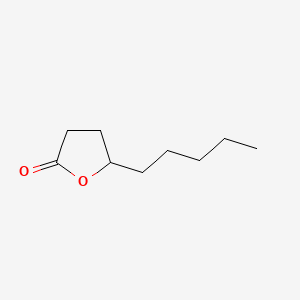
Gamma-Nonalactone
1,4-Decanolide is a metabolite found in or produced by Saccharomyces cerevisiae. — Yeast Metabolome Database (YMDB)
- IUPAC 名称
- 5-pentyloxolan-2-one
- 分子式
- C9H16O2
- 分子量
- 156.22 g/mol
- 精确质量
- 156.115029749 Da
- XLogP3
- 2.2
- 拓扑极性表面积
- 26.3 Ų
- 氢键供体
- 0
- 氢键受体
- 2
- 共价单元
- 1
- 已定义的立体中心
- 0
又称
另有 16 个已报告名称
外部数据库标识符
来自其他科学数据库的证据
EMBL-EBI ChEBI
γ-nonanolactone
- 配方
- C9H16O2
- 平均质量
- 156.225 g/mol
- 单同位素质量
- 156.11503 Da
- 形式电荷
- 0
- butan-4-olide — is a (CHEBI:22950)
- nonanoic acid — has functional parent (CHEBI:29019)
- butan-4-olide — is a (CHEBI:22950)
- 20809147 来源: PubMed
其他整理的名称
来自此来源的交叉引用
- CAS: 104-61-0 — KEGG COMPOUND
- CAS: 57084-16-9 — KEGG COMPOUND
- MANUAL_X_REF: C00001318 — KNApSAcK
- MANUAL_X_REF: C08501 — KEGG COMPOUND
- MANUAL_X_REF: HMDB0031531 — HMDB
映射方: Exact CAS cross-reference in the ChEBI compound record. 来源更新: 2015-10-23. 检索时间: 2026-08-31. 打开来源记录
NIH PubChem PUG-View
Attributed physical-property, hazard, environmental and use annotations.
- Boiling Point: BP: 134 °C at 12 mm Hg 来源: Hazardous Substances Data Bank (HSDB)
- Boiling Point: The boiling point at 1.7 kPa is 136 °C. 来源: Hazardous Substances Data Bank (HSDB)
- Boiling Point: 121-122 °C (6 mmHg) 来源: Joint FAO/WHO Expert Committee on Food Additives (JECFA)
- Color/Form: Colorless to slightly yellow liquid 来源: Hazardous Substances Data Bank (HSDB)
- Density: 0.958-0.966 at 25 °C 来源: Hazardous Substances Data Bank (HSDB)
- Density: 0.958-0.966 来源: Joint FAO/WHO Expert Committee on Food Additives (JECFA)
- Odor: Strong odor reminiscent of coconut 来源: Hazardous Substances Data Bank (HSDB)
- Physical Description: CBI; Liquid; Dry Powder; Liquid 来源: EPA Chemical Data Reporting (CDR)
- Physical Description: Colorless to pale straw-yellow liquid with an odor of coconut; [HSDB] 来源: Haz-Map, Information on Hazardous Chemicals and Occupational Diseases
- Physical Description: colourless to slightly yellow liquid with a coconut-like odour 来源: Joint FAO/WHO Expert Committee on Food Additives (JECFA)
- Refractive Index: Index of refraction: 1.446-1.450 at 20 °C 来源: Hazardous Substances Data Bank (HSDB)
- Refractive Index: 1.446-1.450 来源: Joint FAO/WHO Expert Committee on Food Additives (JECFA)
- Solubility: Soluble in alcohol, most fixed oils, propylene glycol; 1:1 in 60% alcohol 来源: Hazardous Substances Data Bank (HSDB)
- Solubility: Soluble in five volumes of 50% alcohol; soluble in most fixed oils and mineral oil; practically insoluble in glycerol 来源: Hazardous Substances Data Bank (HSDB)
- Solubility: soluble in alcohol, most fixed oils and propylene glycol; insoluble in water 来源: Joint FAO/WHO Expert Committee on Food Additives (JECFA)
- Solubility: 1 ml in 5 ml 60% alcohol (in ethanol) 来源: Joint FAO/WHO Expert Committee on Food Additives (JECFA)
- pH: Acid value max: 2.0 来源: Hazardous Substances Data Bank (HSDB)
- Note: This chemical does not meet GHS hazard criteria for 99.6% (1722 of 1729) of all reports. 来源: European Chemicals Agency (ECHA)
- GHS Hazard Statements: Not Classified; Reported as not meeting GHS hazard criteria by 1722 of 1729 companies (only 0.4% companies provided GHS information). For more detailed information, please visit ECHA C&L website. 来源: European Chemicals Agency (ECHA)
- ECHA C&L Notifications Summary: Aggregated GHS information provided per 1729 reports by companies from 8 notifications to the ECHA C&L Inventory.; Reported as not meeting GHS hazard criteria per 1722 of 1729 reports by companies.; There are 6 notifications provided by 7 of 1729 reports by companies with hazard statement code(s).; Information may vary between notifications depending on impurities, additives, and other factors. The percentage value in parenthesis indicates the notified classification ratio from companies that provide hazard codes. Only hazard codes with percentage values above 10% are shown. For more detailed information, please visit ECHA C&L website. 来源: European Chemicals Agency (ECHA)
- Toxicity Summary: IDENTIFICATION AND USE: Dihydro-5-pentyl-2(3H)-furanone is an essential oil used in perfumery and flavors. It is not registered for current pesticide use in the U.S., but approved pesticide uses may change periodically and so federal, state and local authorities must be consulted for currently approved uses. HUMAN EXPOSURE AND TOXICITY: A maximization test was carried out on 25 volunteers. Dihydro-5-pentyl-2(3H)-furanone was tested at a concentration of 10% in petrolatum and produced no sensitization reactions. Tested at 10% in petrolatum, Dihydro-5-pentyl-2(3H)-furanone produced no irritation after a 48 hr closed-patch test on human subjects. ANIMAL STUDIES: A 90-day feeding study on 15 male and 15 female rats fed 0 or 67.5 mg/kg Dihydro-5-pentyl-2(3H)-furanone body wt/day showed no adverse effect. 0.1-0.5% Dihydro-5-pentyl-2(3H)-furanone fed to groups of 20 male and female rats in diet for 2 yr produced no effects. In a 2-wk study, 61.4 mg/kg Dihydro-5-pentyl-2(3H)-furanone fed to rats in the diet produced no effects. Gamma-nonalactone applied full strength to intact or abraded rabbit skin for 24 hr under occlusion was slightly irritating. 来源: Hazardous Substances Data Bank (HSDB)
- Environmental Bioconcentration: An estimated BCF of 11 was calculated in fish for dihydro-5-pentyl-2(3H)-furanone(SRC), using an estimated log Kow of 2.08(1) and a regression-derived equation(1). According to a classification scheme(2), this BCF suggests the potential for bioconcentration in aquatic organisms is low (SRC). 来源: Hazardous Substances Data Bank (HSDB)
- Environmental Fate: TERRESTRIAL FATE: Based on a classification scheme(1), an estimated Koc value of 120(SRC), determined from a structure estimation method(2), indicates that dihydro-5-pentyl-2(3H)-furanone is expected to have high mobility in soil(SRC). Volatilization of dihydro-5-pentyl-2(3H)-furanone from moist soil surfaces is expected to be an important fate process(SRC) given an estimated Henry's Law constant of 1.7X10⁻⁴ atm-cu m/mole(SRC), using a fragment constant estimation method(3). Dihydro-5-pentyl-2(3H)-furanone is not expected to volatilize from dry soil surfaces(SRC) based upon an estimated vapor pressure of 1.2X10⁻² mm Hg at 25 °C(SRC), determined from a fragment constant method(2). Using a Closed Bottle test, dihydro-5-pentyl-2(3H)-furanone achieved 71% biodegradation in activated sewage sludge after 28 days(4), suggesting that biodegradation is an important environmental fate process in soil(SRC). 来源: Hazardous Substances Data Bank (HSDB)
- Environmental Fate: AQUATIC FATE: Based on a classification scheme(1), an estimated Koc value of 120(SRC), determined from a structure estimation method(2), indicates that dihydro-5-pentyl-2(3H)-furanone is not expected to adsorb to suspended solids and sediment(SRC). Volatilization from water surfaces is expected(3) based upon an estimated Henry's Law constant of 1.7X10⁻⁴ atm-cu m/mole(SRC), developed using a fragment constant estimation method(4). Using this Henry's Law constant and an estimation method(3), volatilization half-lives for a model river and model lake are 10 hours and 7 days, respectively(SRC). According to a classification scheme(5), an estimated BCF of 11(SRC), from an estimated log Kow of 2.08(2) and a regression-derived equation(2), suggests the potential for bioconcentration in aquatic organisms is low(SRC). By analogy to gamma-butyolactone, which exhibits a hydrolysis half-life of approximately 28 days at pH7, dihydro-5-pentyl-2(3H)-furanone is expected to hydrolyze under environmental conditions (pH 5 to 9). Using a Closed Bottle test(6), dihydro-5-pentyl-2(3H)-furanone achieved 71% biodegradation in activated sewage sludge after 28 days(6), suggesting that biodegradation is an 来源: Hazardous Substances Data Bank (HSDB)
- Environmental Fate: ATMOSPHERIC FATE: According to a model of gas/particle partitioning of semivolatile organic compounds in the atmosphere(1), dihydro-5-pentyl-2(3H)-furanone, which has an estimated vapor pressure of 1.2X10⁻² mm Hg at 25 °C(SRC), determined from a fragment constant method(2), is expected to exist solely as a vapor in the ambient atmosphere. Vapor-phase dihydro-5-pentyl-2(3H)-furanone is degraded in the atmosphere by reaction with photochemically-produced hydroxyl radicals(SRC); the half-life for this reaction in air is estimated to be 40 hours(SRC), calculated from its rate constant of 9.7X10⁻¹² cu cm/molecule-sec at 25 °C(SRC) that was derived using a structure estimation method(3). Dihydro-5-pentyl-2(3H)-furanone contains chromophores that absorb at wavelengths >290 nm(4) and, therefore, may be susceptible to direct photolysis by sunlight(SRC). 来源: Hazardous Substances Data Bank (HSDB)
- Consumer Uses: Other; Fragrance 来源: EPA Chemical Data Reporting (CDR)
- Industry Uses: Other; Flavoring and nutrient; Fragrance 来源: EPA Chemical Data Reporting (CDR)
- Sources/Uses: Reportedly found in peaches, apricots, roasted barley, rum, and tomatoes; Used as flavoring and fragrance ingredient; [HSDB] Used in the US as insecticide, insect and mammal repellent, and mosquito larvicide; [Reference #1] 来源: Haz-Map, Information on Hazardous Chemicals and Occupational Diseases
- Uses: For dihydro-5-pentyl-2(3H)-furanone (USEPA/OPP Pesticide Code: 122301) there are 0 labels match. /SRP: Not registered for current use in the U.S., but approved pesticide uses may change periodically and so federal, state and local authorities must be consulted for currently approved uses./ 来源: Hazardous Substances Data Bank (HSDB)
- Uses: Perfumery, flavors 来源: Hazardous Substances Data Bank (HSDB)
- Uses: Reported uses (ppm):; Table: Reported uses (ppm): (Flavor and Extract Manufacturers' Association, 1994) [Table#5371] 来源: Hazardous Substances Data Bank (HSDB)
映射方: Existing checksum-valid CAS to unique PubChem CID match. 检索时间: 2026-08-31. 打开来源记录
科学分类和危害注释仅提供背景信息,不能取代上方所示针对具体市场的监管决定。
其他来源的覆盖范围和匹配状态
| 来源 | 结果 | 已检查 |
|---|---|---|
| EMBL-EBI ChEBI | 精确匹配 | 2026-08-31 |
| NIH PubChem PUG-View | 精确匹配 | 2026-08-31 |
已记录的无匹配结果是该来源已被检查的有效证据;这并不表示该物质在别处不存在。
于 2026-08-31 通过校验和有效的 CAS 匹配从美国国立卫生研究院 (NIH) PubChem 检索。化学性质不能取代本页的监管决定。
欧盟官方成分名称证据
该成分名称与 2025 年欧盟官方通用成分名称词汇表完全匹配。
相关清单证据
配方功能重叠的成分
其他官方和科学来源
11 个可用于核查此身份的外部数据库
每个链接都会在该来源中搜索此身份。 各来源是什么及其法律效力
GAMMA-NONALACTONE 在 CosIng 清单中的呈现方式
CosIng 清单将 GAMMA-NONALACTONE 列为化妆品成分,本页将其关联到 0 条附件记录。清单条目记录名称和标识符,而附件记录显示该物质在欧盟化妆品法规中被禁用、限用或列入准用清单的情况。
在官方数据中,GAMMA-NONALACTONE 还被标记了 3 项化妆品功能。功能标识描述预期用途,但不能取代在配方或标签工作之前对关联附件记录的监管审查。