
ETHYL FORMATE
Ethyl methanoate
ETHYL FORMATE 列于欧盟 CosIng 清单,但本页尚未关联任何直接的附件记录。
按市场划分的监管证据
此处跟踪的 13 个市场均未导入该成分的规则。
这描述的是本清单,而非法律。没有已导入的规则并不能证明某成分获准使用:规则可能以其他名称或标识符存在,或存在于尚未在此导入的数据集中。
ETHYL FORMATE 的清单详情
INCI 名称
ETHYL FORMATE
说明
Ethyl methanoate
ETHYL FORMATE 的附件记录
关键数据
化学身份与性质
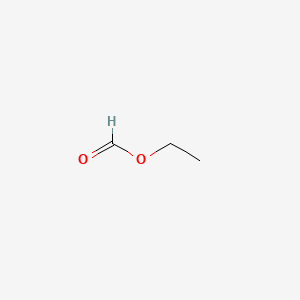
Ethyl formate
Ethyl formate is a formate ester resulting from the formal condensation of formic acid with ethanol. It has a role as a fumigant and a plant metabolite. It is an ethyl ester and a formate ester. — ChEBI
- IUPAC 名称
- ethyl formate
- 分子式
- C3H6O2
- 分子量
- 74.08 g/mol
- 精确质量
- 74.036779430 Da
- XLogP3
- 0.5
- 拓扑极性表面积
- 26.3 Ų
- 氢键供体
- 0
- 氢键受体
- 2
- 共价单元
- 1
- 已定义的立体中心
- 0
又称
另有 16 个已报告名称
外部数据库标识符
- ChEBI:CHEBI:23990
- ChEBI:CHEBI:52342
- ChEMBL:CHEMBL44215
- EPA DTXSID:DTXSID6040117
- PubMed:24928877
- PubMed:23046174
- PubMed:23003109
- PubMed:22916839
- PubMed:22901033
- PubMed:22809751
- PubMed:22716902
- PubMed:22649708
- PubMed:22590416
- PubMed:22589905
- PubMed:22552310
- PubMed:22551633
来自其他科学数据库的证据
NIH PubChem PUG-View
Attributed physical-property, hazard, environmental and use annotations.
- Autoignition Temperature: 851 °F (USCG, 1999) 来源: CAMEO Chemicals
- Autoignition Temperature: 455 °C 来源: Hazardous Substances Data Bank (HSDB)
- Autoignition Temperature: 440 °C 来源: ILO-WHO International Chemical Safety Cards (ICSCs)
- Boiling Point: 129.6 °F at 760 mmHg (USCG, 1999) 来源: CAMEO Chemicals
- Boiling Point: 54.5 °C @ 760 MM HG 来源: Hazardous Substances Data Bank (HSDB)
- Boiling Point: 52.00 to 54.00 °C. @ 760.00 mm Hg 来源: Human Metabolome Database (HMDB)
- Boiling Point: 52-54 °C 来源: ILO-WHO International Chemical Safety Cards (ICSCs)
- Boiling Point: 54 °C 来源: Joint FAO/WHO Expert Committee on Food Additives (JECFA)
- Boiling Point: 130 °F 来源: Occupational Safety and Health Administration (OSHA)
- Boiling Point: 54.3 °C @760 [mm Hg] 来源: PAC Chemical Database, U.S. Department of Energy
- Boiling Point: 130 °F 来源: The National Institute for Occupational Safety and Health (NIOSH)
- Color/Form: MOBILE LIQUID 来源: Hazardous Substances Data Bank (HSDB)
- Color/Form: WATER-WHITE LIQ 来源: Hazardous Substances Data Bank (HSDB)
- Color/Form: Colorless liquid. 来源: Hazardous Substances Data Bank (HSDB)
- Density: 0.922 at 68 °F (USCG, 1999) - Less dense than water; will float 来源: CAMEO Chemicals
- Density: 0.9168 @ 20 °C 来源: Hazardous Substances Data Bank (HSDB)
- Density: CONVERSION FACTORS: 1 MG/L EQUIV TO 330 PPM; 1 PPM EQUIV TO 3.03 MG/CU M; DENSITY OF SATURATED AIR: 1.25 (AIR= 1) 来源: Hazardous Substances Data Bank (HSDB)
- Density: Relative density (water = 1): 0.92 来源: ILO-WHO International Chemical Safety Cards (ICSCs)
- Density: 0.917-0.922 来源: Joint FAO/WHO Expert Committee on Food Additives (JECFA)
- Density: 0.92 来源: Occupational Safety and Health Administration (OSHA)
- Density: 0.9236 @ 20°C 来源: PAC Chemical Database, U.S. Department of Energy
- Density: 0.92 来源: The National Institute for Occupational Safety and Health (NIOSH)
- Flash Point: -4 °F (USCG, 1999) 来源: CAMEO Chemicals
- Flash Point: -20 °C 来源: Haz-Map, Information on Hazardous Chemicals and Occupational Diseases
- Flash Point: -20 °C (-4 °F) (CLOSED CUP) 来源: Hazardous Substances Data Bank (HSDB)
- Flash Point: -20 °C c.c. 来源: ILO-WHO International Chemical Safety Cards (ICSCs)
- Flash Point: -4 °F 来源: Occupational Safety and Health Administration (OSHA)
- Flash Point: -4 °F 来源: The National Institute for Occupational Safety and Health (NIOSH)
- LogP: 0.23 来源: Hazardous Substances Data Bank (HSDB)
- LogP: 0.23 来源: Human Metabolome Database (HMDB)
- LogP: 0.23 来源: ILO-WHO International Chemical Safety Cards (ICSCs)
- Melting Point: -110 °F (USCG, 1999) 来源: CAMEO Chemicals
- Melting Point: -80.5 °C 来源: Hazardous Substances Data Bank (HSDB)
- Melting Point: -80.5 °C 来源: Human Metabolome Database (HMDB)
- Melting Point: -80 °C 来源: ILO-WHO International Chemical Safety Cards (ICSCs)
- Melting Point: -113 °F 来源: Occupational Safety and Health Administration (OSHA)
- Melting Point: -79 °C 来源: PAC Chemical Database, U.S. Department of Energy
- Melting Point: -113 °F 来源: The National Institute for Occupational Safety and Health (NIOSH)
- Odor: Fruity odor. 来源: Hazardous Substances Data Bank (HSDB)
- Physical Description: Ethyl formate appears as a clear colorless liquid with a pleasant odor. Flash point -4 °F. Less dense than water. Vapors heavier than air. 来源: CAMEO Chemicals
- Physical Description: Colorless liquid with a fruity odor; [NIOSH] 来源: Haz-Map, Information on Hazardous Chemicals and Occupational Diseases
- Physical Description: Liquid 来源: Human Metabolome Database (HMDB)
- Physical Description: COLOURLESS LIQUID WITH CHARACTERISTIC ODOUR. 来源: ILO-WHO International Chemical Safety Cards (ICSCs)
- Physical Description: Colourless liquid with a sharp, rum-like odour 来源: Joint FAO/WHO Expert Committee on Food Additives (JECFA)
- Physical Description: Colorless liquid with a fruity odor. 来源: Occupational Safety and Health Administration (OSHA)
- Physical Description: Colorless liquid with a fruity odor. 来源: The National Institute for Occupational Safety and Health (NIOSH)
- Refractive Index: INDEX OF REFRACTION: 1.3598 @ 20 °C/D 来源: Hazardous Substances Data Bank (HSDB)
- Refractive Index: 1.359-1.363 来源: Joint FAO/WHO Expert Committee on Food Additives (JECFA)
- Solubility: 9 % at 64 °F (NIOSH, 2024) 来源: CAMEO Chemicals
- Solubility: SOLUBILITY IN WATER: 9 PARTS/100 @ 18 °C; MISCIBLE WITH BENZENE 来源: Hazardous Substances Data Bank (HSDB)
- Solubility: SOL IN ALL PROPORTIONS IN ALCOHOL, ETHER; VERY SOL IN ACETONE 来源: Hazardous Substances Data Bank (HSDB)
- Solubility: SOL IN MOST ORGANIC SOLVENTS 来源: Hazardous Substances Data Bank (HSDB)
- Solubility: 88,250 mg/L at 25 °C 来源: Hazardous Substances Data Bank (HSDB)
- Solubility: 88.2 mg/mL at 25 °C 来源: Human Metabolome Database (HMDB)
- Solubility: Solubility in water, g/100ml at 20 °C: 10.5 来源: ILO-WHO International Chemical Safety Cards (ICSCs)
- Solubility: Soluble in most fixed oils, propylene glycol, water (with gradual decomposition), slightly soluble in mineral oil. Insoluble in glycerol 来源: Joint FAO/WHO Expert Committee on Food Additives (JECFA)
- Solubility: 1ml in 5ml 50% ethanol (in ethanol) 来源: Joint FAO/WHO Expert Committee on Food Additives (JECFA)
- Solubility: (64 °F): 9% 来源: The National Institute for Occupational Safety and Health (NIOSH)
- Vapor Pressure: 200 mmHg (NIOSH, 2024) 来源: CAMEO Chemicals
- Vapor Pressure: 245.0 [mmHg] 来源: Haz-Map, Information on Hazardous Chemicals and Occupational Diseases
- Vapor Pressure: Vapor pressure = 245 mm Hg at 25 °C (calc from exper determined coefficients) 来源: Hazardous Substances Data Bank (HSDB)
- Vapor Pressure: 200 MM HG @ 20.6 °C 来源: Hazardous Substances Data Bank (HSDB)
- Vapor Pressure: Vapor pressure, kPa at 20 °C: 25.6 来源: ILO-WHO International Chemical Safety Cards (ICSCs)
- Vapor Pressure: 200 mmHg 来源: Occupational Safety and Health Administration (OSHA)
- Vapor Pressure: 100 [mm Hg] @5.4 °C 来源: PAC Chemical Database, U.S. Department of Energy
- Vapor Pressure: 200 mmHg 来源: The National Institute for Occupational Safety and Health (NIOSH)
- Exposure Routes: The substance can be absorbed into the body by inhalation of its vapour and by ingestion. 来源: ILO-WHO International Chemical Safety Cards (ICSCs)
- Exposure Routes: inhalation, ingestion, skin and/or eye contact 来源: The National Institute for Occupational Safety and Health (NIOSH)
- First Aid: Excerpt from NIOSH Pocket Guide for Ethyl formate:; Eye: IRRIGATE IMMEDIATELY - If this chemical contacts the eyes, immediately wash (irrigate) the eyes with large amounts of water, occasionally lifting the lower and upper lids. Get medical attention immediately.; Skin: WATER FLUSH IMMEDIATELY - If this chemical contacts the skin, immediately flush the contaminated skin with water. If this chemical penetrates the clothing, immediately remove the clothing and flush the skin with water. Get medical attention promptly.; Breathing: RESPIRATORY SUPPORT - If a person breathes large amounts of this chemical, move the exposed person to fresh air at once. If breathing has stopped, perform artificial respiration. Keep the affected person warm and at rest. Get medical attention as soon as possible.; Swallow: MEDICAL ATTENTION IMMEDIATELY - If this chemical has been swallowed, get medical attention immediately. (NIOSH, 2024) 来源: CAMEO Chemicals
- ERG2024, Guide 129 (Ethyl formate): General First Aid:; · Call 911 or emergency medical service.; · Ensure that medical personnel are aware of the material(s) involved, take precautions to protect themselves and avoid contamination.; · Move victim to fresh air if it can be done safely.; · Administer oxygen if breathing is difficult.; · If victim is not breathing:; -- DO NOT perform mouth-to-mouth resuscitation; the victim may have ingested or inhaled the substance.; -- If equipped and pulse detected, wash face and mouth, then give artificial respiration using a proper respiratory medical device (bag-valve mask, pocket mask equipped with a one-way valve or other device).; -- If no pulse detected or no respiratory medical device available, provide continuous compressions. Conduct a pulse check every two minutes or monitor for any signs of spontaneous respirations.; · Remove and isolate contaminated clothing and shoes.; · For minor skin contact, avoid spreading material on unaffected skin.; · In case of contact with substance, remove immediately by flushing skin or eyes with running water for at least 20 minutes.; · For severe burns, immediate medical attention is required.; · Effects of exposure (inhalation, ingestion, 来源: Emergency Response Guidebook (ERG)
- First Aid: (General first aid procedures); Eye: Irrigate immediately - If this chemical contacts the eyes, immediately wash (irrigate) the eyes with large amounts of water, occasionally lifting the lower and upper lids. Get medical attention immediately.; Skin: Water flush immediately - If this chemical contacts the skin, immediately flush the contaminated skin with water. If this chemical penetrates the clothing, immediately remove the clothing and flush the skin with water. Get medical attention promptly.; Breathing: Respiratory support; Swallow: Medical attention immediately - If this chemical has been swallowed, get medical attention immediately. 来源: The National Institute for Occupational Safety and Health (NIOSH)
- Signal: Danger 来源: Regulation (EC) No 1272/2008 of the European Parliament and of the Council
- GHS Hazard Statements: H225: Highly Flammable liquid and vapor [Danger Flammable liquids]; H302: Harmful if swallowed [Warning Acute toxicity, oral]; H319: Causes serious eye irritation [Warning Serious eye damage/eye irritation]; H332: Harmful if inhaled [Warning Acute toxicity, inhalation]; H335: May cause respiratory irritation [Warning Specific target organ toxicity, single exposure; Respiratory tract irritation] 来源: Regulation (EC) No 1272/2008 of the European Parliament and of the Council
- Precautionary Statement Codes: P210, P233, P240, P241, P242, P243, P261, P264, P264+P265, P270, P271, P280, P301+P317, P303+P361+P353, P304+P340, P305+P351+P338, P317, P319, P330, P337+P317, P370+P378, P403+P233, P403+P235, P405, and P501 (click each P-code to see the statement) 来源: Regulation (EC) No 1272/2008 of the European Parliament and of the Council
- Note: This chemical does not meet GHS hazard criteria for 0.6% (11 of 1923) of reports. 来源: European Chemicals Agency (ECHA)
- Signal: Danger 来源: European Chemicals Agency (ECHA)
- GHS Hazard Statements: H225 (99.4%): Highly Flammable liquid and vapor [Danger Flammable liquids]; H302 (99.3%): Harmful if swallowed [Warning Acute toxicity, oral]; H319 (99.4%): Causes serious eye irritation [Warning Serious eye damage/eye irritation]; H332 (99.3%): Harmful if inhaled [Warning Acute toxicity, inhalation]; H335 (99.4%): May cause respiratory irritation [Warning Specific target organ toxicity, single exposure; Respiratory tract irritation] 来源: European Chemicals Agency (ECHA)
- Precautionary Statement Codes: P210, P233, P240, P241, P242, P243, P261, P264, P264+P265, P270, P271, P280, P301+P317, P303+P361+P353, P304+P340, P305+P351+P338, P317, P319, P330, P337+P317, P370+P378, P403+P233, P403+P235, P405, and P501 (click each P-code to see the statement) 来源: European Chemicals Agency (ECHA)
- ECHA C&L Notifications Summary: Aggregated GHS information provided per 1923 reports by companies from 21 notifications to the ECHA C&L Inventory. Each notification may be associated with multiple companies.; Reported as not meeting GHS hazard criteria per 11 of 1923 reports by companies.; There are 20 notifications provided by 1912 of 1923 reports by companies with hazard statement code(s).; Information may vary between notifications depending on impurities, additives, and other factors. The percentage value in parenthesis indicates the notified classification ratio from companies that provide hazard codes. Only hazard codes with percentage values above 10% are shown. For more detailed information, please visit ECHA C&L website. 来源: European Chemicals Agency (ECHA)
- Signal: Danger 来源: NITE-CMC
- GHS Hazard Statements: H225: Highly Flammable liquid and vapor [Danger Flammable liquids]; H302: Harmful if swallowed [Warning Acute toxicity, oral]; H319: Causes serious eye irritation [Warning Serious eye damage/eye irritation]; H332: Harmful if inhaled [Warning Acute toxicity, inhalation]; H336: May cause drowsiness or dizziness [Warning Specific target organ toxicity, single exposure; Narcotic effects]; H370: Causes damage to organs [Danger Specific target organ toxicity, single exposure] 来源: NITE-CMC
- Precautionary Statement Codes: P210, P233, P240, P241, P242, P243, P260, P261, P264, P264+P265, P270, P271, P280, P301+P317, P303+P361+P353, P304+P340, P305+P351+P338, P308+P316, P317, P319, P321, P330, P337+P317, P370+P378, P403+P233, P403+P235, P405, and P501 (click each P-code to see the statement) 来源: NITE-CMC
- GHS Hazard Statements: H225: Highly Flammable liquid and vapor [Danger Flammable liquids]; H302: Harmful if swallowed [Warning Acute toxicity, oral]; H319: Causes serious eye irritation [Warning Serious eye damage/eye irritation]; H333: May be harmful if inhaled [Warning Acute toxicity, inhalation]; H335: May cause respiratory irritation [Warning Specific target organ toxicity, single exposure; Respiratory tract irritation]; H336: May cause drowsiness or dizziness [Warning Specific target organ toxicity, single exposure; Narcotic effects] 来源: NITE-CMC
- NFPA Health Rating: 2 - Materials that, under emergency conditions, can cause temporary incapacitation or residual injury. 来源: Hazardous Substances Data Bank (HSDB)
- NFPA Fire Rating: 3 - Liquids and solids that can be ignited under almost all ambient temperature conditions. Materials produce hazardous atmospheres with air under almost all ambient temperatures or, though unaffected by ambient temperatures, are readily ignited under almost all conditions. 来源: Hazardous Substances Data Bank (HSDB)
- NFPA Instability Rating: 0 - Materials that in themselves are normally stable, even under fire conditions. 来源: Hazardous Substances Data Bank (HSDB)
- Target Organs: Eyes, respiratory system, central nervous system 来源: The National Institute for Occupational Safety and Health (NIOSH)
- Environmental Bioconcentration: Ethyl formate did not bioconcentrate in rainbow trout(1). Using a reported log octanol/water partition coefficient of 0.23(2), a BCF of 0.88 is estimated using a regression equation giving additional indication that ethyl formate should not bioconcentrate in aquatic organisms. 来源: Hazardous Substances Data Bank (HSDB)
- Environmental Fate: TERRESTRIAL FATE: If released to soil, ethyl formate would readily volatilize from the surface layers of soil as well as leach. While no data were located concerning the degradation in soil, it would be expected to readily degrade by chemical hydrolysis, especially in alkaline soil, and biodegrade. (SRC) 来源: Hazardous Substances Data Bank (HSDB)
- Environmental Fate: AQUATIC FATE: Ethyl formate has a relatively high Henry's Law constant of 3.85X10⁻⁴ atm-cu m/mol(1) and if released to water, it will be lost due to evaporation. A volatilization half-life of 4.5 hrs was predicted for ethyl formate from a model river 1 m deep, flowing at 1 m/sec with a wind velocity of 3 m/sec(2,SRC). It would not be expected to sorb to sediment or bioconcentrate in aquatic organisms. Chemical hydrolysis will be an important fate process, especially in alkaline waters. The hydrolytic half-life is 3.1 days and 7.5 hr at pH 7 and 8, respectively(3,SRC). Based on limited data from screening tests supplemented by predictions of mathematical models and data on similar chemicals, ethyl formate should rapidly biodegrade(SRC). 来源: Hazardous Substances Data Bank (HSDB)
- Environmental Fate: ATMOSPHERIC FATE: The half-life of ethyl formate in the atmosphere is estimated to be 11 days as a result of reaction with photochemically-produced hydroxyl radicals(1). Being fairly soluble in water, it should be readily washed out of the air by rain(SRC). 来源: Hazardous Substances Data Bank (HSDB)
- Sources/Uses: Used as flavoring agent, solvent for nitrocellulose, and reagent in organic synthesis; Also used as a fungicide/larvicide for tobacco, cereals, and dried fruit; [ACGIH] 来源: Haz-Map, Information on Hazardous Chemicals and Occupational Diseases
- Industrial Processes with risk of exposure: Farming (Pesticides) [Category: Industry] 来源: Haz-Map, Information on Hazardous Chemicals and Occupational Diseases
- Uses: IN LACQUER INDUSTRY, IN ARTIFICIAL SILK MFR AS SOLVENT FOR CELLULOSE ACETATE; IN MFR OF SAFETY GLASS; IN SHOE INDUSTRY AS SOLVENT FOR CELLULOID 来源: Hazardous Substances Data Bank (HSDB)
- Uses: SOLVENT FOR OILS AND GREASES 来源: Hazardous Substances Data Bank (HSDB)
- Uses: FLAVOR FOR LEMONADE & ESSENCES; MFR OF ARTIFICIAL RUM & ARRAC; SOLVENT FOR NITROCELLULOSE; FUNGICIDE AND LARVICIDE; IN ORGANIC SYNTHESIS 来源: Hazardous Substances Data Bank (HSDB)
- Uses: ACETONE SUBSTITUTE; IN SYNTHETIC RESINS 来源: Hazardous Substances Data Bank (HSDB)
- Uses: For more Uses (Complete) data for ETHYL FORMATE (7 total), please visit the HSDB record page. 来源: Hazardous Substances Data Bank (HSDB)
映射方: Existing checksum-valid CAS to unique PubChem CID match. 检索时间: 2026-08-31. 打开来源记录
科学分类和危害注释仅提供背景信息,不能取代上方所示针对具体市场的监管决定。
其他来源的覆盖范围和匹配状态
| 来源 | 结果 | 已检查 |
|---|---|---|
| NIH PubChem PUG-View | 精确匹配 | 2026-08-31 |
已记录的无匹配结果是该来源已被检查的有效证据;这并不表示该物质在别处不存在。
于 2026-08-31 通过校验和有效的 CAS 匹配从美国国立卫生研究院 (NIH) PubChem 检索。化学性质不能取代本页的监管决定。
相关清单证据
配方功能重叠的成分
其他官方和科学来源
11 个可用于核查此身份的外部数据库
每个链接都会在该来源中搜索此身份。 各来源是什么及其法律效力
ETHYL FORMATE 在 CosIng 清单中的呈现方式
CosIng 清单将 ETHYL FORMATE 列为化妆品成分,本页将其关联到 0 条附件记录。清单条目记录名称和标识符,而附件记录显示该物质在欧盟化妆品法规中被禁用、限用或列入准用清单的情况。
在官方数据中,ETHYL FORMATE 还被标记了 1 项化妆品功能。功能标识描述预期用途,但不能取代在配方或标签工作之前对关联附件记录的监管审查。