
GLYCOL STEARATE
2-hydroxyethyl stearate
GLYCOL STEARATE 列于欧盟 CosIng 清单,但本页尚未关联任何直接的附件记录。
按市场划分的监管证据
此处跟踪的 13 个市场均未导入该成分的规则。
这描述的是本清单,而非法律。没有已导入的规则并不能证明某成分获准使用:规则可能以其他名称或标识符存在,或存在于尚未在此导入的数据集中。
GLYCOL STEARATE 的清单详情
INCI 名称
GLYCOL STEARATE
Ph. Eur. 名称
ethylenglycoli monostearas
说明
2-hydroxyethyl stearate
GLYCOL STEARATE 的附件记录
关键数据
- OPACIFYING
Reducing transparency or translucency of cosmetics.
- SKIN CONDITIONING - EMOLLIENT
Acting as lubricants on the skin surface providing the skin with a soft and smooth appearance.
- SURFACTANT - CLEANSING
Wetting body surfaces, emulsifying or solubilizing oils, and suspending soil (generally, such ingredients contribute to the foaming and lathering properties of cleansing products).
- SURFACTANT - EMULSIFYING
Helping suspensions or dispersions of liquids in a second liquid by reducing the surface tension of the substances to be emulsified.
化学身份与性质
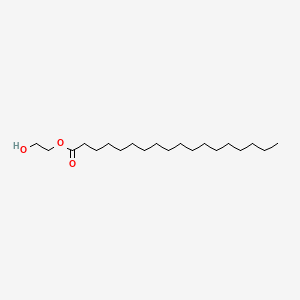
Glycol monostearate
Polyoxyl 40 stearate is an octadecanoate ester composed of repeating 8-40 ethyleneoxy units. It is an ingredient used in cosmetics and beauty products primarily as a surfactant and emulsifier. It has a role as a nonionic surfactant, an emulsifier and a food emulsifier. It is a hydroxypolyether and an octadecanoate ester. — ChEBI
- IUPAC 名称
- 2-hydroxyethyl octadecanoate
- 分子式
- C20H40O3
- 分子量
- 328.5 g/mol
- 精确质量
- 328.29774513 Da
- XLogP3
- 7.8
- 拓扑极性表面积
- 46.5 Ų
- 氢键供体
- 1
- 氢键受体
- 3
- 共价单元
- 1
- 已定义的立体中心
- 0
又称
另有 16 个已报告名称
外部数据库标识符
- ChEBI:CHEBI:167626
- ChEBI:CHEBI:32027
- ChEMBL:CHEMBL2355383
- EPA DTXSID:DTXSID5026881
- PubMed:18717575
- PubMed:1680169
来自其他科学数据库的证据
NIH PubChem PUG-View
Attributed physical-property, hazard, environmental and use annotations.
- Color/Form: CREAM-COLORED SOFT, WAXY OR PASTY SOLID @ 25 °C 来源: Hazardous Substances Data Bank (HSDB)
- Flash Point: MYRJ 45: 500 °F OC 来源: Hazardous Substances Data Bank (HSDB)
- Melting Point: MP: 30-34 °C /POLYETHYLENE GLYCOL 400 MONOSTEARATE USP XVI/ 来源: Hazardous Substances Data Bank (HSDB)
- Melting Point: 60.00 to 61.00 °C. @ 760.00 mm Hg 来源: Human Metabolome Database (HMDB)
- Odor: FAINT FATTY ODOR 来源: Hazardous Substances Data Bank (HSDB)
- Physical Description: Dry Powder; Other Solid; Large Crystals; Liquid; Liquid 来源: EPA Chemical Data Reporting (CDR)
- Physical Description: Light tan solid; [Hawley] 来源: Haz-Map, Information on Hazardous Chemicals and Occupational Diseases
- Solubility: POLYETHYLENE GLYCOL ESTERS AND ETHERS INCR THE WATER SOLUBILITY OF TYROTHRICIN. 来源: Hazardous Substances Data Bank (HSDB)
- Solubility: SOL IN CARBON TETRACHLORIDE, PETROLEUM BENZIN, CHLOROFORM, ETHER; SLIGHTLY SOL IN ALCOHOL; INSOL IN WATER /POLYETHYLENE GLYCOL 400 MONOSTEARATE USP XVI/ 来源: Hazardous Substances Data Bank (HSDB)
- Solubility: GENERALLY SOL OR DISPERSIBLE IN WATER 来源: Hazardous Substances Data Bank (HSDB)
- Solubility: SOL IN TOLUENE, ACETONE, ETHER AND ETHANOL 来源: Hazardous Substances Data Bank (HSDB)
- Note: This chemical does not meet GHS hazard criteria for 75.2% (357 of 475) of all reports. 来源: European Chemicals Agency (ECHA)
- Signal: Warning 来源: European Chemicals Agency (ECHA)
- GHS Hazard Statements: H315 (18.9%): Causes skin irritation [Warning Skin corrosion/irritation]; H319 (19.2%): Causes serious eye irritation [Warning Serious eye damage/eye irritation]; H335 (17.3%): May cause respiratory irritation [Warning Specific target organ toxicity, single exposure; Respiratory tract irritation] 来源: European Chemicals Agency (ECHA)
- Precautionary Statement Codes: P261, P264, P264+P265, P271, P280, P302+P352, P304+P340, P305+P351+P338, P319, P321, P332+P317, P337+P317, P362+P364, P403+P233, P405, and P501 (click each P-code to see the statement) 来源: European Chemicals Agency (ECHA)
- ECHA C&L Notifications Summary: Aggregated GHS information provided per 475 reports by companies from 12 notifications to the ECHA C&L Inventory. Each notification may be associated with multiple companies.; Reported as not meeting GHS hazard criteria per 357 of 475 reports by companies.; There are 10 notifications provided by 118 of 475 reports by companies with hazard statement code(s).; Information may vary between notifications depending on impurities, additives, and other factors. The percentage value in parenthesis indicates the notified classification ratio from companies that provide hazard codes. Only hazard codes with percentage values above 10% are shown. For more detailed information, please visit ECHA C&L website. 来源: European Chemicals Agency (ECHA)
- Note: This chemical does not meet GHS hazard criteria for 87% (267 of 307) of all reports. 来源: European Chemicals Agency (ECHA)
- GHS Hazard Statements: H319 (13%): Causes serious eye irritation [Warning Serious eye damage/eye irritation] 来源: European Chemicals Agency (ECHA)
- Precautionary Statement Codes: P264+P265, P280, P305+P351+P338, and P337+P317 (click each P-code to see the statement) 来源: European Chemicals Agency (ECHA)
- ECHA C&L Notifications Summary: Aggregated GHS information provided per 307 reports by companies from 3 notifications to the ECHA C&L Inventory.; Reported as not meeting GHS hazard criteria per 267 of 307 reports by companies.; There are 2 notifications provided by 40 of 307 reports by companies with hazard statement code(s).; Information may vary between notifications depending on impurities, additives, and other factors. The percentage value in parenthesis indicates the notified classification ratio from companies that provide hazard codes. Only hazard codes with percentage values above 10% are shown. For more detailed information, please visit ECHA C&L website. 来源: European Chemicals Agency (ECHA)
- Cosmetic Ingredient Review Finding(s): Safe in the present practices of use and concentration. Ingredient, concentration, and use information are available in documents discoverable at https://cir-reports.cir-safety.org 来源: Cosmetic Ingredient Review (CIR)
- Consumer Uses: Surfactant (surface active agent); Plasticizer; Emulsifier 来源: EPA Chemical Data Reporting (CDR)
- Industry Uses: Surfactant (surface active agent); Lubricating agent; Emulsifier; Plasticizer 来源: EPA Chemical Data Reporting (CDR)
- Cosmetic Ingredient Review Link: CIR ingredient: Glycol Stearate 来源: Cosmetic Ingredient Review (CIR)
- Cosmetic Ingredient Review Link: CIR ingredient: Glycol Stearate SE 来源: Cosmetic Ingredient Review (CIR)
- Sources/Uses: Used as a surfactant, emulsifier (cosmetics, pharmaceuticals, textile finishes, defoamers, and baked goods), dye assistant, lubricant, and antistatic agent; Also used in dentifrice compositions and to make creams, lotions, ointments, and pharmaceutical preparations; [HSDB] 来源: Haz-Map, Information on Hazardous Chemicals and Occupational Diseases
- Industrial Processes with risk of exposure: Textiles (Printing, Dyeing, or Finishing) [Category: Industry] 来源: Haz-Map, Information on Hazardous Chemicals and Occupational Diseases
- Uses: SURFACTANT 来源: Hazardous Substances Data Bank (HSDB)
- Uses: PEG 400 MONOSTEARATE USP XVI: IN PREPN OF CREAMS, LOTIONS, OINTMENTS & PHARMACEUTICAL PREPN WHICH ARE SOL IN WATER 来源: Hazardous Substances Data Bank (HSDB)
- Uses: EMULSIFIER IN COSMETICS, PHARMACEUTICALS, TEXTILE FINISHES, DEFOAMERS; DYE ASSISTANT; LUBRICANT; ANTISTATIC AGENT 来源: Hazardous Substances Data Bank (HSDB)
- Uses: IN SUNSCREEN COMPOSITIONS AS MOISTURIZING BASE 来源: Hazardous Substances Data Bank (HSDB)
- Uses: For more Uses (Complete) data for POLYETHYLENE GLYCOL STEARATE (6 total), please visit the HSDB record page. 来源: Hazardous Substances Data Bank (HSDB)
映射方: Existing checksum-valid CAS to unique PubChem CID match. 检索时间: 2026-08-31. 打开来源记录
科学分类和危害注释仅提供背景信息,不能取代上方所示针对具体市场的监管决定。
其他来源的覆盖范围和匹配状态
| 来源 | 结果 | 已检查 |
|---|---|---|
| NIH PubChem PUG-View | 精确匹配 | 2026-08-31 |
已记录的无匹配结果是该来源已被检查的有效证据;这并不表示该物质在别处不存在。
于 2026-08-31 通过校验和有效的 CAS 匹配从美国国立卫生研究院 (NIH) PubChem 检索。化学性质不能取代本页的监管决定。
欧盟官方成分名称证据
该成分名称与 2025 年欧盟官方通用成分名称词汇表完全匹配。
相关清单证据
配方功能重叠的成分
其他官方和科学来源
11 个可用于核查此身份的外部数据库
每个链接都会在该来源中搜索此身份。 各来源是什么及其法律效力
GLYCOL STEARATE 在 CosIng 清单中的呈现方式
CosIng 清单将 GLYCOL STEARATE 列为化妆品成分,本页将其关联到 0 条附件记录。清单条目记录名称和标识符,而附件记录显示该物质在欧盟化妆品法规中被禁用、限用或列入准用清单的情况。
在官方数据中,GLYCOL STEARATE 还被标记了 4 项化妆品功能。功能标识描述预期用途,但不能取代在配方或标签工作之前对关联附件记录的监管审查。