
欧盟官方标签名称词汇表条目 16433
METHOXYISOPROPYL ACETATE
本记录确认了用于欧盟化妆品标签标示的官方通用成分名称。它本身并不能确认该物质获准使用、不受限制或安全。
全球证据概览
所解析的身份在 13 个已索引市场数据集中的 1 个有匹配的监管证据:1 条国家记录和 0 条欧盟附件记录。下方列出每项结果和证据缺口。
已检查的市场
13
有证据的市场
1
证据缺口
12
已解析的标识符
3
已解析的物质身份
CAS:108-65-684540-57-8
EC:203-603-9
成分索引记录:
2 个匹配或报告的名称
METHOXYISOPROPYL ACETATEMethoxyisopropyl acetate
全部 13 个市场的监管证据
打开每条匹配记录,查看其范围、浓度、条件、警示语和官方来源版本。
滑动或横向滚动以查看数据集覆盖范围和后续操作。
| 市场 | 结果 | 记录 | 数据集 | 含义 / 后续操作 |
|---|---|---|---|---|
| European Union EU | 未找到匹配项 | 0 | Complete annex dataset Regulation (EC) 1223/2009 consolidated to 1 May 2026 | No annex match only means that these five annexes did not return a match; CosIng identity data and other EU obligations still need review. |
| Great Britain GB | 未找到匹配项 | 0 | Complete consolidated annex dataset GB retained Regulation 1223/2009 schedules, effective 15 August 2026 | No annex match is not approval and does not cover Northern Ireland, which follows the applicable EU framework. |
| Canada CA | Restricted | 1打开记录 1 | Complete Hotlist snapshot Health Canada Cosmetic Ingredient Hotlist, 13 August 2025 | 请查看每条关联记录及其确切条件。 |
| New Zealand NZ | 未找到匹配项 | 0 | Complete schedules dataset Cosmetic Products Group Standard schedules effective 1 January 2026 | The searchable spreadsheet is an aid; the legal Group Standard and incorporated notices remain authoritative. |
| ASEAN ASEAN | 未找到匹配项 | 0 | Complete regional annex dataset ASEAN Cosmetic Directive annexes 2026-1, 22 June 2026 | Regional annex coverage does not replace member-state implementation dates, notifications or national deviations. |
| China CN | 未找到匹配项 | 0 | Complete prohibited catalogues plus official-source workflow NMPA 2021 banned catalogues plus dynamic IECIC List I/List II system current since 2025 | IECIC listing is not blanket approval; absence may require the new cosmetic ingredient route, and restrictions are checked separately. |
| Japan JP | 未找到匹配项 | 0 | Complete Standards appendices dataset MHLW Standards for Cosmetics official English source and Japanese amendments checked for the imported snapshot | The Japanese text and subsequent notices are canonical; no local match is not a product-compliance conclusion. |
| South Korea KR | 未找到匹配项 | 0 | Complete current appendix dataset MFDS Notice 2026-19, effective 18 March 2026 | Korean source wording is canonical and other positive lists/notices may still apply to the formulation. |
| United States US | 未找到匹配项 | 0 | Complete enumerated federal ingredient rules eCFR Title 21 issue date 27 August 2026 | FDA has no general approved-cosmetic-ingredient catalogue; absence from these sections is not approval or proof of safety. |
| Australia AU | 未找到匹配项 | 0 | Complete cosmetic-relevant Poisons Standard subset plus official workflow Therapeutic Goods (Poisons Standard—June 2026) Instrument 2026 | An AICIS Inventory match is not cosmetic approval; no Inventory match can indicate a new, exempted, reported or confidential introduction. |
| Brazil BR | 未找到匹配项 | 0 | Complete prohibited dataset plus current restricted-list workflow ANVISA RDC 1.029/2026 and RDC 1.030/2026, published 15 June 2026 | RDC 1.030/2026 amends rather than replaces the prohibited baseline, and the second restricted-list revision was still under consultation in July 2026. |
| India IN | 未找到匹配项 | 0 | Complete current Part 2 dataset plus official workflow for Parts 1, 3 and 4 Cosmetics Rules 2020 plus current BIS IS 4707 parts (1:2020, 2:2025, 3:2025, 4:2022) | The standards are separate controlled publications; absence from a locally indexed excerpt is not permission. |
| Saudi Arabia SA | 未找到匹配项 | 0 | Complete official list index SFDA live prohibited/restricted lists, snapshot 30 August 2026 | No list match is not permission; Gulf/SFDA product, claim, notification and technical requirements still apply. |
没有与此筛选条件匹配的市场行。
匹配的市场记录和条件
化学身份与性质
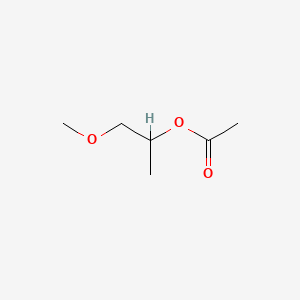
CAS 108-65-6PubChem CID 7946
Propylene glycol methyl ether acetate
Propylene glycol methyl ether acetate is a colorless liquid with a sweet ether-like odor. (USCG, 1999) — CAMEO Chemicals
- IUPAC 名称
- 1-methoxypropan-2-yl acetate
- 分子式
- C6H12O3
- 分子量
- 132.16 g/mol
- 精确质量
- 132.078644241 Da
- XLogP3
- 0.4
- 拓扑极性表面积
- 35.5 Ų
- 氢键供体
- 0
- 氢键受体
- 3
- 共价单元
- 1
- 已定义的立体中心
- 0
又称
PGMEA cpdRefChem:4334931-Methoxy-2-propyl acetatePropylene glycol monomethyl ether acetate2-Acetoxy-1-methoxypropane1-Methoxy-2-acetoxypropaneMETHOXYISOPROPYL ACETATE2-Methoxy-1-methylethyl acetate
另有 16 个已报告名称
2-Propanol, 1-methoxy-, acetate1-METHOXY-2-PROPANOL ACETATEPropyleneglycol monomethyl ether acetateNSC 2207Acetic acid, 2-methoxy-1-methylethyl ester2-Propanol, 1-methoxy-, 2-acetatePropylene glycol 1-methyl ether 2-acetateNSC-2207PROPYLENEGLYCOLMETHYLETHERACETATEPA7O2U6S2QPropylene Glycol 1-Monomethyl Ether 2-Acetate1,2-Propanediol monomethyl ether acetatePropylene glycol monomethyl ether acetate (PMA)Dowanol (R) PMA glycol ether acetateEINECS 203-603-9UNII-PA7O2U6S2Q
外部数据库标识符
- ChEMBL:CHEMBL3182130
- EPA DTXSID:DTXSID1026796
- PubMed:20358921
- PubMed:19553892
- PubMed:18385873
来自其他科学数据库的证据
NIH PubChem PUG-View
标识符精确匹配7946
Attributed physical-property, hazard, environmental and use annotations.
- Autoignition Temperature: 670 °F (USCG, 1999) 来源: CAMEO Chemicals
- Autoignition Temperature: 670 °F (354 °C) 来源: Hazardous Substances Data Bank (HSDB)
- Boiling Point: 302 °F at 760 mmHg (USCG, 1999) 来源: CAMEO Chemicals
- Boiling Point: 145-146 °C 来源: Hazardous Substances Data Bank (HSDB)
- Boiling Point: BP: 145.8 °C at 101.325 kPa 来源: Hazardous Substances Data Bank (HSDB)
- Boiling Point: BP: 302 °F = 150 °C = 423 K at 1 atm 来源: Hazardous Substances Data Bank (HSDB)
- Boiling Point: 146 °C 来源: ILO-WHO International Chemical Safety Cards (ICSCs)
- Boiling Point: 302 °F 来源: Occupational Safety and Health Administration (OSHA)
- Color/Form: Colorless liquid at 15 °C and 1 atm 来源: Hazardous Substances Data Bank (HSDB)
- Density: 0.969 at 68 °F (USCG, 1999) - Less dense than water; will float 来源: CAMEO Chemicals
- Density: 0.969 at 20 °C 来源: Hazardous Substances Data Bank (HSDB)
- Density: Saturated liquid density: 8.090 lbs/cu ft at 68 °F. Saturated vapor pressure: 0.072 lbs/sq in at 68 °C 来源: Hazardous Substances Data Bank (HSDB)
- Density: Saturated vapor density: 0.00167 lbs/cu ft at 68 °C 来源: Hazardous Substances Data Bank (HSDB)
- Density: Relative density (water = 1): 0.96 来源: ILO-WHO International Chemical Safety Cards (ICSCs)
- Density: 0.969 来源: Occupational Safety and Health Administration (OSHA)
- Flash Point: 114 °F (USCG, 1999) 来源: CAMEO Chemicals
- Flash Point: 42 °C 来源: Haz-Map, Information on Hazardous Chemicals and Occupational Diseases
- Flash Point: 45.5 °C (113.9 °F) - closed cup 来源: Hazardous Substances Data Bank (HSDB)
- Flash Point: 108 °F (42 °C) - closed cup 来源: Hazardous Substances Data Bank (HSDB)
- Flash Point: 42 °C c.c. 来源: ILO-WHO International Chemical Safety Cards (ICSCs)
- LogP: log Kow = 0.56 来源: Hazardous Substances Data Bank (HSDB)
- Melting Point: -66 °C 来源: Hazardous Substances Data Bank (HSDB)
- Odor: Sweet, ether-like 来源: Hazardous Substances Data Bank (HSDB)
- Physical Description: Propylene glycol methyl ether acetate is a colorless liquid with a sweet ether-like odor. (USCG, 1999) 来源: CAMEO Chemicals
- Physical Description: Dry Powder; Large Crystals; CBI; Liquid 来源: EPA Chemical Data Reporting (CDR)
- Physical Description: Colorless, hygroscopic liquid, with a characteristic odor; [ICSC] 来源: Haz-Map, Information on Hazardous Chemicals and Occupational Diseases
- Physical Description: Colorless liquid with a sweet odor like ether; [CAMEO] 来源: Haz-Map, Information on Hazardous Chemicals and Occupational Diseases
- Physical Description: COLOURLESS HYGROSCOPIC LIQUID WITH CHARACTERISTIC ODOUR. 来源: ILO-WHO International Chemical Safety Cards (ICSCs)
- Physical Description: Colorless, flammable liquid with sweet ether-like odor. 来源: Occupational Safety and Health Administration (OSHA)
- Solubility: In water, 1.98X10+5 mg/L at 25 °C 来源: Hazardous Substances Data Bank (HSDB)
- Solubility: In water, 198 g/L at 20 °C, pH 6.8 来源: Hazardous Substances Data Bank (HSDB)
- Solubility: Solubility in water, g/100ml: 19.8 来源: ILO-WHO International Chemical Safety Cards (ICSCs)
- Vapor Pressure: 3.92 [mmHg] 来源: Haz-Map, Information on Hazardous Chemicals and Occupational Diseases
- Vapor Pressure: 7.72 [mmHg] 来源: Haz-Map, Information on Hazardous Chemicals and Occupational Diseases
- Vapor Pressure: 3.92 mm Hg at 25 °C 来源: Hazardous Substances Data Bank (HSDB)
- Vapor Pressure: Vapor pressure, kPa at 20 °C: 0.5 来源: ILO-WHO International Chemical Safety Cards (ICSCs)
- Viscosity: 1.23 sq mm/sec at 20 °C 来源: Hazardous Substances Data Bank (HSDB)
- Exposure Routes: The substance can be absorbed into the body by inhalation of its aerosol or vapour and by ingestion. 来源: ILO-WHO International Chemical Safety Cards (ICSCs)
- First Aid: Call for medical aid.; EYES: Wash with water for 15 min.; call a physician.; SKIN: Remove contaminated clothing and wash skin with soap and water.; INGESTION: Induce vomiting after drinking two glasses of water. (USCG, 1999) 来源: CAMEO Chemicals
- Signal: Warning 来源: Regulation (EC) No 1272/2008 of the European Parliament and of the Council
- GHS Hazard Statements: H226: Flammable liquid and vapor [Warning Flammable liquids] 来源: Regulation (EC) No 1272/2008 of the European Parliament and of the Council
- Precautionary Statement Codes: P210, P233, P240, P241, P242, P243, P280, P303+P361+P353, P370+P378, P403+P235, and P501 (click each P-code to see the statement) 来源: Regulation (EC) No 1272/2008 of the European Parliament and of the Council
- Note: This chemical does not meet GHS hazard criteria for < 0.1% (1 of 3028) of reports. 来源: European Chemicals Agency (ECHA)
- Signal: Warning 来源: European Chemicals Agency (ECHA)
- GHS Hazard Statements: H226 (> 99.9%): Flammable liquid and vapor [Warning Flammable liquids]; H336 (15.6%): May cause drowsiness or dizziness [Warning Specific target organ toxicity, single exposure; Narcotic effects] 来源: European Chemicals Agency (ECHA)
- Precautionary Statement Codes: P210, P233, P240, P241, P242, P243, P261, P271, P280, P303+P361+P353, P304+P340, P319, P370+P378, P403+P233, P403+P235, P405, and P501 (click each P-code to see the statement) 来源: European Chemicals Agency (ECHA)
- ECHA C&L Notifications Summary: Aggregated GHS information provided per 3028 reports by companies from 38 notifications to the ECHA C&L Inventory. Each notification may be associated with multiple companies.; Reported as not meeting GHS hazard criteria per 1 of 3028 reports by companies.; There are 37 notifications provided by 3027 of 3028 reports by companies with hazard statement code(s).; Information may vary between notifications depending on impurities, additives, and other factors. The percentage value in parenthesis indicates the notified classification ratio from companies that provide hazard codes. Only hazard codes with percentage values above 10% are shown. For more detailed information, please visit ECHA C&L website. 来源: European Chemicals Agency (ECHA)
- Signal: Warning 来源: NITE-CMC
- GHS Hazard Statements: H320: Causes eye irritation [Warning Serious eye damage/eye irritation]; H336: May cause drowsiness or dizziness [Warning Specific target organ toxicity, single exposure; Narcotic effects] 来源: NITE-CMC
- Precautionary Statement Codes: P261, P264+P265, P271, P304+P340, P305+P351+P338, P319, P337+P317, P403+P233, P405, and P501 (click each P-code to see the statement) 来源: NITE-CMC
- GHS Hazard Statements: H226: Flammable liquid and vapor [Warning Flammable liquids]; H320: Causes eye irritation [Warning Serious eye damage/eye irritation]; H335: May cause respiratory irritation [Warning Specific target organ toxicity, single exposure; Respiratory tract irritation]; H336: May cause drowsiness or dizziness [Warning Specific target organ toxicity, single exposure; Narcotic effects] 来源: NITE-CMC
- NFPA Health Rating: 1 - Materials that, under emergency conditions, can cause significant irritation. 来源: Hazardous Substances Data Bank (HSDB)
- NFPA Fire Rating: 2 - Materials that must be moderately heated or exposed to relatively high ambient temperatures before ignition can occur. Materials would not under normal conditions form hazardous atmospheres with air, but under high ambient temperatures or under moderate heating could release vapor in sufficient quantities to produce hazardous atmospheres with air. 来源: Hazardous Substances Data Bank (HSDB)
- NFPA Instability Rating: 0 - Materials that in themselves are normally stable, even under fire conditions. 来源: Hazardous Substances Data Bank (HSDB)
- Cosmetic Ingredient Review Finding(s): Safe in the present practices of use and concentration. Ingredient, concentration, and use information are available in documents discoverable at https://cir-reports.cir-safety.org 来源: Cosmetic Ingredient Review (CIR)
- Toxicity Summary: IDENTIFICATION AND USE: 1-Methoxy-2-propyl acetate is used as a solvent in cosmetic formulations, as well as in surface coatings, inks, and cleaners. HUMAN STUDIES: The substance defats the skin, which may cause dryness or cracking. It is irritating to the eyes and respiratory tract. Exposure at high levels could cause depression of the central nervous system. ANIMAL STUDIES: Watery eyes, anorexia, rapid shallow breathing, and excess salivation were observed in rats given a single dose of 4000, 6300, or 10,000 mg/kg 1-methoxy-2-propyl acetate. 1-Methoxy-2-propyl acetate was not a skin irritant in rabbits. 10% 1-methoxy-2-propyl acetate in water was not a sensitizer in a guinea pig maximization test. Some slight changes were observed in the appearance of renal tissues in rats exposed to 3000 ppm 1-methoxy-2-propyl acetate. Slight to moderate degeneration of the olfactory epithelium in the nasal cavities was seen in rats and in mice. 1-Methoxy-2-propyl acetate had no adverse effect on reproductive parameters in rat developmental studies. 1-Methoxy-2-propyl acetate did not induce mutations or toxicity in Salmonella typhimurium strains TA98, TA100, TA1535, or TA1537 or in Escherichia c 来源: Hazardous Substances Data Bank (HSDB)
- Environmental Bioconcentration: An estimated BCF of 3 was calculated in fish for 1-methoxy-2-propyl acetate(SRC), using a log Kow of 0.56(1) and a regression-derived equation(1). According to a classification scheme(2), this BCF suggests the potential for bioconcentration in aquatic organisms is low(SRC). 来源: Hazardous Substances Data Bank (HSDB)
- Environmental Fate: TERRESTRIAL FATE: Based on a classification scheme(1), a measured log Koc of 0.362, corresponding to a Koc of 2.3(2) indicates that 1-methoxy-2-propyl acetate is expected to have very high mobility in soil(SRC). Volatilization of 1-methoxy-2-propyl acetate from moist soil surfaces is expected to be an important fate process(SRC) given an estimated Henry's Law constant of 3.4X10⁻⁶ atm-cu m/mole(SRC), based upon its vapor pressure, 3.92 mm Hg(3), and water solubility, 1.98X10+5 mg/L(2). 1-Methoxy-2-propyl acetate is expected to volatilize from dry soil surfaces(SRC) based upon its vapor pressure(2). 50% Biodegradation in less than one day using sandy and sandy loam soils(4) suggests that biodegradation is an important environmental fate process in soil(SRC). 来源: Hazardous Substances Data Bank (HSDB)
- Environmental Fate: AQUATIC FATE: Based on a classification scheme(1), a measured log Koc of 0.362, corresponding to a Koc of 2.3(2) indicates that 1-methoxy-2-propyl acetate is not expected to adsorb to suspended solids and sediment(SRC). Volatilization from water surfaces is expected(3) based upon an estimated Henry's Law constant of 3.4X10⁻⁶ atm-cu m/mole(SRC), derived from its vapor pressure, 3.92 mm Hg(4), and water solubility, 1.2X10+5 mg/L(2). Using this Henry's Law constant and an estimation method(3), volatilization half-lives for a model river and model lake are 12 and 93 days, respectively(SRC). According to a classification scheme(5), an estimated BCF of 3(SRC), from its log Kow of 0.56(2) and a regression-derived equation(6), suggests the potential for bioconcentration in aquatic organisms is low(SRC). 100% Biodegadation in the Zahn-Wellens test(7) indicates that biodegradation is an important environmental fate process in water(SRC). 来源: Hazardous Substances Data Bank (HSDB)
- Environmental Fate: ATMOSPHERIC FATE: According to a model of gas/particle partitioning of semivolatile organic compounds in the atmosphere(1), 1-methoxy-2-propyl acetate, which has a vapor pressure of 3.92 mm Hg at 25 °C(2), is expected to exist solely as a vapor in the ambient atmosphere. Vapor-phase 1-methoxy-2-propyl acetate is degraded in the atmosphere by reaction with photochemically-produced hydroxyl radicals(SRC); the half-life for this reaction in air is estimated to be 32 hrs(SRC), calculated from its rate constant of 1.2X10⁻¹¹ cu cm/molecule-sec at 25 °C(SRC) that was derived using a structure estimation method(3). d(1); this corresponds to half-lives of 2.4 yrs and 88 days at pH values of 7 and 8, respectively(1). Using an atmospheric simulation chamber, no photolysis of 1-methoxy-2-propyl acetate was observed(4); therefore, the compound is not expected to be susceptible to direct photolysis by sunlight(SRC). 来源: Hazardous Substances Data Bank (HSDB)
- Consumer Uses: Cleaning agent; Not Known or Reasonably Ascertainable; Filler; Hardener; Pigment; Defoamer; Polymerization promoter; Dispersing agent; Solvent; Insulators; Binder; Monomers; Semiconductor and photovoltaic agent; Tanning agents not otherwise specified 来源: EPA Chemical Data Reporting (CDR)
- Industry Uses: Not Known or Reasonably Ascertainable; Diluent; Cleaning agent; Hardener; Pigment; Drier; Adhesion/cohesion promoter; Intermediate; Other; Binder; Polymerization promoter; Solvent; Dispersing agent; Plating agent; Chemical reaction regulator; UV stabilizer; Processing aids not otherwise specified; Semiconductor and photovoltaic agent; Monomers; Tanning agents not otherwise specified 来源: EPA Chemical Data Reporting (CDR)
- Cosmetic Ingredient Review Link: CIR ingredient: Methoxyisopropyl Acetate 来源: Cosmetic Ingredient Review (CIR)
- Sources/Uses: Used as a solvent for paints, inks, lacquers, varnishes, cleaners, coatings, ink-removers, and pesticides; [eChemPortal: SIDSUNEP] Used in photoresist formulations in the semiconductor industry; Also used in solvents for degreasing circuit boards and in food contact applications; [CHEMINFO] 来源: Haz-Map, Information on Hazardous Chemicals and Occupational Diseases
- Industrial Processes with risk of exposure: Metal Degreasing [Category: Clean]; Semiconductor Manufacturing [Category: Industry]; Painting (Solvents) [Category: Paint]; Silk-Screen Printing [Category: Other] 来源: Haz-Map, Information on Hazardous Chemicals and Occupational Diseases
- Sources/Uses: Permitted for use as an inert ingredient in non-food pesticide products; [EPA] 来源: Haz-Map, Information on Hazardous Chemicals and Occupational Diseases
- Uses: Methoxyisopropyl acetate functions as a solvent in cosmetic formulations ... . Methoxyisopropyl acetate is used in surface coatings, inks, and cleaners. 来源: Hazardous Substances Data Bank (HSDB)
映射方: Existing checksum-valid CAS to unique PubChem CID match. 检索时间: 2026-08-31. 打开来源记录
科学分类和危害注释仅提供背景信息,不能取代上方所示针对具体市场的监管决定。
其他来源的覆盖范围和匹配状态
| 来源 | 结果 | 已检查 |
|---|---|---|
| NIH PubChem PUG-View | 精确匹配 | 2026-08-31 |
已记录的无匹配结果是该来源已被检查的有效证据;这并不表示该物质在别处不存在。
于 2026-09-02 通过校验和有效的 CAS 匹配从美国国立卫生研究院 (NIH) PubChem 检索。化学性质不能取代本页的监管决定。
官方来源与范围
导入自委员会实施决定 (EU) 2025/1175(数据集版本 EU 2025/1175)。词汇表为第 19(1)(g) 条所要求的成分表提供通用成分名称;它不是准许清单或安全清单。
打开官方决定