
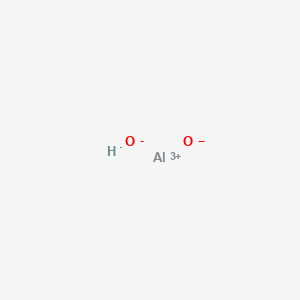
CAS 11139-78-9PubChem CID 73982
Boehmite (Al(OH)O)
gamma-Aluminum oxide hydroxide is a chemical compound of aluminum. Aluminum is the most abundant metal in the earth's crust and is always found combined with other elements such as oxygen, silicon, and fluorine. (L739, L740) — Toxin and Toxin Target Database (T3DB)
- IUPAC 名称
- aluminum;oxygen(2-);hydroxide
- 分子式
- AlHO2
- 分子量
- 59.988 g/mol
- 精确质量
- 59.9791927 Da
- 拓扑极性表面积
- 2.0 Ų
- 氢键供体
- 1
- 氢键受体
- 2
- 共价单元
- 3
- 已定义的立体中心
- 0
又称
PseudoboehmiteRefChem:1080072935-961-31318-23-6215-284-3BoehmitePT-A CompoundVersal 150
另有 12 个已报告名称
Versal 700Versal 900BOEHMITE ALUMINAALFOL ALUMINA SBBOEHMITE [WHO-DD]ALUMINUMHYDROXIDEOXIDEBoehmite (Al2O3.xH2O)Boehmite (Al(OH)O) 2-4umEINECS 215-284-3Aluminium hydroxide oxide (1/1/1)ALUMINUM HYDROXIDE OXIDE (AL(OH)OEC 215-284-3
外部数据库标识符
- EPA DTXSID:DTXSID4051661
- PubMed:26437923
- PubMed:23402729
- PubMed:19428954
来自其他科学数据库的证据
NIH PubChem PUG-View
标识符精确匹配73982
Attributed physical-property, hazard, environmental and use annotations.
- Physical Description: Liquid; Large Crystals; Dry Powder 来源: EPA Chemical Data Reporting (CDR)
- Physical Description: Off-white odorless powder; [Sasol MSDS] 来源: Haz-Map, Information on Hazardous Chemicals and Occupational Diseases
- Carcinogen Classification: Not listed by IARC. IARC classified aluminum production as carcinogenic to humans (Group 1), but did not implicate aluminum itself as a human carcinogen. (L135) A link between use of aluminum-containing antiperspirants and increased risk of breast cancer has been proposed (A235), but studies have not been able to establish a clear link (A15468). 来源: Toxin and Toxin Target Database (T3DB)
- Exposure Routes: Oral (L739) ; inhalation (L739) 来源: Toxin and Toxin Target Database (T3DB)
- Note: This chemical does not meet GHS hazard criteria for 99.6% (270 of 271) of all reports. 来源: European Chemicals Agency (ECHA)
- GHS Hazard Statements: Not Classified; Reported as not meeting GHS hazard criteria by 270 of 271 companies (only 0.4% companies provided GHS information). For more detailed information, please visit ECHA C&L website. 来源: European Chemicals Agency (ECHA)
- ECHA C&L Notifications Summary: Aggregated GHS information provided per 271 reports by companies from 2 notifications to the ECHA C&L Inventory.; Reported as not meeting GHS hazard criteria per 270 of 271 reports by companies.; There is 1 notification provided by 1 of 271 reports by companies with hazard statement code(s).; Information may vary between notifications depending on impurities, additives, and other factors. The percentage value in parenthesis indicates the notified classification ratio from companies that provide hazard codes. Only hazard codes with percentage values above 10% are shown. For more detailed information, please visit ECHA C&L website. 来源: European Chemicals Agency (ECHA)
- GHS Hazard Statements: Not Classified; Reported as not meeting GHS hazard criteria by 1 of 1 companies. For more detailed information, please visit ECHA C&L website. 来源: European Chemicals Agency (ECHA)
- Health Effects: Aluminum targets the nervous system and causes decreased nervous system performance and is associated with altered function of the blood-brain barrier. The accumulation of aluminum in the body may cause bone or brain diseases. High levels of aluminum have been linked to Alzheimer's disease. A small percentage of people are allergic to aluminium and experience contact dermatitis, digestive disorders, vomiting or other symptoms upon contact or ingestion of products containing aluminium. (L739, L740) 来源: Toxin and Toxin Target Database (T3DB)
- Toxicity Summary: The main target organs of aluminum are the central nervous system and bone. Aluminum binds with dietary phosphorus and impairs gastrointestinal absorption of phosphorus. The decreased phosphate body burden results in osteomalacia (softening of the bones due to defective bone mineralization) and rickets. Aluminum's neurotoxicity is believed to involve several mechanisms. Changes in cytoskeletal protein functions as a results of altered phosphorylation, proteolysis, transport, and synthesis are believed to be one cause. Aluminum may induce neurobehavioral effects by affecting permeability of the blood-brain barrier, cholinergic activity, signal transduction pathways, lipid peroxidation, and impair neuronal glutamate nitric oxide-cyclic GMP pathway, as well as interfere with metabolism of essential trace elements because of similar coordination chemistries and consequent competitive interactions. It has been suggested that aluminum's interaction with estrogen receptors increases the expression of estrogen-related genes and thereby contributes to the progression of breast cancer (A235), but studies have not been able to establish a clear link between aluminum and increased risk of brea 来源: Toxin and Toxin Target Database (T3DB)
- Consumer Uses: Dispersing agent; Other 来源: EPA Chemical Data Reporting (CDR)
- Industry Uses: Not Known or Reasonably Ascertainable; Filler; Catalyst; Adsorbent; Heat stabilizer; Intermediate; Other; Binder; Dispersing agent; Fuel agents; Abrasives 来源: EPA Chemical Data Reporting (CDR)
- Sources/Uses: Permitted for use as an inert ingredient in non-food pesticide products; [EPA] Used for catalyst production and as an inorganic coating; [Sasol MSDS] 来源: Haz-Map, Information on Hazardous Chemicals and Occupational Diseases
- Industrial Processes with risk of exposure: Aluminum Producing [Category: Industry] 来源: Haz-Map, Information on Hazardous Chemicals and Occupational Diseases
映射方: Existing checksum-valid CAS to unique PubChem CID match. 检索时间: 2026-08-31. 打开来源记录
科学分类和危害注释仅提供背景信息,不能取代上方所示针对具体市场的监管决定。
其他来源的覆盖范围和匹配状态
| 来源 | 结果 | 已检查 |
|---|---|---|
| NIH PubChem PUG-View | 精确匹配 | 2026-08-31 |
已记录的无匹配结果是该来源已被检查的有效证据;这并不表示该物质在别处不存在。
于 2026-08-31 通过校验和有效的 CAS 匹配从美国国立卫生研究院 (NIH) PubChem 检索。化学性质不能取代本页的监管决定。