
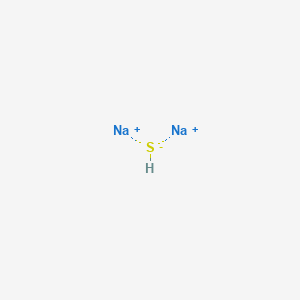
CAS 1313-82-2PubChem CID 237873
Sodium sulfide, hydrated, with not less than 30% water
Sodium sulfide, hydrated, with not less than 30% water appears as yellow-pink or white deliquescent crystals, flakes or lumps. Contains at least 30% water. Alkaline. Burns skin, eyes and mucous membranes. Mildly corrosive to most metals. May be toxic by skin absorption. Releases toxic hydrogen sulfide gas when mixed with an acid. — CAMEO Chemicals
- IUPAC 名称
- disodium;sulfanide
- 分子式
- HNa2S+
- 分子量
- 79.06 g/mol
- 精确质量
- 78.95943477 Da
- 拓扑极性表面积
- 1.0 Ų
- 氢键供体
- 1
- 氢键受体
- 1
- 共价单元
- 3
- 已定义的立体中心
- 0
又称
Disodium sulphideDisodium sulfide (Na2S)SODIUM SULFIDE, (HYDRATED, WITH >= 30% WATER)SODIUM SULFIDE, [HYDRATED, WITH >= 30% WATER]RefChem:887903SODIUM SULPHIDE, HYDRATED, WITH NOT LESS THAN 30% WATERsodium sulfideSodium sulfide (Na2S)
另有 14 个已报告名称
Sodium sulfide (VAN)Sodium Sulfide Hydrate (Technical Grade)Disodium Sulfide Hydrate; Monosulfide HydrateSodum sulfuretNa2-SSodium sulfide, 95%, anhydrousUN1385UN1849Sodium sulfide (Na2S) (8CI,9CI)Sodium sulfide hydrate, >=60%, scalesSodium sulfide, hydrated with at least 30% waterSodium sulfide, hydrated with at least 30% water [UN1849] [Corrosive]Sodium sulfide, anhydrous or sodium sulfide with <30% water of crystallizationSodium sulfide, anhydrous or sodium sulfide with <30% water of crystallization [UN1385] [Spontaneously combustible]
外部数据库标识符
- PubMed:15790858
来自其他科学数据库的证据
NIH PubChem PUG-View
标识符精确匹配237873
Attributed physical-property, hazard, environmental and use annotations.
- Physical Description: Sodium sulfide, hydrated, with not less than 30% water appears as yellow-pink or white deliquescent crystals, flakes or lumps. Contains at least 30% water. Alkaline. Burns skin, eyes and mucous membranes. Mildly corrosive to most metals. May be toxic by skin absorption. Releases toxic hydrogen sulfide gas when mixed with an acid. 来源: CAMEO Chemicals
- Physical Description: Wet Solid; Other Solid; Dry Powder; CBI; Large Crystals; Liquid 来源: EPA Chemical Data Reporting (CDR)
- First Aid: Excerpt from ERG Guide 153 [Substances - Toxic and/or Corrosive (Combustible)]:; Refer to the "General First Aid" section. Specific First Aid: For corrosives, in case of contact, immediately flush skin or eyes with running water for at least 30 minutes. Additional flushing may be required. Removal of solidified molten material from skin requires medical assistance. (ERG, 2024) 来源: CAMEO Chemicals
- Signal: Danger 来源: European Chemicals Agency (ECHA)
- GHS Hazard Statements: H290 (14.7%): May be corrosive to metals [Warning Corrosive to Metals]; H301+H311 (15.7%): Toxic if swallowed or in contact with skin [Danger Acute toxicity, oral; acute toxicity, dermal]; H301 (65.3%): Toxic if swallowed [Danger Acute toxicity, oral]; H302 (34.8%): Harmful if swallowed [Warning Acute toxicity, oral]; H311 (96.2%): Toxic in contact with skin [Danger Acute toxicity, dermal]; H314 (100%): Causes severe skin burns and eye damage [Danger Skin corrosion/irritation]; H318 (62.9%): Causes serious eye damage [Danger Serious eye damage/eye irritation]; H400 (100%): Very toxic to aquatic life [Warning Hazardous to the aquatic environment, acute hazard] 来源: European Chemicals Agency (ECHA)
- Precautionary Statement Codes: P234, P260, P262, P264, P264+P265, P270, P273, P280, P301+P316, P301+P317, P301+P330+P331, P302+P352, P302+P361+P354, P304+P340, P305+P354+P338, P316, P317, P321, P330, P361+P364, P363, P390, P391, P405, P406, and P501 (click each P-code to see the statement) 来源: European Chemicals Agency (ECHA)
- ECHA C&L Notifications Summary: Aggregated GHS information provided per 1100 reports by companies from 24 notifications to the ECHA C&L Inventory. Each notification may be associated with multiple companies.; Information may vary between notifications depending on impurities, additives, and other factors. The percentage value in parenthesis indicates the notified classification ratio from companies that provide hazard codes. Only hazard codes with percentage values above 10% are shown. For more detailed information, please visit ECHA C&L website. 来源: European Chemicals Agency (ECHA)
- Signal: Danger 来源: NITE-CMC
- GHS Hazard Statements: H251: Self-heating; may catch fire [Danger Self-heating substances and mixtures]; H301: Toxic if swallowed [Danger Acute toxicity, oral]; H314: Causes severe skin burns and eye damage [Danger Skin corrosion/irritation]; H318: Causes serious eye damage [Danger Serious eye damage/eye irritation]; H335: May cause respiratory irritation [Warning Specific target organ toxicity, single exposure; Respiratory tract irritation]; H400: Very toxic to aquatic life [Warning Hazardous to the aquatic environment, acute hazard] 来源: NITE-CMC
- Precautionary Statement Codes: P235, P260, P261, P264, P264+P265, P270, P271, P273, P280, P301+P316, P301+P330+P331, P302+P361+P354, P304+P340, P305+P354+P338, P316, P317, P319, P321, P330, P363, P391, P403+P233, P405, P407, P410, P413, P420, and P501 (click each P-code to see the statement) 来源: NITE-CMC
- GHS Hazard Statements: H251: Self-heating; may catch fire [Danger Self-heating substances and mixtures]; H301: Toxic if swallowed [Danger Acute toxicity, oral]; H314: Causes severe skin burns and eye damage [Danger Skin corrosion/irritation]; H318: Causes serious eye damage [Danger Serious eye damage/eye irritation]; H371: May cause damage to organs [Warning Specific target organ toxicity, single exposure] 来源: NITE-CMC
- Precautionary Statement Codes: P235, P260, P264, P264+P265, P270, P280, P301+P316, P301+P330+P331, P302+P361+P354, P304+P340, P305+P354+P338, P308+P316, P316, P317, P321, P330, P363, P405, P407, P410, P413, P420, and P501 (click each P-code to see the statement) 来源: NITE-CMC
- Signal: Danger 来源: Hazardous Chemical Information System (HCIS), Safe Work Australia
- GHS Hazard Statements: H301: Toxic if swallowed [Danger Acute toxicity, oral]; H312: Harmful in contact with skin [Warning Acute toxicity, dermal]; H314: Causes severe skin burns and eye damage [Danger Skin corrosion/irritation]; H400: Very toxic to aquatic life [Warning Hazardous to the aquatic environment, acute hazard] 来源: Hazardous Chemical Information System (HCIS), Safe Work Australia
- Precautionary Statement Codes: P260, P264, P270, P273, P280, P301+P316, P301+P330+P331, P302+P352, P302+P361+P354, P304+P340, P305+P354+P338, P316, P317, P321, P330, P362+P364, P363, P391, P405, and P501 (click each P-code to see the statement) 来源: Hazardous Chemical Information System (HCIS), Safe Work Australia
- Consumer Uses: Not Known or Reasonably Ascertainable 来源: EPA Chemical Data Reporting (CDR)
- Industry Uses: Intermediate; Processing aids, specific to petroleum production; Solids separation (precipitating) agent, not otherwise specified; Not Known or Reasonably Ascertainable; pH regulating agent; Tanning agents not otherwise specified; Processing aids not otherwise specified; Lubricating agent; Other 来源: EPA Chemical Data Reporting (CDR)
映射方: Existing checksum-valid CAS to unique PubChem CID match. 检索时间: 2026-08-31. 打开来源记录
科学分类和危害注释仅提供背景信息,不能取代上方所示针对具体市场的监管决定。
其他来源的覆盖范围和匹配状态
| 来源 | 结果 | 已检查 |
|---|---|---|
| NIH PubChem PUG-View | 精确匹配 | 2026-08-31 |
已记录的无匹配结果是该来源已被检查的有效证据;这并不表示该物质在别处不存在。
于 2026-09-02 通过校验和有效的 CAS 匹配从美国国立卫生研究院 (NIH) PubChem 检索。化学性质不能取代本页的监管决定。