
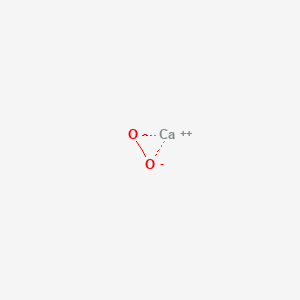
CAS 1305-79-9PubChem CID 14779
Calcium peroxide
Calcium peroxide is a member of calcium oxides. — ChEBI
- IUPAC 名称
- calcium peroxide
- 分子式
- CaO2
- 分子量
- 72.08 g/mol
- 精确质量
- 71.9524201 Da
- 拓扑极性表面积
- 46.1 Ų
- 氢键供体
- 0
- 氢键受体
- 2
- 共价单元
- 2
- 已定义的立体中心
- 0
又称
Calcium dioxideCalperCalper GCalcium peroxide (Ca(O2))7FRO2ENO91CHEBI:48233RefChem:122888215-139-4
另有 13 个已报告名称
684-873-9calcium;peroxideUNII-7FRO2ENO91peroxidocalciumCalciumperoxidKalziumperoxidHSDB 965cyc-CaO2EINECS 215-139-4UN1457Ca(O2)(eta~2~-Dioxidanediido)calciumCalcium peroxide [UN1457] [Oxidizer]
外部数据库标识符
- ChEBI:CHEBI:48233
- EPA DTXSID:DTXSID4050489
- PubMed:31515881
- PubMed:26053405
来自其他科学数据库的证据
NIH PubChem PUG-View
标识符精确匹配14779
Attributed physical-property, hazard, environmental and use annotations.
- Color/Form: White or yellowish powder 来源: Hazardous Substances Data Bank (HSDB)
- Color/Form: White tetragonal crystals 来源: Hazardous Substances Data Bank (HSDB)
- Density: 2.92 at 77 °F (USCG, 1999) - Denser than water; will sink 来源: CAMEO Chemicals
- Density: 2.9 g/cu cm 来源: Hazardous Substances Data Bank (HSDB)
- Melting Point: Decomp at 200 °C 来源: Hazardous Substances Data Bank (HSDB)
- Odor: Odorless 来源: Hazardous Substances Data Bank (HSDB)
- Physical Description: Calcium peroxide appears as a grayish white granular material. Used in baking, in medicine, in bleaching oils. 来源: CAMEO Chemicals
- Physical Description: White or yellowish odorless solid; Slightly soluble in water; Decomposes in moist air; [Merck Index] Yellowish odorless powder; Insoluble in water; [MSDSonline] 来源: Haz-Map, Information on Hazardous Chemicals and Occupational Diseases
- Refractive Index: INDEX OF REFRACTION: 1.895 来源: Hazardous Substances Data Bank (HSDB)
- Solubility: Slightly soluble in water 来源: Hazardous Substances Data Bank (HSDB)
- Solubility: Soluble in acids with formation of hydrogen peroxide 来源: Hazardous Substances Data Bank (HSDB)
- First Aid: INHALATION: remove to fresh air.; EYES: flush with water for 15 min. and consult physician.; SKIN: flush with water.; INGESTION: give large amounts of water. (USCG, 1999) 来源: CAMEO Chemicals
- ERG2024, Guide 140 (Calcium peroxide): General First Aid:; · Call 911 or emergency medical service.; · Ensure that medical personnel are aware of the material(s) involved, take precautions to protect themselves and avoid contamination.; · Move victim to fresh air if it can be done safely.; · Administer oxygen if breathing is difficult.; · If victim is not breathing:; -- DO NOT perform mouth-to-mouth resuscitation; the victim may have ingested or inhaled the substance.; -- If equipped and pulse detected, wash face and mouth, then give artificial respiration using a proper respiratory medical device (bag-valve mask, pocket mask equipped with a one-way valve or other device).; -- If no pulse detected or no respiratory medical device available, provide continuous compressions. Conduct a pulse check every two minutes or monitor for any signs of spontaneous respirations.; · Remove and isolate contaminated clothing and shoes.; · For minor skin contact, avoid spreading material on unaffected skin.; · In case of contact with substance, remove immediately by flushing skin or eyes with running water for at least 20 minutes.; · For severe burns, immediate medical attention is required.; · Effects of exposure (inhalation, ingestion, 来源: Emergency Response Guidebook (ERG)
- Signal: Danger 来源: European Chemicals Agency (ECHA)
- GHS Hazard Statements: H272 (97.1%): May intensify fire; oxidizer [Danger Oxidizing liquids; Oxidizing solids]; H315 (94.3%): Causes skin irritation [Warning Skin corrosion/irritation]; H319 (94.3%): Causes serious eye irritation [Warning Serious eye damage/eye irritation]; H335 (94.3%): May cause respiratory irritation [Warning Specific target organ toxicity, single exposure; Respiratory tract irritation] 来源: European Chemicals Agency (ECHA)
- Precautionary Statement Codes: P210, P220, P261, P264, P264+P265, P271, P280, P302+P352, P304+P340, P305+P351+P338, P319, P321, P332+P317, P337+P317, P362+P364, P370+P378, P403+P233, P405, and P501 (click each P-code to see the statement) 来源: European Chemicals Agency (ECHA)
- ECHA C&L Notifications Summary: Aggregated GHS information provided per 140 reports by companies from 7 notifications to the ECHA C&L Inventory. Each notification may be associated with multiple companies.; Information may vary between notifications depending on impurities, additives, and other factors. The percentage value in parenthesis indicates the notified classification ratio from companies that provide hazard codes. Only hazard codes with percentage values above 10% are shown. For more detailed information, please visit ECHA C&L website. 来源: European Chemicals Agency (ECHA)
- GHS Hazard Statements: H272 (100%): May intensify fire; oxidizer [Danger Oxidizing liquids; Oxidizing solids]; H315 (100%): Causes skin irritation [Warning Skin corrosion/irritation]; H319 (100%): Causes serious eye irritation [Warning Serious eye damage/eye irritation]; H335 (100%): May cause respiratory irritation [Warning Specific target organ toxicity, single exposure; Respiratory tract irritation] 来源: European Chemicals Agency (ECHA)
- ECHA C&L Notifications Summary: Aggregated GHS information provided per 38 reports by companies from 1 notifications to the ECHA C&L Inventory. Each notification may be associated with multiple companies.; Information may vary between notifications depending on impurities, additives, and other factors. The percentage value in parenthesis indicates the notified classification ratio from companies that provide hazard codes. Only hazard codes with percentage values above 10% are shown. For more detailed information, please visit ECHA C&L website. 来源: European Chemicals Agency (ECHA)
- Signal: Danger 来源: NITE-CMC
- GHS Hazard Statements: H272: May intensify fire; oxidizer [Danger Oxidizing liquids; Oxidizing solids]; H318: Causes serious eye damage [Danger Serious eye damage/eye irritation] 来源: NITE-CMC
- Precautionary Statement Codes: P210, P220, P264+P265, P280, P305+P354+P338, P317, P370+P378, and P501 (click each P-code to see the statement) 来源: NITE-CMC
- Signal: Danger 来源: Hazardous Chemical Information System (HCIS), Safe Work Australia
- GHS Hazard Statements: H302: Harmful if swallowed [Warning Acute toxicity, oral]; H314: Causes severe skin burns and eye damage [Danger Skin corrosion/irritation]; H335: May cause respiratory irritation [Warning Specific target organ toxicity, single exposure; Respiratory tract irritation] 来源: Hazardous Chemical Information System (HCIS), Safe Work Australia
- Precautionary Statement Codes: P260, P261, P264, P270, P271, P280, P301+P317, P301+P330+P331, P302+P361+P354, P304+P340, P305+P354+P338, P316, P319, P321, P330, P363, P403+P233, P405, and P501 (click each P-code to see the statement) 来源: Hazardous Chemical Information System (HCIS), Safe Work Australia
- Toxicity Summary: IDENTIFICATION AND USE: Calcium peroxide is white or yellowish powder. It is used as a stabilizer for rubber. Other uses including seed disinfectant, dentifrices, dough conditioners, antiseptic, bleaching of oils, modification of starches, high temperature oxidation. An important application of calcium peroxide is for curing the polysulfide sealants used in double glazing window units. Calcium peroxide is also used at several gold mines in Australia to increase recovery of gold and reduce the consumption of cyanide. Calcium peroxide has been identified as being used in hydraulic fracturing as a breaker. HUMAN EXPOSURE AND TOXICITY: Contact with calcium peroxide can severely irritate and may burn the skin and eyes. Exposure can irritate the eyes, nose, and throat. Prolonged exposure can damage the skin. Higher levels of calcium peroxide can irritate the lungs causing coughing and/or shortness of breath. Still higher exposures may cause a buildup of fluid in the lungs (pulmonary edema). This can cause death. ANIMAL STUDIES: Experiments with calcium peroxide revealed that the compound is not toxic to dogs treated orally. ECOTOXICITY STUDIES: New method was proposed for increasing the 来源: Hazardous Substances Data Bank (HSDB)
- Consumer Uses: Oxidizing agent 来源: EPA Chemical Data Reporting (CDR)
- Industry Uses: Oxidizing agent 来源: EPA Chemical Data Reporting (CDR)
- Sources/Uses: Used as a rubber stabilizer, antiseptic, seed disinfectant, starch modifier, sewage deodorizer, and wastewater dechlorinator; Also used for dentifrices; in dough conditioners; for bleaching of oils; in high temperature oxidations; for curing the polysulfide sealants used in double glazing window units; to increase recovery of gold and reduce the consumption of cyanide (at gold mines); to improve the bioremediation of soils contaminated with creosote or kerosene; for removing metal ions from acidic waste streams such as coal ash leachate and acid mine drainage; in the cultivation of tomatoes, cucumbers, tobacco, and prawns (Japan); [HSDB] Used as a flour treatment agent; [JECFA] 来源: Haz-Map, Information on Hazardous Chemicals and Occupational Diseases
- Industrial Processes with risk of exposure: Using Disinfectants or Biocides [Category: Clean]; Farming (Pesticides) [Category: Industry]; Sewer and Wastewater Treatment [Category: Industry]; Metal Extraction and Refining [Category: Industry] 来源: Haz-Map, Information on Hazardous Chemicals and Occupational Diseases
- Uses: Stabilizer for rubber. 来源: Hazardous Substances Data Bank (HSDB)
- Uses: Seed disinfectant, dentifrices, dough conditioners, antiseptic, bleaching of oils, modification of starches, high temperature oxidation. 来源: Hazardous Substances Data Bank (HSDB)
- Uses: Calcium peroxide is used as oxygen source in the leaching of gold and silver ores with cyanide to improve precious metal recovery and leaching kinetics. A relatively new application for CaO2 is as a peroxide source in toothpaste and dental chewing gum products. Calcium peroxide is also used in limited quantities as a hardening accelerator for sulfide rubber, as dough conditioner in the baking industry, and as a nontoxic disinfectant for seed and grain. 来源: Hazardous Substances Data Bank (HSDB)
- Uses: An important application of calcium peroxide is for curing the polysulfide sealants used in double glazing window units. Calcium peroxide is also used at several gold mines in Australia to increase recovery of gold and reduce the consumption of cyanide. Calcium peroxide (PermeOx) is also used to improve the bioremediation of soils contaminated with creosote or kerosene, to deodorize sewage sludges and wastewater, and to dechlorinate wastewater and effluents. A special formulation of calcium peroxide ... is used for removing metal ions from acidic waste streams such as coal ash leachate and acid mine drainage. 来源: Hazardous Substances Data Bank (HSDB)
- Uses: For more Uses (Complete) data for CALCIUM PEROXIDE (7 total), please visit the HSDB record page. 来源: Hazardous Substances Data Bank (HSDB)
映射方: Existing checksum-valid CAS to unique PubChem CID match. 检索时间: 2026-08-31. 打开来源记录
科学分类和危害注释仅提供背景信息,不能取代上方所示针对具体市场的监管决定。
其他来源的覆盖范围和匹配状态
| 来源 | 结果 | 已检查 |
|---|---|---|
| NIH PubChem PUG-View | 精确匹配 | 2026-08-31 |
已记录的无匹配结果是该来源已被检查的有效证据;这并不表示该物质在别处不存在。
于 2026-08-31 通过校验和有效的 CAS 匹配从美国国立卫生研究院 (NIH) PubChem 检索。化学性质不能取代本页的监管决定。