
CAS 129-73-7
CAS 129-73-7 与法规 1223/2009 附件 II–VI 中的 1 条欧盟附件记录相匹配。
CAS 129-73-7 的记录
1 共化学身份与性质
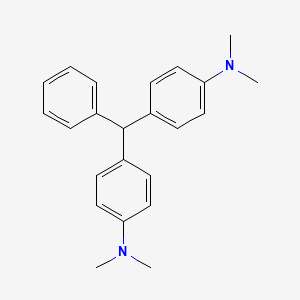
Leucomalachite green
Leucomalachite green is a benzenoid aromatic compound. — ChEBI
- IUPAC 名称
- 4-[[4-(dimethylamino)phenyl]-phenylmethyl]-N,N-dimethylaniline
- 分子式
- C23H26N2
- 分子量
- 330.5 g/mol
- 精确质量
- 330.209598838 Da
- XLogP3
- 5.3
- 拓扑极性表面积
- 6.5 Ų
- 氢键供体
- 0
- 氢键受体
- 2
- 共价单元
- 1
- 已定义的立体中心
- 0
又称
另有 16 个已报告名称
外部数据库标识符
- ChEBI:CHEBI:181416
- ChEMBL:CHEMBL1898627
- EPA DTXSID:DTXSID7031531
- PubMed:26558467
- PubMed:21578770
- PubMed:16904259
- PubMed:12351145
- PubMed:9760285
来自其他科学数据库的证据
NIH PubChem PUG-View
Attributed physical-property, hazard, environmental and use annotations.
- Color/Form: Off-white to light-brown powder 来源: Hazardous Substances Data Bank (HSDB)
- Color/Form: Needles or leaflets from alcohol, benzene 来源: Hazardous Substances Data Bank (HSDB)
- Melting Point: 102 °C 来源: Hazardous Substances Data Bank (HSDB)
- Physical Description: Reduced form of malachite green; [Merck Index] 来源: Haz-Map, Information on Hazardous Chemicals and Occupational Diseases
- Solubility: Very soluble in benzene, ethyl ether 来源: Hazardous Substances Data Bank (HSDB)
- Solubility: Solubilities (mg/mL): 30 ethyleneglycol monomethyl ether; 4 ethanol 来源: Hazardous Substances Data Bank (HSDB)
- IARC Carcinogenic Agent: Leucomalachite green 来源: International Agency for Research on Cancer (IARC)
- IARC Carcinogenic Classes: Group 2B: Possibly carcinogenic to humans 来源: International Agency for Research on Cancer (IARC)
- IARC Monographs: Volume 129: (2022) Gentian Violet, Leucogentian Violet, Malachite Green, Leucomalachite Green, and CI Direct Blue 218 来源: International Agency for Research on Cancer (IARC)
- Publication Year: 2022 online 来源: International Agency for Research on Cancer (IARC)
- Evaluation Year: 2021 来源: International Agency for Research on Cancer (IARC)
- Substance: Leucomalachite Green 来源: NTP Technical Reports
- NTP Technical Report: TR-527: Toxicology and Carcinogenesis Studies of Malachite Green Chloride and Leucomalachite Green (CASRNs 569-64-2 and 129-73-7) in F344/N Rats and B6C3F1 Mice (Feed Studies) (2005 ) 来源: NTP Technical Reports
- Peer Review Date: 02/17/04 来源: NTP Technical Reports
- Conclusion for Male Rat: Equivocal Evidence 来源: NTP Technical Reports
- Conclusion for Female Rat: Equivocal Evidence 来源: NTP Technical Reports
- Conclusion for Male Mice: Chemical Not Tested in Species/Sex 来源: NTP Technical Reports
- Conclusion for Female Mice: Some Evidence 来源: NTP Technical Reports
- Signal: Warning 来源: Regulation (EC) No 1272/2008 of the European Parliament and of the Council
- GHS Hazard Statements: H341: Suspected of causing genetic defects [Warning Germ cell mutagenicity]; H351: Suspected of causing cancer [Warning Carcinogenicity] 来源: Regulation (EC) No 1272/2008 of the European Parliament and of the Council
- Precautionary Statement Codes: P203, P280, P318, P405, and P501 (click each P-code to see the statement) 来源: Regulation (EC) No 1272/2008 of the European Parliament and of the Council
- Signal: Danger 来源: European Chemicals Agency (ECHA)
- GHS Hazard Statements: H302 (96.2%): Harmful if swallowed [Warning Acute toxicity, oral]; H311 (15.4%): Toxic in contact with skin [Danger Acute toxicity, dermal]; H315 (15.4%): Causes skin irritation [Warning Skin corrosion/irritation]; H331 (15.4%): Toxic if inhaled [Danger Acute toxicity, inhalation]; H332 (15.4%): Harmful if inhaled [Warning Acute toxicity, inhalation]; H400 (96.2%): Very toxic to aquatic life [Warning Hazardous to the aquatic environment, acute hazard] 来源: European Chemicals Agency (ECHA)
- Precautionary Statement Codes: P261, P262, P264, P270, P271, P273, P280, P301+P317, P302+P352, P304+P340, P316, P317, P321, P330, P332+P317, P361+P364, P362+P364, P391, P403+P233, P405, and P501 (click each P-code to see the statement) 来源: European Chemicals Agency (ECHA)
- ECHA C&L Notifications Summary: Aggregated GHS information provided per 52 reports by companies from 6 notifications to the ECHA C&L Inventory. Each notification may be associated with multiple companies.; Information may vary between notifications depending on impurities, additives, and other factors. The percentage value in parenthesis indicates the notified classification ratio from companies that provide hazard codes. Only hazard codes with percentage values above 10% are shown. For more detailed information, please visit ECHA C&L website. 来源: European Chemicals Agency (ECHA)
- Signal: Danger 来源: NITE-CMC
- GHS Hazard Statements: H341: Suspected of causing genetic defects [Warning Germ cell mutagenicity]; H351: Suspected of causing cancer [Warning Carcinogenicity]; H361: Suspected of damaging fertility or the unborn child [Warning Reproductive toxicity]; H372: Causes damage to organs through prolonged or repeated exposure [Danger Specific target organ toxicity, repeated exposure]; H373: May causes damage to organs through prolonged or repeated exposure [Warning Specific target organ toxicity, repeated exposure] 来源: NITE-CMC
- Precautionary Statement Codes: P203, P260, P264, P270, P280, P318, P319, P405, and P501 (click each P-code to see the statement) 来源: NITE-CMC
- Signal: Warning 来源: Hazardous Chemical Information System (HCIS), Safe Work Australia
- GHS Hazard Statements: H341: Suspected of causing genetic defects [Warning Germ cell mutagenicity]; H351: Suspected of causing cancer [Warning Carcinogenicity] 来源: Hazardous Chemical Information System (HCIS), Safe Work Australia
- Environmental Bioconcentration: An estimated BCF of 2800 was calculated in fish for leucomalachite green(SRC), using an estimated log Kow of 5.72(1) and a regression-derived equation(2). According to a classification scheme(3), this BCF suggests the potential for bioconcentration in aquatic organisms is very high(SRC), provided the compound is not metabolized by the organism(SRC). 来源: Hazardous Substances Data Bank (HSDB)
- Environmental Fate: TERRESTRIAL FATE: Based on a classification scheme(1), an estimated Koc value of 9.8X10+4(SRC), determined from a structure estimation method(2), indicates that leucomalachite green is expected to be immobile in soil(SRC). The estimated pKa of leucomalachite green is 5.46(3), indicating that this compound will exist partially in the cation form in the environment and cations generally adsorb more strongly to soils containing organic carbon and clay than their neutral counterparts(4). Volatilization of the neutral species from moist soil surfaces is not expected to be an important fate process(SRC) given an estimated Henry's Law constant of 9.8X10⁻⁹ atm-cu m/mole(SRC), using a fragment constant estimation method(5). Leucomalachite green is not expected to volatilize from dry soil surfaces(SRC) based upon an estimated vapor pressure of 1.9X10⁻⁷ mm Hg at 25 °C(SRC), determined from a fragment constant method(6). Biodegradation data in soil were not available(SRC, 2012). 来源: Hazardous Substances Data Bank (HSDB)
- Environmental Fate: AQUATIC FATE: Based on a classification scheme(1), an estimated Koc value of 9.8X10+4(SRC), determined from a structure estimation method(2), indicates that leucomalachite green is expected to adsorb to suspended solids and sediment(SRC). Volatilization of the neutral species from water surfaces is not expected(3) based upon an estimated Henry's Law constant of 9.8X10⁻⁹ atm-cu m/mole(SRC), developed using a fragment constant estimation method(4). The estimated pKa of 5.72(5) indicates leucomalachite green will exist partially in the cation form at pH values of 5 to 9 and, therefore, volatilization from water surfaces is not expected to be an important fate process(SRC). According to a classification scheme(6), an estimated BCF of 2800(SRC), from an estimated log Kow of 5.72(7) and a regression-derived equation(8), suggests the potential for bioconcentration in aquatic organisms is very high, provided the compound is not metabolized by the organism(SRC). Biodegradation data in water were not available(SRC, 2012). 来源: Hazardous Substances Data Bank (HSDB)
- Environmental Fate: ATMOSPHERIC FATE: According to a model of gas/particle partitioning of semivolatile organic compounds in the atmosphere(1), leucomalachite green, which has an estimated vapor pressure of 1.9X10⁻⁷ mm Hg at 25 °C(SRC), determined from a fragment constant method(2), will exist in both the vapor and particulate phases in the ambient atmosphere. Vapor-phase leucomalachite green is degraded in the atmosphere by reaction with photochemically-produced hydroxyl radicals(SRC); the half-life for this reaction in air is estimated to be 0.6 hours(SRC), calculated from its rate constant of 2.1X10⁻¹⁰ cu cm/molecule-sec at 25 °C(SRC) that was derived using a structure estimation method(3). Particulate-phase leucomalachite green may be removed from the air by wet or dry deposition(SRC). Leucomalachite green contains chromophores that absorb at wavelengths >290 nm(4) and, therefore, may be susceptible to direct photolysis by sunlight(SRC). 来源: Hazardous Substances Data Bank (HSDB)
- Sources/Uses: Used to dye silk, wool, jute, leather, and cotton (after mordanting); Also used as a biological stain, reagent, pH indicator, fungicide, and parasiticide; [Merck Index] 来源: Haz-Map, Information on Hazardous Chemicals and Occupational Diseases
- Industrial Processes with risk of exposure: Textiles (Printing, Dyeing, or Finishing) [Category: Industry] 来源: Haz-Map, Information on Hazardous Chemicals and Occupational Diseases
- Uses: Reagent for the quantitative colorimetric microdetermination of hemoglobin and other heme compounds 来源: Hazardous Substances Data Bank (HSDB)
映射方: Existing checksum-valid CAS to unique PubChem CID match. 检索时间: 2026-08-31. 打开来源记录
科学分类和危害注释仅提供背景信息,不能取代上方所示针对具体市场的监管决定。
其他来源的覆盖范围和匹配状态
| 来源 | 结果 | 已检查 |
|---|---|---|
| NIH PubChem PUG-View | 精确匹配 | 2026-08-31 |
已记录的无匹配结果是该来源已被检查的有效证据;这并不表示该物质在别处不存在。
于 2026-09-02 通过校验和有效的 CAS 匹配从美国国立卫生研究院 (NIH) PubChem 检索。化学性质不能取代本页的监管决定。
本站如何使用 CAS 129-73-7
CAS 129-73-7 是化学文摘社 (Chemical Abstracts Service) 的标识符,用于将本页对应到特定物质。在当前数据集中,有 1 条欧盟附件记录共用该标识符,可帮助您交叉核对同一物质是出现在一种还是多种监管情境中。
当供应商规格书、SDS 或原料档案给出 CAS 129-73-7,而您需要在一处查看所有关联的附件 II–VI 记录时,请使用本页。上方的条目卡片是查看浓度限值、警示语、附件归属和产品类型条件的最快途径。