
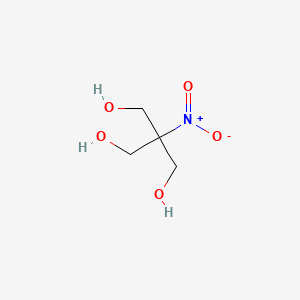
CAS 126-11-4PubChem CID 31337
Tris(hydroxymethyl)nitromethane
- IUPAC 名称
- 2-(hydroxymethyl)-2-nitropropane-1,3-diol
- 分子式
- C4H9NO5
- 分子量
- 151.12 g/mol
- 精确质量
- 151.04807239 Da
- XLogP3
- -2.2
- 拓扑极性表面积
- 107.0 Ų
- 氢键供体
- 3
- 氢键受体
- 5
- 共价单元
- 1
- 已定义的立体中心
- 0
又称
2-(Hydroxymethyl)-2-nitro-1,3-propanediolCimcool wafersTrimethylolnitromethaneNitroisobutylglycerol1,3-Propanediol, 2-(hydroxymethyl)-2-nitro-TrihydroxymethylnitromethaneNitrotris(hydroxymethyl)methane2-(Hydroxymethyl)-2-nitropropanediol
另有 16 个已报告名称
2-Nitro-2-(hydroxymethyl)-1,3-propanediol2-HYDROXYMETHYL-2-NITRO-1,3-PROPANEDIOL2-Hydroxymethyl-2-nitropropane-1,3-diol3E794G4ZRBNSC-17675Isobutylglycerol, NitroRefChem:473469204-769-5Tris nitroIsobutylglycerol, nitro-Methane, trimethylolnitro-1,1,1-Tris(hydroxymethyl)nitromethaneNSC 17675WLN: WNX1Q1Q1QNitromethylidynetri(methanol)Caswell No. 495
外部数据库标识符
- ChEMBL:CHEMBL1895497
- EPA DTXSID:DTXSID8027034
- PubMed:22188016
- PubMed:22016638
- PubMed:20670016
- PubMed:20573163
- PubMed:19797229
来自其他科学数据库的证据
NIH PubChem PUG-View
标识符精确匹配31337
Attributed physical-property, hazard, environmental and use annotations.
- Color/Form: Crystals from ethyl acetate and benzene 来源: Hazardous Substances Data Bank (HSDB)
- Color/Form: White solid 来源: Hazardous Substances Data Bank (HSDB)
- Melting Point: 214 °C (pure) 来源: Hazardous Substances Data Bank (HSDB)
- Melting Point: MP: 180 °C (usual lab product); 175-176 °C (technical grade) 来源: Hazardous Substances Data Bank (HSDB)
- Odor: Odorless 来源: Hazardous Substances Data Bank (HSDB)
- Physical Description: Liquid; Dry Powder 来源: EPA Chemical Data Reporting (CDR)
- Physical Description: White solid; [Hawley] Light yellow crystals; [MSDSonline] 来源: Haz-Map, Information on Hazardous Chemicals and Occupational Diseases
- Solubility: Soluble in polar solvents such as methanol and isopropanol. Insoluble in non-polar solvents such as aliphatic and aromatic hydrocarbons. 来源: Hazardous Substances Data Bank (HSDB)
- Solubility: Freely soluble in alcohols, sparingly soluble in benzene 来源: Hazardous Substances Data Bank (HSDB)
- Solubility: In water, 2.20X10+6 mg/L at 20 °C 来源: Hazardous Substances Data Bank (HSDB)
- Vapor Pressure: 0.00000154 [mmHg] 来源: Haz-Map, Information on Hazardous Chemicals and Occupational Diseases
- Signal: Warning 来源: European Chemicals Agency (ECHA)
- GHS Hazard Statements: H302+H332 (58.6%): Harmful if swallowed or if inhaled [Warning Acute toxicity, oral; acute toxicity, inhalation]; H302 (86.4%): Harmful if swallowed [Warning Acute toxicity, oral]; H315 (37.7%): Causes skin irritation [Warning Skin corrosion/irritation]; H319 (37.7%): Causes serious eye irritation [Warning Serious eye damage/eye irritation]; H332 (59.3%): Harmful if inhaled [Warning Acute toxicity, inhalation]; H335 (24.1%): May cause respiratory irritation [Warning Specific target organ toxicity, single exposure; Respiratory tract irritation]; H400 (58%): Very toxic to aquatic life [Warning Hazardous to the aquatic environment, acute hazard]; H410 (58%): Very toxic to aquatic life with long lasting effects [Warning Hazardous to the aquatic environment, long-term hazard] 来源: European Chemicals Agency (ECHA)
- Precautionary Statement Codes: P261, P264, P264+P265, P270, P271, P273, P280, P301+P317, P302+P352, P304+P340, P305+P351+P338, P317, P319, P321, P330, P332+P317, P337+P317, P362+P364, P391, P403+P233, P405, and P501 (click each P-code to see the statement) 来源: European Chemicals Agency (ECHA)
- ECHA C&L Notifications Summary: Aggregated GHS information provided per 162 reports by companies from 8 notifications to the ECHA C&L Inventory. Each notification may be associated with multiple companies.; Information may vary between notifications depending on impurities, additives, and other factors. The percentage value in parenthesis indicates the notified classification ratio from companies that provide hazard codes. Only hazard codes with percentage values above 10% are shown. For more detailed information, please visit ECHA C&L website. 来源: European Chemicals Agency (ECHA)
- Environmental Bioconcentration: An estimated BCF of 1.3 was calculated for 2-hydroxymethyl-2-nitro-1,3-propanediol(SRC), using an estimated log Kow of -1.66(1) and a regression-derived equation(2). According to a classification scheme(3), this BCF suggests the potential for bioconcentration in aquatic organisms is low(SRC). 来源: Hazardous Substances Data Bank (HSDB)
- Environmental Fate: TERRESTRIAL FATE: Based on a classification scheme(1), an estimated Koc value of 10(SRC), determined from a structure estimation method(2), indicates that 2-hydroxymethyl-2-nitro-1,3-propanediol is expected to have very high mobility in soil(SRC). Volatilization of 2-hydroxymethyl-2-nitro-1,3-propanediol from moist soil surfaces is not expected to be an important fate process(SRC) given an estimated Henry's Law constant of 4.8X10⁻¹² atm-cu m/mole(SRC), using a fragment constant estimation method(3). 2-Hydroxymethyl-2-nitro-1,3-propanediol is not expected to volatilize from dry soil surfaces(SRC) based upon an estimated vapor pressure of 3.2X10⁻⁷ mm Hg(SRC), determined from a fragment constant method(4). Biodegradation data were not available(SRC, 2006). 来源: Hazardous Substances Data Bank (HSDB)
- Environmental Fate: AQUATIC FATE: Based on a classification scheme(1), an estimated Koc value of 10(SRC), determined from a structure estimation method(2), indicates that 2-hydroxymethyl-2-nitro-1,3-propanediol is not expected to adsorb to suspended solids and sediment(SRC). Volatilization from water surfaces is not expected(3) based upon an estimated Henry's Law constant of 4.8X10⁻¹² atm-cu m/mole(SRC), developed using a fragment constant estimation method(4). According to a classification scheme(5), an estimated BCF of 1.3(SRC), from an estimated log Kow of -1.66(6) and a regression-derived equation(7), suggests the potential for bioconcentration in aquatic organisms is low(SRC). 2-Hydroxymethyl-2-nitro-1,3-propanediol has reported hydrolysis half-lives of stable, 3.4 days and 2.4 days at pH values 5, 7 and 9, respectively(8). 2-Hydroxymethyl-2-nitro-1,3-propanediol decomposes to formaldehyde under alkaline conditions and at temperatures above 49 °C(9). Biodegradation data were not available(SRC, 2006). 来源: Hazardous Substances Data Bank (HSDB)
- Environmental Fate: ATMOSPHERIC FATE: According to a model of gas/particle partitioning of semivolatile organic compounds in the atmosphere(1), 2-hydroxymethyl-2-nitro-1,3-propanediol, which has an estimated vapor pressure of 3.2X10⁻⁷ mm Hg at 25 °C(SRC), determined from a fragment constant method(2), will exist in both the vapor and particulate phases in the ambient atmosphere. Vapor-phase 2-hydroxymethyl-2-nitro-1,3-propanediol is degraded in the atmosphere by reaction with photochemically-produced hydroxyl radicals(SRC); the half-life for this reaction in air is estimated to be 33 days(SRC), calculated from its rate constant of 1.9X10⁻¹² cu cm/molecule-sec at 25 °C(SRC) that was derived using a structure estimation method(3). Particulate-phase 2-hydroxymethyl-2-nitro-1,3-propanediol may be removed from the air by wet and dry deposition(SRC). 2-Hydroxymethyl-2-nitro-1,3-propanediol does not contain chromophores that absorb at wavelengths >290 nm and therefore is not expected to be susceptible to direct photolysis by sunlight(SRC). 来源: Hazardous Substances Data Bank (HSDB)
- Consumer Uses: Other 来源: EPA Chemical Data Reporting (CDR)
- Industry Uses: Polymerization promoter; Other 来源: EPA Chemical Data Reporting (CDR)
- Sources/Uses: Used as a general disinfectant, bactericide (circulating industrial water systems, cutting oils, secondary oil field recovery waters, and paper mills), and preservative (latex paints, polishes, non-protein glues, sizings, and detergents); Also used as a disinfectant in livestock and poultry farms; [HSDB] 来源: Haz-Map, Information on Hazardous Chemicals and Occupational Diseases
- Industrial Processes with risk of exposure: Metal Machining [Category: Heat or Machine]; Petroleum Production and Refining [Category: Industry]; Pulp and Paper Processing [Category: Industry]; Textiles (Fiber & Fabric Manufacturing) [Category: Industry]; Painting (Pigments, Binders, and Biocides) [Category: Paint]; Working with Glues and Adhesives [Category: Other]; Using Disinfectants or Biocides [Category: Clean] 来源: Haz-Map, Information on Hazardous Chemicals and Occupational Diseases
- Uses: For 2-hydroxymethyl-2-nitro-1,3-propanediol (USEPA/OPP Pesticide Code: 083902) ACTIVE products with label matches. /SRP: Registered for use in the U.S. but approved pesticide uses may change periodically and so federal, state and local authorities must be consulted for currently approved uses./ 来源: Hazardous Substances Data Bank (HSDB)
- Uses: Bactericide for inanimate objects. To inhibit bacterial growth in circulating industrial water systems, cutting oils, non-protein glues and sizings. 来源: Hazardous Substances Data Bank (HSDB)
- Uses: Disinfectant (general); microbicide/microbiostat (slime-forming bacteria and fungi) ... industrial preservative/preservative (bacteriostat) 来源: Hazardous Substances Data Bank (HSDB)
- Uses: Microbiocide and bacteriostat in disinfectants and industrial preservatives. Specifically ... used as an industrial preservative in metalworking fluids, secondary oil field recovery waters, paper mills, and commercial/industrial water cooling systems; as an in-can preservative in latex paints, polishes, and detergents; and as a disinfectant to control disease organisms in livestock and poultry areas on farms and equipment. 来源: Hazardous Substances Data Bank (HSDB)
映射方: Existing checksum-valid CAS to unique PubChem CID match. 检索时间: 2026-08-31. 打开来源记录
科学分类和危害注释仅提供背景信息,不能取代上方所示针对具体市场的监管决定。
其他来源的覆盖范围和匹配状态
| 来源 | 结果 | 已检查 |
|---|---|---|
| NIH PubChem PUG-View | 精确匹配 | 2026-08-31 |
已记录的无匹配结果是该来源已被检查的有效证据;这并不表示该物质在别处不存在。
于 2026-08-31 通过校验和有效的 CAS 匹配从美国国立卫生研究院 (NIH) PubChem 检索。化学性质不能取代本页的监管决定。