
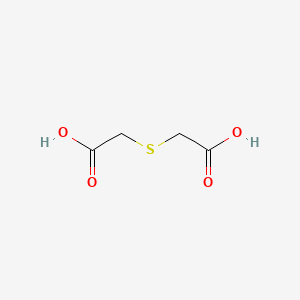
- IUPAC 名称
- 2-(carboxymethylsulfanyl)acetic acid
- 分子式
- C4H6O4S
- 分子量
- 150.16 g/mol
- 精确质量
- 149.99867984 Da
- XLogP3
- 0.1
- 拓扑极性表面积
- 99.9 Ų
- 氢键供体
- 2
- 氢键受体
- 5
- 共价单元
- 1
- 已定义的立体中心
- 0
又称
Thiodiacetic acidMercaptodiacetic acidTHIODIGLYCOLLIC ACIDTDGADicarboxymethyl sulfide2,2'-Thiodiglycolic acidAcetic acid, 2,2'-thiobis-USAF E-2
另有 16 个已报告名称
USAF CB-36(Carboxymethylthio)acetic acidAcetic acid, thiodi-2,2'-Thiodiethanoic acid2,2'-Thiobisacetic acid2-[(carboxymethyl)sulfanyl]acetic acidNSC-28743483M3RG5GWDimethylsulfide-alpha-alpha'-dicarboxylic acidCHEBI:350122-((carboxymethyl)sulfanyl)acetic acidRefChem:897791204-663-92,2'-Thiodiacetic acidThiodi(acetic acid)NSC 28743
外部数据库标识符
- ChEBI:CHEBI:35012
- ChEMBL:CHEMBL1570500
- EPA DTXSID:DTXSID1051432
- PubMed:22219769
- PubMed:21941408
- PubMed:21754589
- PubMed:21522378
- PubMed:21522233
- PubMed:21300029
- PubMed:21117655
- PubMed:19249916
- PubMed:19191966
- PubMed:19173086
- PubMed:16608215
- PubMed:16497089
来自其他科学数据库的证据
NIH PubChem PUG-View
标识符精确匹配31277
Attributed physical-property, hazard, environmental and use annotations.
- Color/Form: Crystals from water 来源: Hazardous Substances Data Bank (HSDB)
- Color/Form: A white powder or crystals from ethyl acetate/benzene 来源: Hazardous Substances Data Bank (HSDB)
- Color/Form: Colorless crystals 来源: Hazardous Substances Data Bank (HSDB)
- Melting Point: 129 °C 来源: Hazardous Substances Data Bank (HSDB)
- Melting Point: 129 °C 来源: Human Metabolome Database (HMDB)
- Physical Description: Colorless or white solid; [HSDB] Tan powder; [Alfa Aesar MSDS] 来源: Haz-Map, Information on Hazardous Chemicals and Occupational Diseases
- Physical Description: Solid 来源: Human Metabolome Database (HMDB)
- Solubility: Very soluble in ethanol, soluble in benzene 来源: Hazardous Substances Data Bank (HSDB)
- Solubility: In water, 4X10+5 mg/l @ 25 deg 来源: Hazardous Substances Data Bank (HSDB)
- Solubility: 400 mg/mL at 25 °C 来源: Human Metabolome Database (HMDB)
- Signal: Danger 来源: European Chemicals Agency (ECHA)
- GHS Hazard Statements: H314 (92.7%): Causes severe skin burns and eye damage [Danger Skin corrosion/irritation] 来源: European Chemicals Agency (ECHA)
- Precautionary Statement Codes: P260, P264, P280, P301+P330+P331, P302+P361+P354, P304+P340, P305+P354+P338, P316, P321, P363, P405, and P501 (click each P-code to see the statement) 来源: European Chemicals Agency (ECHA)
- ECHA C&L Notifications Summary: Aggregated GHS information provided per 110 reports by companies from 5 notifications to the ECHA C&L Inventory.; Information may vary between notifications depending on impurities, additives, and other factors. The percentage value in parenthesis indicates the notified classification ratio from companies that provide hazard codes. Only hazard codes with percentage values above 10% are shown. For more detailed information, please visit ECHA C&L website. 来源: European Chemicals Agency (ECHA)
- Environmental Bioconcentration: An estimated BCF of 3 was calculated for thiodiglycolic acid(SRC), using an estimated log Kow of -1.2(1) and a regression-derived equation(2). According to a classification scheme(3), this BCF suggests the potential for bioconcentration in aquatic organisms is low(SRC). 来源: Hazardous Substances Data Bank (HSDB)
- Environmental Fate: TERRESTRIAL FATE: Based on a classification scheme(1), an estimated Koc value of 12(SRC), determined from a structure estimation method(2), indicates that thiodiglycolic acid is expected to have very high mobility in soil(SRC). Volatilization of thiodiglycolic acid from moist soil surfaces is not expected to be an important fate process(SRC) given an estimated Henry's Law constant of 4.4X10⁻¹⁴ atm-cu m/mole(SRC), using a fragment constant estimation method(3). Thiodiglycolic acid is not expected to volatilize from dry soil surfaces(SRC) based upon an estimated vapor pressure of 5.5X10⁻⁵ mm Hg(SRC), determined from a fragment constant method(4). 来源: Hazardous Substances Data Bank (HSDB)
- Environmental Fate: AQUATIC FATE: Based on a classification scheme(1), an estimated Koc value of 12(SRC), determined from a structure estimation method(2), indicates that thiodiglycolic acid is not expected to adsorb to suspended solids and sediment(SRC). Volatilization from water surfaces is not expected(3) based upon an estimated Henry's Law constant of 4.4X10⁻¹⁴ atm-cu m/mole(SRC), developed using a fragment constant estimation method(4). The estimated pKa of thiodiglycolic acid is 3.4(5), indicating that this compound will partially exist in the dissociated form in the environment and anions generally do not adsorb more strongly to organic carbon and clay than their neutral counterparts(6). According to a classification scheme(7), an estimated BCF of 3(SRC), from an estimated log Kow of -1.2(SRC) and a regression-derived equation(8), suggests the potential for bioconcentration in aquatic organisms is low(SRC). Thiodiglycolic acid is stable to hydrolysis(9). 来源: Hazardous Substances Data Bank (HSDB)
- Environmental Fate: ATMOSPHERIC FATE: According to a model of gas/particle partitioning of semivolatile organic compounds in the atmosphere(1), thiodiglycolic acid, which has an estimated vapor pressure of 5.5X10⁻⁵ mm Hg at 25 °C(SRC), determined from a fragment constant method(2), will exist in both the vapor and particulate phases in the ambient atmosphere. Vapor-phase thiodiglycolic acid is degraded in the atmosphere by reaction with photochemically-produced hydroxyl radicals(SRC); the half-life for this reaction in air is estimated to be 28 hrs(SRC), calculated from its rate constant of 1.4X10⁻¹¹ cu cm/molecule-sec at 25 °C(SRC) that was derived using a structure estimation method(3). Particulate-phase thiodiglycolic acid may be removed from the air by wet and dry deposition(SRC). Thiodiglycolic acid is stable to photolysis(4). 来源: Hazardous Substances Data Bank (HSDB)
- Sources/Uses: Used for detection of copper, lead, mercury, and silver; A major metabolite of vinyl chloride monomer and ifosfamide (anti-cancer drug) in human urine; [HSDB] 来源: Haz-Map, Information on Hazardous Chemicals and Occupational Diseases
- Uses: Detection of copper, lead, mercury, silver. 来源: Hazardous Substances Data Bank (HSDB)
- Uses: Analytical reagent 来源: Hazardous Substances Data Bank (HSDB)
映射方: Existing checksum-valid CAS to unique PubChem CID match. 检索时间: 2026-08-31. 打开来源记录
科学分类和危害注释仅提供背景信息,不能取代上方所示针对具体市场的监管决定。
其他来源的覆盖范围和匹配状态
| 来源 | 结果 | 已检查 |
|---|---|---|
| NIH PubChem PUG-View | 精确匹配 | 2026-08-31 |
已记录的无匹配结果是该来源已被检查的有效证据;这并不表示该物质在别处不存在。
于 2026-08-31 通过校验和有效的 CAS 匹配从美国国立卫生研究院 (NIH) PubChem 检索。化学性质不能取代本页的监管决定。