
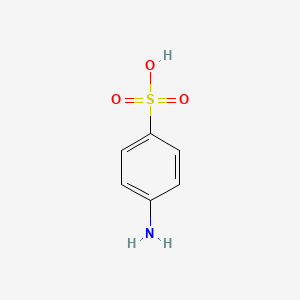
CAS 121-57-3PubChem CID 8479
Sulfanilic acid
4-aminobenzenesulfonic acid is an aminobenzenesulfonic acid that is aniline sulfonated at the para-position. It has a role as a xenobiotic, an allergen, a xenobiotic metabolite and an environmental contaminant. It is a conjugate acid of a 4-aminobenzenesulfonate. — ChEBI
- IUPAC 名称
- 4-aminobenzenesulfonic acid
- 分子式
- C6H7NO3S
- 分子量
- 173.19 g/mol
- 精确质量
- 173.01466426 Da
- XLogP3
- -0.6
- 拓扑极性表面积
- 88.8 Ų
- 氢键供体
- 2
- 氢键受体
- 4
- 共价单元
- 1
- 已定义的立体中心
- 0
又称
Sulphanilic acidp-Aminobenzenesulfonic acidAniline-4-sulfonic acidAniline-p-sulfonic acidSulfanilsaeureAniline-p-sulphonic acidp-Aminophenylsulfonic acidp-Anilinesulfonic acid
另有 16 个已报告名称
Kyselina sulfanilovap-sulfoaniline4-Sulfoaniline4-Sulfanilic acidNSC 7170CCRIS 4576CHEBI:27500HSDB 5590EINECS 204-482-51-aminobenzene-4-sulfonic acidAI3-15414UNII-434Z8C2635NSC-71704-aminophenylsulfonic acidp-aminobenzene sulfonic acid434Z8C2635
外部数据库标识符
- ChEBI:CHEBI:27500
- ChEMBL:CHEMBL1566888
- EPA DTXSID:DTXSID6024464
- PubMed:22798828
- PubMed:22750687
- PubMed:22719384
- PubMed:22706451
- PubMed:22701692
- PubMed:22666289
- PubMed:22609751
- PubMed:22586486
- PubMed:22579405
- PubMed:22574013
- PubMed:22567567
- PubMed:22558436
来自其他科学数据库的证据
NIH PubChem PUG-View
标识符精确匹配8479
Attributed physical-property, hazard, environmental and use annotations.
- Color/Form: Orthorhombic plates or monoclinic from water 来源: Hazardous Substances Data Bank (HSDB)
- Density: 1.485 at 77 °F (NTP, 1992) - Denser than water; will sink 来源: CAMEO Chemicals
- Density: 1.485 at 25 °C/4 °C 来源: Hazardous Substances Data Bank (HSDB)
- Density: 1.49 g/cm³ 来源: ILO-WHO International Chemical Safety Cards (ICSCs)
- Density: 1.485 @25 °C 来源: PAC Chemical Database, U.S. Department of Energy
- Dissociation Constants: pKa = 3.25 at 25 °C; pKa = 3.34 at 15 °C 来源: Hazardous Substances Data Bank (HSDB)
- LogP: log Kow = -2.16 来源: Hazardous Substances Data Bank (HSDB)
- LogP: -0.9 来源: ILO-WHO International Chemical Safety Cards (ICSCs)
- Melting Point: Decomposes without melting at 550 °F (NTP, 1992) 来源: CAMEO Chemicals
- Melting Point: 288 °C decomposes without melting 来源: Hazardous Substances Data Bank (HSDB)
- Physical Description: 4-aminobenzene sulfonic acid appears as white powder with faint purple tinge. Grayish-white flat crystals. Becomes anhydrous at around 212 °F. Low toxicity (used medicinally). 来源: CAMEO Chemicals
- Physical Description: Dry Powder 来源: EPA Chemical Data Reporting (CDR)
- Physical Description: Greyish-white solid; [Hawley] White to grey solid; [ICSC] Light grey fine crystals and fragments; [MSDSonline] 来源: Haz-Map, Information on Hazardous Chemicals and Occupational Diseases
- Physical Description: WHITE POWDER OR WHITE-TO-GREY CRYSTALS. 来源: ILO-WHO International Chemical Safety Cards (ICSCs)
- Solubility: less than 1 mg/mL at 68 °F (NTP, 1992) 来源: CAMEO Chemicals
- Solubility: Insoluble in ethanol and ether 来源: Hazardous Substances Data Bank (HSDB)
- Solubility: Soluble in fuming hydrochloric acid 来源: Hazardous Substances Data Bank (HSDB)
- Solubility: Slowly sol in water: about 1% at 20 °C, about 1.45% at 30 °C, about 1.94% at 40 °C 来源: Hazardous Substances Data Bank (HSDB)
- Solubility: In water, 10.68 g/L at 20 °C; 14.68 g/L at 30 °C 来源: Hazardous Substances Data Bank (HSDB)
- Solubility: Solubility in water: poor 来源: ILO-WHO International Chemical Safety Cards (ICSCs)
- Vapor Pressure: 0.0000002 [mmHg] 来源: Haz-Map, Information on Hazardous Chemicals and Occupational Diseases
- First Aid: EYES: First check the victim for contact lenses and remove if present. Flush victim's eyes with water or normal saline solution for 20 to 30 minutes while simultaneously calling a hospital or poison control center. Do not put any ointments, oils, or medication in the victim's eyes without specific instructions from a physician. IMMEDIATELY transport the victim after flushing eyes to a hospital even if no symptoms (such as redness or irritation) develop.; SKIN: IMMEDIATELY flood affected skin with water while removing and isolating all contaminated clothing. Gently wash all affected skin areas thoroughly with soap and water. If symptoms such as redness or irritation develop, IMMEDIATELY call a physician and be prepared to transport the victim to a hospital for treatment.; INHALATION: IMMEDIATELY leave the contaminated area; take deep breaths of fresh air. If symptoms (such as wheezing, coughing, shortness of breath, or burning in the mouth, throat, or chest) develop, call a physician and be prepared to transport the victim to a hospital. Provide proper respiratory protection to rescuers entering an unknown atmosphere. Whenever possible, Self-Contained Breathing Apparatus (SCBA) shou 来源: CAMEO Chemicals
- Signal: Warning 来源: Regulation (EC) No 1272/2008 of the European Parliament and of the Council
- GHS Hazard Statements: H315: Causes skin irritation [Warning Skin corrosion/irritation]; H317: May cause an allergic skin reaction [Warning Sensitization, Skin]; H319: Causes serious eye irritation [Warning Serious eye damage/eye irritation] 来源: Regulation (EC) No 1272/2008 of the European Parliament and of the Council
- Precautionary Statement Codes: P261, P264, P264+P265, P272, P280, P302+P352, P305+P351+P338, P321, P332+P317, P333+P317, P337+P317, P362+P364, and P501 (click each P-code to see the statement) 来源: Regulation (EC) No 1272/2008 of the European Parliament and of the Council
- Signal: Warning 来源: European Chemicals Agency (ECHA)
- GHS Hazard Statements: H315 (98.6%): Causes skin irritation [Warning Skin corrosion/irritation]; H317 (98.6%): May cause an allergic skin reaction [Warning Sensitization, Skin]; H319 (99.8%): Causes serious eye irritation [Warning Serious eye damage/eye irritation] 来源: European Chemicals Agency (ECHA)
- Precautionary Statement Codes: P261, P264, P264+P265, P272, P280, P302+P352, P305+P351+P338, P321, P332+P317, P333+P317, P337+P317, P362+P364, and P501 (click each P-code to see the statement) 来源: European Chemicals Agency (ECHA)
- ECHA C&L Notifications Summary: Aggregated GHS information provided per 442 reports by companies from 9 notifications to the ECHA C&L Inventory. Each notification may be associated with multiple companies.; Information may vary between notifications depending on impurities, additives, and other factors. The percentage value in parenthesis indicates the notified classification ratio from companies that provide hazard codes. Only hazard codes with percentage values above 10% are shown. For more detailed information, please visit ECHA C&L website. 来源: European Chemicals Agency (ECHA)
- GHS Hazard Statements: Not Classified 来源: NITE-CMC
- Signal: Warning 来源: NITE-CMC
- GHS Hazard Statements: H317: May cause an allergic skin reaction [Warning Sensitization, Skin]; H319: Causes serious eye irritation [Warning Serious eye damage/eye irritation] 来源: NITE-CMC
- Precautionary Statement Codes: P261, P264+P265, P272, P280, P302+P352, P305+P351+P338, P321, P333+P317, P337+P317, P362+P364, and P501 (click each P-code to see the statement) 来源: NITE-CMC
- Signal: Warning 来源: Hazardous Chemical Information System (HCIS), Safe Work Australia
- Environmental Bioconcentration: An estimated BCF of 3 was calculated in fish for sulfanilic acid(SRC), using a log Kow of -2.16(1) and a regression-derived equation(2). According to a classification scheme(3), this BCF suggests the potential for bioconcentration in aquatic organisms is low(SRC). 来源: Hazardous Substances Data Bank (HSDB)
- Environmental Fate: TERRESTRIAL FATE: Based on a classification scheme(1), an estimated Koc value of 10(SRC), determined from a structure estimation method(2), indicates that sulfanilic acid is expected to have very high mobility in soil(SRC). The pKa of sulfanilic acid is 3.25 at 25 °C(3), indicating that this compound will partially exist in anion form in the environment and anions generally do not adsorb more strongly to soils containing organic carbon and clay than their neutral counterparts(4). Volatilization of sulfanilic acid from moist soil surfaces is not expected to be an important fate process(SRC) given an estimated Henry's Law constant of 8.9X10⁻¹³ atm-cu m/mole(SRC), using a fragment constant estimation method(2). Sulfanilic acid is not expected to volatilize from dry soil surfaces(SRC) based upon an estimated vapor pressure of 1X10⁻⁹ mm Hg at 25 °C(SRC), determined from a fragment constant method(2). Based on results of the majority of eight separate laboratory determinations, it can be concluded that sulfanilic acid is not readily biodegradable(5). Sulfanilic acid, present at 100 mg/L, reached 8% of its theoretical BOD in 2 weeks using an activated sludge inoculum at 30 mg/L in the Jap 来源: Hazardous Substances Data Bank (HSDB)
- Environmental Fate: AQUATIC FATE: Based on a classification scheme(1), an estimated Koc value of 10(SRC), determined from a structure estimation method(2), indicates that sulfanilic acid is not expected to adsorb to suspended solids and sediment(SRC). Volatilization from water surfaces is not expected(3) based upon an estimated Henry's Law constant of 8.9X10⁻¹³ atm-cu m/mole(SRC), developed using a fragment constant estimation method(2). According to a classification scheme(4), an estimated BCF of 3(SRC), from a log Kow of -2.16(5) and a regression-derived equation(2), suggests the potential for bioconcentration in aquatic organisms is low(SRC). Sulfanilic acid absorbs UV light at wavelengths >290 nm(6) and may be susceptible to direct photolysis in sunlit water(SRC). Based on results of the majority of eight separate laboratory determinations, it can be concluded that sulfanilic acid is not readily biodegradable(7). Sulfanilic acid, present at 100 mg/L, reached 8% of its theoretical BOD in 2 weeks using an activated sludge inoculum at 30 mg/L in the Japanese MITI test(8) which also indicates the compound is not readily biodegradable(SRC). 来源: Hazardous Substances Data Bank (HSDB)
- Environmental Fate: ATMOSPHERIC FATE: According to a model of gas/particle partitioning of semivolatile organic compounds in the atmosphere(1), sulfanilic acid, which has an estimated vapor pressure of 1X10⁻⁹ mm Hg at 25 °C(SRC), determined from a fragment constant method(2), is expected to exist solely in the particulate phase in the ambient atmosphere. Particulate-phase sulfanilic acid may be removed from the air by wet or dry deposition(SRC). Sulfanilic acid absorbs UV light at wavelengths >290 nm(3), and therefore may be susceptible to direct photolysis by sunlight(SRC). 来源: Hazardous Substances Data Bank (HSDB)
- Industry Uses: Intermediate; Plasticizer; Brightener 来源: EPA Chemical Data Reporting (CDR)
- Sources/Uses: Used to make dyes and other organic chemicals; Also used as an analytical reagent (Ehrlich's reagent and determination of nitrites) and antibacterial; [Merck Index] Used in the paper, pulp, board, and polymer industries; Used as an additive to construction materials and foodstuffs; [IUCLID] 来源: Haz-Map, Information on Hazardous Chemicals and Occupational Diseases
- Industrial Processes with risk of exposure: Pulp and Paper Processing [Category: Industry] 来源: Haz-Map, Information on Hazardous Chemicals and Occupational Diseases
- Uses: Manufacture of various dyes and organic chemicals; as reagent in analytical chemistry (Ehrlich's reagent, determination of nitrites) 来源: Hazardous Substances Data Bank (HSDB)
- Uses: Intermediate in the production of dyes, pesticides, pharmaceuticals. 来源: Hazardous Substances Data Bank (HSDB)
- Uses: CHEM INT FOR DYES (ESP AZO DYES), EG, C.I. ACID ORANGE 24 来源: Hazardous Substances Data Bank (HSDB)
- Uses: CHEM INT FOR ANALGESICS AND OTHER ORG CHEMS 来源: Hazardous Substances Data Bank (HSDB)
- Uses: For more Uses (Complete) data for SULFANILIC ACID (6 total), please visit the HSDB record page. 来源: Hazardous Substances Data Bank (HSDB)
- Uses: Substance listed with specific concentration in tattoo ink and/or permanent make up according to EU Commission Regulation 2020/2081. The concentration limit (by weight) is 0.0005%. 来源: NORMAN Suspect List Exchange
映射方: Existing checksum-valid CAS to unique PubChem CID match. 检索时间: 2026-08-31. 打开来源记录
科学分类和危害注释仅提供背景信息,不能取代上方所示针对具体市场的监管决定。
其他来源的覆盖范围和匹配状态
| 来源 | 结果 | 已检查 |
|---|---|---|
| NIH PubChem PUG-View | 精确匹配 | 2026-08-31 |
已记录的无匹配结果是该来源已被检查的有效证据;这并不表示该物质在别处不存在。
于 2026-08-31 通过校验和有效的 CAS 匹配从美国国立卫生研究院 (NIH) PubChem 检索。化学性质不能取代本页的监管决定。