
CAS 121-44-8PubChem CID 8471
Triethylamine
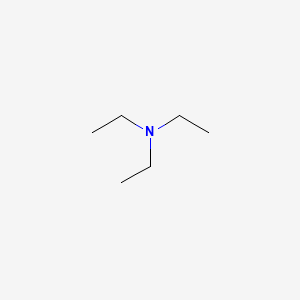
Triethylamine is a tertiary amine that is ammonia in which each hydrogen atom is substituted by an ethyl group. — ChEBI
- IUPAC 名称
- N,N-diethylethanamine
- 分子式
- C6H15N
- 分子量
- 101.19 g/mol
- 精确质量
- 101.120449483 Da
- XLogP3
- 1.4
- 拓扑极性表面积
- 3.2 Ų
- 氢键供体
- 0
- 氢键受体
- 1
- 共价单元
- 1
- 已定义的立体中心
- 0
又称
(Diethylamino)ethaneEthanamine, N,N-diethyl-TriaethylaminTrietilaminaVOU728O6AYTEN [Base]FEMA NO. 4246CHEBI:35026
另有 16 个已报告名称
TEN (Base)RefChem:899489204-469-4triethyl amineTriethylaminN,N,N-TriethylamineNEt3trietylaminetri-ethyl amine(C2H5)3NN,N-diethyl-ethanamineethane, diethylamino-SCHEMBL30DiethylaminoethaneTriethylamine, >=99.5%Triaethylamin [German]
外部数据库标识符
- ChEBI:CHEBI:35026
- ChEMBL:CHEMBL284057
- EPA DTXSID:DTXSID3024366
- PubMed:23124566
- PubMed:23112409
- PubMed:23079493
- PubMed:23074886
- PubMed:23030392
- PubMed:23023604
- PubMed:23011277
- PubMed:22999478
- PubMed:22991695
- PubMed:22969445
- PubMed:22963600
- PubMed:22963285
来自其他科学数据库的证据
NIH PubChem PUG-View
标识符精确匹配8471
Attributed physical-property, hazard, environmental and use annotations.
- Autoignition Temperature: 842 °F (USCG, 1999) 来源: CAMEO Chemicals
- Autoignition Temperature: 480 °F (249 °C) 来源: Hazardous Substances Data Bank (HSDB)
- Autoignition Temperature: 230 °C 来源: ILO-WHO International Chemical Safety Cards (ICSCs)
- Boiling Point: 192.7 °F at 760 mmHg (NTP, 1992) 来源: CAMEO Chemicals
- Boiling Point: 88.8 °C 来源: Hazardous Substances Data Bank (HSDB)
- Boiling Point: 88.80 to 89.00 °C. @ 760.00 mm Hg 来源: Human Metabolome Database (HMDB)
- Boiling Point: 89 °C 来源: ILO-WHO International Chemical Safety Cards (ICSCs)
- Boiling Point: 88 °C 来源: Joint FAO/WHO Expert Committee on Food Additives (JECFA)
- Boiling Point: 193 °F 来源: Occupational Safety and Health Administration (OSHA)
- Boiling Point: 89.5 °C @760 [mm Hg] 来源: PAC Chemical Database, U.S. Department of Energy
- Boiling Point: 193 °F 来源: The National Institute for Occupational Safety and Health (NIOSH)
- Color/Form: Colorless liquid 来源: Hazardous Substances Data Bank (HSDB)
- Density: 0.729 at 68 °F (USCG, 1999) - Less dense than water; will float 来源: CAMEO Chemicals
- Density: 0.7275 g/cu cm at 20 °C 来源: Hazardous Substances Data Bank (HSDB)
- Density: Bulk density: 6.1 lb/gal 来源: Hazardous Substances Data Bank (HSDB)
- Density: Saturated liquid density: 45.420 lb/cu ft; liquid heat capacity: 0.556 Btu/lb °F; saturated vapor pressure: 1.084 lb/sq in; saturated vapor density: 0.01930 lb/cu ft (all at 70 °F) 来源: Hazardous Substances Data Bank (HSDB)
- Density: Relative density (water = 1): 0.7 来源: ILO-WHO International Chemical Safety Cards (ICSCs)
- Density: 0.724-0.730 来源: Joint FAO/WHO Expert Committee on Food Additives (JECFA)
- Density: 0.73 来源: Occupational Safety and Health Administration (OSHA)
- Density: 0.7255 @25 °C 来源: PAC Chemical Database, U.S. Department of Energy
- Density: 0.73 来源: The National Institute for Occupational Safety and Health (NIOSH)
- Basic pKa: 10.9 来源: ChEMBL
- Dissociation Constants: pKb = 3.25 来源: Hazardous Substances Data Bank (HSDB)
- Dissociation Constants: pKa = 10.78 at 25 °C 来源: Hazardous Substances Data Bank (HSDB)
- Flash Point: 20 °F (NTP, 1992) 来源: CAMEO Chemicals
- Flash Point: -7 °C 来源: Haz-Map, Information on Hazardous Chemicals and Occupational Diseases
- Flash Point: -15 °C (5 °F) - closed cup 来源: Hazardous Substances Data Bank (HSDB)
- Flash Point: 16 °F (-7 °F) (open cup) 来源: Hazardous Substances Data Bank (HSDB)
- Flash Point: -17 °C c.c. 来源: ILO-WHO International Chemical Safety Cards (ICSCs)
- Flash Point: 20 °F 来源: Occupational Safety and Health Administration (OSHA)
- Flash Point: 20 °F 来源: The National Institute for Occupational Safety and Health (NIOSH)
- LogP: log Kow = 1.45 来源: Hazardous Substances Data Bank (HSDB)
- LogP: 1.45 来源: Human Metabolome Database (HMDB)
- LogP: 1.45 来源: ILO-WHO International Chemical Safety Cards (ICSCs)
- Melting Point: -174.5 °F (NTP, 1992) 来源: CAMEO Chemicals
- Melting Point: -114.7 °C 来源: Hazardous Substances Data Bank (HSDB)
- Melting Point: -114.7 °C 来源: Human Metabolome Database (HMDB)
- Melting Point: -115 °C 来源: ILO-WHO International Chemical Safety Cards (ICSCs)
- Melting Point: -175 °F 来源: Occupational Safety and Health Administration (OSHA)
- Melting Point: -114.8 °C 来源: PAC Chemical Database, U.S. Department of Energy
- Melting Point: -175 °F 来源: The National Institute for Occupational Safety and Health (NIOSH)
- Odor: Strong, ammoniacal ordor 来源: Hazardous Substances Data Bank (HSDB)
- Odor: Fishy 来源: Hazardous Substances Data Bank (HSDB)
- Physical Description: Triethylamine appears as a clear colorless liquid with a strong ammonia to fish-like odor. Flash point 20 °F. Vapors irritate the eyes and mucous membranes. Less dense (6.1 lb / gal) than water. Vapors heavier than air. Produces toxic oxides of nitrogen when burned. 来源: CAMEO Chemicals
- Physical Description: Liquid; CBI 来源: EPA Chemical Data Reporting (CDR)
- Physical Description: Colorless liquid with a strong, ammonia-like odor; [NIOSH] 来源: Haz-Map, Information on Hazardous Chemicals and Occupational Diseases
- Physical Description: Liquid 来源: Human Metabolome Database (HMDB)
- Physical Description: COLOURLESS LIQUID WITH CHARACTERISTIC ODOUR. 来源: ILO-WHO International Chemical Safety Cards (ICSCs)
- Physical Description: Colourless to yellowish liquid; Fishy aroma 来源: Joint FAO/WHO Expert Committee on Food Additives (JECFA)
- Physical Description: Colorless liquid with a strong, ammonia-like odor. 来源: Occupational Safety and Health Administration (OSHA)
- Physical Description: Colorless liquid with a strong, ammonia-like odor. 来源: The National Institute for Occupational Safety and Health (NIOSH)
- Refractive Index: Index of refraction: 1.4003 at 20 °C/D 来源: Hazardous Substances Data Bank (HSDB)
- Refractive Index: 1.395-1.401 来源: Joint FAO/WHO Expert Committee on Food Additives (JECFA)
- Solubility: Soluble (NTP, 1992) 来源: CAMEO Chemicals
- Solubility: In water, 6.86X10+4 mg/L at 25 °C 来源: Hazardous Substances Data Bank (HSDB)
- Solubility: Miscible with water below 18.7 °C 来源: Hazardous Substances Data Bank (HSDB)
- Solubility: Soluble in ethanol, carbon tetrachloride, ethyl ether; very soluble in acetone, benzene, chloroform 来源: Hazardous Substances Data Bank (HSDB)
- Solubility: Soluble in fixed oils, mineral oil, oleic and stearic acids and in hot carnauba and paraffin waxes. 来源: Hazardous Substances Data Bank (HSDB)
- Solubility: For more Solubility (Complete) data for TRIETHYLAMINE (6 total), please visit the HSDB record page. 来源: Hazardous Substances Data Bank (HSDB)
- Solubility: 68.6 mg/mL at 25 °C 来源: Human Metabolome Database (HMDB)
- Solubility: Solubility in water, g/100ml at 20 °C: 17 (good) 来源: ILO-WHO International Chemical Safety Cards (ICSCs)
- Solubility: Soluble in water 来源: Joint FAO/WHO Expert Committee on Food Additives (JECFA)
- Solubility: Soluble (in ethanol) 来源: Joint FAO/WHO Expert Committee on Food Additives (JECFA)
- Solubility: 2% 来源: The National Institute for Occupational Safety and Health (NIOSH)
- Vapor Pressure: 53.5 mmHg (NTP, 1992) 来源: CAMEO Chemicals
- Vapor Pressure: 57.07 [mmHg] 来源: Haz-Map, Information on Hazardous Chemicals and Occupational Diseases
- Vapor Pressure: 57.07 mm Hg at 25 °C 来源: Hazardous Substances Data Bank (HSDB)
- Vapor Pressure: Vapor pressure, kPa at 20 °C: 7.2 来源: ILO-WHO International Chemical Safety Cards (ICSCs)
- Vapor Pressure: 54 mmHg 来源: Occupational Safety and Health Administration (OSHA)
- Vapor Pressure: 54 mmHg 来源: The National Institute for Occupational Safety and Health (NIOSH)
- Viscosity: 0.347 mPa.s at 25 °C 来源: Hazardous Substances Data Bank (HSDB)
- Exposure Routes: The substance can be absorbed into the body by inhalation, through the skin and by ingestion. 来源: ILO-WHO International Chemical Safety Cards (ICSCs)
- Exposure Routes: inhalation, skin absorption, ingestion, skin and/or eye contact 来源: The National Institute for Occupational Safety and Health (NIOSH)
- First Aid: EYES: First check the victim for contact lenses and remove if present. Flush victim's eyes with water or normal saline solution for 20 to 30 minutes while simultaneously calling a hospital or poison control center. Do not put any ointments, oils, or medication in the victim's eyes without specific instructions from a physician. IMMEDIATELY transport the victim after flushing eyes to a hospital even if no symptoms (such as redness or irritation) develop.; SKIN: IMMEDIATELY flood affected skin with water while removing and isolating all contaminated clothing. Gently wash all affected skin areas thoroughly with soap and water. IMMEDIATELY call a hospital or poison control center even if no symptoms (such as redness or irritation) develop. IMMEDIATELY transport the victim to a hospital for treatment after washing the affected areas.; INHALATION: IMMEDIATELY leave the contaminated area; take deep breaths of fresh air. If symptoms (such as wheezing, coughing, shortness of breath, or burning in the mouth, throat, or chest) develop, call a physician and be prepared to transport the victim to a hospital. Provide proper respiratory protection to rescuers entering an unknown atmosphere. Whene 来源: CAMEO Chemicals
- ERG2024, Guide 132 (Triethylamine): General First Aid:; · Call 911 or emergency medical service.; · Ensure that medical personnel are aware of the material(s) involved, take precautions to protect themselves and avoid contamination.; · Move victim to fresh air if it can be done safely.; · Administer oxygen if breathing is difficult.; · If victim is not breathing:; -- DO NOT perform mouth-to-mouth resuscitation; the victim may have ingested or inhaled the substance.; -- If equipped and pulse detected, wash face and mouth, then give artificial respiration using a proper respiratory medical device (bag-valve mask, pocket mask equipped with a one-way valve or other device).; -- If no pulse detected or no respiratory medical device available, provide continuous compressions. Conduct a pulse check every two minutes or monitor for any signs of spontaneous respirations.; · Remove and isolate contaminated clothing and shoes.; · For minor skin contact, avoid spreading material on unaffected skin.; · In case of contact with substance, remove immediately by flushing skin or eyes with running water for at least 20 minutes.; · For severe burns, immediate medical attention is required.; · Effects of exposure (inhalation, ingestion, 来源: Emergency Response Guidebook (ERG)
- First Aid: (General first aid procedures); Eye: Irrigate immediately - If this chemical contacts the eyes, immediately wash (irrigate) the eyes with large amounts of water, occasionally lifting the lower and upper lids. Get medical attention immediately.; Skin: Soap wash immediately - If this chemical contacts the skin, immediately wash the contaminated skin with soap and water. If this chemical penetrates the clothing, immediately remove the clothing, wash the skin with soap and water, and get medical attention promptly.; Breathing: Respiratory support; Swallow: Medical attention immediately - If this chemical has been swallowed, get medical attention immediately. 来源: The National Institute for Occupational Safety and Health (NIOSH)
- Signal: Danger 来源: Regulation (EC) No 1272/2008 of the European Parliament and of the Council
- GHS Hazard Statements: H225: Highly Flammable liquid and vapor [Danger Flammable liquids]; H301: Toxic if swallowed [Danger Acute toxicity, oral]; H311: Toxic in contact with skin [Danger Acute toxicity, dermal]; H314: Causes severe skin burns and eye damage [Danger Skin corrosion/irritation]; H318: Causes serious eye damage [Danger Serious eye damage/eye irritation]; H331: Toxic if inhaled [Danger Acute toxicity, inhalation] 来源: Regulation (EC) No 1272/2008 of the European Parliament and of the Council
- Precautionary Statement Codes: P210, P233, P240, P241, P242, P243, P260, P261, P262, P264, P264+P265, P270, P271, P280, P301+P316, P301+P330+P331, P302+P352, P302+P361+P354, P303+P361+P353, P304+P340, P305+P354+P338, P316, P317, P321, P330, P361+P364, P363, P370+P378, P403+P233, P403+P235, P405, and P501 (click each P-code to see the statement) 来源: Regulation (EC) No 1272/2008 of the European Parliament and of the Council
- Note: This chemical does not meet GHS hazard criteria for < 0.1% (2 of 5716) of reports. 来源: European Chemicals Agency (ECHA)
- Signal: Danger 来源: European Chemicals Agency (ECHA)
- GHS Hazard Statements: H225 (> 99.9%): Highly Flammable liquid and vapor [Danger Flammable liquids]; H302 (97.5%): Harmful if swallowed [Warning Acute toxicity, oral]; H311 (47.5%): Toxic in contact with skin [Danger Acute toxicity, dermal]; H312 (52.5%): Harmful in contact with skin [Warning Acute toxicity, dermal]; H314 (> 99.9%): Causes severe skin burns and eye damage [Danger Skin corrosion/irritation]; H318 (45.2%): Causes serious eye damage [Danger Serious eye damage/eye irritation]; H331 (46.5%): Toxic if inhaled [Danger Acute toxicity, inhalation]; H332 (52.6%): Harmful if inhaled [Warning Acute toxicity, inhalation]; H335 (47.4%): May cause respiratory irritation [Warning Specific target organ toxicity, single exposure; Respiratory tract irritation] 来源: European Chemicals Agency (ECHA)
- Precautionary Statement Codes: P210, P233, P240, P241, P242, P243, P260, P261, P262, P264, P264+P265, P270, P271, P280, P301+P317, P301+P330+P331, P302+P352, P302+P361+P354, P303+P361+P353, P304+P340, P305+P354+P338, P316, P317, P319, P321, P330, P361+P364, P362+P364, P363, P370+P378, P403+P233, P403+P235, P405, and P501 (click each P-code to see the statement) 来源: European Chemicals Agency (ECHA)
- ECHA C&L Notifications Summary: Aggregated GHS information provided per 5716 reports by companies from 76 notifications to the ECHA C&L Inventory. Each notification may be associated with multiple companies.; Reported as not meeting GHS hazard criteria per 2 of 5716 reports by companies.; There are 75 notifications provided by 5714 of 5716 reports by companies with hazard statement code(s).; Information may vary between notifications depending on impurities, additives, and other factors. The percentage value in parenthesis indicates the notified classification ratio from companies that provide hazard codes. Only hazard codes with percentage values above 10% are shown. For more detailed information, please visit ECHA C&L website. 来源: European Chemicals Agency (ECHA)
- Signal: Danger 来源: NITE-CMC
- GHS Hazard Statements: H225: Highly Flammable liquid and vapor [Danger Flammable liquids]; H302: Harmful if swallowed [Warning Acute toxicity, oral]; H311: Toxic in contact with skin [Danger Acute toxicity, dermal]; H314: Causes severe skin burns and eye damage [Danger Skin corrosion/irritation]; H318: Causes serious eye damage [Danger Serious eye damage/eye irritation]; H332: Harmful if inhaled [Warning Acute toxicity, inhalation]; H335: May cause respiratory irritation [Warning Specific target organ toxicity, single exposure; Respiratory tract irritation]; H370: Causes damage to organs [Danger Specific target organ toxicity, single exposure]; H373: May causes damage to organs through prolonged or repeated exposure [Warning Specific target organ toxicity, repeated exposure]; H401: Toxic to aquatic life [Hazardous to the aquatic environment, acute hazard]; H412: Harmful to aquatic life with long lasting effects [Hazardous to the aquatic environment, long-term hazard] 来源: NITE-CMC
- Precautionary Statement Codes: P210, P233, P240, P241, P242, P243, P260, P261, P262, P264, P264+P265, P270, P271, P273, P280, P301+P317, P301+P330+P331, P302+P352, P302+P361+P354, P303+P361+P353, P304+P340, P305+P354+P338, P308+P316, P316, P317, P319, P321, P330, P361+P364, P363, P370+P378, P403+P233, P403+P235, P405, and P501 (click each P-code to see the statement) 来源: NITE-CMC
- GHS Hazard Statements: H225: Highly Flammable liquid and vapor [Danger Flammable liquids]; H302: Harmful if swallowed [Warning Acute toxicity, oral]; H311: Toxic in contact with skin [Danger Acute toxicity, dermal]; H314: Causes severe skin burns and eye damage [Danger Skin corrosion/irritation]; H318: Causes serious eye damage [Danger Serious eye damage/eye irritation]; H331: Toxic if inhaled [Danger Acute toxicity, inhalation]; H370: Causes damage to organs [Danger Specific target organ toxicity, single exposure]; H372: Causes damage to organs through prolonged or repeated exposure [Danger Specific target organ toxicity, repeated exposure] 来源: NITE-CMC
- NFPA Health Rating: 3 - Materials that, under emergency conditions, can cause serious or permanent injury. 来源: Hazardous Substances Data Bank (HSDB)
- NFPA Fire Rating: 3 - Liquids and solids that can be ignited under almost all ambient temperature conditions. Materials produce hazardous atmospheres with air under almost all ambient temperatures or, though unaffected by ambient temperatures, are readily ignited under almost all conditions. 来源: Hazardous Substances Data Bank (HSDB)
- NFPA Instability Rating: 0 - Materials that in themselves are normally stable, even under fire conditions. 来源: Hazardous Substances Data Bank (HSDB)
- Target Organs: Respiratory 来源: EPA Integrated Risk Information System (IRIS)
- Target Organs: Eyes, skin, respiratory system, cardiovascular system, liver, kidneys 来源: The National Institute for Occupational Safety and Health (NIOSH)
- Toxicity Summary: IDENTIFICATION AND USE: Triethylamine (TEA) is a colorless liquid. It is used as catalytic solvent in chemical synthesis; accelerator activators for rubber; wetting, penetrating, and waterproofing agents of quaternary ammonium types; curing and hardening of polymers; corrosion inhibitor; propellant. HUMAN EXPOSURE AND TOXICITY: Aside from irritation of the eyes and respiratory tract, triethylamine also stimulates the central nervous system, because it inhibits monamine oxidase. Experimental studies were conducted in four healthy men on the metabolism of inhaled TEA (20 mg/cu m) with and without ethanol ingestion. Three subjects displayed visual disturbances in the experiments without ethanol. These same subjects did not experience any visual disturbances in those experiments containing ethanol. In another study, four hour exposure to a TEA concentration of 3.0 mg/cu m seemed to cause no effects, whereas exposure to 6.5 mg/cu m for the same period caused blurred vision and a decrease in contrast sensitivity. Two volunteers were exposed to various airborne concentrations of triethylamine. Levels of 18 mg/cu m for eight hours caused subjective visual disturbances (haze and halos) and 来源: Hazardous Substances Data Bank (HSDB)
- Environmental Bioconcentration: Measured BCF values of <0.5 and <4.9 were reported in carp (Cyprinus carpio; lipid content, 3.9%), exposed to triethylamine at 0.5 and 0.05 mg/L, respectively, over a 6-week period(1). According to a classification scheme(2), these BCFs suggest the potential for bioconcentration in aquatic organisms is low(SRC). 来源: Hazardous Substances Data Bank (HSDB)
- Environmental Fate: TERRESTRIAL FATE: Based on a classification scheme(1), an estimated Koc value of 51(SRC), determined from a structure estimation method(2), indicates that triethylamine is expected to have high mobility in soil(SRC). The pKa of triethylamine is 10.78(3), indicating that this compound will exist almost entirely in cation form in the environment and cations generally adsorb more strongly to soils containing organic carbon and clay than their neutral counterparts(4). Volatilization of the cation from moist soil is not expected because cations do not volatilize(SRC). Triethylamine is expected to volatilize from dry soil surfaces(SRC) based upon a vapor pressure of 57.07 mm Hg at 25 °C(3). A 28% of Theoretical BOD using activated sludge in the Japanese MITI test(5) suggests that biodegradation may be an important environmental fate process in soil(SRC). 来源: Hazardous Substances Data Bank (HSDB)
- Environmental Fate: AQUATIC FATE: Based on a classification scheme(1), an estimated Koc value of 51(SRC), determined from a structure estimation method(2), indicates that triethylamine is not expected to adsorb to suspended solids and sediment(SRC). Volatilization from water surfaces is not expected based upon a pKa of 10.78(3), indicating that triethylamine will exist almost entirely in the cation form and cations do not volatilize(SRC). Triethylamine is not expected to undergo hydrolysis in the environment due to the lack of functional groups that hydrolyze under environmental conditions(4). According to a classification scheme(5), BCFs of <4.9(6), suggest bioconcentration in aquatic organisms is low. Triethylamine present at 100 mg/L, reached 28% of its theoretical BOD in 4 weeks using an activated sludge inoculum at 30 mg/L and the Japanese MITI test(6). 来源: Hazardous Substances Data Bank (HSDB)
- Environmental Fate: ATMOSPHERIC FATE: According to a model of gas/particle partitioning of semivolatile organic compounds in the atmosphere(1), triethylamine, which has a vapor pressure of 57.07 mm Hg at 25 °C(2), is expected to exist solely as a vapor in the ambient atmosphere. Vapor-phase triethylamine is degraded in the atmosphere by reaction with photochemically-produced hydroxyl radicals(SRC); the half-life for this reaction in air is estimated to be 4.2 hours(SRC), calculated from its rate constant of 9.3X10⁻¹¹ cu cm/molecule-sec at 25 °C(SRC) that was derived using a structure estimation method(3). Triethylamine does not contain chromophores that absorb at wavelengths >290 nm(4) and, therefore, is not expected to be susceptible to direct photolysis by sunlight(SRC). 来源: Hazardous Substances Data Bank (HSDB)
- Consumer Uses: Not Known or Reasonably Ascertainable; Intermediate; Semiconductor and photovoltaic agent 来源: EPA Chemical Data Reporting (CDR)
- Industry Uses: Solvent; pH regulating agent; Semiconductor and photovoltaic agent; Not Known or Reasonably Ascertainable; Cleaning agent; Intermediate 来源: EPA Chemical Data Reporting (CDR)
- Uses: Triethylamine is used as a catalytic solvent in chemical syntheses; as an accelerator activator for rubber; as a corrosion inhibitor; as a curing and hardening agent for polymers; as a propellant; in the manufacture of wetting, penetrating, and waterproofing agents of quaternary ammonium compounds; and for the desalination of seawater. 来源: EPA Hazardous Air Pollutants
- Sources/Uses: Used as a catalyst for polyurethane foams, an accelerator for rubber, and a curing agent for amino and epoxy resins; (HSDB) Used as an accelerator in photography development; [ILO Encyclo: Amines, Aliphatic] Used to make quaternary ammonium compounds and as a catalyst to make sand-based cores and molds; [ACGIH] 来源: Haz-Map, Information on Hazardous Chemicals and Occupational Diseases
- Industrial Processes with risk of exposure: Molding and Core Making [Category: Foundry]; Plastic Composites Manufacturing [Category: Industry]; Photographic Processing [Category: Other] 来源: Haz-Map, Information on Hazardous Chemicals and Occupational Diseases
- Uses: CHEMICAL INTERMEDIATE; ANTI-LIVERING AGENT FOR UREA & MELAMINE BASED ENAMELS; RECOVERY OF GELLED PAINT VEHICLES; CATALYST FOR POLYURETHANE FOAMS; FLUX FOR COPPER SOLDERING 来源: Hazardous Substances Data Bank (HSDB)
- Uses: Catalytic solvent in chemical synthesis; accelerator activators for rubber; wetting, penetrating, and waterproofing agents of quaternary ammonium types; curing and hardening of polymers (e.g., core-binding resins); corrosion inhibitor; propellant. 来源: Hazardous Substances Data Bank (HSDB)
- Uses: Catalyst for epoxy resins 来源: Hazardous Substances Data Bank (HSDB)
- Uses: Manufacture of ... dyestuffs 来源: Hazardous Substances Data Bank (HSDB)
- Uses: For more Uses (Complete) data for TRIETHYLAMINE (8 total), please visit the HSDB record page. 来源: Hazardous Substances Data Bank (HSDB)
映射方: Existing checksum-valid CAS to unique PubChem CID match. 检索时间: 2026-08-31. 打开来源记录
科学分类和危害注释仅提供背景信息,不能取代上方所示针对具体市场的监管决定。
其他来源的覆盖范围和匹配状态
| 来源 | 结果 | 已检查 |
|---|---|---|
| NIH PubChem PUG-View | 精确匹配 | 2026-08-31 |
已记录的无匹配结果是该来源已被检查的有效证据;这并不表示该物质在别处不存在。
于 2026-08-31 通过校验和有效的 CAS 匹配从美国国立卫生研究院 (NIH) PubChem 检索。化学性质不能取代本页的监管决定。