
CAS 121-14-2PubChem CID 8461
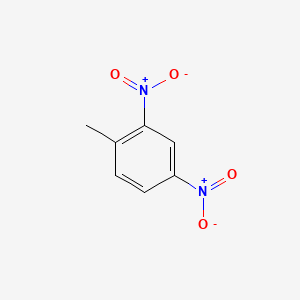
2,4-Dinitrotoluene
2,4-dinitrotoluene is a dinitrotoluene in which the methyl group is ortho to one of the nitro groups and para to the other. It is the most common isomer of dinitrotoluene. — ChEBI
- IUPAC 名称
- 1-methyl-2,4-dinitrobenzene
- 分子式
- C7H6N2O4
- 分子量
- 182.13 g/mol
- 精确质量
- 182.03275668 Da
- XLogP3
- 2.0
- 拓扑极性表面积
- 91.6 Ų
- 氢键供体
- 0
- 氢键受体
- 4
- 共价单元
- 1
- 已定义的立体中心
- 0
又称
2,4-Dinitrotoluol2,4-DNTBenzene, 1-methyl-2,4-dinitro-2,4-DinitromethylbenzeneToluene, 2,4-dinitro-2,4-Dinitro-1-methylbenzene4-Methyl-1,3-dinitrobenzeneNCI-C01865
另有 16 个已报告名称
6-Methyl-1,3-dinitrobenzeneNSC-71946741D310EDCHEBI:920RefChem:443843204-450-0RCRA waste number U105NSC 71942,4-Dinitrotoluene, practical gradeBenzene, 1-methyl-2,4-dinitro-, sulfurized1326-41-6DNTEINECS 215-422-22,4-Dinitrotoluene (containing 0.5% 2,6-dinitrotoluene)2,4-Dinitrotoluene (containing 1.0-1.5% 2,6-dinitrotoluene)2,-Dinitrotoluene
外部数据库标识符
来自其他科学数据库的证据
NIH PubChem PUG-View
标识符精确匹配8461
Attributed physical-property, hazard, environmental and use annotations.
- Boiling Point: 572 °F at 760 mmHg (Decomposes) (NTP, 1992) 来源: CAMEO Chemicals
- Boiling Point: 300 °C (decomposes) 来源: Hazardous Substances Data Bank (HSDB)
- Boiling Point: 572 °F 来源: Occupational Safety and Health Administration (OSHA)
- Color/Form: Yellow needles or monoclinic prisms 来源: Hazardous Substances Data Bank (HSDB)
- Color/Form: Yellow or orange crystals 来源: Hazardous Substances Data Bank (HSDB)
- Density: 1.379 at 68 °F (USCG, 1999) - Denser than water; will sink 来源: CAMEO Chemicals
- Density: Density = 1.521 g/mL at 15 °C 来源: Hazardous Substances Data Bank (HSDB)
- Density: Density = 1.3208 g/mL at 71 °C 来源: Hazardous Substances Data Bank (HSDB)
- Density: 1.52 g/cm³ 来源: ILO-WHO International Chemical Safety Cards (ICSCs)
- Density: 1.379 来源: Occupational Safety and Health Administration (OSHA)
- Density: 1.3208 @ 71°C 来源: PAC Chemical Database, U.S. Department of Energy
- Flash Point: 405 °F (NTP, 1992) 来源: CAMEO Chemicals
- Flash Point: 404 °F (207 °F) (Closed cup) 来源: Hazardous Substances Data Bank (HSDB)
- Flash Point: 169 °C c.c. 来源: ILO-WHO International Chemical Safety Cards (ICSCs)
- Flash Point: 404 °F 来源: Occupational Safety and Health Administration (OSHA)
- LogP: log Kow = 1.98 来源: Hazardous Substances Data Bank (HSDB)
- LogP: 1.98 来源: ILO-WHO International Chemical Safety Cards (ICSCs)
- Melting Point: 153 to 158 °F (NTP, 1992) 来源: CAMEO Chemicals
- Melting Point: 70.5 °C 来源: Hazardous Substances Data Bank (HSDB)
- Melting Point: 71 °C 来源: ILO-WHO International Chemical Safety Cards (ICSCs)
- Melting Point: 158 °F 来源: Occupational Safety and Health Administration (OSHA)
- Melting Point: 70.5 °C 来源: PAC Chemical Database, U.S. Department of Energy
- Odor: SLIGHT ODOR 来源: Hazardous Substances Data Bank (HSDB)
- Physical Description: Heated yellow liquid. Solidifies if allowed to cool. Insoluble in water and more dense than water. Toxic by skin absorption, inhalation and ingestion. Easily absorbed through the skin. Produces toxic oxides of nitrogen during combustion. Used to make dyes and other chemicals. 来源: CAMEO Chemicals
- Physical Description: Other Solid; Dry Powder 来源: EPA Chemical Data Reporting (CDR)
- Physical Description: Yellow solid; [ICSC] Yellow to red solid; Yellow liquid when heated; [CHRIS] 来源: Haz-Map, Information on Hazardous Chemicals and Occupational Diseases
- Physical Description: YELLOW CRYSTALS WITH CHARACTERISTIC ODOUR. 来源: ILO-WHO International Chemical Safety Cards (ICSCs)
- Physical Description: Orange-yellow crystalline solid with a characteristic odor. 来源: Occupational Safety and Health Administration (OSHA)
- Refractive Index: Index of refraction: 1.442 来源: Hazardous Substances Data Bank (HSDB)
- Solubility: less than 0.1 mg/mL at 63 °F (NTP, 1992) 来源: CAMEO Chemicals
- Solubility: Soluble in ethanol, chloroform, benzene and ethyl ether; very soluble in acetone, pyridine 来源: Hazardous Substances Data Bank (HSDB)
- Solubility: Ethanol, at 15 °C, 30.46 g/L; diethyl ether, at 22 °C, 94 g/L; carbon disulfide, at 17 °C, 21.9 g/L 来源: Hazardous Substances Data Bank (HSDB)
- Solubility: In water, 2.70X10+2 mg/L at 22 °C 来源: Hazardous Substances Data Bank (HSDB)
- Solubility: In water, 200 mg/L at 25 °C 来源: Hazardous Substances Data Bank (HSDB)
- Solubility: Solubility in water: very poor 来源: ILO-WHO International Chemical Safety Cards (ICSCs)
- Vapor Pressure: 1 mmHg at 68 °F (NTP, 1992) 来源: CAMEO Chemicals
- Vapor Pressure: 0.000147 [mmHg] 来源: Haz-Map, Information on Hazardous Chemicals and Occupational Diseases
- Vapor Pressure: Vapor pressure = 6X10⁻⁵ mm Hg at 15 °C 来源: Hazardous Substances Data Bank (HSDB)
- Vapor Pressure: 1.47X10⁻⁴ mm Hg at 22 °C 来源: Hazardous Substances Data Bank (HSDB)
- Vapor Pressure: Vapor pressure, Pa at 25 °C: 0.02 来源: ILO-WHO International Chemical Safety Cards (ICSCs)
- Vapor Pressure: 1 mmHg 来源: Occupational Safety and Health Administration (OSHA)
- Viscosity: 0.0034553 Pa.s at 342.65 deg K 来源: Hazardous Substances Data Bank (HSDB)
- IARC Carcinogenic Agent: 2,4-Dinitrotoluene 来源: International Agency for Research on Cancer (IARC)
- IARC Carcinogenic Classes: Group 2B: Possibly carcinogenic to humans 来源: International Agency for Research on Cancer (IARC)
- IARC Monographs: Volume 65: (1996) Printing Processes and Printing Inks, Carbon Black and Some Nitro Compounds 来源: International Agency for Research on Cancer (IARC)
- Publication Year: 1996 来源: International Agency for Research on Cancer (IARC)
- Evaluation Year: 1995 来源: International Agency for Research on Cancer (IARC)
- Substance: 2,4-Dinitrotoluene 来源: NTP Technical Reports
- NTP Technical Report: TR-054: Bioassay of 2,4-Dinitrotoluene for Possible Carcinogenicity (CASRN 121-14-2) (1978 ) 来源: NTP Technical Reports
- Peer Review Date: 01/18/78 来源: NTP Technical Reports
- Conclusion for Male Rat: Clear Evidence 来源: NTP Technical Reports
- Conclusion for Female Rat: Clear Evidence 来源: NTP Technical Reports
- Conclusion for Male Mice: No Evidence 来源: NTP Technical Reports
- Conclusion for Female Mice: No Evidence 来源: NTP Technical Reports
- Exposure Routes: The substance can be absorbed into the body by inhalation, through the skin and by ingestion. 来源: ILO-WHO International Chemical Safety Cards (ICSCs)
- Exposure Routes: Dermal (T44) ; eye contact (T44) ; inhalation (T44) ; oral (T44) 来源: Toxin and Toxin Target Database (T3DB)
- First Aid: EYES: First check the victim for contact lenses and remove if present. Flush victim's eyes with water or normal saline solution for 20 to 30 minutes while simultaneously calling a hospital or poison control center. Do not put any ointments, oils, or medication in the victim's eyes without specific instructions from a physician. IMMEDIATELY transport the victim after flushing eyes to a hospital even if no symptoms (such as redness or irritation) develop.; SKIN: IMMEDIATELY flood affected skin with water while removing and isolating all contaminated clothing. Gently wash all affected skin areas thoroughly with soap and water. IMMEDIATELY call a hospital or poison control center even if no symptoms (such as redness or irritation) develop. IMMEDIATELY transport the victim to a hospital for treatment after washing the affected areas.; INHALATION: IMMEDIATELY leave the contaminated area; take deep breaths of fresh air. IMMEDIATELY call a physician and be prepared to transport the victim to a hospital even if no symptoms (such as wheezing, coughing, shortness of breath, or burning in the mouth, throat, or chest) develop. Provide proper respiratory protection to rescuers entering an unknow 来源: CAMEO Chemicals
- Signal: Danger 来源: Regulation (EC) No 1272/2008 of the European Parliament and of the Council
- GHS Hazard Statements: H301: Toxic if swallowed [Danger Acute toxicity, oral]; H311: Toxic in contact with skin [Danger Acute toxicity, dermal]; H331: Toxic if inhaled [Danger Acute toxicity, inhalation]; H341: Suspected of causing genetic defects [Warning Germ cell mutagenicity]; H350: May cause cancer [Danger Carcinogenicity]; H361f ***: Suspected of damaging fertility [Warning Reproductive toxicity]; H373 **: May causes damage to organs through prolonged or repeated exposure [Warning Specific target organ toxicity, repeated exposure]; H400: Very toxic to aquatic life [Warning Hazardous to the aquatic environment, acute hazard]; H410: Very toxic to aquatic life with long lasting effects [Warning Hazardous to the aquatic environment, long-term hazard] 来源: Regulation (EC) No 1272/2008 of the European Parliament and of the Council
- Precautionary Statement Codes: P203, P260, P261, P262, P264, P270, P271, P273, P280, P301+P316, P302+P352, P304+P340, P316, P318, P319, P321, P330, P361+P364, P391, P403+P233, P405, and P501 (click each P-code to see the statement) 来源: Regulation (EC) No 1272/2008 of the European Parliament and of the Council
- Signal: Danger 来源: European Chemicals Agency (ECHA)
- GHS Hazard Statements: H301+H311+H331 (26.7%): Toxic if swallowed, in contact with skin or if inhaled [Danger Acute toxicity, oral; acute toxicity, dermal; acute toxicity, inhalation]; H301+H311 (37%): Toxic if swallowed or in contact with skin [Danger Acute toxicity, oral; acute toxicity, dermal]; H301 (100%): Toxic if swallowed [Danger Acute toxicity, oral]; H311 (98.6%): Toxic in contact with skin [Danger Acute toxicity, dermal]; H330 (38.4%): Fatal if inhaled [Danger Acute toxicity, inhalation]; H331 (61.6%): Toxic if inhaled [Danger Acute toxicity, inhalation]; H341 (99.6%): Suspected of causing genetic defects [Warning Germ cell mutagenicity]; H350 (99.3%): May cause cancer [Danger Carcinogenicity]; H361 (49.5%): Suspected of damaging fertility or the unborn child [Warning Reproductive toxicity]; H361f (50.5%): Suspected of damaging fertility [Warning Reproductive toxicity]; H373 (99.6%): May causes damage to organs through prolonged or repeated exposure [Warning Specific target organ toxicity, repeated exposure]; H400 (98.2%): Very toxic to aquatic life [Warning Hazardous to the aquatic environment, acute hazard]; H410 (98.6%): Very toxic to aquatic life with long lasting effects [Warning Hazardou 来源: European Chemicals Agency (ECHA)
- Precautionary Statement Codes: P203, P260, P261, P262, P264, P270, P271, P273, P280, P284, P301+P316, P302+P352, P304+P340, P316, P318, P319, P320, P321, P330, P361+P364, P391, P403+P233, P405, and P501 (click each P-code to see the statement) 来源: European Chemicals Agency (ECHA)
- ECHA C&L Notifications Summary: Aggregated GHS information provided per 281 reports by companies from 15 notifications to the ECHA C&L Inventory. Each notification may be associated with multiple companies.; Information may vary between notifications depending on impurities, additives, and other factors. The percentage value in parenthesis indicates the notified classification ratio from companies that provide hazard codes. Only hazard codes with percentage values above 10% are shown. For more detailed information, please visit ECHA C&L website. 来源: European Chemicals Agency (ECHA)
- Signal: Danger 来源: NITE-CMC
- GHS Hazard Statements: H301: Toxic if swallowed [Danger Acute toxicity, oral]; H336: May cause drowsiness or dizziness [Warning Specific target organ toxicity, single exposure; Narcotic effects]; H341: Suspected of causing genetic defects [Warning Germ cell mutagenicity]; H350: May cause cancer [Danger Carcinogenicity]; H361: Suspected of damaging fertility or the unborn child [Warning Reproductive toxicity]; H370: Causes damage to organs [Danger Specific target organ toxicity, single exposure]; H372: Causes damage to organs through prolonged or repeated exposure [Danger Specific target organ toxicity, repeated exposure]; H373: May causes damage to organs through prolonged or repeated exposure [Warning Specific target organ toxicity, repeated exposure]; H400: Very toxic to aquatic life [Warning Hazardous to the aquatic environment, acute hazard]; H410: Very toxic to aquatic life with long lasting effects [Warning Hazardous to the aquatic environment, long-term hazard] 来源: NITE-CMC
- Precautionary Statement Codes: P203, P260, P261, P264, P270, P271, P273, P280, P301+P316, P304+P340, P308+P316, P318, P319, P321, P330, P391, P403+P233, P405, and P501 (click each P-code to see the statement) 来源: NITE-CMC
- Signal: Warning 来源: NITE-CMC
- GHS Hazard Statements: H400: Very toxic to aquatic life [Warning Hazardous to the aquatic environment, acute hazard]; H410: Very toxic to aquatic life with long lasting effects [Warning Hazardous to the aquatic environment, long-term hazard] 来源: NITE-CMC
- Health Effects: 2,4-Dinitrotoluene poisoning may cause methemoglobinemia, anemia, leukopenia, and liver necrosis. Liver injury may be more common than cyanosis. (T48, L276) 来源: Toxin and Toxin Target Database (T3DB)
- NFPA Health Rating: 3 - Materials that, under emergency conditions, can cause serious or permanent injury. 来源: Hazardous Substances Data Bank (HSDB)
- NFPA Fire Rating: 1 - Materials that must be preheated before ignition can occur. Materials require considerable preheating, under all ambient temperature conditions, before ignition and combustion can occur. 来源: Hazardous Substances Data Bank (HSDB)
- NFPA Instability Rating: 3 - Materials that in themselves are capable of detonation or explosive decomposition or explosive reaction but that require a strong initiating source or must be heated under confinement before initiation. 来源: Hazardous Substances Data Bank (HSDB)
- Target Organs: Hematologic; Hepatic; Nervous 来源: EPA Integrated Risk Information System (IRIS)
- Toxicity Summary: 2,4-DNT may cause conversion of oxyhemoglobin to methemoglobin via oxidation of iron(II) to iron(III) by its metabolites. High levels of methemoglobin are removed by catabolism, leading to the development of anemia. Some metabolites of 2,4-DNT are also transported back from the bile to the liver, where the amine group is N-hydroxylated by cytochrome P-450 to form an unstable sulfate conjugate. The sulfate conjugate is degraded into carbonium or nitrenium ions. These ions covalently bind to hepatic macromolecules (DNA, RNA), leading to mutations and subsequently liver tumors. They also bind to DNA of the lung and the intestine. (L276, T45, A171, L280) 来源: Toxin and Toxin Target Database (T3DB)
- Environmental Bioconcentration: Bioconcentration factor (weighted average) = 3.8 (calculated) for aquatic organisms that contain about 7.6% lipids. 来源: Hazardous Substances Data Bank (HSDB)
- Environmental Bioconcentration: An estimated BCF of 9 was calculated for 2,4-dinitrotoluene(SRC), using a log Kow of 1.98(1) and a regression-derived equation(2). The BCF for dinitrotoluene (mixed isomers) has been measured to be low (BCF values of 0.6 to 21.2) in carp (Carprinus carpio)(3). According to a classification scheme(4), these BCF values suggest the potential for bioconcentration in aquatic organisms is low. An experimental BCF of 204 (fat basis) was determined for 2,4-dinitrotoluene in the guppy (Poecilia reticulata)(5). 来源: Hazardous Substances Data Bank (HSDB)
- Environmental Fate: TERRESTRIAL FATE: Based on a classification scheme(1), a Koc range of 57-2000, determined from two adsorption studies(2,3), indicates that 2,4-dinitrotoluene can have high to low mobility in soil(SRC). Leaching of 2,4-dinitrotoluene has been observed in soil column transport studies(4) and it has been detected in groundwater samples beneath ammunition plants(5,6) indicating 2,4-dinitrotoluene can leach from soil. Volatilization of 2,4-dinitrotoluene from moist soil surfaces is not expected to be an important fate process(SRC) given a measured Henry's Law constant 5.4X10⁻⁸ atm-cu m/mole at 25 °C(7). 2,4-Dinitrotoluene is not expected to volatilize from dry soil surfaces(SRC) based upon a vapor pressure of 1.47X10⁻⁴ mm Hg(8). 2,4-Dinitrotoluene may undergo direct photolysis on soil surfaces, based on observed photolysis of 2,4-dinitrotoluene in water(9). Biodegradation of 2,4-dinitrotoluene is expected to be an important fate process in soil based on results of various screening tests that demonstrated microbial degradation(10-14). 来源: Hazardous Substances Data Bank (HSDB)
- Environmental Fate: AQUATIC FATE: Based on a classification scheme(1), a Koc range of 57-2000, determined from two adsorption studies(2,3), indicates that 2,4-dinitrotoluene is expected to be susceptible to some adsorption to suspended solids and sediment in water(SRC). Volatilization from water surfaces is not expected(4) based upon a Henry's Law constant of 5.4X10⁻⁸ atm-cu m/mole at 25 °C(5). According to a classification scheme(6), an estimated BCF of 9(SRC), from its log Kow of 1.98(7) and a regression-derived equation(8), suggests the potential for bioconcentration in aquatic organisms is low. Photolysis of 1.0 ppm 2,4-dinitrotoluene in distilled and natural waters gave half-lives of 43 hrs in distilled water and 2.7, 9.6, and 3.7 hrs in river, bay and pond waters, respectively(9). 2,4-Dinitrotoluene is not expected to undergo hydrolysis in the environment due to the lack of hydrolyzable functional groups(4). Biodegradation of 2,4-dinitrotoluene is expected to be an important fate process in water based on results of various screening tests that demonstrated microbial degradation(10-14). 来源: Hazardous Substances Data Bank (HSDB)
- Environmental Fate: ATMOSPHERIC FATE: According to a model of gas/particle partitioning of semivolatile organic compounds in the atmosphere(1), 2,4-dinitrotoluene, which has a vapor pressure of 1.47X10⁻⁴ mm Hg at 22 °C(2), is expected to exist solely as a vapor in the ambient atmosphere at 22 °C. However, at 15 °C, 2,4-dinitrotoluene has a vapor pressure of 6X10⁻⁵ mm Hg(3) which indicates it will exist in both the vapor and particulate phases in the ambient atmosphere. 2,4-Dinitrotoluene has been detected in atmospheric particulate matter(4). Vapor-phase 2,4-dinitrotoluene is degraded in the atmosphere by reaction with photochemically-produced hydroxyl radicals(SRC); the half-life for this reaction in air is estimated to be 75 days(SRC), calculated from its rate constant of 2.2X10⁻¹³ cu cm/molecule-sec at 25 °C(SRC), determined using a structure estimation method(5). Particulate-phase 2,4-dinitrotoluene may be removed from the air by wet or dry deposition(SRC). 2,4-Dinitrotoluene is susceptible to direct photolysis in sunlight(6). 来源: Hazardous Substances Data Bank (HSDB)
- Industry Uses: Intermediate; Energy Releasers (explosives, motive propellant) 来源: EPA Chemical Data Reporting (CDR)
- Uses: The predominant use of 2,4-dinitrotoluene is as an intermediate in the manufacture of polyurethanes. 来源: EPA Hazardous Air Pollutants
- Sources/Uses: Used to make dyes, explosives, munitions, propellants, rubber chemicals, plastics, and other chemicals; [HSDB] The technical grade (approximately 80/20 of the 2,4/2,6 isomers) is used primarily as an intermediate for toluene diamines and diisocyanates; [IARC] 来源: Haz-Map, Information on Hazardous Chemicals and Occupational Diseases
- Uses: 2,4-Dinitrotoluene is used by the munitions industry as a modifier for smokeless powders and, to a limited extent, as a gelatinizing and waterproofing agent in military and commercial explosive compositions. 来源: Hazardous Substances Data Bank (HSDB)
- Uses: Intermediate in the manufacture of toluene diisocyanate and polyurethanes. 来源: Hazardous Substances Data Bank (HSDB)
- Uses: Organic synthesis, toluidines. 来源: Hazardous Substances Data Bank (HSDB)
- Uses: Most of the 2,4-dinitrotoluene produced is hydrogenated to 2,4-diaminotoluene (m-tolylenediamine) for conversion to toluene diisocyanate (TDI), which is a component of a polyurethane; a much smaller amount is used in explosives and for further nitration to TNT. 来源: Hazardous Substances Data Bank (HSDB)
- Uses: It is a high explosive and one of the precursors for trinitrotoluene (TNT), which is synthesized through three separate nitrations of toluene. 2,4-Dinitrotoluene can affect the body if it is inhaled, comes in contact with the eyes or skin, is swallowed, or is absorbed through the skin. Even a small amount absorbed from clothes or shoes may cause toxic symptoms. It is assumed that oral ingestion could be a secondary route for occupationally exposed humans. (L270, T44) 来源: Toxin and Toxin Target Database (T3DB)
映射方: Existing checksum-valid CAS to unique PubChem CID match. 检索时间: 2026-08-31. 打开来源记录
科学分类和危害注释仅提供背景信息,不能取代上方所示针对具体市场的监管决定。
其他来源的覆盖范围和匹配状态
| 来源 | 结果 | 已检查 |
|---|---|---|
| NIH PubChem PUG-View | 精确匹配 | 2026-08-31 |
已记录的无匹配结果是该来源已被检查的有效证据;这并不表示该物质在别处不存在。
于 2026-09-02 通过校验和有效的 CAS 匹配从美国国立卫生研究院 (NIH) PubChem 检索。化学性质不能取代本页的监管决定。