
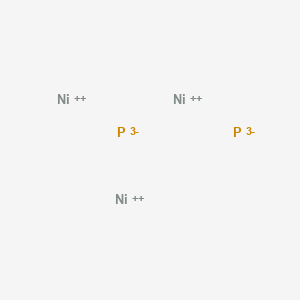
CAS 12035-64-2PubChem CID 166013
Nickel phosphide (Ni2P)
- IUPAC 名称
- tris(nickel(2+));bis(phosphorus(3-))
- 分子式
- Ni3P2
- 分子量
- 238.028 g/mol
- 精确质量
- 237.748992 Da
- 拓扑极性表面积
- 0.0 Ų
- 氢键供体
- 0
- 氢键受体
- 2
- 共价单元
- 5
- 已定义的立体中心
- 0
又称
Dinickel phosphideEINECS 234-828-0RefChem:853898234-828-0nickel(2+);phosphorus(3-)
来自其他科学数据库的证据
NIH PubChem PUG-View
标识符精确匹配166013
Attributed physical-property, hazard, environmental and use annotations.
- Signal: Danger 来源: Regulation (EC) No 1272/2008 of the European Parliament and of the Council
- GHS Hazard Statements: H317: May cause an allergic skin reaction [Warning Sensitization, Skin]; H350i: May cause cancer by inhalation [Danger Carcinogenicity]; H372 **: Causes damage to organs through prolonged or repeated exposure [Danger Specific target organ toxicity, repeated exposure]; H400: Very toxic to aquatic life [Warning Hazardous to the aquatic environment, acute hazard]; H410: Very toxic to aquatic life with long lasting effects [Warning Hazardous to the aquatic environment, long-term hazard] 来源: Regulation (EC) No 1272/2008 of the European Parliament and of the Council
- Precautionary Statement Codes: P203, P260, P261, P264, P270, P272, P273, P280, P302+P352, P318, P319, P321, P333+P317, P362+P364, P391, P405, and P501 (click each P-code to see the statement) 来源: Regulation (EC) No 1272/2008 of the European Parliament and of the Council
- Signal: Danger 来源: European Chemicals Agency (ECHA)
- GHS Hazard Statements: H302+H312+H332 (48.1%): Harmful if swallowed, in contact with skin or if inhaled [Warning Acute toxicity, oral; acute toxicity, dermal; acute toxicity, inhalation]; H302 (48.1%): Harmful if swallowed [Warning Acute toxicity, oral]; H312 (48.1%): Harmful in contact with skin [Warning Acute toxicity, dermal]; H317 (100%): May cause an allergic skin reaction [Warning Sensitization, Skin]; H332 (48.1%): Harmful if inhaled [Warning Acute toxicity, inhalation]; H350 (63.3%): May cause cancer [Danger Carcinogenicity]; H350i (36.7%): May cause cancer by inhalation [Danger Carcinogenicity]; H372 (100%): Causes damage to organs through prolonged or repeated exposure [Danger Specific target organ toxicity, repeated exposure]; H400 (100%): Very toxic to aquatic life [Warning Hazardous to the aquatic environment, acute hazard]; H410 (100%): Very toxic to aquatic life with long lasting effects [Warning Hazardous to the aquatic environment, long-term hazard] 来源: European Chemicals Agency (ECHA)
- Precautionary Statement Codes: P203, P260, P261, P264, P270, P271, P272, P273, P280, P301+P317, P302+P352, P304+P340, P317, P318, P319, P321, P330, P333+P317, P362+P364, P391, P405, and P501 (click each P-code to see the statement) 来源: European Chemicals Agency (ECHA)
- ECHA C&L Notifications Summary: Aggregated GHS information provided per 79 reports by companies from 4 notifications to the ECHA C&L Inventory. Each notification may be associated with multiple companies.; Information may vary between notifications depending on impurities, additives, and other factors. The percentage value in parenthesis indicates the notified classification ratio from companies that provide hazard codes. Only hazard codes with percentage values above 10% are shown. For more detailed information, please visit ECHA C&L website. 来源: European Chemicals Agency (ECHA)
映射方: Existing checksum-valid CAS to unique PubChem CID match. 检索时间: 2026-08-31. 打开来源记录
科学分类和危害注释仅提供背景信息,不能取代上方所示针对具体市场的监管决定。
其他来源的覆盖范围和匹配状态
| 来源 | 结果 | 已检查 |
|---|---|---|
| NIH PubChem PUG-View | 精确匹配 | 2026-08-31 |
已记录的无匹配结果是该来源已被检查的有效证据;这并不表示该物质在别处不存在。
于 2026-09-02 通过校验和有效的 CAS 匹配从美国国立卫生研究院 (NIH) PubChem 检索。化学性质不能取代本页的监管决定。