
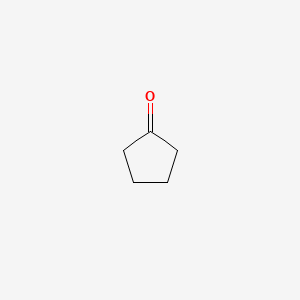
CAS 120-92-3PubChem CID 8452
Cyclopentanone
Cyclopentanone appears as a clear colorless liquid with a petroleum-like odor. Flash point 87 °F. Less dense than water and insoluble in water. Vapors heavier than air. — CAMEO Chemicals
- IUPAC 名称
- cyclopentanone
- 分子式
- C5H8O
- 分子量
- 84.12 g/mol
- 精确质量
- 84.057514874 Da
- XLogP3
- 0.4
- 拓扑极性表面积
- 17.1 Ų
- 氢键供体
- 0
- 氢键受体
- 1
- 共价单元
- 1
- 已定义的立体中心
- 0
又称
Adipic ketoneKetocyclopentaneKetopentamethyleneDumasinAdipinketonAdipin keton220W81TN3SNSC-4122
另有 16 个已报告名称
FEMA NO. 3910CHEBI:16486RefChem:5722204-435-9cyclopentan-1-oneoxocyclopentaneNSC 4122cyclopentanonCAS-120-92-3CYCLOPENTANONE (2,2,5,5-D4)HSDB 2822EINECS 204-435-9UN2245cyclopentaneonDumasinecyclo-pentanone
外部数据库标识符
- ChEBI:CHEBI:16486
- ChEMBL:CHEMBL18620
- EPA DTXSID:DTXSID3029154
- PubMed:23261716
- PubMed:23083207
- PubMed:23042187
- PubMed:22987885
- PubMed:22985418
- PubMed:22983549
- PubMed:22982731
- PubMed:22963654
- PubMed:22829408
- PubMed:22828583
- PubMed:22822376
- PubMed:22799615
来自其他科学数据库的证据
NIH PubChem PUG-View
标识符精确匹配8452
Attributed physical-property, hazard, environmental and use annotations.
- Boiling Point: 267.17 °F at 760 mmHg (NTP, 1992) 来源: CAMEO Chemicals
- Boiling Point: 130.6 °C AT 760 MM HG 来源: Hazardous Substances Data Bank (HSDB)
- Boiling Point: 130.00 to 131.00 °C. @ 760.00 mm Hg 来源: Human Metabolome Database (HMDB)
- Boiling Point: 131 °C 来源: ILO-WHO International Chemical Safety Cards (ICSCs)
- Boiling Point: 130-131 °C 来源: Joint FAO/WHO Expert Committee on Food Additives (JECFA)
- Boiling Point: 130.6 °C @760 [mm Hg] 来源: PAC Chemical Database, U.S. Department of Energy
- Color/Form: WATER-WHITE, MOBILE LIQUID 来源: Hazardous Substances Data Bank (HSDB)
- Density: 0.94869 at 68 °F (NTP, 1992) - Less dense than water; will float 来源: CAMEO Chemicals
- Density: 0.94869 @ 20 °C/4 °C 来源: Hazardous Substances Data Bank (HSDB)
- Density: Relative density (water = 1): 0.95 来源: ILO-WHO International Chemical Safety Cards (ICSCs)
- Density: 0.950-0.960 来源: Joint FAO/WHO Expert Committee on Food Additives (JECFA)
- Density: 0.95 @ 20°C 来源: PAC Chemical Database, U.S. Department of Energy
- Flash Point: 86 °F (NTP, 1992) 来源: CAMEO Chemicals
- Flash Point: 87 °F (CLOSED CUP) 来源: Hazardous Substances Data Bank (HSDB)
- Flash Point: 26 °C 来源: ILO-WHO International Chemical Safety Cards (ICSCs)
- LogP: 0.38 来源: Human Metabolome Database (HMDB)
- Melting Point: -60.3 °F (NTP, 1992) 来源: CAMEO Chemicals
- Melting Point: -51.3 °C 来源: Hazardous Substances Data Bank (HSDB)
- Melting Point: -58 °C 来源: Human Metabolome Database (HMDB)
- Melting Point: -51 °C 来源: ILO-WHO International Chemical Safety Cards (ICSCs)
- Odor: DISTINCTIVE ETHEREAL ODOR, SOMEWHAT LIKE PEPPERMINT 来源: Hazardous Substances Data Bank (HSDB)
- Physical Description: Cyclopentanone appears as a clear colorless liquid with a petroleum-like odor. Flash point 87 °F. Less dense than water and insoluble in water. Vapors heavier than air. 来源: CAMEO Chemicals
- Physical Description: CBI; Liquid 来源: EPA Chemical Data Reporting (CDR)
- Physical Description: Water-white liquid with distinctive odor like peppermint; [Hawley] Colorless clear liquid; Polymerizes easily in presence of acids; [ICSC] 来源: Haz-Map, Information on Hazardous Chemicals and Occupational Diseases
- Physical Description: Liquid 来源: Human Metabolome Database (HMDB)
- Physical Description: CLEAR COLOURLESS LIQUID. 来源: ILO-WHO International Chemical Safety Cards (ICSCs)
- Physical Description: liquid; agreeable odour somewhat like peppermint 来源: Joint FAO/WHO Expert Committee on Food Additives (JECFA)
- Refractive Index: INDEX OF REFRACTION: 1.4366 AT 20 °C; SADTLER REFERENCE NUMBER: 171 (IR, PRISM), 55 (IR, GRATING); MAX ABSORPTION (ALCOHOL): 290 NM (LOG E= 1.28) 来源: Hazardous Substances Data Bank (HSDB)
- Refractive Index: 1.432-1.438 来源: Joint FAO/WHO Expert Committee on Food Additives (JECFA)
- Solubility: Sol in alcohol, acetone, ether 来源: Hazardous Substances Data Bank (HSDB)
- Solubility: Estimated water solubility of 9175 mg/l 来源: Hazardous Substances Data Bank (HSDB)
- Solubility: Solubility in water: poor 来源: ILO-WHO International Chemical Safety Cards (ICSCs)
- Solubility: water; miscible in ether 来源: Joint FAO/WHO Expert Committee on Food Additives (JECFA)
- Solubility: Miscible at room temperature (in ethanol) 来源: Joint FAO/WHO Expert Committee on Food Additives (JECFA)
- Vapor Pressure: 11.4 [mmHg] 来源: Haz-Map, Information on Hazardous Chemicals and Occupational Diseases
- Vapor Pressure: 11.4 mm Hg at 25 °C 来源: Hazardous Substances Data Bank (HSDB)
- Vapor Pressure: 11.4 [mm Hg] @25 °C 来源: PAC Chemical Database, U.S. Department of Energy
- Exposure Routes: The substance can be absorbed into the body by inhalation of its vapour, through the skin and by ingestion. 来源: ILO-WHO International Chemical Safety Cards (ICSCs)
- First Aid: EYES: First check the victim for contact lenses and remove if present. Flush victim's eyes with water or normal saline solution for 20 to 30 minutes while simultaneously calling a hospital or poison control center. Do not put any ointments, oils, or medication in the victim's eyes without specific instructions from a physician. IMMEDIATELY transport the victim after flushing eyes to a hospital even if no symptoms (such as redness or irritation) develop.; SKIN: IMMEDIATELY flood affected skin with water while removing and isolating all contaminated clothing. Gently wash all affected skin areas thoroughly with soap and water. If symptoms such as redness or irritation develop, IMMEDIATELY call a physician and be prepared to transport the victim to a hospital for treatment.; INHALATION: IMMEDIATELY leave the contaminated area; take deep breaths of fresh air. If symptoms (such as wheezing, coughing, shortness of breath, or burning in the mouth, throat, or chest) develop, call a physician and be prepared to transport the victim to a hospital. Provide proper respiratory protection to rescuers entering an unknown atmosphere. Whenever possible, Self-Contained Breathing Apparatus (SCBA) shou 来源: CAMEO Chemicals
- ERG2024, Guide 128 (Cyclopentanone): General First Aid:; · Call 911 or emergency medical service.; · Ensure that medical personnel are aware of the material(s) involved, take precautions to protect themselves and avoid contamination.; · Move victim to fresh air if it can be done safely.; · Administer oxygen if breathing is difficult.; · If victim is not breathing:; -- DO NOT perform mouth-to-mouth resuscitation; the victim may have ingested or inhaled the substance.; -- If equipped and pulse detected, wash face and mouth, then give artificial respiration using a proper respiratory medical device (bag-valve mask, pocket mask equipped with a one-way valve or other device).; -- If no pulse detected or no respiratory medical device available, provide continuous compressions. Conduct a pulse check every two minutes or monitor for any signs of spontaneous respirations.; · Remove and isolate contaminated clothing and shoes.; · For minor skin contact, avoid spreading material on unaffected skin.; · In case of contact with substance, remove immediately by flushing skin or eyes with running water for at least 20 minutes.; · For severe burns, immediate medical attention is required.; · Effects of exposure (inhalation, ingestion, 来源: Emergency Response Guidebook (ERG)
- Signal: Warning 来源: Regulation (EC) No 1272/2008 of the European Parliament and of the Council
- GHS Hazard Statements: H226: Flammable liquid and vapor [Warning Flammable liquids]; H315: Causes skin irritation [Warning Skin corrosion/irritation]; H319: Causes serious eye irritation [Warning Serious eye damage/eye irritation] 来源: Regulation (EC) No 1272/2008 of the European Parliament and of the Council
- Precautionary Statement Codes: P210, P233, P240, P241, P242, P243, P264, P264+P265, P280, P302+P352, P303+P361+P353, P305+P351+P338, P321, P332+P317, P337+P317, P362+P364, P370+P378, P403+P235, and P501 (click each P-code to see the statement) 来源: Regulation (EC) No 1272/2008 of the European Parliament and of the Council
- Note: This chemical does not meet GHS hazard criteria for 1.8% (12 of 678) of reports. 来源: European Chemicals Agency (ECHA)
- Signal: Warning 来源: European Chemicals Agency (ECHA)
- GHS Hazard Statements: H226 (98.2%): Flammable liquid and vapor [Warning Flammable liquids]; H315 (97.8%): Causes skin irritation [Warning Skin corrosion/irritation]; H319 (98.2%): Causes serious eye irritation [Warning Serious eye damage/eye irritation]; H332 (11.2%): Harmful if inhaled [Warning Acute toxicity, inhalation] 来源: European Chemicals Agency (ECHA)
- Precautionary Statement Codes: P210, P233, P240, P241, P242, P243, P261, P264, P264+P265, P271, P280, P302+P352, P303+P361+P353, P304+P340, P305+P351+P338, P317, P321, P332+P317, P337+P317, P362+P364, P370+P378, P403+P235, and P501 (click each P-code to see the statement) 来源: European Chemicals Agency (ECHA)
- ECHA C&L Notifications Summary: Aggregated GHS information provided per 678 reports by companies from 8 notifications to the ECHA C&L Inventory. Each notification may be associated with multiple companies.; Reported as not meeting GHS hazard criteria per 12 of 678 reports by companies.; There are 7 notifications provided by 666 of 678 reports by companies with hazard statement code(s).; Information may vary between notifications depending on impurities, additives, and other factors. The percentage value in parenthesis indicates the notified classification ratio from companies that provide hazard codes. Only hazard codes with percentage values above 10% are shown. For more detailed information, please visit ECHA C&L website. 来源: European Chemicals Agency (ECHA)
- Signal: Warning 来源: NITE-CMC
- GHS Hazard Statements: H226: Flammable liquid and vapor [Warning Flammable liquids]; H302: Harmful if swallowed [Warning Acute toxicity, oral]; H319: Causes serious eye irritation [Warning Serious eye damage/eye irritation] 来源: NITE-CMC
- Precautionary Statement Codes: P210, P233, P240, P241, P242, P243, P264, P264+P265, P270, P280, P301+P317, P303+P361+P353, P305+P351+P338, P330, P337+P317, P370+P378, P403+P235, and P501 (click each P-code to see the statement) 来源: NITE-CMC
- Signal: Warning 来源: Hazardous Chemical Information System (HCIS), Safe Work Australia
- NFPA Health Rating: 2 - Materials that, under emergency conditions, can cause temporary incapacitation or residual injury. 来源: Hazardous Substances Data Bank (HSDB)
- NFPA Fire Rating: 3 - Liquids and solids that can be ignited under almost all ambient temperature conditions. Materials produce hazardous atmospheres with air under almost all ambient temperatures or, though unaffected by ambient temperatures, are readily ignited under almost all conditions. 来源: Hazardous Substances Data Bank (HSDB)
- NFPA Instability Rating: 0 - Materials that in themselves are normally stable, even under fire conditions. 来源: Hazardous Substances Data Bank (HSDB)
- Environmental Bioconcentration: Based upon an estimated log kow of 0.24(1), the bioconcentration factor (log BCF) for cyclopentanone has been calculated to be -0.05, from a recommended regression-derived equations(2). This BCF value indicates cyclopentanone should not bioconcentrate in aquatic organisms(SRC). 来源: Hazardous Substances Data Bank (HSDB)
- Environmental Fate: TERRESTRIAL FATE: Cyclopentanone is not expected to hydrolyse in soils(1), or undergo photolysis on sunlit soil surfaces due to lack of >290 nm UV adsorption(2). A single 5-day BOD screening test, which utilized activated sludge for inocula, suggests that cyclopentanone will biodegrade rapidly upon acclimation in terrestrial environments(3). An estimated Koc of 30(1) indicates cyclopentanone should have a very high mobility in soil(4). A Henry's Law constant of 1.0X10⁻⁵ atm-cu m/mole(5) suggests volatilization of cyclopentanone from moist soils may be an important fate process(1). Based on a vapor pressure of 11.4 mm Hg at 25 °C(6), cyclopentanone should evaporate from dry surfaces, especially when present in high concn such as in spill situations(SRC). 来源: Hazardous Substances Data Bank (HSDB)
- Environmental Fate: AQUATIC FATE: Cyclopentanone is not expected to hydrolyze(1) or undergo direct photolysis in aquatic systems(2). A single 5-day BOD screening test, which utilized activated sludge for inocula, suggests that cyclopentanone will biodegrade rapidly upon acclimation in natural waters(3). An estimated log bioconcentration factor (log BCF) of -0.05(1) indicates cyclopentanone should not bioconcentrate in aquatic organisms(SRC). An estimated Koc of 30(1) indicates cyclopentanone should not partition from the water column to organic matter contained in sediments and suspended solids(SRC). A Henry's Law constant of 1.0X10⁻⁵ atm-cu m/mole at 25 °C(4) indicates that volatilization of cyclopentanone from natural bodies of water should be an important fate process(1). Based on this Henry's Law constant, the volatilization half-life from a model river has been estimated to be 3.5 days(1,SRC). The volatilization half-life from an model pond, which considers the effect of adsorption, has been estimated to be about 40 days(5,SRC). 来源: Hazardous Substances Data Bank (HSDB)
- Environmental Fate: ATMOSPHERIC FATE: Based on a vapor pressure of 11.4 mm Hg at 25 °C(1), cyclopentanone is expected to exist almost entirely in the vapor phase in ambient air(2). Vapor phase reactions with photochemically produced hydroxyl radicals in the atmosphere have been shown to be important(SRC). A rate constant for cyclopentanone of 2.94X10⁻¹² cu cm/molecule-sec at 25 °C corresponds to an atmospheric half-life of about 5.5 days at an atmospheric concn of 5X10+5 hydroxyl radicals per cu cm(3). Direct photolysis in air is not expected to be an important environmental fate process(4). 来源: Hazardous Substances Data Bank (HSDB)
- Consumer Uses: Fragrance 来源: EPA Chemical Data Reporting (CDR)
- Industry Uses: Solvent; Intermediate 来源: EPA Chemical Data Reporting (CDR)
- Sources/Uses: Used as intermediate for pharmaceuticals, biologicals, insecticides, and rubber chemicals; [Hawley] 来源: Haz-Map, Information on Hazardous Chemicals and Occupational Diseases
- Uses: INT FOR PHARMACEUTICALS, BIOLOGICALS, INSECTICIDES, & RUBBER CHEMICALS. 来源: Hazardous Substances Data Bank (HSDB)
映射方: Existing checksum-valid CAS to unique PubChem CID match. 检索时间: 2026-08-31. 打开来源记录
科学分类和危害注释仅提供背景信息,不能取代上方所示针对具体市场的监管决定。
其他来源的覆盖范围和匹配状态
| 来源 | 结果 | 已检查 |
|---|---|---|
| NIH PubChem PUG-View | 精确匹配 | 2026-08-31 |
已记录的无匹配结果是该来源已被检查的有效证据;这并不表示该物质在别处不存在。
于 2026-08-31 通过校验和有效的 CAS 匹配从美国国立卫生研究院 (NIH) PubChem 检索。化学性质不能取代本页的监管决定。