
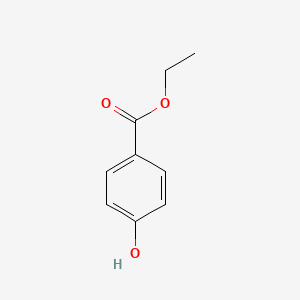
CAS 120-47-8PubChem CID 8434
Ethylparaben
Ethylparaben is an ethyl ester resulting from the formal condensation of the carboxy group of 4-hydroxybenzoic acid with ethanol. It has a role as an antifungal agent, an antimicrobial food preservative, a plant metabolite and a phytoestrogen. It is an ethyl ester and a paraben. — ChEBI
- IUPAC 名称
- ethyl 4-hydroxybenzoate
- 分子式
- C9H10O3
- 分子量
- 166.17 g/mol
- 精确质量
- 166.062994177 Da
- XLogP3
- 2.5
- 拓扑极性表面积
- 46.5 Ų
- 氢键供体
- 1
- 氢键受体
- 3
- 共价单元
- 1
- 已定义的立体中心
- 0
又称
Ethyl parabenEthyl p-hydroxybenzoateTegosept EMycoctenEthyl parasept4-Hydroxybenzoic acid ethyl esterAseptoform ENipagin A
另有 16 个已报告名称
EaseptolEthyl butexNapagin ANipazin ASolbrol ASobrol AEthyl parahydroxybenzoatep-Hydroxybenzoic acid ethyl esterEthyl p-oxybenzoateBonomold OEBenzoic acid, 4-hydroxy-, ethyl esterp-CarbethoxyphenolEthyl-p-hydroxybenzoateMekkings EAseptin AEthyl hydroxybenzoate
外部数据库标识符
- ChEBI:CHEBI:31575
- ChEMBL:CHEMBL15841
- EPA DTXSID:DTXSID9022528
- PubMed:39532263
- PubMed:37690743
- PubMed:35307500
- PubMed:34101200
- PubMed:33113465
- PubMed:31472229
- PubMed:30481674
- PubMed:29162470
- PubMed:27432241
- PubMed:27286252
- PubMed:25349334
- PubMed:25012808
来自其他科学数据库的证据
NIH PubChem PUG-View
标识符精确匹配8434
Attributed physical-property, hazard, environmental and use annotations.
- Boiling Point: 297-298 °C (decomposition) 来源: Hazardous Substances Data Bank (HSDB)
- Boiling Point: 298.00 °C. @ 760.00 mm Hg 来源: Human Metabolome Database (HMDB)
- Color/Form: Small, colorless crystals or powder at room temperature 来源: Hazardous Substances Data Bank (HSDB)
- Color/Form: Crystals from dilute alcohol 来源: Hazardous Substances Data Bank (HSDB)
- Dissociation Constants: pKa = 8.34 来源: Hazardous Substances Data Bank (HSDB)
- LogP: log Kow = 2.47 来源: Hazardous Substances Data Bank (HSDB)
- LogP: 2.47 来源: Human Metabolome Database (HMDB)
- Melting Point: ofp-hydroxybenzoic acid isolated by acidification and not recrystallised: 213 °C to 217 °C, after vacuum drying in a sulphuric acid desiccator 来源: EU Food Improvement Agents
- Melting Point: 117 °C 来源: Hazardous Substances Data Bank (HSDB)
- Melting Point: 116 °C 来源: Human Metabolome Database (HMDB)
- Odor: Odorless 来源: Hazardous Substances Data Bank (HSDB)
- Physical Description: Liquid; Other Solid 来源: EPA Chemical Data Reporting (CDR)
- Physical Description: Almost odourless, small, colourless crystals or a white, crystalline powder 来源: EU Food Improvement Agents
- Physical Description: Colorless solid; [Hawley] Crystalline powder; [MSDSonline] 来源: Haz-Map, Information on Hazardous Chemicals and Occupational Diseases
- Physical Description: Solid 来源: Human Metabolome Database (HMDB)
- Solubility: In water, 8.85X10+2 mg/L at 25 °C 来源: Hazardous Substances Data Bank (HSDB)
- Solubility: Solubility in water at 25 °C is 0.075% w/w; at 20 °C. 0.70% w/w 来源: Hazardous Substances Data Bank (HSDB)
- Solubility: Solubilities in various solvents [Table#2496] 来源: Hazardous Substances Data Bank (HSDB)
- Solubility: AT 25 °C: 0.5 G/100 G GLYCERIN 来源: Hazardous Substances Data Bank (HSDB)
- Solubility: For more Solubility (Complete) data for ETHYLPARABEN (6 total), please visit the HSDB record page. 来源: Hazardous Substances Data Bank (HSDB)
- Solubility: 0.885 mg/mL at 25 °C 来源: Human Metabolome Database (HMDB)
- Vapor Pressure: 0.0000929 [mmHg] 来源: Haz-Map, Information on Hazardous Chemicals and Occupational Diseases
- Carcinogen Classification: No indication of carcinogenicity to humans (not listed by IARC). 来源: Toxin and Toxin Target Database (T3DB)
- Note: This chemical does not meet GHS hazard criteria for 60.7% (811 of 1336) of all reports. 来源: European Chemicals Agency (ECHA)
- Signal: Danger 来源: European Chemicals Agency (ECHA)
- GHS Hazard Statements: H304 (33.5%): May be fatal if swallowed and enters airways [Danger Aspiration hazard]; H315 (38.8%): Causes skin irritation [Warning Skin corrosion/irritation]; H317 (34%): May cause an allergic skin reaction [Warning Sensitization, Skin]; H319 (39.3%): Causes serious eye irritation [Warning Serious eye damage/eye irritation] 来源: European Chemicals Agency (ECHA)
- Precautionary Statement Codes: P261, P264, P264+P265, P272, P280, P301+P316, P302+P352, P305+P351+P338, P321, P331, P332+P317, P333+P317, P337+P317, P362+P364, P405, and P501 (click each P-code to see the statement) 来源: European Chemicals Agency (ECHA)
- ECHA C&L Notifications Summary: Aggregated GHS information provided per 1336 reports by companies from 10 notifications to the ECHA C&L Inventory. Each notification may be associated with multiple companies.; Reported as not meeting GHS hazard criteria per 811 of 1336 reports by companies.; There are 8 notifications provided by 525 of 1336 reports by companies with hazard statement code(s).; Information may vary between notifications depending on impurities, additives, and other factors. The percentage value in parenthesis indicates the notified classification ratio from companies that provide hazard codes. Only hazard codes with percentage values above 10% are shown. For more detailed information, please visit ECHA C&L website. 来源: European Chemicals Agency (ECHA)
- Note: This chemical does not meet GHS hazard criteria for 100% (2 of 2) of all reports. 来源: European Chemicals Agency (ECHA)
- GHS Hazard Statements: Not Classified; Reported as not meeting GHS hazard criteria by 2 of 2 companies. For more detailed information, please visit ECHA C&L website. 来源: European Chemicals Agency (ECHA)
- ECHA C&L Notifications Summary: Aggregated GHS information provided per 2 reports by companies from 1 notifications to the ECHA C&L Inventory.; Reported as not meeting GHS hazard criteria per 2 of 2 reports by companies.; There are 0 notifications provided by 0 of 2 reports by companies with hazard statement code(s).; Information may vary between notifications depending on impurities, additives, and other factors. The percentage value in parenthesis indicates the notified classification ratio from companies that provide hazard codes. Only hazard codes with percentage values above 10% are shown. For more detailed information, please visit ECHA C&L website. 来源: European Chemicals Agency (ECHA)
- GHS Hazard Statements: H401: Toxic to aquatic life [Hazardous to the aquatic environment, acute hazard] 来源: Hazardous Substances Data Bank (HSDB)
- Precautionary Statement Codes: P273, and P501 (click each P-code to see the statement) 来源: Hazardous Substances Data Bank (HSDB)
- Cosmetic Ingredient Review Conclusion: The CIR Expert Panel concluded that the following 20 parabens are safe in cosmetics in the present practices of use and concentration described in the safety assessment when the sum of the combined concentration of parabens in any given formulation does not exceed 0.8 %...Ehtylparaben.. 来源: Cosmetic Ingredient Review (CIR)
- Cosmetic Ingredient Review Finding(s): Safe for use in cosmetics, with qualifications 来源: Cosmetic Ingredient Review (CIR)
- Toxicity Summary: IDENTIFICATION AND USE: Ethylparaben forms small colorless crystals, or white powder. Ethylparaben inhibits the growth of fungi and bacteria and is used as a preservative for pharmaceuticals, adhesives, and various cosmetic preparations. HUMAN EXPOSURE AND TOXICITY: Ethylparaben was a skin irritant in man. It gave no evidence of sensitizing potential in a human study. The paraben esters as a generic class are rare sensitizers when applied to the intact skin of man. Application to the damaged skin is a more common cause of sensitization. A methyl:ethyl:propylparaben mixture has been shown on oral administration to exacerbate pre-existing skin complaints. ANIMAL STUDIES: Ethylparaben was an eye irritant in rabbits. A low acute oral toxicity has been demonstrated for ethylparaben in laboratory animals. Limited long-term studies in rats have also indicated a low toxicity and have generated no evidence of carcinogenic activity. Ethylparaben in the diet produced cell proliferation in the forestomach of rats. No evidence of mutagenicity was reported in limited Ames Bacterial tests. Ethylparaben did increase chromosomal aberrations in a Chinese Hamster ovary cell assay, but similar effects 来源: Hazardous Substances Data Bank (HSDB)
- Environmental Bioconcentration: An estimated BCF of 20 was calculated for ethylparaben(SRC), using a log Kow of 2.47(1) and a regression derived equation(2). According to a classification scheme(3), this BCF suggests the potential for bioconcentration in aquatic organisms is low(SRC). 来源: Hazardous Substances Data Bank (HSDB)
- Environmental Fate: TERRESTRIAL FATE: Based on a classification scheme(1), Koc values ranging from 119 to 209(2) indicate that ethylparaben is expected to have high to moderate mobility in soil(SRC). The pKa of ethylparaben is 8.34(3), indicating that this compound will partially exist in the anion form in the environment and anions generally do not adsorb more strongly to soils containing organic carbon and clay than their neutral counterparts(4). Volatilization of ethylparaben from moist soil surfaces is not expected to be an important fate process(SRC) given an estimated Henry's Law constant of 4.8X10⁻⁹ atm-cu m/mole(SRC), using a fragment constant estimation method(5). Ethylparaben is not expected to volatilize from dry soil surfaces(SRC) based upon an estimated vapor pressure of 9.3X10⁻⁵ mm Hg(SRC), determined from a fragment constant method(6). Half-lives of about 14 days and 3.5 days were measured in aerobic screening tests conducted with phenol- and cresol-acclimated sludge over 7 day and 1 day incubation periods(7,8), respectively, suggesting that biodegradation may be an important fate process in soil(SRC). 来源: Hazardous Substances Data Bank (HSDB)
- Environmental Fate: AQUATIC FATE: Based on a classification scheme(1), Koc values ranging from 119 to 209(2), indicate that ethylparaben is not expected to adsorb to suspended solids and sediment(SRC). Volatilization from water surfaces is not expected(3) based upon an estimated Henry's Law constant of 4.8X10⁻⁹ atm-cu m/mole(SRC), developed using a fragment constant estimation method(4). According to a classification scheme(5), an estimated BCF of 20(SRC), from its log Kow of 2.47(6) and a regression-derived equation(7), suggests the potential for bioconcentration in aquatic organisms is low(SRC). Half-lives of about 14 days and 3.5 days were measured in aerobic screening tests conducted with phenol- and cresol-acclimated sludge over 7 day and 1 day incubation periods(8,9), respectively, suggesting that biodegradation may be an important fate process in water(SRC). 来源: Hazardous Substances Data Bank (HSDB)
- Environmental Fate: ATMOSPHERIC FATE: According to a model of gas/particle partitioning of semivolatile organic compounds in the atmosphere(1), ethylparaben, which has an estimated vapor pressure of 9.3X10⁻⁵ mm Hg at 25 °C(SRC), determined from a fragment constant method(2), will exist in both the vapor and particulate phases in the ambient atmosphere. Vapor-phase ethylparaben is degraded in the atmosphere by reaction with photochemically-produced hydroxyl radicals(SRC); the half-life for this reaction in air is estimated to be one day(SRC), calculated from its rate constant of 1.3X10⁻¹¹ cu cm/molecule-sec at 25 °C(SRC) that was derived using a structure estimation method(3). Particulate-phase ethylparaben may be removed from the air by wet and dry deposition(SRC). Ethylparaben contains chromophores that absorb at wavelengths >290 nm(4) and therefore may be susceptible to direct photolysis by sunlight(SRC). 来源: Hazardous Substances Data Bank (HSDB)
- Consumer Uses: Not Known or Reasonably Ascertainable 来源: EPA Chemical Data Reporting (CDR)
- Cosmetic Ingredient Review Link: CIR ingredient: Ethylparaben 来源: Cosmetic Ingredient Review (CIR)
- Sources/Uses: Used as a preservative for pharmaceuticals, adhesives, and various cosmetic preparations (inhibits fungal and bacterial growth); [HSDB] The parabens (methyl, ethyl, propyl, and butyl) were the most widely used preservatives in cosmetics (0.1% to 0.8%) until their sensitizing potential was recognized; [Marks, p. 115] 来源: Haz-Map, Information on Hazardous Chemicals and Occupational Diseases
- Industrial Processes with risk of exposure: Working with Glues and Adhesives [Category: Other] 来源: Haz-Map, Information on Hazardous Chemicals and Occupational Diseases
- Uses: For ethylparaben (USEPA/OPP Pesticide Code: 061202) there are 0 labels match. /SRP: Not registered for current use in the U.S., but approved pesticide uses may change periodically and so federal, state and local authorities must be consulted for currently approved uses./ 来源: Hazardous Substances Data Bank (HSDB)
- Uses: Antimicrobial preservative for pharmaceuticals. 来源: Hazardous Substances Data Bank (HSDB)
- Uses: Ethyl paraben ... inhibits the growth of fungi and bacteria and is used as a preservative for pharmaceuticals, adhesives, and various cosmetic preparations. 来源: Hazardous Substances Data Bank (HSDB)
- Uses: ... Antibacterials that prevent /food spoilage by/ Clostridium botulinum include ... parabens ... /Parabens/ 来源: Hazardous Substances Data Bank (HSDB)
- Uses: Ethylparaben is found in alcoholic beverages. 来源: Toxin and Toxin Target Database (T3DB)
映射方: Existing checksum-valid CAS to unique PubChem CID match. 检索时间: 2026-08-31. 打开来源记录
科学分类和危害注释仅提供背景信息,不能取代上方所示针对具体市场的监管决定。
其他来源的覆盖范围和匹配状态
| 来源 | 结果 | 已检查 |
|---|---|---|
| NIH PubChem PUG-View | 精确匹配 | 2026-08-31 |
已记录的无匹配结果是该来源已被检查的有效证据;这并不表示该物质在别处不存在。
于 2026-09-02 通过校验和有效的 CAS 匹配从美国国立卫生研究院 (NIH) PubChem 检索。化学性质不能取代本页的监管决定。