
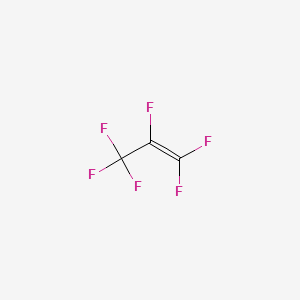
CAS 116-15-4PubChem CID 8302
Hexafluoropropylene
Hexafluoropropylene is an odorless, colorless gas. It is noncombustible. It can asphyxiate by the displacement of air. Exposure of the container to prolonged heat or fire can cause it to rupture violently and rocket. — CAMEO Chemicals
- IUPAC 名称
- 1,1,2,3,3,3-hexafluoroprop-1-ene
- 分子式
- C3F6
- 分子量
- 150.02 g/mol
- 精确质量
- 149.99041897 Da
- XLogP3
- 1.9
- 拓扑极性表面积
- 0.0 Ų
- 氢键供体
- 0
- 氢键受体
- 6
- 共价单元
- 1
- 已定义的立体中心
- 0
又称
HexafluoropropenePerfluoropropenePerfluoropropylenePropene, hexafluoro-Perfluoro-1-propenePropylene, hexafluoro-Hexfluoropropylene1,1,2,3,3,3-HEXAFLUORO-1-PROPENE
另有 16 个已报告名称
1-Propene, 1,1,2,3,3,3-hexafluoro-propylene hexafluorideTRW23XOS20RefChem:146013204-127-4C3F6CF3CF=CF2R1216hexafluoro-1-propeneHexafluoroprop-1-eneEsafluoropropeneHSDB 5582EINECS 204-127-4UN1858UNII-TRW23XOS20hexafluoro-propene
外部数据库标识符
来自其他科学数据库的证据
NIH PubChem PUG-View
标识符精确匹配8302
Attributed physical-property, hazard, environmental and use annotations.
- Boiling Point: -29.6 °C 来源: Hazardous Substances Data Bank (HSDB)
- Boiling Point: -29.6 °C @760 [mm Hg] 来源: PAC Chemical Database, U.S. Department of Energy
- Color/Form: Colorless gas 来源: Hazardous Substances Data Bank (HSDB)
- Density: 1.583 AT -40 °C/4 °C 来源: Hazardous Substances Data Bank (HSDB)
- Density: 1.583 @ -40°C 来源: PAC Chemical Database, U.S. Department of Energy
- Melting Point: -156.5 °C 来源: Hazardous Substances Data Bank (HSDB)
- Melting Point: -156.5 °C 来源: PAC Chemical Database, U.S. Department of Energy
- Odor: Odorless gas 来源: Hazardous Substances Data Bank (HSDB)
- Physical Description: Hexafluoropropylene is an odorless, colorless gas. It is noncombustible. It can asphyxiate by the displacement of air. Exposure of the container to prolonged heat or fire can cause it to rupture violently and rocket. 来源: CAMEO Chemicals
- Physical Description: Liquid; Gas Vapor 来源: EPA Chemical Data Reporting (CDR)
- Physical Description: An odorless, colorless, noncombustible gas that can act as a simple asphyxiant; [CAMEO] 来源: Haz-Map, Information on Hazardous Chemicals and Occupational Diseases
- Vapor Pressure: 4900.0 [mmHg] 来源: Haz-Map, Information on Hazardous Chemicals and Occupational Diseases
- Vapor Pressure: 4.9X10+3 mm Hg at 25 °C /from experimentally derived coefficients/ 来源: Hazardous Substances Data Bank (HSDB)
- Vapor Pressure: 750 [mm Hg] @-30.6 °C 来源: PAC Chemical Database, U.S. Department of Energy
- First Aid: Excerpt from ERG Guide 126 [Gases - Compressed or Liquefied (Including Refrigerant Gases)]:; Refer to the "General First Aid" section. Specific First Aid: In case of contact with liquefied gas, only medical personnel should attempt thawing frosted parts. (ERG, 2024) 来源: CAMEO Chemicals
- ERG2024, Guide 126 (Refrigerant gas R-1216): General First Aid:; · Call 911 or emergency medical service.; · Ensure that medical personnel are aware of the material(s) involved, take precautions to protect themselves and avoid contamination.; · Move victim to fresh air if it can be done safely.; · Administer oxygen if breathing is difficult.; · If victim is not breathing:; -- DO NOT perform mouth-to-mouth resuscitation; the victim may have ingested or inhaled the substance.; -- If equipped and pulse detected, wash face and mouth, then give artificial respiration using a proper respiratory medical device (bag-valve mask, pocket mask equipped with a one-way valve or other device).; -- If no pulse detected or no respiratory medical device available, provide continuous compressions. Conduct a pulse check every two minutes or monitor for any signs of spontaneous respirations.; · Remove and isolate contaminated clothing and shoes.; · For minor skin contact, avoid spreading material on unaffected skin.; · In case of contact with substance, remove immediately by flushing skin or eyes with running water for at least 20 minutes.; · For severe burns, immediate medical attention is required.; · Effects of exposure (inhalation, ingestion, 来源: Emergency Response Guidebook (ERG)
- ERG2024, Guide 126 (Hexafluoropropylene; Hexafluoropropylene, compressed): General First Aid:; · Call 911 or emergency medical service.; · Ensure that medical personnel are aware of the material(s) involved, take precautions to protect themselves and avoid contamination.; · Move victim to fresh air if it can be done safely.; · Administer oxygen if breathing is difficult.; · If victim is not breathing:; -- DO NOT perform mouth-to-mouth resuscitation; the victim may have ingested or inhaled the substance.; -- If equipped and pulse detected, wash face and mouth, then give artificial respiration using a proper respiratory medical device (bag-valve mask, pocket mask equipped with a one-way valve or other device).; -- If no pulse detected or no respiratory medical device available, provide continuous compressions. Conduct a pulse check every two minutes or monitor for any signs of spontaneous respirations.; · Remove and isolate contaminated clothing and shoes.; · For minor skin contact, avoid spreading material on unaffected skin.; · In case of contact with substance, remove immediately by flushing skin or eyes with running water for at least 20 minutes.; · For severe burns, immediate medical attention is required.; · Effects of exposure (inhalation, ingestion, 来源: Emergency Response Guidebook (ERG)
- Signal: Warning 来源: Regulation (EC) No 1272/2008 of the European Parliament and of the Council
- GHS Hazard Statements: H332: Harmful if inhaled [Warning Acute toxicity, inhalation]; H335: May cause respiratory irritation [Warning Specific target organ toxicity, single exposure; Respiratory tract irritation] 来源: Regulation (EC) No 1272/2008 of the European Parliament and of the Council
- Precautionary Statement Codes: P261, P271, P304+P340, P317, P319, P403+P233, P405, and P501 (click each P-code to see the statement) 来源: Regulation (EC) No 1272/2008 of the European Parliament and of the Council
- Signal: Warning 来源: European Chemicals Agency (ECHA)
- GHS Hazard Statements: H280 (89.5%): Contains gas under pressure; may explode if heated [Warning Gases under pressure]; H332 (100%): Harmful if inhaled [Warning Acute toxicity, inhalation]; H335 (100%): May cause respiratory irritation [Warning Specific target organ toxicity, single exposure; Respiratory tract irritation]; H351 (48.6%): Suspected of causing cancer [Warning Carcinogenicity]; H371 (34.6%): May cause damage to organs [Warning Specific target organ toxicity, single exposure]; H373 (38.1%): May causes damage to organs through prolonged or repeated exposure [Warning Specific target organ toxicity, repeated exposure]; H412 (26.3%): Harmful to aquatic life with long lasting effects [Hazardous to the aquatic environment, long-term hazard] 来源: European Chemicals Agency (ECHA)
- Precautionary Statement Codes: P203, P260, P261, P264, P270, P271, P273, P280, P304+P340, P308+P316, P317, P318, P319, P403+P233, P405, P410+P403, and P501 (click each P-code to see the statement) 来源: European Chemicals Agency (ECHA)
- ECHA C&L Notifications Summary: Aggregated GHS information provided per 457 reports by companies from 20 notifications to the ECHA C&L Inventory. Each notification may be associated with multiple companies.; Information may vary between notifications depending on impurities, additives, and other factors. The percentage value in parenthesis indicates the notified classification ratio from companies that provide hazard codes. Only hazard codes with percentage values above 10% are shown. For more detailed information, please visit ECHA C&L website. 来源: European Chemicals Agency (ECHA)
- Signal: Danger 来源: NITE-CMC
- GHS Hazard Statements: H280: Contains gas under pressure; may explode if heated [Warning Gases under pressure]; H332: Harmful if inhaled [Warning Acute toxicity, inhalation]; H370: Causes damage to organs [Danger Specific target organ toxicity, single exposure]; H372: Causes damage to organs through prolonged or repeated exposure [Danger Specific target organ toxicity, repeated exposure] 来源: NITE-CMC
- Precautionary Statement Codes: P260, P261, P264, P270, P271, P304+P340, P308+P316, P317, P319, P321, P405, P410+P403, and P501 (click each P-code to see the statement) 来源: NITE-CMC
- Signal: Warning 来源: Hazardous Chemical Information System (HCIS), Safe Work Australia
- GHS Hazard Statements: H332: Harmful if inhaled [Warning Acute toxicity, inhalation]; H335: May cause respiratory irritation [Warning Specific target organ toxicity, single exposure; Respiratory tract irritation] 来源: Hazardous Chemical Information System (HCIS), Safe Work Australia
- Environmental Bioconcentration: An estimated BCF value of 24 was calculated for hexafluoropropene(SRC), using an estimated log Kow of 2.12(1,SRC) and a recommended regression-derived equation(2). According to a classification scheme(3), this BCF value suggests that bioconcentration in aquatic organisms is low(SRC). 来源: Hazardous Substances Data Bank (HSDB)
- Environmental Fate: TERRESTRIAL FATE: Based on a recommended classification scheme(1), an estimated Koc value of 470(SRC), determined from a structure estimation method(2), indicates that hexafluoropropene is expected to have moderate mobility in soil(SRC). Volatilization of hexafluoropropene is expected from moist soil surfaces(SRC) given an estimated Henry's Law constant of 5.34 atm-cu m/mole(SRC), developed using a fragment constant estimation method(3). Hexafluoropropene is expected to rapidly volatilize from dry soil surfaces based on a vapor pressure of 4.9X10+3 mm Hg(SRC), determined from a fragment constant method(4). Highly chlorinated/fluorinated compounds are not expected to biodegrade rapidly(5). 来源: Hazardous Substances Data Bank (HSDB)
- Environmental Fate: AQUATIC FATE: Based on a recommended classification scheme(1), an estimated Koc value of 470(SRC), determined from a structure estimation method(2), indicates that hexafluoropropene is expected to adsorb to suspended solids and sediment in water(SRC). Hexafluoropropene is expected to volatilize rapidly from water surfaces(3,SRC) based on an estimated Henry's Law constant of 5.34 atm-cu m/mole(SRC), developed using a fragment constant estimation method(4). Estimated half-lives for a model river and model lake are 4 and 116 hours, respectively(3,SRC). According to a classification scheme(5), an estimated BCF value of 24(3,SRC), from an estimated log Kow of 2.12(6,SRC), suggests that bioconcentration in aquatic organisms is low(SRC). Highly chlorinated/fluorinated compounds are not expected to biodegrade rapidly(7). 来源: Hazardous Substances Data Bank (HSDB)
- Environmental Fate: ATMOSPHERIC FATE: According to a model of gas/particle partitioning of semivolatile organic compounds in the atmosphere(1), hexafluoropropene, which has a vapor pressure of 4.9X10+3 mm Hg at 25 °C(2), is expected to exist solely as a vapor in the ambient atmosphere. Vapor-phase hexafluoropropene is degraded in the atmosphere by reaction with photochemically-produced hydroxyl radicals and ozone molecules(SRC); the half-lives for these reactions in air are estimated to be about 21(3,SRC) and 95(4,SRC) days, respectively. 来源: Hazardous Substances Data Bank (HSDB)
- Consumer Uses: Monomers 来源: EPA Chemical Data Reporting (CDR)
- Industry Uses: Intermediate; Monomers 来源: EPA Chemical Data Reporting (CDR)
- Sources/Uses: About 90% is used as a monomer in closed systems to produce fluoropolymers, fluoroelastomers, and fluorolubricants; About 10% is used to produce replacement chlorofluorocarbons; [ACGIH] 来源: Haz-Map, Information on Hazardous Chemicals and Occupational Diseases
- Uses: MONOMER FOR FLUORINATED ETHYLENE-PROPYLENE COPOLYMERS 来源: Hazardous Substances Data Bank (HSDB)
- Uses: COMONOMER FOR VINYLIDENE FLUORIDE ELASTOMERS 来源: Hazardous Substances Data Bank (HSDB)
- Uses: CHEM INT FOR PERFLUOROALKYL POLYETHER FLUIDS 来源: Hazardous Substances Data Bank (HSDB)
- Uses: Production of copolymers and hexafluoropropylene oxide. 来源: Hazardous Substances Data Bank (HSDB)
映射方: Existing checksum-valid CAS to unique PubChem CID match. 检索时间: 2026-08-31. 打开来源记录
科学分类和危害注释仅提供背景信息,不能取代上方所示针对具体市场的监管决定。
其他来源的覆盖范围和匹配状态
| 来源 | 结果 | 已检查 |
|---|---|---|
| NIH PubChem PUG-View | 精确匹配 | 2026-08-31 |
已记录的无匹配结果是该来源已被检查的有效证据;这并不表示该物质在别处不存在。
于 2026-08-31 通过校验和有效的 CAS 匹配从美国国立卫生研究院 (NIH) PubChem 检索。化学性质不能取代本页的监管决定。