
CAS 115-77-5PubChem CID 8285
Pentaerythritol
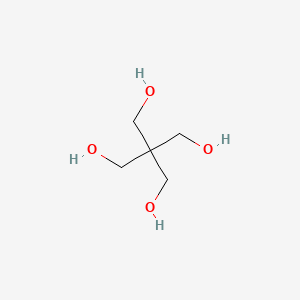
Pentaerythritol is a tetrol that is neopentane in which one of the methyl hydrogens of all four methyl groups are replaced by hydroxy groups. It is a chemical intermediate used in the production of explosives, plastics, paints, appliances, and cosmetics. It has a role as a laxative and a flame retardant. It is a primary alcohol and a tetrol. It derives from a hydride of a neopentane. — ChEBI
- IUPAC 名称
- 2,2-bis(hydroxymethyl)propane-1,3-diol
- 分子式
- C5H12O4
- 分子量
- 136.15 g/mol
- 精确质量
- 136.07355886 Da
- XLogP3
- -2.4
- 拓扑极性表面积
- 80.9 Ų
- 氢键供体
- 4
- 氢键受体
- 4
- 共价单元
- 1
- 已定义的立体中心
- 0
又称
PentekTetramethylolmethaneAuxinutrilMaxinutrilMonopentekPentaerythritePenetekMetab-Auxil
另有 16 个已报告名称
MonopentaerythritolHercules P6Tetrakis(hydroxymethyl)methane2,2-Bis(hydroxymethyl)-1,3-propanediolMethane tetramethylolpentaerithritylTetrahydroxymethylmethane1,3-Propanediol, 2,2-bis(hydroxymethyl)-AuxitransTHMEPE 200SU420W1S6NNSC-8100CHEBI:134760TetrahydroxymethylolmethaneRefChem:171351
外部数据库标识符
- ChEBI:CHEBI:134760
- ChEMBL:CHEMBL3186112
- EPA DTXSID:DTXSID2026943
- PubMed:23080400
- PubMed:22647196
- PubMed:22629200
- PubMed:22460027
- PubMed:22436966
- PubMed:22393408
- PubMed:22346285
- PubMed:22333437
- PubMed:22311422
- PubMed:22284520
- PubMed:22274556
- PubMed:22226139
来自其他科学数据库的证据
NIH PubChem PUG-View
标识符精确匹配8285
Attributed physical-property, hazard, environmental and use annotations.
- Autoignition Temperature: 842 °F (USCG, 1999) 来源: CAMEO Chemicals
- Autoignition Temperature: 390-490 °C 来源: ILO-WHO International Chemical Safety Cards (ICSCs)
- Boiling Point: Sublimes (NIOSH, 2024) 来源: CAMEO Chemicals
- Boiling Point: Sublimes 来源: Hazardous Substances Data Bank (HSDB)
- Boiling Point: BP: 276 °C at 30 mm Hg 来源: Hazardous Substances Data Bank (HSDB)
- Boiling Point: at 4kPa: 276 °C 来源: ILO-WHO International Chemical Safety Cards (ICSCs)
- Boiling Point: Sublimes 来源: Occupational Safety and Health Administration (OSHA)
- Boiling Point: Sublimes 来源: The National Institute for Occupational Safety and Health (NIOSH)
- Color/Form: Ditetragonal crystals from dilute hydrochloric acid 来源: Hazardous Substances Data Bank (HSDB)
- Color/Form: White, crystalline powder 来源: Hazardous Substances Data Bank (HSDB)
- Color/Form: Colorless to white, crystalline powder [Note: Technical grade is 88% monopentaerythritol & 12% dipentaerythritol]. 来源: Hazardous Substances Data Bank (HSDB)
- Density: 1.39 at 77 °F (USCG, 1999) - Denser than water; will sink 来源: CAMEO Chemicals
- Density: 1.399 at 25 °C/4 °C 来源: Hazardous Substances Data Bank (HSDB)
- Density: Relative density (water = 1): 1.4 来源: ILO-WHO International Chemical Safety Cards (ICSCs)
- Density: 1.38 来源: Occupational Safety and Health Administration (OSHA)
- Density: 1.55 @25 °C 来源: PAC Chemical Database, U.S. Department of Energy
- Density: 1.38 来源: The National Institute for Occupational Safety and Health (NIOSH)
- Dissociation Constants: pKa = 14.10 来源: Hazardous Substances Data Bank (HSDB)
- Flash Point: About 240 °C (open cup) 来源: Hazardous Substances Data Bank (HSDB)
- Flash Point: 240 °C o.c. 来源: ILO-WHO International Chemical Safety Cards (ICSCs)
- LogP: log Kow = -1.69 来源: Hazardous Substances Data Bank (HSDB)
- LogP: -1.69 来源: ILO-WHO International Chemical Safety Cards (ICSCs)
- Melting Point: 502 °F (USCG, 1999) 来源: CAMEO Chemicals
- Melting Point: 258 °C 来源: Hazardous Substances Data Bank (HSDB)
- Melting Point: 260 °C 来源: ILO-WHO International Chemical Safety Cards (ICSCs)
- Melting Point: 500 °F (sublimes) 来源: Occupational Safety and Health Administration (OSHA)
- Melting Point: 258 °C 来源: PAC Chemical Database, U.S. Department of Energy
- Melting Point: 500 °F (Sublimes) 来源: The National Institute for Occupational Safety and Health (NIOSH)
- Odor: Odorless 来源: Hazardous Substances Data Bank (HSDB)
- Physical Description: Pentaerythritol is an odorless white solid. Sinks and mixes slowly with water. (USCG, 1999) 来源: CAMEO Chemicals
- Physical Description: Liquid; CBI; Large Crystals; Other Solid; Dry Powder 来源: EPA Chemical Data Reporting (CDR)
- Physical Description: Colorless to white, crystalline, odorless powder. [Note: Technical grade is 88% monopentaerythritol & 12% dipentaerythritol.]; [NIOSH] 来源: Haz-Map, Information on Hazardous Chemicals and Occupational Diseases
- Physical Description: COLOURLESS-TO-WHITE ODOURLESS CRYSTALLINE POWDER. 来源: ILO-WHO International Chemical Safety Cards (ICSCs)
- Physical Description: Colorless to white, crystalline, odorless powder. 来源: Occupational Safety and Health Administration (OSHA)
- Physical Description: Colorless to white, crystalline, odorless powder. [Note: Technical grade is 88% monopentaerythritol & 12% dipentaerythritol.] 来源: The National Institute for Occupational Safety and Health (NIOSH)
- Refractive Index: Index of refraction: 1.548 at 25 °C/D 来源: Hazardous Substances Data Bank (HSDB)
- Solubility: 6 % at 59 °F (NIOSH, 2024) 来源: CAMEO Chemicals
- Solubility: Insoluble in ethyl ether, benzene 来源: Hazardous Substances Data Bank (HSDB)
- Solubility: Soluble in ethanol, glycerol, ethylene glycol, formamide. Insoluble in acetone, benzene, paraffin, ether, carbon tetrachloride 来源: Hazardous Substances Data Bank (HSDB)
- Solubility: 1 gram dissolves in 18 mL water at 15 °C 来源: Hazardous Substances Data Bank (HSDB)
- Solubility: Slightly soluble in alcohol; insoluble in benzene, ether, carbon tetrachloride and petroleum ether 来源: Hazardous Substances Data Bank (HSDB)
- Solubility: In water, 72,300 mg/L at 25 °C 来源: Hazardous Substances Data Bank (HSDB)
- Solubility: Solubility in water, g/100ml at 25 °C: 2.5 来源: ILO-WHO International Chemical Safety Cards (ICSCs)
- Solubility: (59 °F): 6% 来源: The National Institute for Occupational Safety and Health (NIOSH)
- Vapor Pressure: 8e-08 mmHg (NIOSH, 2024) 来源: CAMEO Chemicals
- Vapor Pressure: Vapor pressure, Pa at 20 °C: 0.013 来源: ILO-WHO International Chemical Safety Cards (ICSCs)
- Vapor Pressure: 0.00000008 mmHg 来源: Occupational Safety and Health Administration (OSHA)
- Vapor Pressure: 0.00000008 mmHg 来源: The National Institute for Occupational Safety and Health (NIOSH)
- Exposure Routes: inhalation, ingestion, skin and/or eye contact 来源: The National Institute for Occupational Safety and Health (NIOSH)
- First Aid: Excerpt from NIOSH Pocket Guide for Pentaerythritol:; Eye: IRRIGATE IMMEDIATELY - If this chemical contacts the eyes, immediately wash (irrigate) the eyes with large amounts of water, occasionally lifting the lower and upper lids. Get medical attention immediately.; Skin: WATER WASH - If this chemical contacts the skin, wash the contaminated skin with water.; Breathing: FRESH AIR - If a person breathes large amounts of this chemical, move the exposed person to fresh air at once. Other measures are usually unnecessary.; Swallow: MEDICAL ATTENTION IMMEDIATELY - If this chemical has been swallowed, get medical attention immediately. (NIOSH, 2024) 来源: CAMEO Chemicals
- First Aid: (General first aid procedures); Eye: Irrigate immediately - If this chemical contacts the eyes, immediately wash (irrigate) the eyes with large amounts of water, occasionally lifting the lower and upper lids. Get medical attention immediately.; Skin: Water wash - If this chemical contacts the skin, wash the contaminated skin with water.; Breathing: Fresh air; Swallow: Medical attention immediately - If this chemical has been swallowed, get medical attention immediately. 来源: The National Institute for Occupational Safety and Health (NIOSH)
- Note: This chemical does not meet GHS hazard criteria for 99.4% (995 of 1001) of all reports. 来源: European Chemicals Agency (ECHA)
- GHS Hazard Statements: Not Classified; Reported as not meeting GHS hazard criteria by 995 of 1001 companies (only 0.6% companies provided GHS information). For more detailed information, please visit ECHA C&L website. 来源: European Chemicals Agency (ECHA)
- ECHA C&L Notifications Summary: Aggregated GHS information provided per 1001 reports by companies from 5 notifications to the ECHA C&L Inventory.; Reported as not meeting GHS hazard criteria per 995 of 1001 reports by companies.; There are 2 notifications provided by 6 of 1001 reports by companies with hazard statement code(s).; Information may vary between notifications depending on impurities, additives, and other factors. The percentage value in parenthesis indicates the notified classification ratio from companies that provide hazard codes. Only hazard codes with percentage values above 10% are shown. For more detailed information, please visit ECHA C&L website. 来源: European Chemicals Agency (ECHA)
- GHS Hazard Statements: H412 (100%): Harmful to aquatic life with long lasting effects [Hazardous to the aquatic environment, long-term hazard] 来源: European Chemicals Agency (ECHA)
- Precautionary Statement Codes: P273, and P501 (click each P-code to see the statement) 来源: European Chemicals Agency (ECHA)
- ECHA C&L Notifications Summary: The GHS information provided by 1 company from 1 notification to the ECHA C&L Inventory. 来源: European Chemicals Agency (ECHA)
- Target Organs: Eyes, respiratory system 来源: The National Institute for Occupational Safety and Health (NIOSH)
- Toxicity Summary: Pentaerythritol is a stable solid and the production volume was ca. 25,000 tonnes/year in 1996 and 1997 in Japan. The chemical is used as intermediate for alkyd resin, rosin ester, explosive and lubricants. No consumer use is reported... Predicted No Effect Concentration (PNEC) of the chemical was determined using a Daphnia magna 48 h immobility data (600 mg/L). The assessment factor of 1000 used to an acute toxicity data to determine PNEC, ... , because only one acute toxicity data is available among algae, cladocera and fishes. Thus, PNEC of the chemical is determined as 0.6 mg/l, tentatively. Thus, PEC / PNEC is 0.0072. Effects of the chemical on aquatic ecosystems are of low concern at present. Pentaerythritol was not mutagenic in bacterial and chromosomal aberration tests in vitro. The chemical is not considered as an irritant to the skin and the eyes, nor as a sensitizer. In a combined repeat dose and reproductive/developmental toxicity screening test, both male and female rats showed only soft feces and diarrhea. The chemical did not show any toxicity to parents and offspring. The no observed effect levels were 100 mg/kg/day for repeated dose toxicity and 1000 mg/kg/day for 来源: Hazardous Substances Data Bank (HSDB)
- Environmental Bioconcentration: Values for BCF of 0.3-0.6 and 0.2-2.1 were calculated in fish for pentaerythritol(SRC), using carp (Cyprinus carpio) which were exposed 10 and 1 ppm pentaerythritol, respectively, over an 6-week period(1). According to a classification scheme(3), this BCF suggests the potential for bioconcentration in aquatic organisms is low(SRC). 来源: Hazardous Substances Data Bank (HSDB)
- Environmental Fate: TERRESTRIAL FATE: Based on a classification scheme(1), an estimated Koc value of 1.5(SRC), determined from a log Kow of -1.69(2) and a regression-derived equation(3), indicates that pentaerythritol is expected to have very high mobility in soil(SRC). Volatilization of pentaerythritol from moist soil surfaces is not expected to be an important fate process(SRC) given an estimated Henry's Law constant of 4.1X10⁻¹⁰ atm-cu m/mole(SRC), using a fragment constant estimation method(4). Pentaerythritol is not expected to volatilize from dry soil surfaces(SRC) based upon an estimated vapor pressure of 2.5X10⁻⁸ mm Hg at 25 °C(SRC), determined from a fragment constant method(5). Utilizing the Japanese MITI test, 13.2% of the Theoretical BOD was reached in 25 days(6) indicating that biodegradation is not an important environmental fate process in soil(SRC). However, aerobic biodegradation test results for pentaerythritol do show varying results(7). 来源: Hazardous Substances Data Bank (HSDB)
- Environmental Fate: AQUATIC FATE: Based on a classification scheme(1), an estimated Koc value of 1.5(SRC), determined from a log Kow of -1.69(2) and a regression-derived equation(3), indicates that pentaerythritol is not expected to adsorb to suspended solids and sediment(SRC). Volatilization from water surfaces is not expected(4) based upon an estimated Henry's Law constant of 4.1X10⁻¹⁰ atm-cu m/mole(SRC), developed using a fragment constant estimation method(5). According to a classification scheme(6), a BCF range of 0.3-2.1 using carp (Cyprinus carpio)(7), suggests the potential for bioconcentration in aquatic organisms is low(SRC). Utilizing the Japanese MITI test, 13.2% of the Theoretical BOD was reached in 25 days(7) indicating that biodegradation is not an important environmental fate process in water(SRC). However, aerobic biodegradation test results for pentaerythritol do show varying results(8). 来源: Hazardous Substances Data Bank (HSDB)
- Environmental Fate: ATMOSPHERIC FATE: According to a model of gas/particle partitioning of semivolatile organic compounds in the atmosphere(1), pentaerythritol, which has an estimated vapor pressure of 2.5X10⁻⁸ mm Hg at 25 °C(SRC), determined from a fragment constant method(2), will exist in both the vapor and particulate phases in the ambient atmosphere. Vapor-phase pentaerythritol is degraded in the atmosphere by reaction with photochemically-produced hydroxyl radicals(SRC); the half-life for this reaction in air is estimated to be 26 hrs(SRC), calculated from its rate constant of 1.48X10⁻¹¹ cu cm/molecule-sec at 25 °C(3). Particulate-phase pentaerythritol may be removed from the air by wet or dry deposition(SRC). Pentaerythritol does not contain chromophores that absorb at wavelengths >290 nm(4) and therefore is not expected to be susceptible to direct photolysis by sunlight(SRC). 来源: Hazardous Substances Data Bank (HSDB)
- Consumer Uses: Surface modifier; Filler; Not Known or Reasonably Ascertainable; Flame retardant 来源: EPA Chemical Data Reporting (CDR)
- Industry Uses: Not Known or Reasonably Ascertainable; Filler; Flame retardant; Surface modifier; Adhesion/cohesion promoter; Intermediate; Heat stabilizer; Other; Lubricating agent; Dispersing agent; Polymerization promoter; Energy Releasers (explosives, motive propellant); Processing aids not otherwise specified; Monomers 来源: EPA Chemical Data Reporting (CDR)
- Sources/Uses: Used to manufacture the explosive, pentaerythritol-tetranitrate (PETN); [ACGIH] 来源: Haz-Map, Information on Hazardous Chemicals and Occupational Diseases
- Uses: In synthetic resins, in paint and varnish industries 来源: Hazardous Substances Data Bank (HSDB)
- Uses: Alkyd resins, rosin and tall oil esters, special varnishes, pharmaceuticals, plasticizers, insecticides, synthetic lubricants, explosives, paint swelling agents.[Lewis RJ Sr; Hawley's Condensed Chemical Dictionary 15th ed Wiley (2007) 来源: Hazardous Substances Data Bank (HSDB)
- Uses: CHEMICAL PROFILE: Pentaerythritol. Pentaerythritol is used in alkyd resins, radiation cure monomers, polyvinyl chloride (PVC) stabilizers, polyurethanes, rosin esters, synthetic lubricants, pigment treatment, antioxidants, and explosives. 来源: Hazardous Substances Data Bank (HSDB)
映射方: Existing checksum-valid CAS to unique PubChem CID match. 检索时间: 2026-08-31. 打开来源记录
科学分类和危害注释仅提供背景信息,不能取代上方所示针对具体市场的监管决定。
其他来源的覆盖范围和匹配状态
| 来源 | 结果 | 已检查 |
|---|---|---|
| NIH PubChem PUG-View | 精确匹配 | 2026-08-31 |
已记录的无匹配结果是该来源已被检查的有效证据;这并不表示该物质在别处不存在。
于 2026-08-31 通过校验和有效的 CAS 匹配从美国国立卫生研究院 (NIH) PubChem 检索。化学性质不能取代本页的监管决定。