
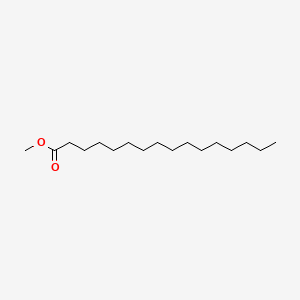
CAS 112-39-0PubChem CID 8181
Methyl Palmitate
Methyl palmitate is a fatty acid methyl ester. It has a role as a metabolite. — ChEBI
- IUPAC 名称
- methyl hexadecanoate
- 分子式
- C17H34O2
- 分子量
- 270.5 g/mol
- 精确质量
- 270.255880323 Da
- XLogP3
- 7.9
- 拓扑极性表面积
- 26.3 Ų
- 氢键供体
- 0
- 氢键受体
- 2
- 共价单元
- 1
- 已定义的立体中心
- 0
又称
Palmitic acid methyl esterHexadecanoic acid, methyl esterMetholene 2216Palmitic acid, methyl esterMethyl n-hexadecanoateUniphat A60n-Hexadecanoic acid methyl esterDPY8VCM98I
另有 16 个已报告名称
DUB PM COSNSC-4197AEC METHYL PALMITATERefChem:6025203-966-3Hexadecanoic acid methyl esterUNII-DPY8VCM98INSC 4197Methyl palmitic acidC16 FAMEhexadecanoic acid-methyl esterCHEBI:69187CS-D1457HY-N1482CAS-112-39-0P0006
外部数据库标识符
- ChEBI:CHEBI:69187
- ChEMBL:CHEMBL335125
- EPA DTXSID:DTXSID4029149
- PubMed:32967526
- PubMed:27633901
- PubMed:22978235
- PubMed:22888533
- PubMed:22885112
- PubMed:22842335
- PubMed:22649385
- PubMed:22567415
- PubMed:22479417
- PubMed:22369235
- PubMed:22339978
- PubMed:22279556
来自其他科学数据库的证据
NIH PubChem PUG-View
标识符精确匹配8181
Attributed physical-property, hazard, environmental and use annotations.
- Boiling Point: 417 °C 来源: Hazardous Substances Data Bank (HSDB)
- Color/Form: Colorless liq 来源: Hazardous Substances Data Bank (HSDB)
- LogP: log Kow= 7.38 来源: Hazardous Substances Data Bank (HSDB)
- Melting Point: 30 °C 来源: Hazardous Substances Data Bank (HSDB)
- Physical Description: Liquid 来源: EPA Chemical Data Reporting (CDR)
- Physical Description: Colorless liquid; mp = 29.5 deg C; [Hawley] Clear liquid; mp = 26-29 deg C; [MSDSonline] 来源: Haz-Map, Information on Hazardous Chemicals and Occupational Diseases
- Refractive Index: Index of refraction: 1.4310 @ 45 °C 来源: Hazardous Substances Data Bank (HSDB)
- Solubility: Insol in water; very sol in ethyl alc, acetone; sol in ether 来源: Hazardous Substances Data Bank (HSDB)
- Solubility: Insoluble in water, soluble in alcohol and ether 来源: Hazardous Substances Data Bank (HSDB)
- Vapor Pressure: 0.0000604 [mmHg] 来源: Haz-Map, Information on Hazardous Chemicals and Occupational Diseases
- Vapor Pressure: 6.04X10⁻⁵ @ 25 °C 来源: Hazardous Substances Data Bank (HSDB)
- Note: This chemical does not meet GHS hazard criteria for 5.9% (99 of 1667) of reports. 来源: European Chemicals Agency (ECHA)
- Signal: Warning 来源: European Chemicals Agency (ECHA)
- GHS Hazard Statements: H315 (82.7%): Causes skin irritation [Warning Skin corrosion/irritation]; H317 (13.6%): May cause an allergic skin reaction [Warning Sensitization, Skin] 来源: European Chemicals Agency (ECHA)
- Precautionary Statement Codes: P261, P264, P272, P280, P302+P352, P321, P332+P317, P333+P317, P362+P364, and P501 (click each P-code to see the statement) 来源: European Chemicals Agency (ECHA)
- ECHA C&L Notifications Summary: Aggregated GHS information provided per 1667 reports by companies from 5 notifications to the ECHA C&L Inventory. Each notification may be associated with multiple companies.; Reported as not meeting GHS hazard criteria per 99 of 1667 reports by companies.; There are 4 notifications provided by 1568 of 1667 reports by companies with hazard statement code(s).; Information may vary between notifications depending on impurities, additives, and other factors. The percentage value in parenthesis indicates the notified classification ratio from companies that provide hazard codes. Only hazard codes with percentage values above 10% are shown. For more detailed information, please visit ECHA C&L website. 来源: European Chemicals Agency (ECHA)
- Environmental Bioconcentration: An estimated BCF of 2 was calculated for methyl palmitate (SRC) using a log Kow of 7.38(1) and a regression-derived equation developed for hydrophobic chemicals(2). According to a classification scheme(3), the estimated BCF suggests the potential for bioconcentration in aquatic organisms is low. 来源: Hazardous Substances Data Bank (HSDB)
- Environmental Fate: TERRESTRIAL FATE: Based on a classification scheme(1), an estimated Koc value of 18,000(SRC), determined from a structure estimation method(2), indicates that methyl palmitate is expected to be immobile in soil(SRC). Volatilization of methyl palmitate from moist soil surfaces is expected to be an important fate process(SRC) given an estimated Henry's Law constant of 0.009 atm-cu m/mole(SRC), using a fragment constant estimation method(3). However, adsorption to soil is expected to attenuate volatilization(SRC). Methyl palmitate is not expected to volatilize from dry soil surfaces(SRC) based upon a vapor pressure of 0.00006 mm Hg(4). Methyl palmitate is expected to rapidly biodegrade in aerobic soils based on the results of screening studies(5). 来源: Hazardous Substances Data Bank (HSDB)
- Environmental Fate: AQUATIC FATE: Based on a classification scheme(1), an estimated Koc value of 18,000(SRC), determined from an estimation method(2), indicates that methyl palmitate is expected to adsorb to suspended solids and sediment in water(SRC). Volatilization from water surfaces is expected(3) based upon an estimated Henry's Law constant of 0.009 atm-cu m/mole(SRC), developed using a fragment constant estimation method(4). Volatilization half-lives for a model river and model lake are 5 and 160 hours, respectively(SRC), using an estimation method(3). However, volatilization from water surfaces is expected to be attenuated by adsorption to suspended solids and sediment in the water column(SRC). The volatilization half-life from a model pond is estimated to be about 60 hours ignoring adsorption; when considering maximum adsorption the volatilization half-life increases to 150 days(5). According to a classification scheme(6), an estimated BCF of 620(SRC) from a log Kow of 7.38(10) regression-derived equation(7) suggests the potential for bioconcentration in aquatic organisms is high. Methyl palmitate is expected to rapidly biodegrade in aerobic waters(8). An estimated base-catalyzed second-order 来源: Hazardous Substances Data Bank (HSDB)
- Environmental Fate: ATMOSPHERIC FATE: According to a model of gas/particle partitioning of semivolatile organic compounds in the atmosphere(1), methyl palmitate, which has a vapor pressure of 0.00006 mm Hg at 25 °C(2), will exist in both the vapor and particulate phases in the ambient atmosphere. Vapor-phase methyl palmitate is degraded in the atmosphere by reaction with photochemically-produced hydroxyl radicals(SRC); the half-life for this reaction in air is estimated to be 20 hours(SRC) from its estimated rate constant of 1.9X10⁻¹¹ cu cm/molecule-sec at 25 °C(3). Particulate-phase methyl palmitate may be removed from the air by wet and dry deposition(SRC). 来源: Hazardous Substances Data Bank (HSDB)
- Consumer Uses: Not Known or Reasonably Ascertainable; Lubricating agent 来源: EPA Chemical Data Reporting (CDR)
- Industry Uses: Lubricating agent; Not Known or Reasonably Ascertainable 来源: EPA Chemical Data Reporting (CDR)
- Sources/Uses: Found in flowers of the Japanese honeysuckle (Lonicera japonica), clove essential oil, cassava, gari, farine, clams, short neck clams, and corbicula; Used to make detergents, emulsifiers, wetting agents, stabilizers, resins, lubricants, plasticizers, and animal feeds, [HSDB] 来源: Haz-Map, Information on Hazardous Chemicals and Occupational Diseases
- Industrial Processes with risk of exposure: Farming (Feed Additives) [Category: Industry] 来源: Haz-Map, Information on Hazardous Chemicals and Occupational Diseases
- Uses: Intermediate for detergents, emulsifiers, wetting agents, stabilizers, resins, lubricants, plasticizers, animal feeds, medical research. 来源: Hazardous Substances Data Bank (HSDB)
- Uses: CHEM INT-EG, FOR ALKANOLAMIDES, FATTY ALCOHOLS & ACIDS 来源: Hazardous Substances Data Bank (HSDB)
映射方: Existing checksum-valid CAS to unique PubChem CID match. 检索时间: 2026-08-31. 打开来源记录
科学分类和危害注释仅提供背景信息,不能取代上方所示针对具体市场的监管决定。
其他来源的覆盖范围和匹配状态
| 来源 | 结果 | 已检查 |
|---|---|---|
| NIH PubChem PUG-View | 精确匹配 | 2026-08-31 |
已记录的无匹配结果是该来源已被检查的有效证据;这并不表示该物质在别处不存在。
于 2026-08-31 通过校验和有效的 CAS 匹配从美国国立卫生研究院 (NIH) PubChem 检索。化学性质不能取代本页的监管决定。